DDR4 vs DDR5 Prices in 2026: What a Gigabyte Really Costs
Key takeaways
- DDR4 is still the cheaper gigabyte, by a wide margin. Across the kits we price today, DDR5 costs 1.9× to 2.3× what DDR4 does per gigabyte — $7.50–$9.37 against a DDR5 median of $17.47.
- The published figures do not agree with each other. On 8 September 2026, DDR4 was quoted anywhere from $3.06/GB to $8.75/GB depending on which tracker you opened. Most of them never say which listings the number came from, which makes the number impossible to check and therefore impossible to trust.
- DDR4 is a finished product line, not a budget tier. Samsung, Micron and SK hynix all closed DDR4 order books between June 2025 and April 2026. What is on a shelf in 2026 is inventory, and inventory does not get restocked at the old price.
- The kit price is not the decision. DDR4 needs an AM4 or DDR4-flavoured LGA1700 board; both current desktop sockets take DDR5 only. A cheaper gigabyte on a socket with no upgrade path ahead of it is a different purchase from a dearer gigabyte on a live one.
- We report, we do not forecast. Our DDR5 index has moved +7.5% across 4 points since Aug 1, 2026. That is what happened, not what happens next.
- The DDR4 vs DDR5 price gap, in one table
- Why every published $/GB figure disagrees
- Contract, spot and shelf are three different prices
- DDR4 is a finished product line
- The kit is not the cost: pricing the socket
- Capacity moves the answer more than brand does
- A snapshot is not a trend
- How to decide, in five checks
- What this comparison will not tell you
- Related reading
- FAQ
You open three tabs to settle the DDR4 vs DDR5 price question and get three different answers, none of which tells you where the number came from. That is not a rounding difference: on 8 September 2026 the published price of a DDR4 gigabyte ranged from $3.06 to $8.75 depending on the tab, a spread wide enough to flip a build decision worth several hundred dollars. This page settles it the only way it can be settled — with named kits, named retailers and the date each price was recorded.
We scrape live Newegg and B&H product pages, store every observation with a timestamp, and compute price per gigabyte from those observations rather than from a press release. The tables below render from that database each time this page is built, and where our sample is too thin to support a median we say so and show you the raw range instead. You can check every kit on our RAM price chart, which lists each SKU, the retailer and the observation date beside it.
What follows is the comparison itself, then the four things a $/GB table on its own cannot tell you: why the published numbers conflict, why contract prices are a separate market, what it means that DDR4 has stopped being manufactured, and why the socket under the kit often matters more than the kit.
The DDR4 vs DDR5 price gap, in one table
Here is what a gigabyte of each costs across the kits we currently hold an in-stock price for. Per SKU we take the cheapest offer across the retailers we track, divide by the kit capacity, and take the median across SKUs — the same formula our indexes use, so the table and the chart cannot drift apart.
| Memory type | Median $/GB | Cheapest | Dearest | SKUs |
|---|---|---|---|---|
| DDR5 memory | $17.47 | $14.37 | $20.31 | 7 |
| DDR4 memory | withheld | $7.50 | $9.37 | 4 |
Median withheld: DDR4 memory (4 SKUs) — below our 5-SKU floor. The cheapest and dearest columns are real observations and stand on their own; a median of four listings does not.
That is a gap of 1.9× to 2.3×, and it is large enough that it does not need a decimal point to be actionable. On a 64GB purchase the difference between the cheapest DDR4 gigabyte and the median DDR5 one runs to several hundred dollars. What the gap does not do is tell you which to buy, because the two are not interchangeable parts — a point the rest of this article is mostly about.
Why every published $/GB figure disagrees
Before you use any DDR4 vs DDR5 price comparison, including this one, look at what it was computed from. We collected the figures below on 8 September 2026 from the trackers that rank for this question, and they do not agree with each other by a factor of nearly three on the DDR4 side alone.
| Source | Dated | DDR4 / DDR5 $/GB | Sample |
|---|---|---|---|
| rampricesusa.com | 8 Sep 2026 | $8.75 / $22.77 | 2,098 DDR4 and 1,736 DDR5 modules; basket not published |
| ramradar.app | 8 Sep 2026 | $3.06–$4.31 / n/a | 8 live DDR4 offers; no DDR5 $/GB given |
| pcserverandparts.com | 21 Aug 2026 | $7.81 / $12.81–$19.37 | One DDR4-3200 32GB kit; DDR5-6000 32GB range |
| ByteWatch (this page) | rendered on request | $7.50–$9.37 / $17.47 | 4 DDR4 and 7 DDR5 kits, named on our RAM chart |
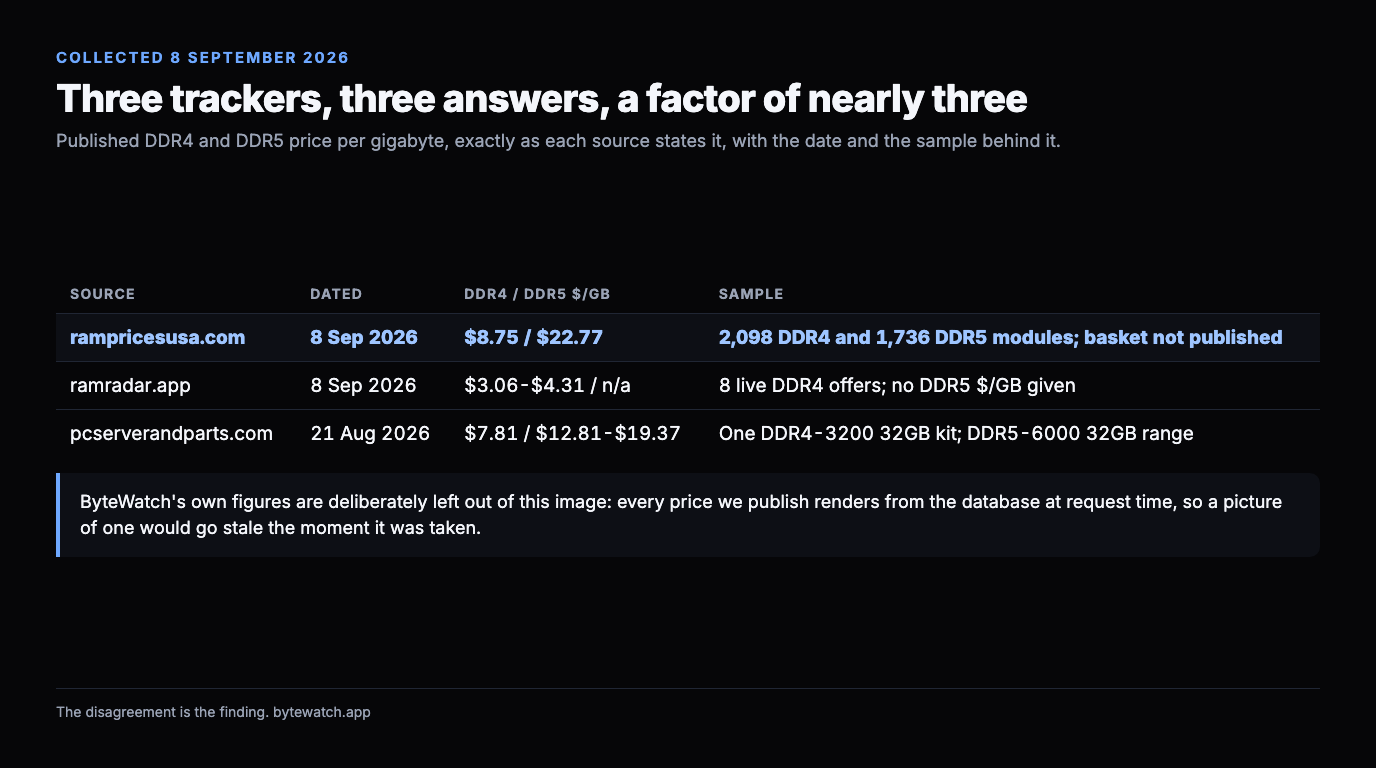
There are legitimate reasons two honest trackers land on different numbers. A basket of 2,098 modules includes single sticks, low-capacity SO-DIMMs, marketplace sellers and third-party listings; a basket of four desktop kits from two first-party retailers does not. Averages and medians behave differently when a handful of cheap 8GB sticks sit in the tail. Some trackers price the module, some price the kit. Some include used and refurbished inventory.
The problem is not that the numbers differ. It is that most of the pages publishing them do not tell you which of those choices they made, which leaves you unable to tell a considered methodology from a scraping error. Our rule is the one we would want applied to us: publish the sample count next to the figure, name the SKUs, print the observation date, and withhold a median entirely below 5 SKUs rather than dress a thin sample as a market rate.
Contract, spot and shelf are three different prices

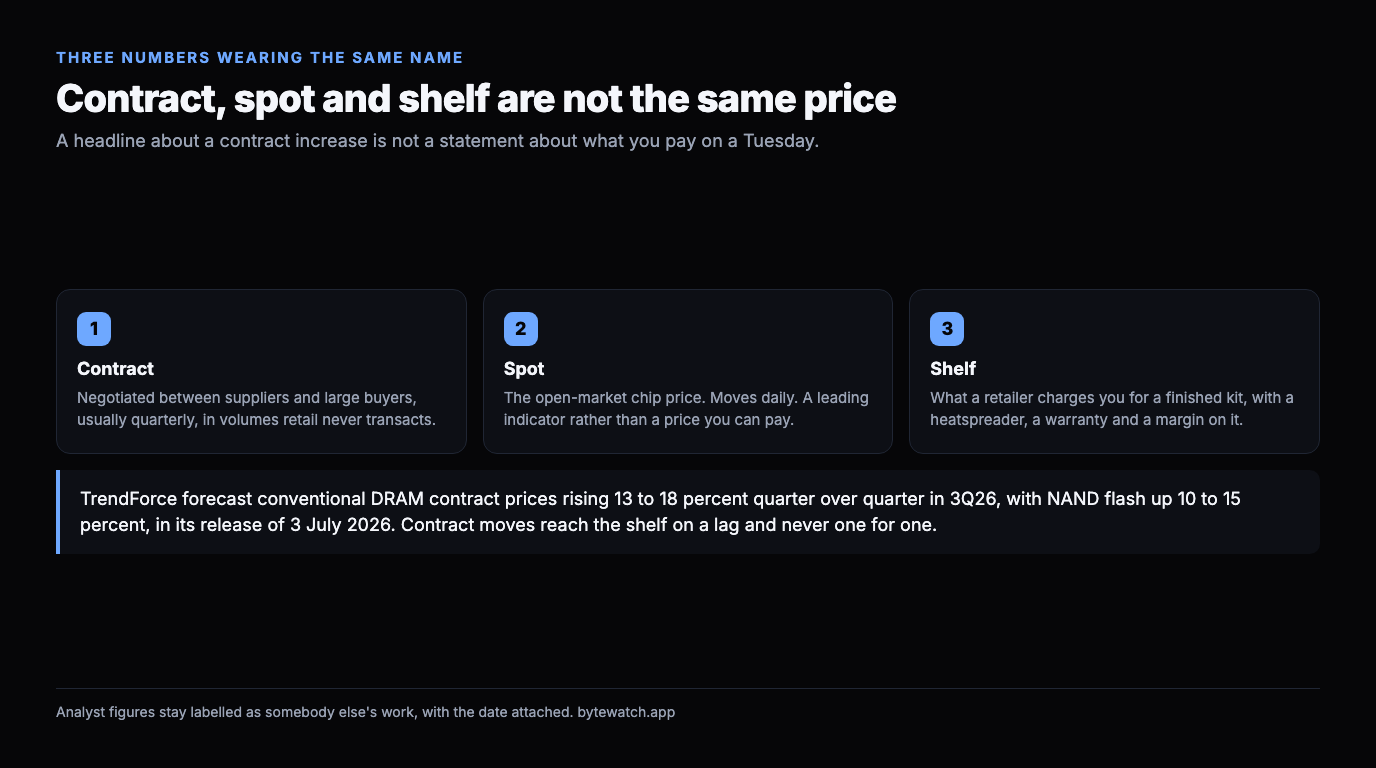
A large share of the confusion in memory-price coverage comes from three numbers wearing the same name. Contract prices are negotiated between suppliers and large buyers, usually quarterly, in volumes retail never transacts. Spot prices are the open-market chip price, which moves daily and is a leading indicator rather than a price you can pay. Shelf prices are what Newegg charges you on a Tuesday for a finished kit with a heatspreader, a warranty and a retailer margin on it.
Contract moves reach the shelf on a lag and never one-for-one, because a retailer is selling inventory it already bought at an older price. That lag is why a headline about a 15% contract increase does not mean your kit went up 15% this week, and why our observed prices are the ones we publish while analyst figures stay clearly labelled as somebody else’s work.
| Segment | Period | Move | Published |
|---|---|---|---|
| Conventional DRAM contract | 3Q26 (forecast) | +13–18% QoQ | TrendForce, 3 Jul 2026 |
| NAND flash contract | 3Q26 (forecast) | +10–15% QoQ | TrendForce, 3 Jul 2026 |
| Consumer DDR4 contract | 3Q25 (forecast) | +40–45% QoQ | TrendForce, 9 Jul 2025 |
| PC DRAM contract, DDR4 portion | 3Q25 (forecast) | +38–43% QoQ | TrendForce, 9 Jul 2025 |
| DRAM supplier inventory | Oct 2025 vs late 2024 | 2–4 wks, from 13–17 wks | TrendForce, 4 Dec 2025 |
The most recent of those is the one to hold on to: TrendForce forecast conventional DRAM contract prices rising 13–18% quarter over quarter in 3Q26 in its 3 July 2026 release, with NAND flash up 10–15% over the same period. That is upstream pressure on both memory and storage, and we cover what it did to the storage side separately in our SSD price tracker guide.
DDR4 is a finished product line

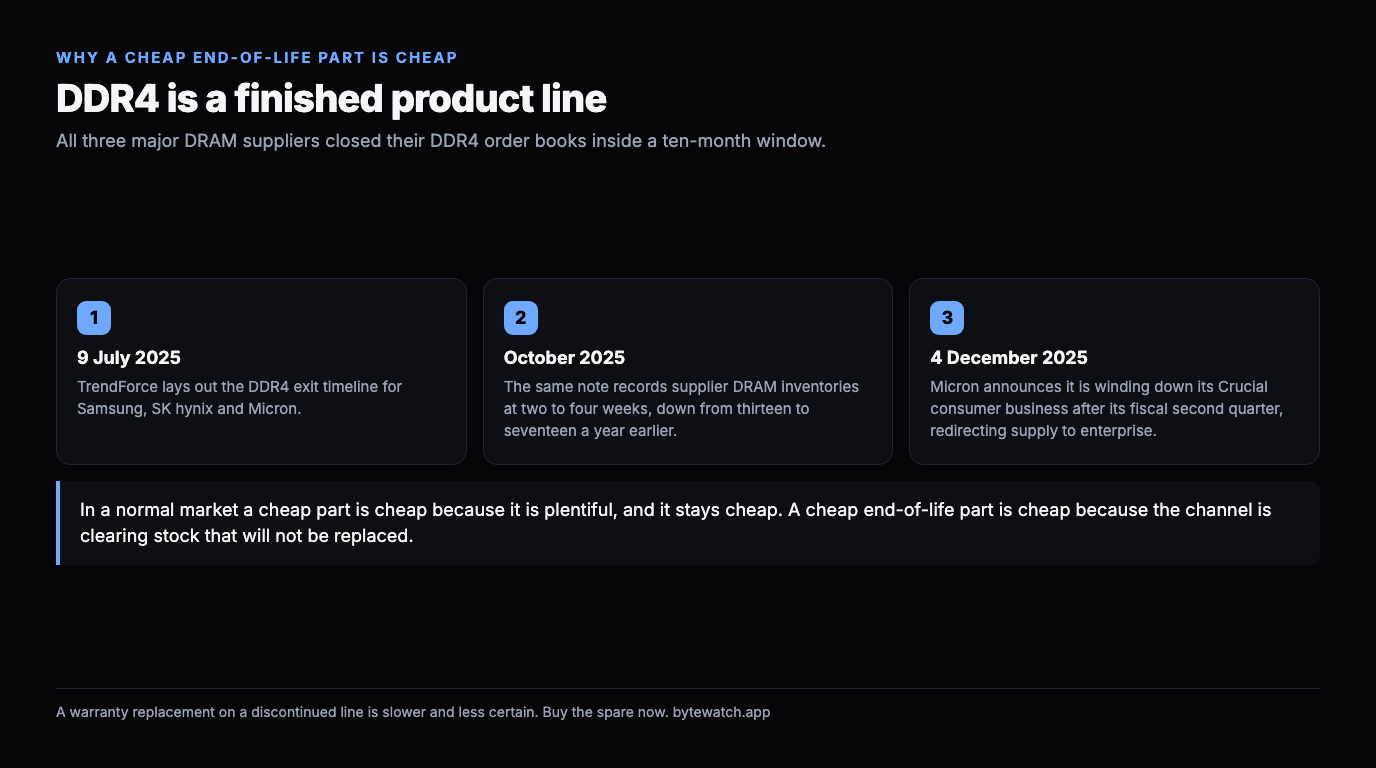
The single most important fact about DDR4 pricing in 2026 is that nobody is making much of it any more. All three major DRAM suppliers closed their DDR4 order books inside a ten-month window, and TrendForce laid out the timeline on 9 July 2025. Micron went further and announced on 4 December 2025 that it was winding down its Crucial consumer business entirely after its fiscal second quarter, redirecting supply toward enterprise customers.
| Supplier | Orders | Last shipments |
|---|---|---|
| Samsung | Stopped taking DDR4 orders by June 2025 | Shipments wrapped up mid-December 2025 |
| Micron | End-of-life notices issued June 2025 | Final mainstream shipments in Q1 2026 |
| SK hynix | Order intake stopped October 2025 | Shipments completed by April 2026 |
| Micron (Crucial retail) | Consumer business wind-down announced | Ends after fiscal Q2, late February 2026 |
This changes what a cheap DDR4 price means. In a normal market, a cheap part is cheap because it is plentiful, and it stays cheap. A cheap end-of-life part is cheap because the channel is clearing stock that will not be replaced, and its price is set by how much of that stock is left rather than by what it costs to make. The same TrendForce note recorded supplier DRAM inventories at two to four weeks in October 2025, down from thirteen to seventeen weeks a year earlier.
There is a practical consequence beyond price. When a kit fails outside a retailer’s return window, a warranty replacement on a discontinued line is a slower and less certain thing than on a current one. If you are buying DDR4 for a machine that has to stay up, buy the spare stick at the same time rather than assuming you can buy it later.
The kit is not the cost: pricing the socket
Every DDR4 vs DDR5 price comparison that stops at the kit is answering a question nobody actually has. Memory is not a component you choose freely; it is a component your motherboard chooses for you. The gap in the first table is only spendable if you already own the socket that takes the cheaper part.
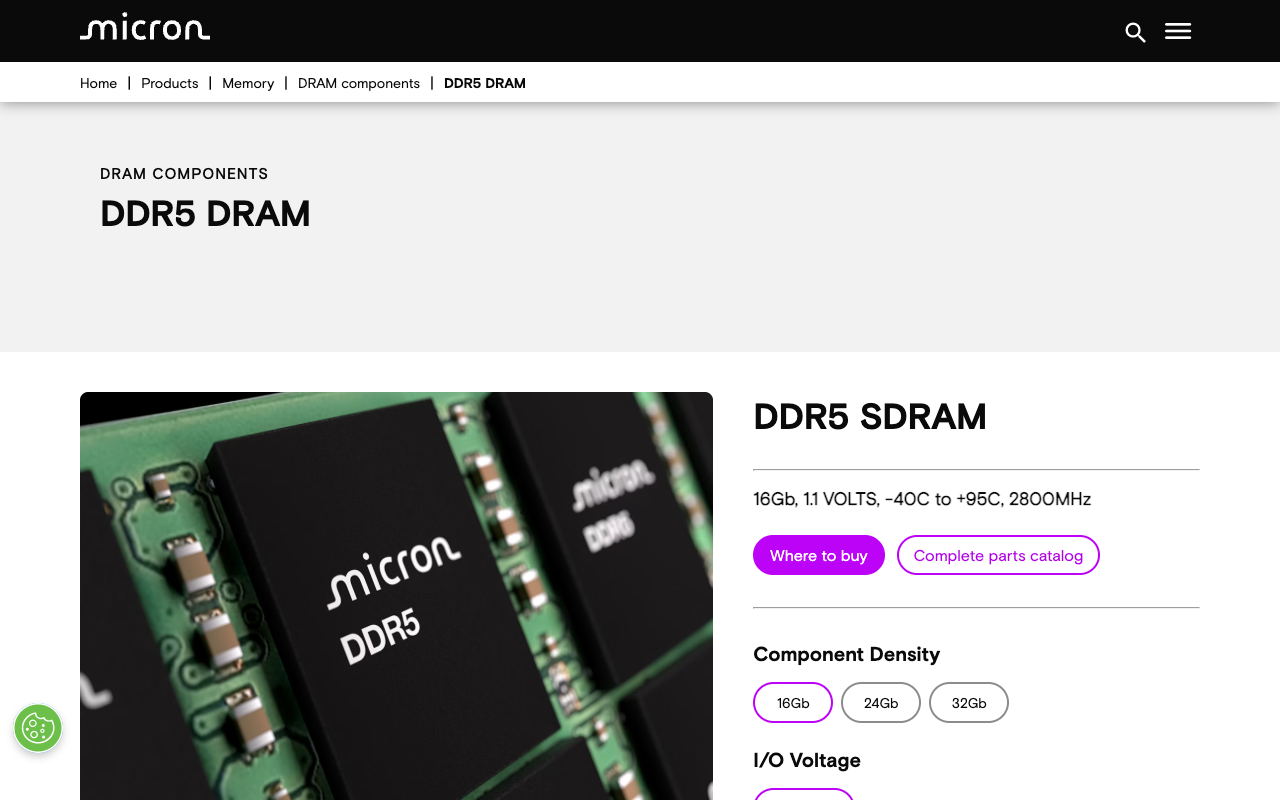
The two generations are not swappable in either direction. Per Micron’s own DDR5 documentation, DDR5 runs at 1.1V against DDR4’s 1.2V, moves power management onto the module, splits each DIMM into two independent channels and adds on-die error correction that DDR4 does not have. The notch sits in a different place for exactly this reason: a board is built for one generation, and no consumer board takes both.
| Platform | Memory accepted | Status |
|---|---|---|
| AMD AM4 | DDR4 only | Superseded by AM5; boards and chips still sold as stock lasts |
| AMD AM5 | DDR5 only | Current AMD desktop socket |
| Intel LGA1700 | DDR4 or DDR5, decided by the board | 12th–14th gen; a board takes one type, never both |
| Intel LGA1851 | DDR5 only | Current Intel desktop socket |
Read that table as three separate situations. If you are already on AM4 or a DDR4 LGA1700 board, the cheaper gigabyte is genuinely yours: adding capacity is usually the highest-value upgrade available to that machine, and Tom’s Hardware reached the same conclusion in its 2026 look at DDR4 build options, particularly where memory carries over from a previous build.
If you are building new, the DDR4 saving buys you a platform that is behind you rather than ahead of you, on a memory type that is no longer manufactured. That can still be the right call for a fixed-purpose machine you do not intend to upgrade. It is a poor call for a system you expect to change processors in.
If you are buying for a fleet, the calculation is different again, because the number that matters is total cost across a refresh cycle rather than the price of one kit. That is the case where a spare-parts strategy for an end-of-life line becomes a real line item.
Capacity moves the answer more than brand does
Inside each memory type there is a second gap that gets far less attention than the DDR4 versus DDR5 one, and it is often worth more. The dearest and cheapest gigabytes we can buy within a single category are not close together: across DDR5 alone, the range today runs $14.37 to $20.31 per gigabyte, a spread of 1.4× between two kits of the same memory type. Choosing well inside a category can matter more than choosing between categories.
Capacity is the biggest single driver of that spread. Larger kits usually carry a lower cost per gigabyte than smaller ones, so a 64GB kit frequently prices better per gigabyte than a 32GB kit of the same generation and speed — which means “buy less memory to save money” sometimes costs more per gigabyte than buying the capacity you actually wanted. Verify it against the kits on our chart rather than treating it as a rule; it holds often, not always.
The check itself is one division. Take every quote on your shortlist, divide the price by the gigabytes, and compare those numbers instead of the sticker prices. A $/GB figure survives a capacity change and a generation change; “a good price for 32GB” does not survive either.
A snapshot is not a trend
Every figure in this article so far is a photograph of one moment. The reason we run an index as well is that a single day’s price cannot tell you whether you are looking at a normal number or an unusual one, and that is the question a buyer actually has.
Read those cards with their point counts visible, because that is the honest way to read a young series. We started tracking in June 2026, so the window is short, and we would rather print the number of observations under the move than let a nine-point series pass for a long-run trend. What the index does support is a comparison over a fixed window, computed the same way each time from the same basket — which is exactly what a headline price cannot give you.
It is also how we caught something worth knowing: memory and storage have not been moving together, despite constant coverage that treats “memory prices” as one market. The full version of that story, with the wafer-allocation explanation behind it, is in why RAM prices are so high.
How to decide, in five checks
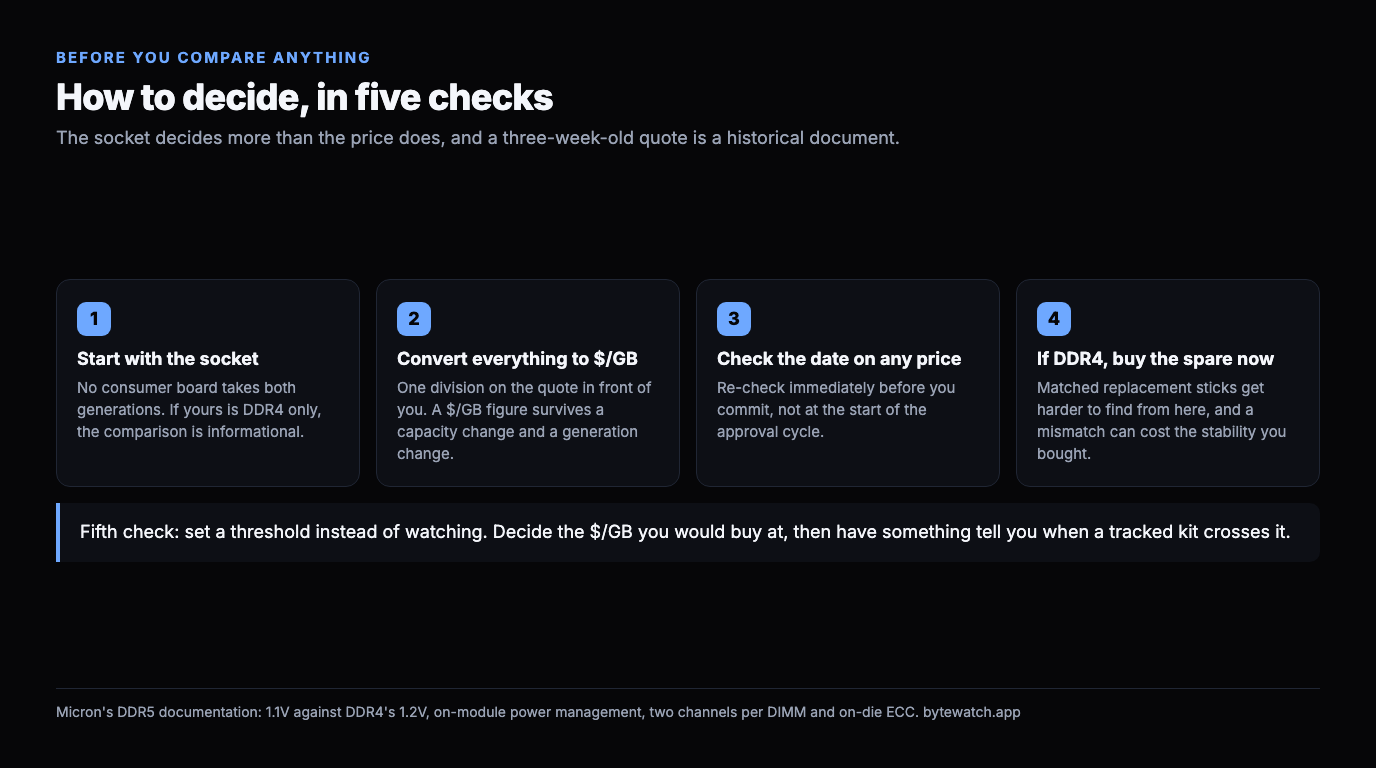
- Start with the socket, not the price. Look up what your board accepts before you compare anything. If it takes DDR4 only, the comparison in this article is informational; your decision is how much DDR4 to buy and when.
- Convert every candidate to $/GB. One division, done on the quote in front of you, compared against the observed ranges in the first table rather than against what you paid in 2024.
- Check the date on any price you did not just see. In a market moving at this rate a three-week-old quote is a historical document. Re-check immediately before you commit, not at the start of the approval cycle.
- If you are choosing DDR4, buy the spare now. The line is discontinued; matched replacement sticks get harder to find from here, and a mismatched replacement can cost you the stability you bought the kit for.
- Set a threshold instead of watching. Decide the $/GB you would buy at, then have something tell you when a tracked kit crosses it. Checking a chart daily is how buyers end up timing badly and calling it discipline.
What this comparison will not tell you
We do not forecast prices, and we are not going to start in a FAQ answer. We report observed retailer prices and attribute anybody else’s projections to them with a date attached. If you want a view on where DDR5 goes next, take it from an analyst who publishes one and judge their record; we would rather be useful about the present than confident about the future.
We also track a deliberately small basket. Two retailers, a couple of dozen desktop SKUs, no marketplace sellers, no used inventory, no server RDIMMs or SO-DIMMs. That makes our numbers checkable and narrow at the same time, and if your purchase sits outside that basket — server memory especially, which prices on a different curve — our figures are context rather than a quote. The honest framing is that we would rather cover less and show our working than cover everything and show none of it.
Related reading
FAQ
Is DDR4 cheaper than DDR5 in 2026?
Yes, and by a wide margin in our data. Across the kits we currently hold in-stock prices for, DDR4 runs $7.50 to $9.37 per gigabyte against a DDR5 median of $17.47, a gap of 1.9× to 2.3×. Those figures come from live Newegg and B&H listings with the observation date printed beside each one on our RAM price chart, and they re-render whenever this page is rebuilt.
How much does a gigabyte of DDR5 cost right now?
Across the 7 DDR5 kits we currently price, the median is $17.47 per gigabyte, with the cheapest at $14.37 and the dearest at $20.31. Every one of those is the lowest in-stock offer we observed for that kit across the retailers we track, so the number reflects our most recent scrape rather than the day this article was written.
Why do different sites quote completely different RAM prices per GB?
Because they are computing different things and mostly not telling you which. A tracker averaging two thousand modules is including single sticks, SO-DIMMs, marketplace sellers and sometimes used inventory; a tracker pricing a dozen desktop kits from two first-party retailers is not. Mean versus median changes the answer again when cheap low-capacity sticks sit in the tail. On 8 September 2026 the published DDR4 figure ranged from $3.06/GB to $8.75/GB across the trackers ranking for this question. The fix is to only use figures that state their sample, their retailers and their observation date.
Is DDR4 still being manufactured?
Not in volume by the major suppliers. TrendForce reported on 9 July 2025 that Samsung stopped taking DDR4 orders by June 2025 with shipments wrapping up in mid-December, that Micron issued end-of-life notices in June 2025 with final mainstream shipments in Q1 2026, and that SK hynix stopped order intake in October 2025 with shipments completing by April 2026. Micron then announced on 4 December 2025 that it was winding down its Crucial consumer business after its fiscal second quarter, in late February 2026. DDR4 on a shelf in 2026 is inventory rather than production.
Should I buy DDR4 or DDR5 for a new PC build?
If the build is new, DDR5 in almost every case, because both current desktop sockets (AMD AM5 and Intel LGA1851) accept DDR5 only and a new DDR4 build starts on a platform with no processor upgrades ahead of it. DDR4 remains a reasonable choice for a fixed-purpose machine you do not intend to change, or when you already own an AM4 or DDR4 LGA1700 board and are adding capacity to it. The price gap is real; whether you can spend it depends entirely on the socket.
Can I put DDR4 memory in a DDR5 motherboard?
No. The two are physically and electrically different: the notch position differs, DDR5 runs at 1.1V against DDR4 at 1.2V, power management moved onto the module, and each DDR5 DIMM is split into two independent channels — all documented by Micron. No consumer board accepts both. Intel LGA1700 boards were sold in DDR4 and DDR5 variants, but any individual board takes one type only. Check your board model before you price anything, because compatibility settles the decision before cost gets a vote.
Does buying a larger kit lower the price per gigabyte?
Usually, but verify it for the specific kits on your shortlist rather than assuming it. Larger capacities often carry a lower cost per gigabyte than smaller ones of the same generation and speed, which means buying less memory to save money can leave you paying more per gigabyte for the privilege. Our RAM price chart prints the $/GB beside every tracked kit so the comparison takes a few seconds rather than a spreadsheet.
Will RAM prices come down in 2026?
We do not forecast, and we would rather say so plainly than guess with a straight face. What we can tell you is what we observed: our DDR5 index moved +7.5% across 4 index points between Aug 1, 2026 and Aug 13, 2026. On the analyst side, TrendForce forecast conventional DRAM contract prices rising 13–18% quarter over quarter in 3Q26 in its 3 July 2026 release. That is their call with their date on it, and contract prices are not shelf prices.
Decide the number once, then let us watch it
We track DDR5, DDR4 and NVMe SKUs across Newegg and B&H and tell you when one of yours crosses your threshold. No deal scores, no affiliate links, no commission on anything you buy — observed prices, dated, and what they mean.