Best Value NVMe SSD 2026: What a Gigabyte Actually Costs, Drive by Drive
Key takeaways
- The best value NVMe SSD is a per-gigabyte question, and the answer spans tens of percent inside a single capacity. Among the mainstream 2 TB Gen4 drives we track at one retailer, the dearest gigabyte runs double-digit percentages above the cheapest — more than most buying guides discuss at all.
- Every cheapest-SSD list we checked prices a different class of product. Read 20 September 2026, their cheapest 2 TB picks ran $0.099 to $0.120 per gigabyte — all below our cheapest name-brand Gen4 observation, because the top of a price-sorted list is a SATA or Gen3 drive.
- Buying bigger stops paying above 2 TB. Compared at two capacities of the same model, with controller, warranty and interface all held still, the larger drive has been the dearer gigabyte.
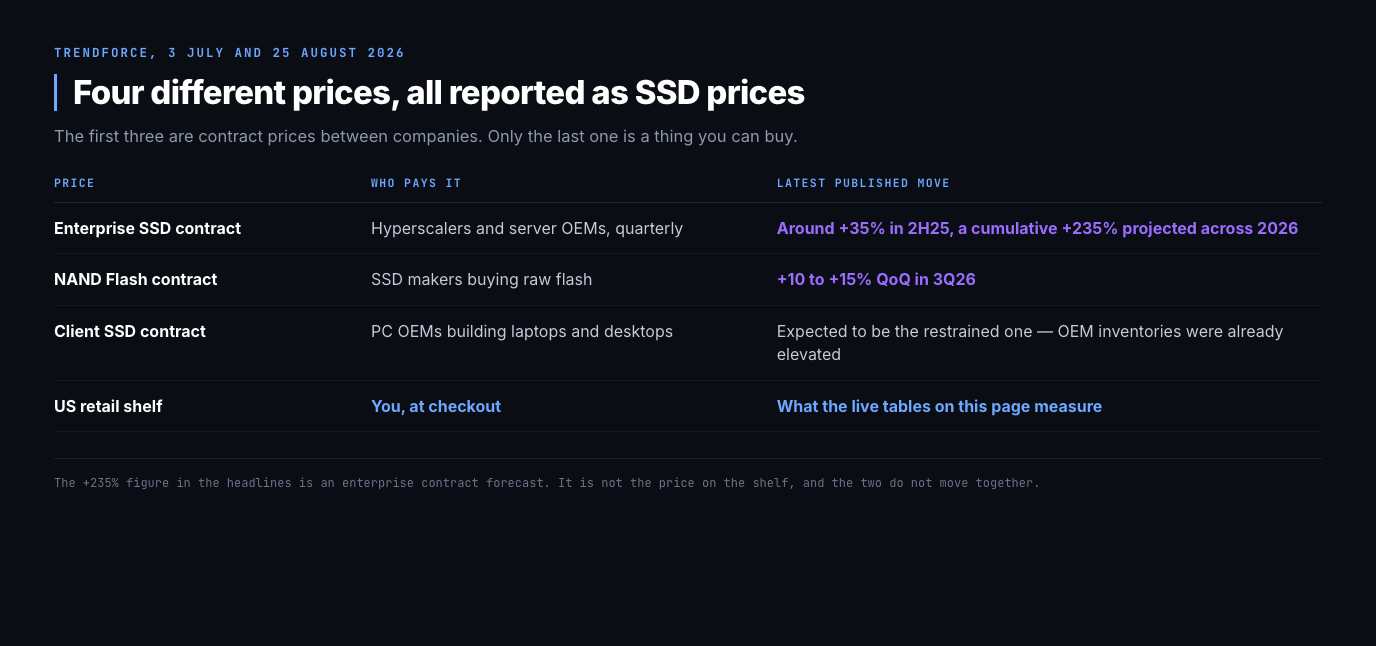
- The alarming SSD numbers in circulation are contract prices, not shelf prices. TrendForce put enterprise SSD contract prices on a cumulative +235% path for 2026 on 25 August 2026. That is a hyperscaler procurement figure and it is not what a 2 TB drive costs you.
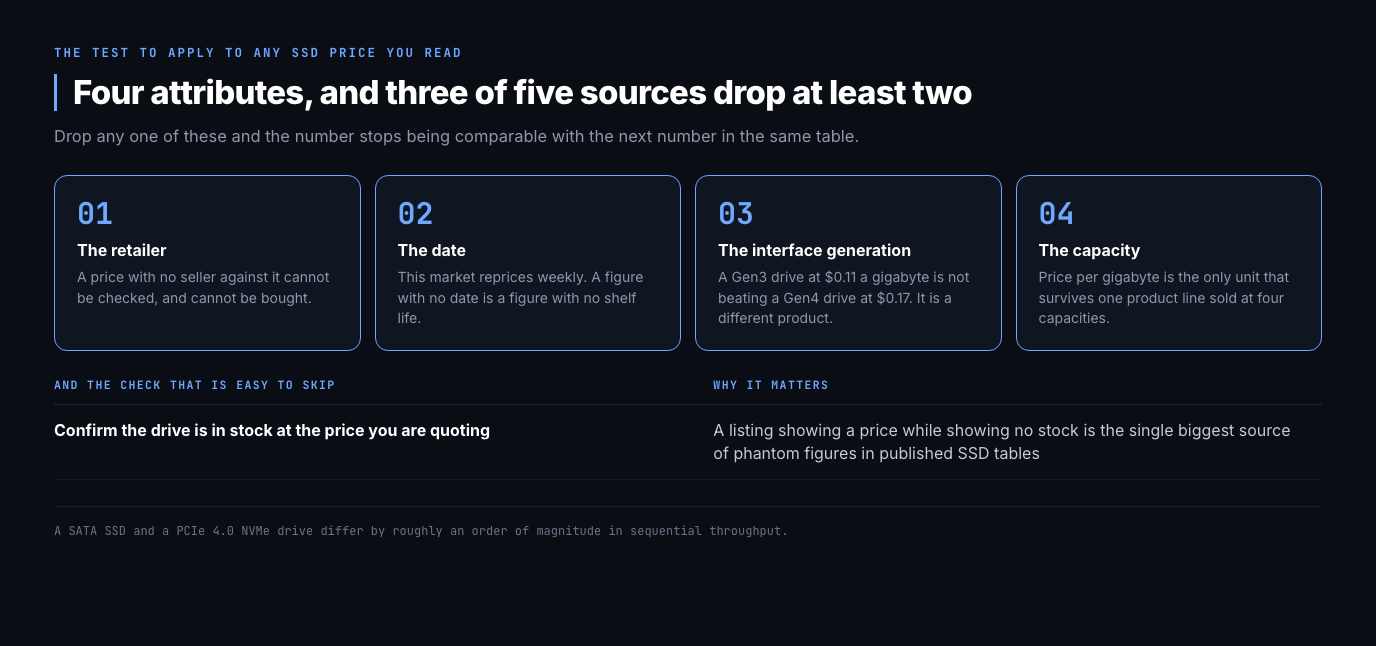
- A price without a retailer, a date, a capacity and an interface generation is not comparable to the price next to it. Three of the five sources in our comparison table drop at least two of the four.
Every guide to the best value NVMe SSD in 2026 either ranks drives without printing a price or prints a price without saying where it came from. That is an expensive gap in a year when a 2 TB drive is a three-figure line item and the drives we track run from $0.171 to $0.234 a gigabyte. This page is the version with the money in it: every NVMe drive we track, priced per gigabyte, at a named retailer, with the day each price was observed printed beside it.
We can do that because we are not summarising anyone else. We scrape live product pages at tracked US retailers, store every observation with a timestamp and a stock flag, and compute price per gigabyte from those records — every figure in our own tables below rendered from that database when this page was built, with the drive count printed next to it. Where a sample is too thin to carry a median, you will see the word withheld rather than a number.
What follows is the current shelf price of a gigabyte, the value ladder inside a single capacity, the five published lists that disagree with it and why, the point where buying bigger stops paying, and the difference between the SSD price in the headlines and the one at your checkout.
What a gigabyte of NVMe actually costs today
Start with the number the whole decision rests on, before any drive is named. Price per gigabyte is the only unit that survives a market where the same product line is sold at four capacities and repriced weekly, and it is the unit almost none of the buying guides use.
| Capacity | Drives | Median $/GB | Cheapest | Dearest | Spread |
|---|---|---|---|---|---|
| 1 TB | 1 | withheld | $0.227 | $0.227 | — |
| 2 TB | 5 | $0.190 | $0.171 | $0.234 | 36.8% |
| 4 TB | 1 | withheld | $0.212 | $0.212 | — |
Across every capacity we track, the cheapest observed gigabyte is $0.171 on Kingston KC3000 2048GB NVMe Gen4 SSD and the dearest is $0.234 on SK hynix Platinum P41 2TB NVMe Gen4 SSD — 36.8% apart, both observed in stock at a tracked US retailer within the last month. That gap is the actual subject of this page. It is larger than the difference most buying guides spend their word count on.
Hold that range in mind while reading everything below, because every published figure we checked sits outside it, and the reason is never that someone found a better deal.
Every 2 TB drive we track, priced per gigabyte
A roundup that compares a 1 TB drive with a 4 TB drive is comparing capacities, not value. So hold the capacity still, hold the interface generation still, and put the drives in one column sorted by the only thing left that matters.
| Drive | Best price | $/GB | Vs cheapest | Retailer | Observed |
|---|---|---|---|---|---|
| Kingston KC3000 2048GB NVMe Gen4 SSD | $349.95 | $0.171 | — | Newegg | Sep 20, 2026 |
| WD Black SN850X 2TB NVMe Gen4 SSD | $349.99 | $0.175 | +2.4% | Newegg | Sep 20, 2026 |
| Samsung 990 Pro 2TB NVMe Gen4 SSD | $379.99 | $0.190 | +11.2% | Newegg | Sep 23, 2026 |
| Crucial T500 2TB NVMe Gen4 SSD | $400.61 | $0.200 | +17.2% | Newegg | Sep 20, 2026 |
| SK hynix Platinum P41 2TB NVMe Gen4 SSD | $467.60 | $0.234 | +36.8% | Newegg | Sep 20, 2026 |
That is 5 named drives at one capacity on one interface generation, spanning 36.8% per gigabyte. Every one of them is a mainstream part from a manufacturer you have heard of. None of them is a clearance listing, a refurbished unit or a marketplace seller: they are the same shelf, on the same days, at the same retailer.
The obvious objection is that these drives are not interchangeable — different controllers, different flash, different endurance ratings, different warranties. That is true, and it is exactly why the next section matters: none of the pages ranking these drives by price tells you which of those differences you are paying for either.
Why every cheapest-SSD list disagrees with the shelf
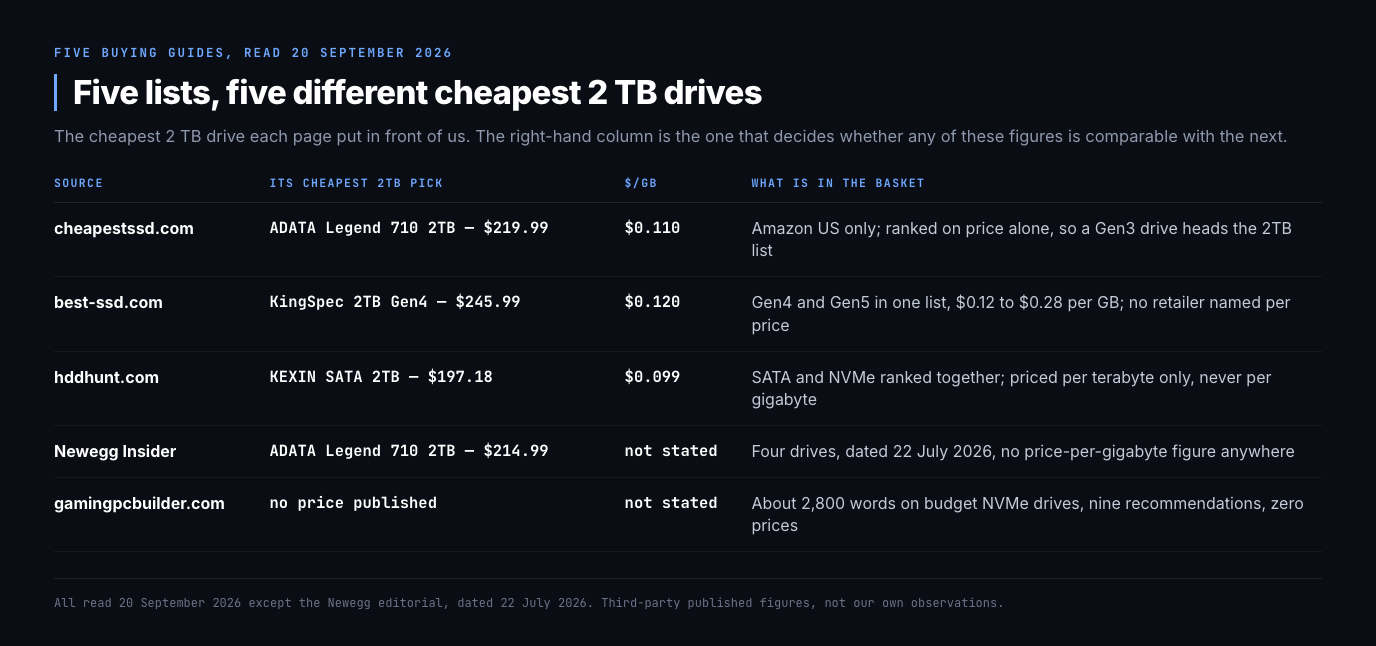
Here is what the pages ranking for this question actually publish. Five sources, four of them read on the same day this article was written, all answering “what is the cheapest 2 TB drive”.
| Source | Its cheapest 2TB pick | $/GB | What's in the basket |
|---|---|---|---|
| cheapestssd.com | ADATA Legend 710 2TB — $219.99 | $0.110 | Amazon US only; ranked on price alone, so a Gen3 drive heads the 2TB list |
| best-ssd.com | KingSpec 2TB Gen4 — $245.99 | $0.120 | Gen4 and Gen5 in one list, $0.12–$0.28/GB; no retailer named per price |
| hddhunt.com | KEXIN SATA 2TB — $197.18 | $0.099 | SATA and NVMe ranked together; priced per terabyte only, never per gigabyte |
| Newegg Insider | ADATA Legend 710 2TB — $214.99 | not stated | four drives, dated 22 July 2026, no price-per-gigabyte figure anywhere |
| gamingpcbuilder.com | no price published | not stated | ~2,800 words on budget NVMe drives, nine recommendations, zero prices |
Four different cheapest drives and three different per-gigabyte figures, spanning $0.099 to $0.120 — and every one of them sits below the cheapest gigabyte in our own table. That looks like we are tracking expensive retailers. We are not. Those pages are pricing a different class of product.
The top of a list sorted by price alone is always a Gen3 or SATA drive, or a brand whose entire proposition is being the cheapest listing on a marketplace. Put one of those at the head of a table titled “best 2 TB SSD” and the ranking silently stops being about value and starts being about which product category happens to be cheapest per gigabyte — a question with a known answer that has nothing to do with the drive you were shopping for.
A 2 TB NVMe drive is not one product
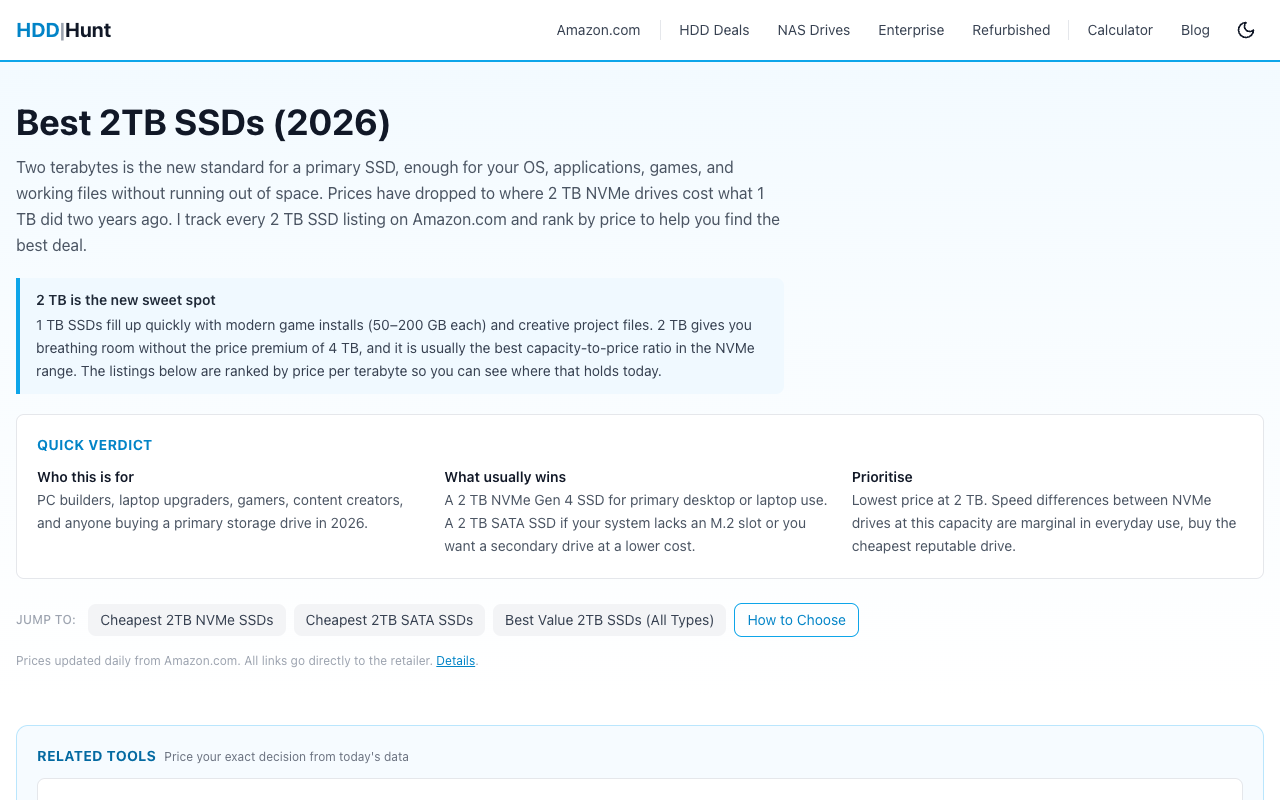
The clearest case is hddhunt.com, whose “best 2 TB SSD” ranking we read on 20 September 2026 with SATA drives and NVMe drives interleaved in one list, priced per terabyte, cheapest first. A SATA SSD and a PCIe 4.0 NVMe drive differ by roughly an order of magnitude in sequential throughput. Sorting them into one column by price puts the slowest product at the top and calls it the best.
best-ssd.com does the same thing one layer up: its 2 TB NVMe list, updated the day we read it, runs from $0.12 to $0.28 per gigabyte with Gen4 and Gen5 drives in the same ranking and no retailer named against any price. And gamingpcbuilder.com is the opposite failure, and in some ways the more revealing one: roughly 2,800 words of genuinely good technical writing about budget NVMe drives, published 20 July 2026, with nine recommendations and not a single price on the page.
Buying bigger stops paying above 2 TB
The standing advice is to buy the largest drive you can afford, because price per gigabyte falls with capacity. It does — up to a point, and we can now show where the point is without changing anything else about the drive.
| Model | Smaller | $/GB | Larger | $/GB | Change |
|---|---|---|---|---|---|
| Samsung 990 Pro | 2 TB | $0.190 | 4 TB | $0.212 | +11.6% |
The clearest row is Samsung 990 Pro: the 4 TB drive costs +11.6% per gigabyte more than the 2 TB version of the same drive, observed Sep 17, 2026 and Sep 23, 2026. Same model, same controller, same warranty, same retailer. Doubling the capacity costs more than twice the money, which is the reverse of the rule every guide states.
We found the same shape across product lines in our capacity analysis, where the storage discount is real and stops at 2 TB. Seeing it inside a single model is the stronger version of that finding, because there is no product-mix explanation left.
The +235% you read about is not the price you pay
Every few weeks a figure lands saying SSD prices have doubled or tripled. They have — some of them. The reported number is almost never the one at your checkout, and telling the four apart is most of what it takes to read this market.
| Price | Who pays it | Latest published move |
|---|---|---|
| Enterprise SSD contract | Hyperscalers and server OEMs, quarterly | around +35% in 2H25, a cumulative +235% projected across 2026 |
| NAND Flash contract | SSD makers buying raw flash | +10–15% QoQ in 3Q26 |
| Client SSD contract | PC OEMs building laptops and desktops | expected to be the restrained one — OEM inventories were already elevated |
| US retail shelf | You, at checkout | what the table at the top of this page measures |
Against those contract moves, our own storage index has gone −0.5% across 17 points between Aug 1, 2026 and Sep 21, 2026. That is the retail shelf, and it is a different animal from a 235% contract move. The consumer shelf absorbed its repricing earlier and more shallowly than the enterprise contract market, and a headline about hyperscaler procurement tells you very little about what a 2 TB drive costs on a Tuesday.
One caveat we would rather state than have you infer: our index starts in June 2026, after the large retail repricing had already happened. A flat series since then is not evidence that the shortage is over. It is evidence that the part we can see has been stable, which is a much smaller claim. We go through that window in detail in what the shelf actually did in 2026.
What to pay, and four checks before you buy
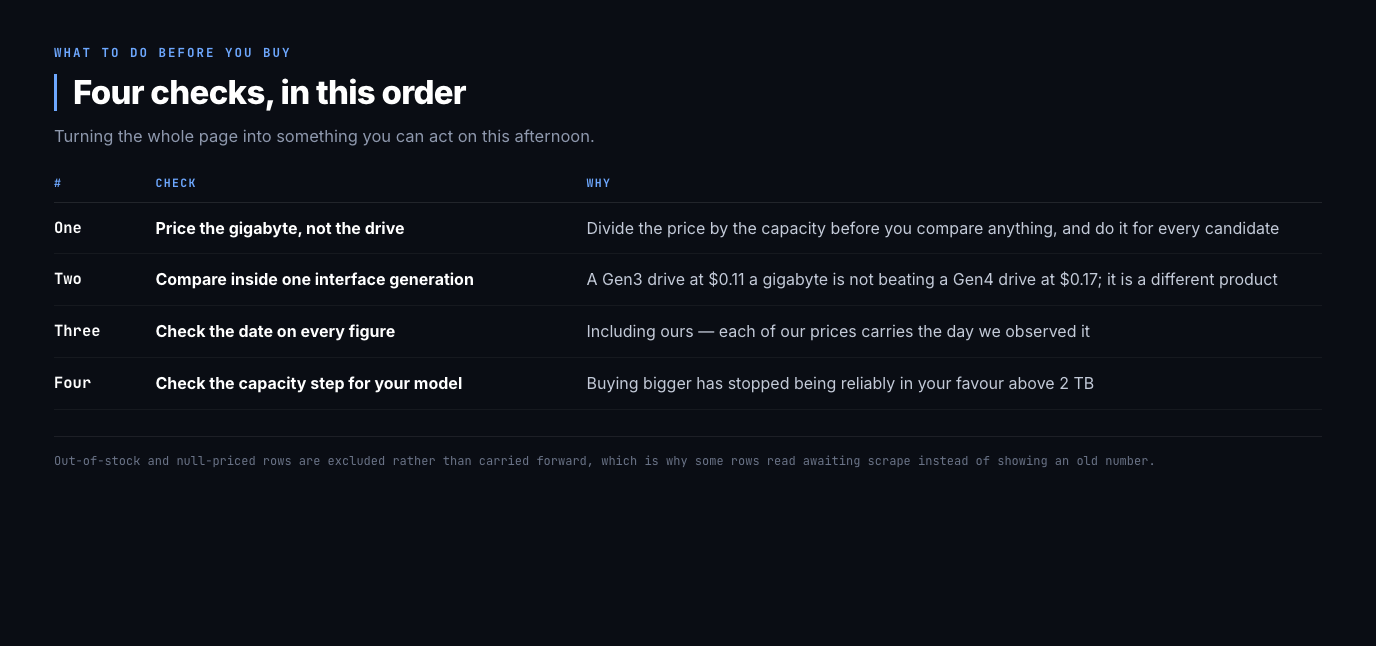
Turning all of that into something you can act on this afternoon. The figures below render from the same observations as the tables above, so they are never staler than the dates in them.
| Capacity | Good $/GB | Typical $/GB | Good total | Drives priced |
|---|---|---|---|---|
| 1 TB | $0.227 | withheld | $227.00 | 1 |
| 2 TB | $0.171 | $0.190 | $341.75 | 5 |
| 4 TB | $0.212 | withheld | $848.50 | 1 |
One. Price the gigabyte, not the drive. Divide the price by the capacity before you compare anything, and do it for every candidate. Two. Compare inside one interface generation. A Gen3 drive at $0.11 a gigabyte is not beating a Gen4 drive at $0.17; it is a different product. Three. Check the date on every figure you are using, including ours — each of our prices carries the day we observed it. Four. Check the capacity step for your specific model before buying bigger, because it has stopped being reliably in your favour above 2 TB.
And the check that is easy to skip: confirm the drive is in stock at the price you are quoting. A listing showing a price while showing no stock is the single biggest source of phantom figures in published SSD tables. We exclude those observations rather than carrying them forward, which is why some rows in our tracked SKU list read “awaiting scrape” instead of showing an old number.
How these numbers are produced, and what we withhold
We scrape live product pages at tracked US retailers and store every observation with a timestamp and a stock flag. Per drive we take the cheapest in-stock observation across those retailers inside a 30-day window, divide by capacity, and that is the $/GB figure in every table above. Out-of-stock and null-priced rows are excluded rather than carried forward.
The window is 30 days rather than something tighter because our scrape cadence runs from two to ten days per listing: at 48 hours most drives would have no observation at all and every figure here would collapse to a single listing. That is a real limitation and it is why each price prints the day it was seen.
A median prints only where a band holds five or more drives. Below that the table says withheld, which is the whole discipline: a basket this size can support a spread, a range and a named pair of drives, and it cannot support a market-wide average. Every figure on this page is an observation or arithmetic over observations — none of it is a forecast, and we do not publish one.
Related reading

FAQ
What is the best value NVMe SSD in 2026?
The one with the lowest price per gigabyte at the capacity and interface generation you actually want — which changes week to week and is not a fixed model name. On the drives we track, NVMe Gen4 currently runs from $0.171 to $0.234 per gigabyte with a median of $0.200 across 7 drives, all observed in stock at a named US retailer. Shortlist on capacity and generation first, then buy the cheapest gigabyte in that shortlist on the day.
How much should a 2TB NVMe SSD cost in 2026?
Multiply the cheapest observed price per gigabyte for Gen4 NVMe by 2,000 and that is roughly what a good quote looks like; the table in this article prints both figures with the date each was seen. Published lists will show you 2TB drives well below that, but the cheap entries on those lists are SATA or PCIe Gen3 drives, or marketplace brands, rather than mainstream Gen4 NVMe. Compare within one interface generation or the comparison means nothing.
Why are SSD prices so different between websites?
Because they are pricing different baskets and rarely say so. A list that ranks by price alone puts the cheapest product class at the top, so a SATA drive or a Gen3 drive heads a table headed "best 2TB SSD". Retailer matters too: several of the trackers we checked price Amazon US exclusively, ours observes a different retailer set, and neither is wrong. The fix is to insist on four things next to any SSD price — the retailer, the date, the capacity and the interface generation.
Is it cheaper per gigabyte to buy a bigger SSD?
Up to about 2TB, yes. Above it, not reliably. We compare the same model at two capacities, which removes brand, controller, warranty and interface from the comparison entirely, and the larger drive has been the dearer gigabyte. That is the reverse of the standing advice, so check the step for the specific model you are buying rather than assuming a bigger drive is the better deal.
Did SSD prices really rise 235% in 2026?
Enterprise SSD contract prices did, on TrendForce figures published 25 August 2026 — that is a cumulative 2026 projection for the drives hyperscalers and server makers buy under quarterly contracts. It is not the consumer retail shelf. TrendForce separately put NAND Flash contract prices up 10–15% QoQ in 3Q26 and expected client SSD contract growth to be the restrained one, because PC maker inventories were already elevated. Four different prices get reported as "the SSD price" and only the last of them is one you can pay.
Should I buy an SSD now or wait for prices to fall?
We do not publish forecasts, so we cannot tell you prices will fall and neither can anyone who does. What we can tell you is what the shelf has actually done in the window we observe, and that our index only starts in June 2026 — after the large retail repricing — so a flat series since then is not evidence the shortage is over. If you need the drive, the useful question is not whether to wait but whether the quote in front of you is above or below the observed range in the tables above.
Is a PCIe Gen5 SSD worth the extra money?
Not on price-per-gigabyte grounds, on the published figures we checked. One tracker we read on 20 September 2026 listed Gen4 and Gen5 2TB drives in a single ranking spanning $0.12 to $0.28 per gigabyte, with the Gen5 entries clustered at the top of the range. Gen5 buys sequential throughput that most desktop workloads never ask for. If you are choosing on cost per gigabyte, compare Gen4 against Gen4 and treat Gen5 as a separate purchase decision with its own justification.
Price the gigabyte, not the drive
We track NVMe, DDR5 and DDR4 listings at US retailers and tell you when one of yours moves. No deal scores, no affiliate links, no commission on anything you buy — observed prices, dated, with the sample size printed next to them.