RAM and SSD Price Per Gigabyte by Capacity in 2026: When Bigger Is Cheaper, and When It Is Not
Key takeaways
- “Bigger kits are cheaper per gigabyte” is not true of memory in September 2026. On a 2,609-module Amazon basket published by rampricesusa.com, dated 14 September 2026, 64 GB DDR5 kits run $19.53/GB against $17.89/GB for 32 GB — a 9.2% penalty for buying bigger, with DDR4 penalised 6.7%.
- On storage the discount is real and it stops at 2 TB. The cheapest NVMe per gigabyte falls 29.9% from 1 TB to 2 TB and rises 4.5% at 4 TB on cheapestssd.com’s 14 September 2026 figures. Our own observations trace the same shape on a different basket.
- The spread inside one capacity is wider than the step between capacities. Parts of identical capacity in our basket run from $0.171 to $0.234 per gigabyte on the storage side alone.
- Most published price-per-GB-by-capacity tables are 2–4× off the shelf. One page ranking for this question quotes 2 TB NVMe Gen4 at $0.045–$0.062/GB. No live tracker we checked on 14 September 2026 came near it.
- Most capacity bands are too thin to carry a median, including ours. We publish a band median only at 5 parts or more and name the rest withheld. Nobody else answering this question states a floor.
- Why the gigabyte is the only unit that survives
- What a gigabyte costs right now
- RAM and SSD price per GB by capacity, band by band
- The spread inside one capacity beats the step between them
- The bigger-kit discount is folklore on memory this year
- On storage the discount is real, and it stops at 2 TB
- Why the published price-per-GB tables miss the shelf
- What to pay, and the three checks before you buy
- How these numbers are produced, and what we withhold
- Related reading
- FAQ
Everyone buying memory or storage this year hits the same fork: take the 32 GB kit, or pay up for 64 GB because the bigger one is supposed to be cheaper per gigabyte. That folklore is expensive — a 64 GB DDR5 kit is a four-figure line item in September 2026, and being wrong about the direction of the discount costs a few hundred dollars per machine. So we checked. This is price per GB by capacity, measured rather than assumed, for memory and NVMe storage.
We can check it because we are not summarising anyone. We scrape live product pages at Newegg and B&H, store every observation with a timestamp, and compute price per gigabyte from those records; every figure in our own tables rendered from that database when this page was built, with the part count printed alongside. Where a band is too thin for a median you will see the word withheld — insist on that from anyone publishing a table like this.
Our basket is small, so we also read the larger ones. What follows is our observed per-capacity data, two dated third-party baskets, the arithmetic on both, and the one conclusion all three agree on.
Why the gigabyte is the only unit that survives
A retailer quotes you a kit price and a capacity. Those two numbers are not comparable to the next listing down the page, which has a different capacity and often a different speed grade and generation. Dividing price by capacity is the one operation that makes a shortlist sortable, and nobody performs it at the shelf.
It has limits. Price per gigabyte says nothing about latency, endurance, controller quality, DRAM cache, or whether a kit will train at its rated speed on your board. It is a cost unit, not a quality score, and the cheapest gigabyte in a table is regularly the worst part in it. Rank candidates you have already judged acceptable — never pick the part with it.
The second limit is arithmetic. Drive makers count a terabyte as 1,000 GB while your OS counts 1,024, so a “2 TB” drive formats to about 1.82 TiB. Every storage figure here uses the marketed decimal capacity, the number the price is attached to. Compare like with like or you manufacture a 7% discount out of nothing. Our SSD price tracker guide works the full method through rule by rule.

What a gigabyte costs right now, before capacity comes into it
Start at the category level, because that is the bigger number by a wide margin. Memory and storage are different supply chains, and the gap between them dwarfs anything capacity does inside either one.
| Category | Median $/GB | Cheapest | Dearest | SKUs |
|---|---|---|---|---|
| DDR5 memory | $17.47 | $14.37 | $20.31 | 7 |
| DDR4 memory | withheld | $7.50 | $9.37 | 4 — below floor |
| NVMe Gen4 SSD | $0.200 | $0.171 | $0.234 | 7 |
On today’s observed figures a gigabyte of DDR5 costs roughly 87× a gigabyte of NVMe flash. No capacity decision inside either category moves the needle like that, which is the first reason to price the two separately and never budget them together. With that established, the question this page exists for: inside one category, does the gigabyte get cheaper when you buy more of them at once?
RAM and SSD price per GB by capacity, band by band
The same observations regrouped: what a 32 GB DDR5 kit costs per gigabyte against a 64 GB one, and what a 2 TB NVMe drive costs against a 4 TB one.
| Category | Capacity | Median $/GB | Cheapest | Dearest | Spread | SKUs |
|---|---|---|---|---|---|---|
| DDR5 memory | 32 GB | $17.50 | $15.81 | $20.31 | +28.5% | 5 |
| DDR5 memory | 64 GB | withheld | $14.37 | $17.19 | +19.6% | 2 — below floor |
| DDR4 memory | 32 GB | withheld | $7.50 | $9.37 | +25.0% | 3 — below floor |
| DDR4 memory | 64 GB | withheld | $9.37 | $9.37 | — | 1 — below floor |
| NVMe Gen4 SSD | 1 TB | withheld | $0.227 | $0.227 | — | 1 — below floor |
| NVMe Gen4 SSD | 2 TB | $0.190 | $0.171 | $0.234 | +36.8% | 5 |
| NVMe Gen4 SSD | 4 TB | withheld | $0.212 | $0.212 | — | 1 — below floor |
The last column matters most. 2 of our 7 bands clear the 5-part floor we require before publishing a median; the rest are withheld, with their observations intact. That is not a hedge, it is the finding: most confident per-capacity tables online are built on slices this thin without saying so.
| Part | Band | Best price | $/GB | Retailer | Observed |
|---|---|---|---|---|---|
| G.Skill Flare X5 DDR5-6000 CL36 32GB (2x16GB) | 32 GB cheapest | $506.00 | $15.81 | Newegg | Sep 20, 2026 |
| G.Skill Trident Z5 Neo DDR5-6000 CL30 32GB (2x16GB) | 32 GB dearest | $649.99 | $20.31 | Newegg | Sep 17, 2026 |
| Corsair Vengeance DDR5-5600 64GB (2x32GB) | 64 GB cheapest | $919.99 | $14.37 | Newegg | Aug 28, 2026 |
| Crucial Pro DDR5-5600 64GB (2x32GB) | 64 GB dearest | $1,099.99 | $17.19 | Newegg | Sep 20, 2026 |
| G.Skill Ripjaws V DDR4-3600 CL18 32GB (2x16GB) | 32 GB cheapest | $239.99 | $7.50 | Newegg | Sep 20, 2026 |
| Kingston Fury Beast DDR4-3200 32GB (2x16GB) | 32 GB dearest | $299.99 | $9.37 | Newegg | Sep 17, 2026 |
| Crucial Pro DDR4-3200 64GB (2x32GB) | 64 GB only part | $599.95 | $9.37 | Newegg | Sep 20, 2026 |
| Crucial P3 Plus 1TB NVMe Gen4 SSD | 1 TB only part | $227.00 | $0.227 | Newegg | Sep 20, 2026 |
| Kingston KC3000 2048GB NVMe Gen4 SSD | 2 TB cheapest | $349.95 | $0.171 | Newegg | Sep 20, 2026 |
| SK hynix Platinum P41 2TB NVMe Gen4 SSD | 2 TB dearest | $467.60 | $0.234 | Newegg | Sep 20, 2026 |
| Samsung 990 Pro 4TB NVMe Gen4 SSD | 4 TB only part | $848.50 | $0.212 | Newegg | Sep 17, 2026 |
Two things there are worth reading slowly. Our 64 GB DDR5 sample is a slower speed grade than our 32 GB one, so any gap between those bands is partly a speed effect in a capacity costume. And the cheapest and dearest part inside one capacity sit much further apart than the bands sit from each other — which turns out to be the whole story.
| Category | Step | Change in $/GB | Comparison | SKUs either side |
|---|---|---|---|---|
| DDR5 memory | 32 GB → 64 GB | −9.1% | cheapest to cheapest | 5 → 2 |
| DDR4 memory | 32 GB → 64 GB | +25.0% | cheapest to cheapest | 3 → 1 |
| NVMe Gen4 SSD | 1 TB → 2 TB | −24.7% | cheapest to cheapest | 1 → 5 |
| NVMe Gen4 SSD | 2 TB → 4 TB | +24.1% | cheapest to cheapest | 5 → 1 |
The largest step we can measure is DDR4 memory, 32 GB → 64 GB, at +25.0%, cheapest to cheapest. Treat every row there as directional until the bands either side of it clear the floor.
The spread inside one capacity beats the step between capacities
This is the finding that changes what you do with a shortlist open. Buyers deliberate over the capacity — 32 or 64, 2 TB or 4 TB — then pick a part inside it on brand habit. The money is in the second decision.
The widest band we currently hold is NVMe Gen4 SSD at 2 TB, where the dearest part costs +36.8% more per gigabyte than the cheapest — $0.171 against $0.234, across 5 parts, all of them the same capacity and all in stock inside the same 30-day window. The largest capacity step we can measure is 25.0%. Choosing well inside one capacity is worth more than 1.5× what stepping capacity is worth, and it costs you nothing but a column of division.
The bigger-kit discount is folklore on memory this year
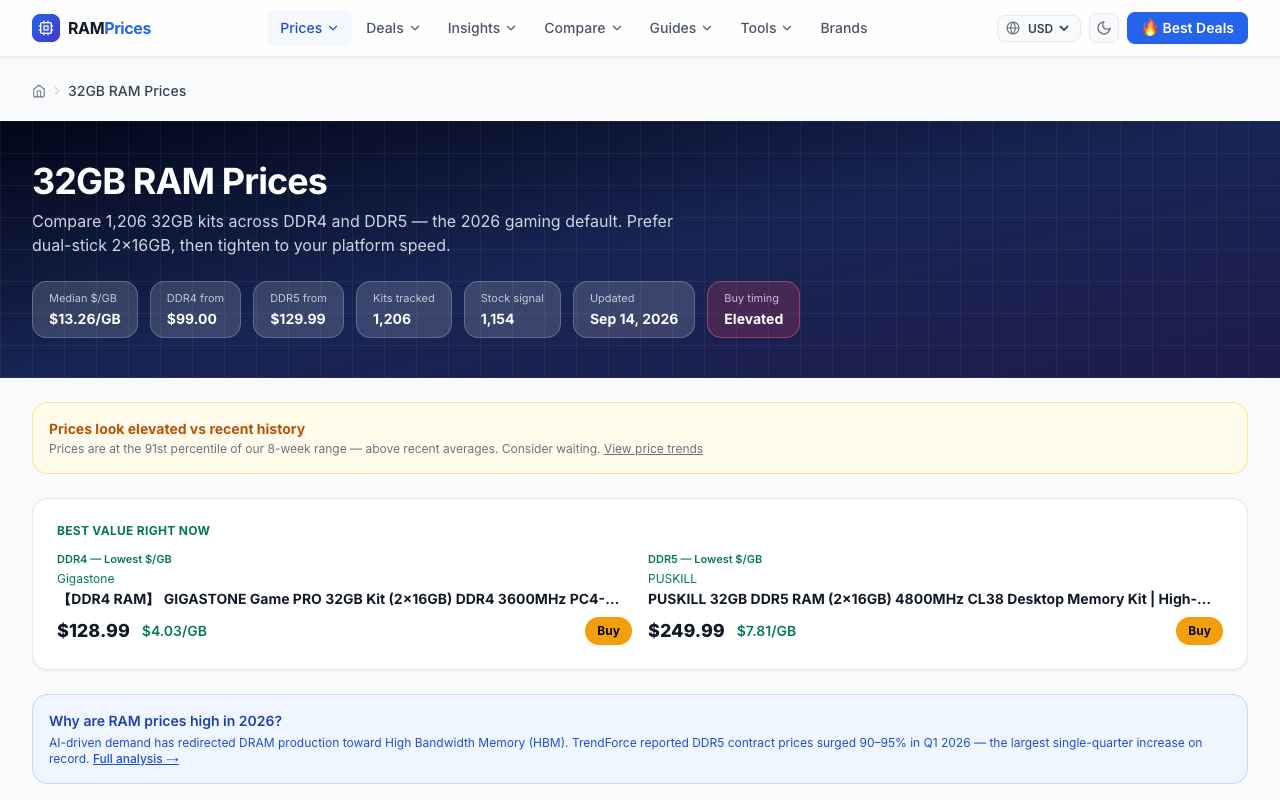
Our own memory bands are too thin to settle this, so we went to a basket that is not. The table below is published by a third party from Amazon US listings, dated the same day as this article. It carries hundreds of modules per cell where we carry single digits.
| Kit capacity | DDR4 median $/GB | DDR4 modules | DDR5 median $/GB | DDR5 modules |
|---|---|---|---|---|
| 16 GB kits | $7.86 | 650 | $17.87 | 294 |
| 32 GB kits | $7.63 | 532 | $17.89 | 609 |
| 64 GB kits | $8.14 | 216 | $19.53 | 308 |
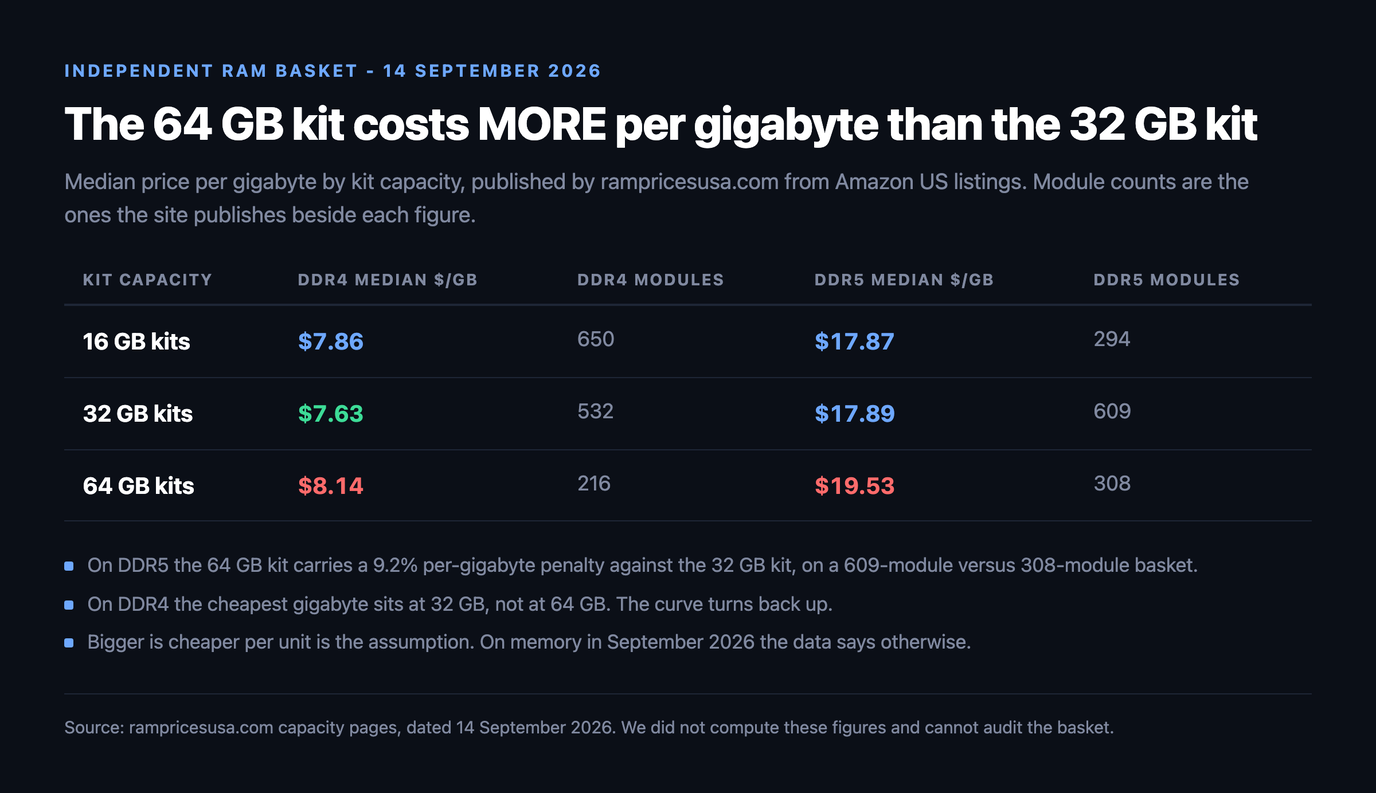
Read the DDR5 column downward. Going from a 32 GB kit to a 64 GB kit costs you 9.2% more per gigabyte, not less — $19.53 against $17.89 — across 308 and 609 modules respectively. DDR4 does the same thing more gently at 6.7%, $8.14 against $7.63. The 16 GB to 32 GB step is flat on DDR5 (+0.1%) and mildly favourable on DDR4 (−2.9%). There is no capacity discount in that table at all above 32 GB; there is a capacity penalty.
Our own observation lands in the same place from a different retailer: the one 64 GB DDR4 kit we track prices above every 32 GB DDR4 kit we track. One observation is not evidence, but two independent baskets pointing the same way on the same day is worth telling you about.
For the generational half of this question rather than the capacity half, our DDR4 vs DDR5 price comparison does it with dated observations, and why RAM prices are so high covers the supply story underneath both.

On storage the discount is real, and it stops at 2 TB
Flash behaves differently, and this is the one place the folklore survives contact with the data — up to a point, and the point is 2 TB.
| Capacity | Cheapest $/GB | Drive behind it | Step from the tier below |
|---|---|---|---|
| 1 TB | $0.157 | Kingston NV3 | — |
| 2 TB | $0.110 | ADATA Legend 710 | −29.9% vs 1 TB |
| 4 TB | $0.115 | WD Black SN7100 | +4.5% vs 2 TB |
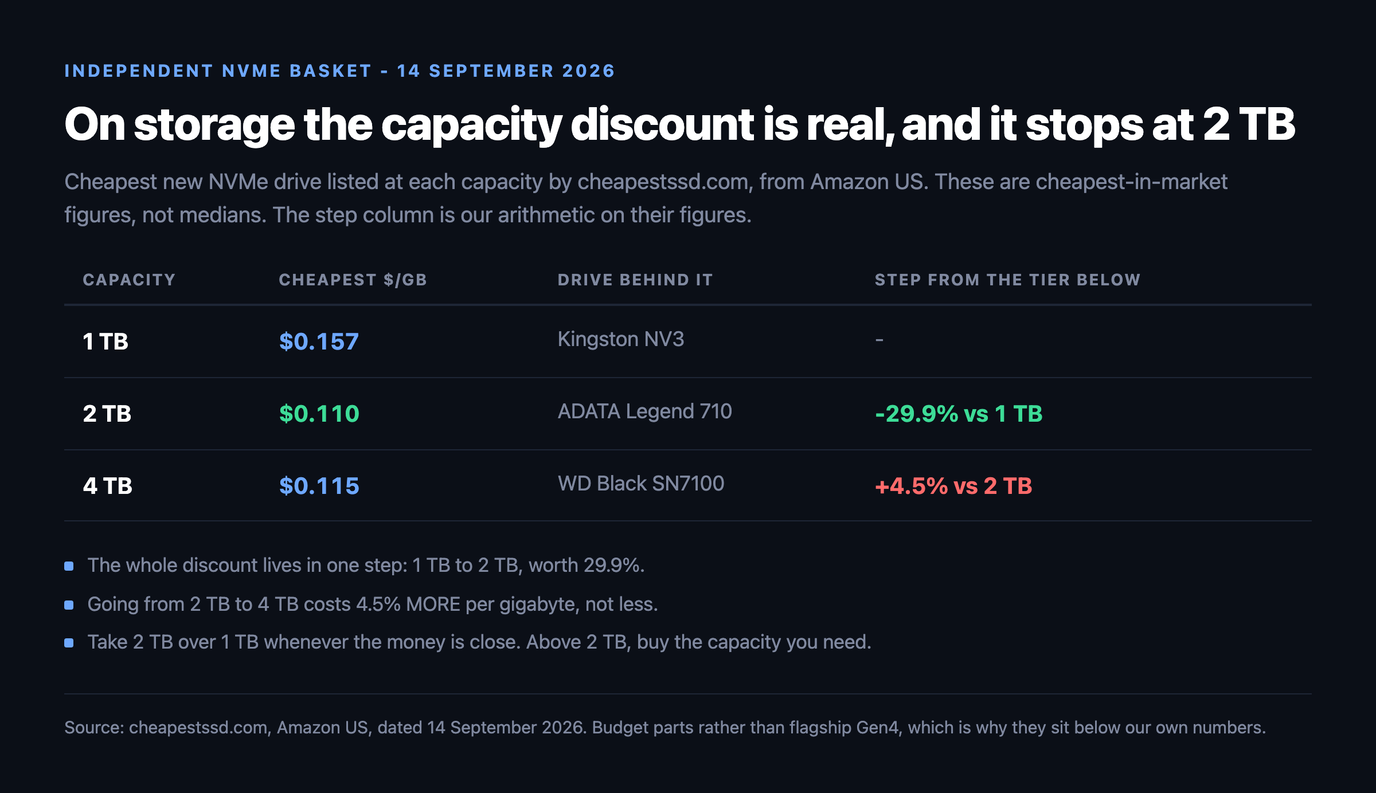
The 1 TB to 2 TB step is a large discount: nearly 30% off the price of a gigabyte for buying one size up. The 2 TB to 4 TB step gives a little back. That shape — a steep drop into 2 TB, flat-to-rising above it — is what our own observations trace too, on different drives at different retailers. So 2 TB is the value tier, and 4 TB is a capacity decision rather than a price one.
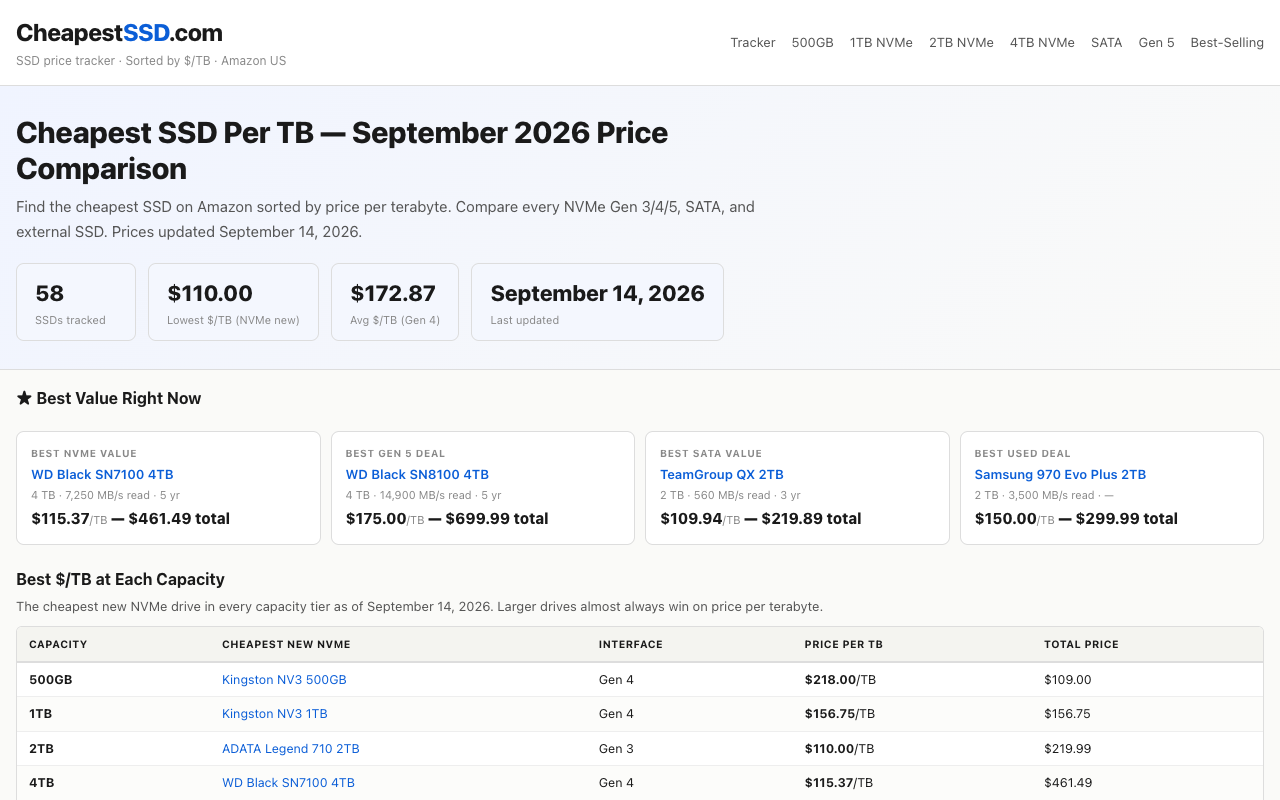
The two tables sit at different levels because of basket composition, not disagreement. A cheapest-in-market figure picks the market’s cheapest drive that day, which in the 2 TB row is a Gen3 drive without DRAM cache; our basket is named mainstream and flagship Gen4 parts. Neither is comparable to the other without saying which is which — the failure mode of most of the tables in the next section. For the level rather than the shape, our SSD prices in 2026 piece has the observed retail series.
Why the published price-per-GB tables miss the shelf
We read the pages currently answering this question first. Most publish a per-gigabyte figure with no observation date, no named part and no sample size — and the one with the most specific numbers is furthest from any shelf we can find.
| Source | Dated | What it publishes | What it discloses about its basket |
|---|---|---|---|
| buyperunit.com | 10 Mar 2026 | 2 TB NVMe Gen4 at $0.045–$0.062/GB | No sample size, no named SKU, no observation date |
| qootec.com | 8 Sep 2026 | No dollar figure at any capacity | One table, no prices in it |
| rampricehistory.com | 7 Apr 2026 | 1 TB NVMe at $0.085/GB; 32 GB DDR5 at $12.50/GB | No tables, no retailer named |
| electronics.alibaba.com | 21 Jul 2026 | 32 GB vs 64 GB DDR5 gap “narrowed to just 22–28%” | Relative claim only; four EU kits priced in euros, April 2026 |
| ByteWatch (this page) | rendered live | See the tables above | SKU count printed per band; medians withheld under the floor |
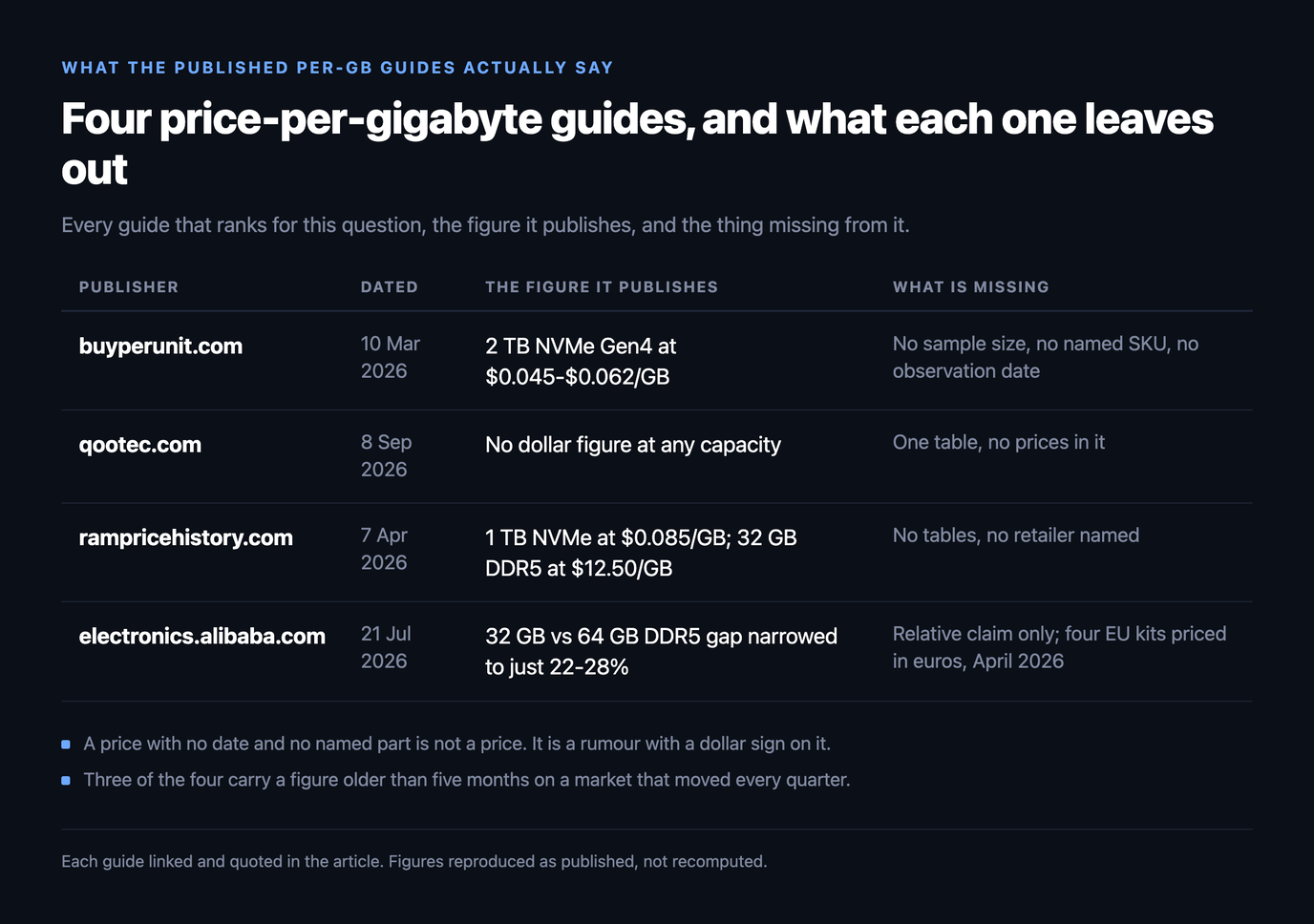
The first row is the instructive one. $0.045–$0.062 per gigabyte for a 2 TB Gen4 NVMe drive is $90–$124 for the drive. On 14 September 2026 the cheapest 2 TB NVMe listed anywhere by a live tracker was $0.110/GB, and the mainstream Gen4 parts we track sat well above that. The published figure is not slightly stale; it is two to four times away from the market you can buy in, in a table dated 2026.
None of that requires bad faith. A per-gigabyte figure decays fast, and a page that does not print its observation date cannot tell you it has decayed. That is the argument for a tracker over a guide: the guide was true once and has no way of saying when it stopped being true.
What to pay, and the three checks before you buy
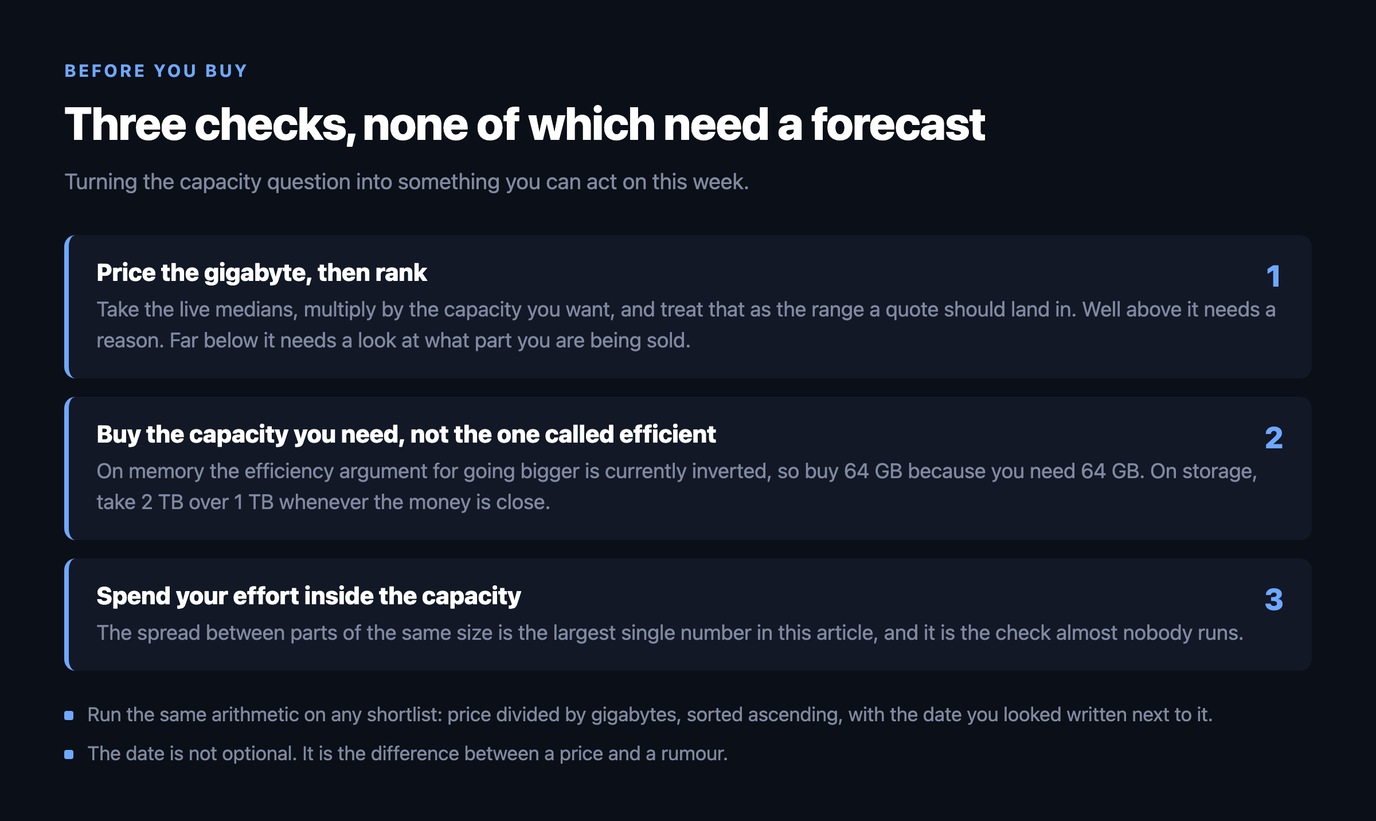
Turning that into something you can act on, with no forecast in it:
One: price the gigabyte, then rank. Take the live medians from our RAM price chart and SSD price chart, multiply by the capacity you want, and treat that as the range a quote should land in. Well above it needs a reason — speed grade, warranty, availability. Far below it needs a look at what part you are being sold.
Two: buy the capacity you need, not the one you were told is efficient. On memory the efficiency argument for going bigger is currently inverted, so buy 64 GB because you need 64 GB. On storage, take 2 TB over 1 TB whenever the money is close, because that step is where the discount actually is.
Three: spend your effort inside the capacity. The spread between parts of the same size is the largest single number in this article, and it is the check almost nobody runs.
How these numbers are produced, and what we withhold
Our own figures come from live product pages at Newegg and B&H, both of which permit it in robots.txt. Amazon is read through the Keepa API and never scraped. Each observation carries a timestamp, and an out-of-stock listing records no price rather than carrying the last one forward. Per part we take the cheapest in-stock price across tracked retailers inside a 30-day window and divide by the marketed capacity. A band under 5 parts is published as withheld, a price jump over 60% waits for a second scrape, and demo rows are blocked at the database layer rather than by convention.
The third-party figures are hand-written, each with its publisher, date and basket. We did not compute them and cannot audit them. They are here because our own memory bands are too thin to answer the capacity question alone, and saying so beats publishing a two-part median and hoping nobody counts. If you would rather be told when a part moves, our guide to alert thresholds explains what number actually fires.
Related reading
FAQ
Is a bigger RAM kit cheaper per gigabyte?
Not in September 2026, on any memory basket we could check. On rampricesusa.com figures dated 14 September 2026, 64GB DDR5 kits sit at $19.53 per gigabyte against $17.89 for 32GB kits — a 9.2% penalty for buying bigger, across 308 and 609 modules. DDR4 does the same at 6.7%. The rule came from an abundant market; in a constrained one the large-capacity part is the scarce one, not the promotional one.
Is a bigger SSD cheaper per gigabyte?
Up to 2TB, clearly. On cheapestssd.com figures dated 14 September 2026 the cheapest NVMe per gigabyte falls 29.9% from 1TB to 2TB, then rises 4.5% at 4TB, and our own observations trace the same shape on different drives. So 2TB is the value tier: take it over 1TB whenever the money is close, and treat 4TB as a capacity decision rather than a price one.
What is a good price per GB for RAM and SSDs right now?
On the parts we track, DDR5 runs from $14.37 to $20.31 per gigabyte with a median of $17.47 across 7 kits, and NVMe Gen4 from $0.171 to $0.234 with a median of $0.200 across 7 drives. Multiply the figure for your category by the capacity you want and that is the range a quote should land in. Every one of those numbers is an observation from a live Newegg or B&H product page with the date printed beside it on our price charts.
Why do published price-per-GB tables disagree with each other so much?
Because they price different baskets and usually do not say which. A cheapest-in-market figure, a median across hundreds of listings, and a named flagship drive are three different numbers for the same capacity, and can legitimately sit two or three times apart. Add an undated observation and the gap widens: one page quotes 2TB NVMe Gen4 at $0.045 to $0.062 per gigabyte, which no live tracker we checked on 14 September 2026 came close to.
Should I buy 32GB or 64GB of RAM in 2026?
Buy the capacity your workload needs: the per-gigabyte efficiency argument for going bigger is currently inverted on both DDR4 and DDR5. If 32GB covers your work, the 64GB kit is not buying you cheaper memory as well as more of it — on today's figures it costs about 9% more per gigabyte. If you need 64GB, buy it; just do not call it the thrifty choice this year.
Why does this page withhold some medians?
Because a median needs a sample. We publish a band median only where the capacity band holds at least 5 parts with a current in-stock observation; below that we show the individual observations and the word withheld. Most per-capacity tables online are built on samples at least this thin and print the number anyway. Where our own bands are too thin, we cite larger third-party baskets with their dates instead of dressing ours up.
Does price per gigabyte tell you which part to buy?
No. Price per gigabyte is a cost unit, not a quality score: it says nothing about latency, endurance, controller, DRAM cache, warranty or whether a kit will train at its rated speed on your board. The cheapest gigabyte in any table is regularly the worst part in it. Use it to rank candidates you have already judged acceptable, never to choose the shortlist.
Where do your own price-per-gigabyte figures come from?
They are scraped from live product pages at Newegg and B&H, both of which permit it in robots.txt, and every observation is stored with a timestamp. Amazon is read through the Keepa API and never scraped. Per part we take the cheapest in-stock price across tracked retailers inside a 30-day window and divide by the marketed decimal capacity; a band under 5 parts is withheld. Demo rows are blocked from public pages at the database layer, so a fabricated price cannot reach this page.
Price the gigabyte, not the box
We track NVMe, DDR5 and DDR4 listings at Newegg and B&H and tell you when one of yours moves. No deal scores, no affiliate links, no commission on anything you buy — observed prices, dated, with the sample size printed next to them.