DDR5 Speed Premium 2026: What Faster Memory Actually Costs
Key takeaways
- The DDR5 speed premium is now several times smaller than the spread inside a single speed grade. On our tracked kits the quicker half of a shortlist costs single-digit percent more, while the cheapest and dearest part of one grade sit tens of percent apart. The grade is the cheap decision; the part is the expensive one.
- The slow kit is not the budget kit. The slowest DDR5 grade in our basket is not the cheapest gigabyte in it — a kit two grades below the cheapest one costs meaningfully more per gigabyte. Buying down the speed ladder to save money currently does neither.
- Compare nanoseconds, never CAS latency across grades. CL divided by half the transfer rate, times a thousand. CL36 at DDR5-6000 is 12.00 ns and beats CL30 at DDR5-4800 at 12.50 ns — the CL numbers say the opposite.
- A twelve-grade third-party basket agrees, and more strongly. On rampricehistory.com figures read 16 September 2026, the cheapest listings of the slowest and fastest grades sit 19.5% apart, while one single grade’s own cheapest- to-average range runs 38–54%.
- Nobody publishing per-grade prices states a sample size. We publish a grade median only at 5 parts or more, and name the rest withheld. This week that means every one of ours is withheld, and the table says so.
- The DDR5 speed premium, measured
- Nanoseconds, not CL
- What each speed grade costs per gigabyte
- The spread inside one grade beats the premium
- DDR4 says the same thing at a third of the price
- What to pay, and four checks before you buy
- A basket twelve grades wide agrees
- Why the premium compressed: dies, not bins
- How these numbers are produced, and what we withhold
- Related reading
- FAQ
You have narrowed it to two DDR5 kits and one of them is faster, and every buying guide tells you the same thing: work out whether the speed is worth the premium on the day you buy. None of them tells you what the premium is. That is an expensive blank in 2026, when a 32 GB kit is a three-figure line item and the difference between the best and worst part on a shortlist runs to hundreds of dollars. So we measured it. This is the DDR5 speed premium priced per gigabyte, from dated retailer observations rather than from a rule of thumb.
We can measure it because we are not summarising anyone. We scrape live product pages at Newegg and B&H, store every observation with a timestamp and a stock flag, and compute price per gigabyte from those records — every figure in our own tables below rendered from that database when this page was built, with the part count printed alongside it. Where a grade is too thin to carry a median you will see the word withheld instead of a number.
Our basket is small, so we read a much larger one too. What follows is our observed ladder, the arithmetic that makes speed grades comparable at all, a twelve-grade third-party basket that reaches the same conclusion, and the supply-side reason the premium compressed.
The DDR5 speed premium, measured on dated prices
Here is our own basket, restricted to one capacity so that nothing in the $/GB column is secretly a capacity effect. Read it top to bottom and ask whether it is sorted by speed.
| Part | Spec | True latency | Best price | $/GB | Retailer | Observed |
|---|---|---|---|---|---|---|
| G.Skill Flare X5 DDR5-6000 CL36 32GB (2x16GB) | DDR5-6000 CL36 | 12.00 ns | $506.00 | $15.81 | Newegg | Sep 20, 2026 |
| Kingston Fury Beast DDR5-6000 32GB (2x16GB) | DDR5-6000 CL40 | 13.33 ns | $559.00 | $17.47 | Newegg | Sep 20, 2026 |
| Corsair Vengeance DDR5-6000 CL30 32GB (2x16GB) | DDR5-6000 CL30 | 10.00 ns | $559.99 | $17.50 | Newegg | Sep 24, 2026 |
| G.Skill Trident Z5 RGB DDR5-6400 CL32 32GB (2x16GB) | DDR5-6400 CL32 | 10.00 ns | $639.99 | $20.00 | Newegg | Sep 17, 2026 |
| G.Skill Trident Z5 Neo DDR5-6000 CL30 32GB (2x16GB) | DDR5-6000 CL30 | 10.00 ns | $649.99 | $20.31 | Newegg | Sep 17, 2026 |
It is not. The cheapest gigabyte belongs to a DDR5-6000 CL36 kit at $15.81, and 10.5% above it sits a DDR5-6000 CL40 kit — a part that is slower on every axis. 13.33 ns against 12.00 ns, a lower transfer rate, and it costs $17.47 per gigabyte. Nobody is paying that for performance.
That single pair is enough to retire the idea that the slow kit is the budget kit. It is not an outlier either: it is the ordinary condition of a memory market where the module maker’s bin has stopped being the thing that sets the price.
Nanoseconds, not CL: the only honest speed comparison
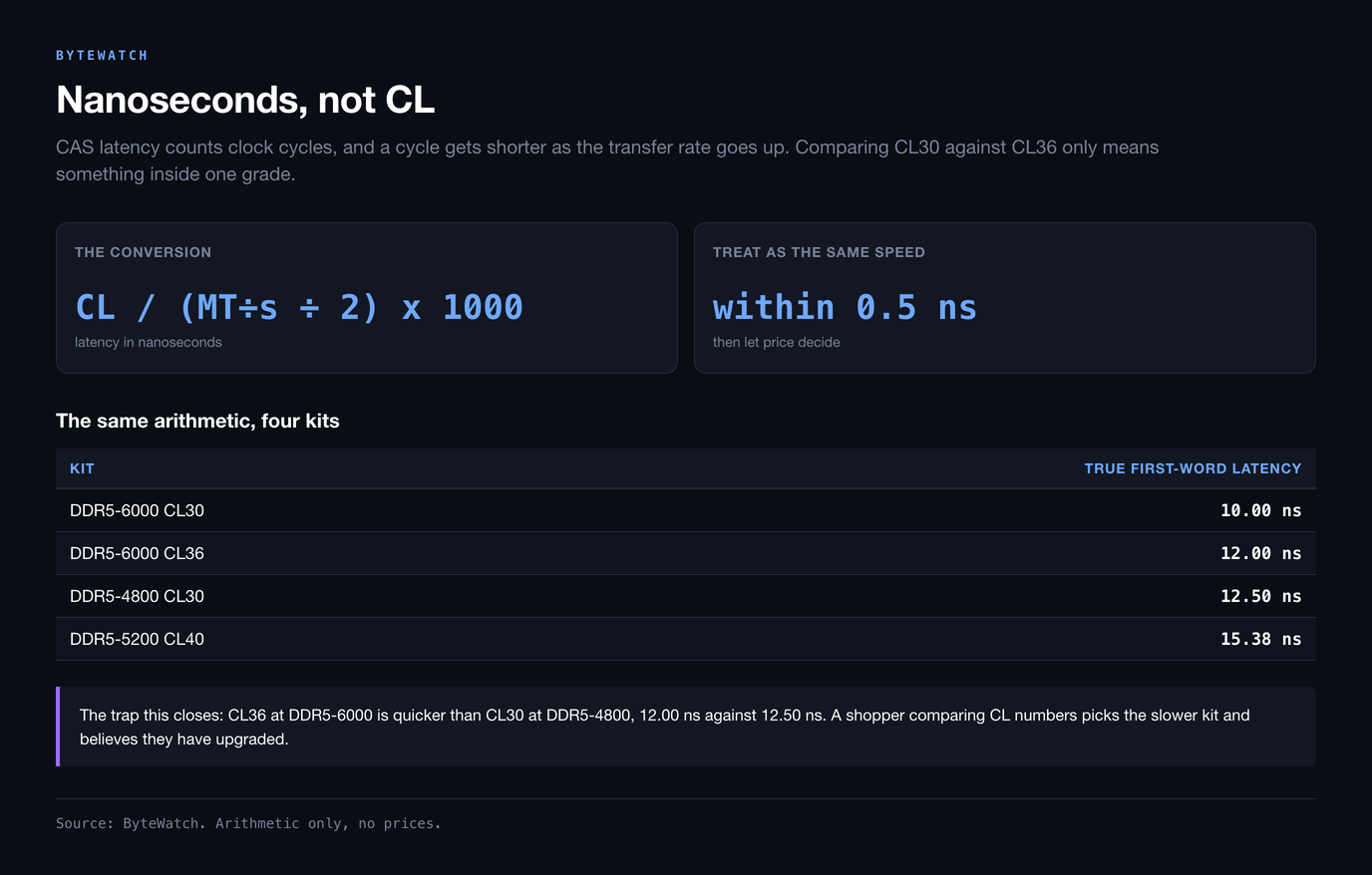
Every comparison above uses true first-word latency rather than the CAS number, and that choice does most of the work. CAS latency counts clock cycles, and a cycle is not a fixed amount of time — it gets shorter as the transfer rate goes up. Comparing CL30 against CL36 tells you something only if both kits run the same grade.
The conversion is one line: latency in nanoseconds equals CL divided by half the transfer rate, times a thousand. A DDR5-6000 CL30 kit is 10.00 ns. A DDR5-6000 CL36 kit is 12.00 ns. A DDR5-5200 CL40 kit is 15.38 ns, so it is slower than both despite having the largest CL of the three by only four over the CL36 part.
What each DDR5 speed grade costs per gigabyte
Grouped by grade rather than by part, the same observations look like this. Every CAS latency of one transfer rate sits in one row, because the question a buyer asks at the shelf is what a grade costs, not what one bin costs.
| Grade | CAS | Median $/GB | Cheapest | Dearest | Spread | Parts |
|---|---|---|---|---|---|---|
| DDR5-5600 | CL40-CL46 | withheld | $14.37 | $17.19 | +19.6% | 2 — below floor |
| DDR5-6000 | CL30-CL40 | withheld | $15.81 | $20.31 | +28.5% | 4 — below floor |
| DDR5-6400 | CL32 | withheld | $20.00 | $20.00 | — | 1 — below floor |
| DDR4-3200 | CL16-CL22 | withheld | $7.81 | $9.37 | +20.0% | 3 — below floor |
| DDR4-3600 | CL18 | withheld | $7.50 | $7.50 | — | 1 — below floor |
Read the Parts column before the price columns. We would rather show an empty cell than a median of two listings, and you should want that from anyone publishing a table like this — the trackers ranking for this question print a figure per grade and state no sample size at all.
What the two ends can carry is the spread column, and that is where the finding is: the cheapest and dearest part of a single grade are further apart than the grades are from each other. Every tracked part is listed with its own observation date if you want to check the arithmetic.
The spread inside one grade beats the DDR5 speed premium
Take DDR5-6000, the grade we hold most parts of. Its 4 kits run from $15.81 to $20.31 per gigabyte — a 28.5% range inside one line of the spec sheet. That is the number to weigh against the speed premium, and it is several times larger.
This is also why a threshold set on a grade is the wrong alert. If you want to be told when a kit gets cheap, watch the part, not the category — our guide to alert thresholds works through what number actually fires.
DDR4 says the same thing at a third of the price
If this were a DDR5 quirk it would be a smaller story. It is not. DDR4 is a mature, shrinking product line on which the bins have been settled for years, and it does the same thing.
| Part | Spec | True latency | Best price | $/GB | Retailer | Observed |
|---|---|---|---|---|---|---|
| G.Skill Ripjaws V DDR4-3600 CL18 32GB (2x16GB) | DDR4-3600 CL18 | 10.00 ns | $239.99 | $7.50 | Newegg | Sep 20, 2026 |
| Corsair Vengeance LPX DDR4-3200 CL16 32GB (2x16GB) | DDR4-3200 CL16 | 10.00 ns | $249.99 | $7.81 | Newegg | Sep 17, 2026 |
| Kingston Fury Beast DDR4-3200 32GB (2x16GB) | DDR4-3200 CL16 | 10.00 ns | $299.99 | $9.37 | Newegg | Sep 17, 2026 |
Look at the latency column: G.Skill Ripjaws V DDR4-3600 CL18 32GB (2x16GB) and Kingston Fury Beast DDR4-3200 32GB (2x16GB) are both 10.00 ns parts, and they are 25.0% apart per gigabyte at $7.50 against $9.37. A DDR4-3600 CL18 kit and a DDR4-3200 CL16 kit compute to exactly the same first-word latency, which is the cleanest demonstration of the nanosecond rule we have: the higher grade buys bandwidth, not responsiveness, and the market prices them as near-equivalents.
The generational gap between these two tables dwarfs everything on this page, and we have measured it separately in DDR4 vs DDR5 prices in 2026. If your board takes either, that decision is worth multiples of any speed grade.
What to pay, and four checks before you click buy
Turning all of that into money: below is the cheapest gigabyte we have actually observed at each grade, multiplied out to the two capacities people buy. Use it as the number a quote should land near, not as a price we are offering.
| Grade | Best $/GB seen | 32 GB at that rate | 64 GB at that rate | Parts behind it |
|---|---|---|---|---|
| DDR5-5600 | $14.37 | $460.00 | $919.99 | 2 |
| DDR5-6000 | $15.81 | $506.00 | $1,012.00 | 4 |
| DDR5-6400 | $20.00 | $639.99 | $1,279.98 | 1 |
| DDR4-3200 | $7.81 | $249.99 | $499.98 | 3 |
| DDR4-3600 | $7.50 | $239.99 | $479.98 | 1 |
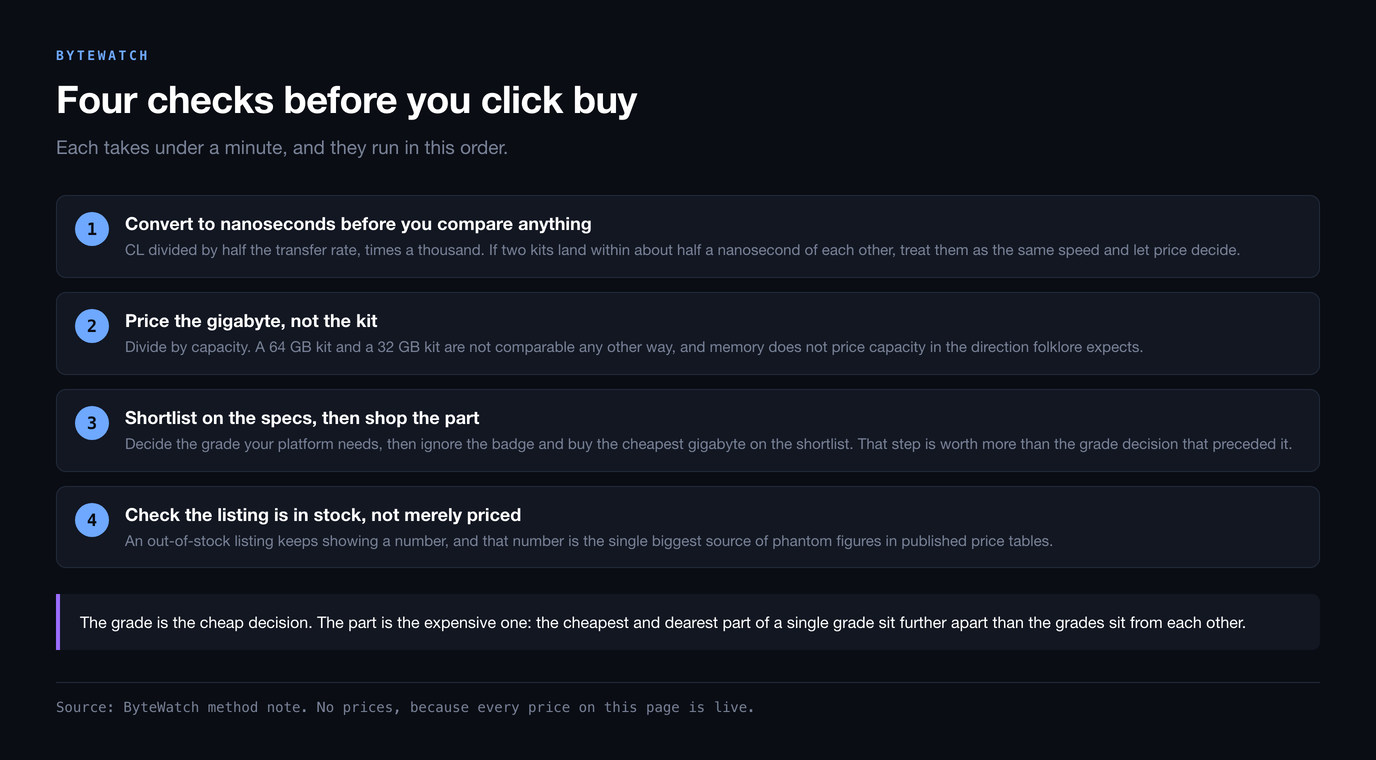
Then four checks, in order, each of which takes under a minute:
One: convert to nanoseconds before you compare anything. CL divided by half the transfer rate, times a thousand. If two kits land within about half a nanosecond of each other, treat them as the same speed and let price decide.
Two: price the gigabyte, not the kit. Divide by capacity. A 64 GB kit and a 32 GB kit are not comparable any other way, and memory does not price capacity in the direction folklore expects — we measured that in price per GB by capacity.
Three: shortlist on the specs, then shop the part. Decide the grade you need for your platform from the performance coverage, which is genuinely good, then ignore the badge and buy the cheapest gigabyte on the shortlist. That step is worth more than the grade decision that preceded it.
Four: check the listing is in stock, not merely priced. An out-of-stock listing keeps showing a number, and that number is the single biggest source of phantom figures in published price tables. Every observation on this page was in stock when we recorded it; that is a filter, not a detail.
A basket twelve grades wide reaches the same conclusion
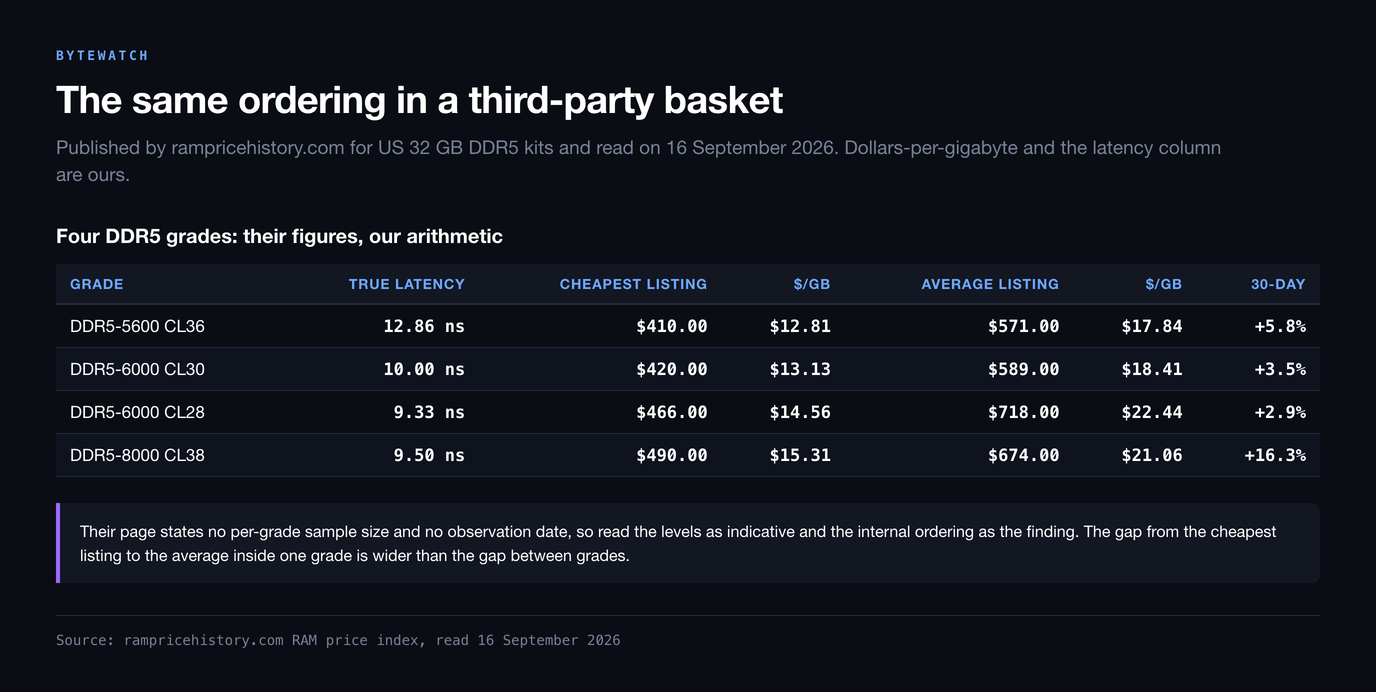
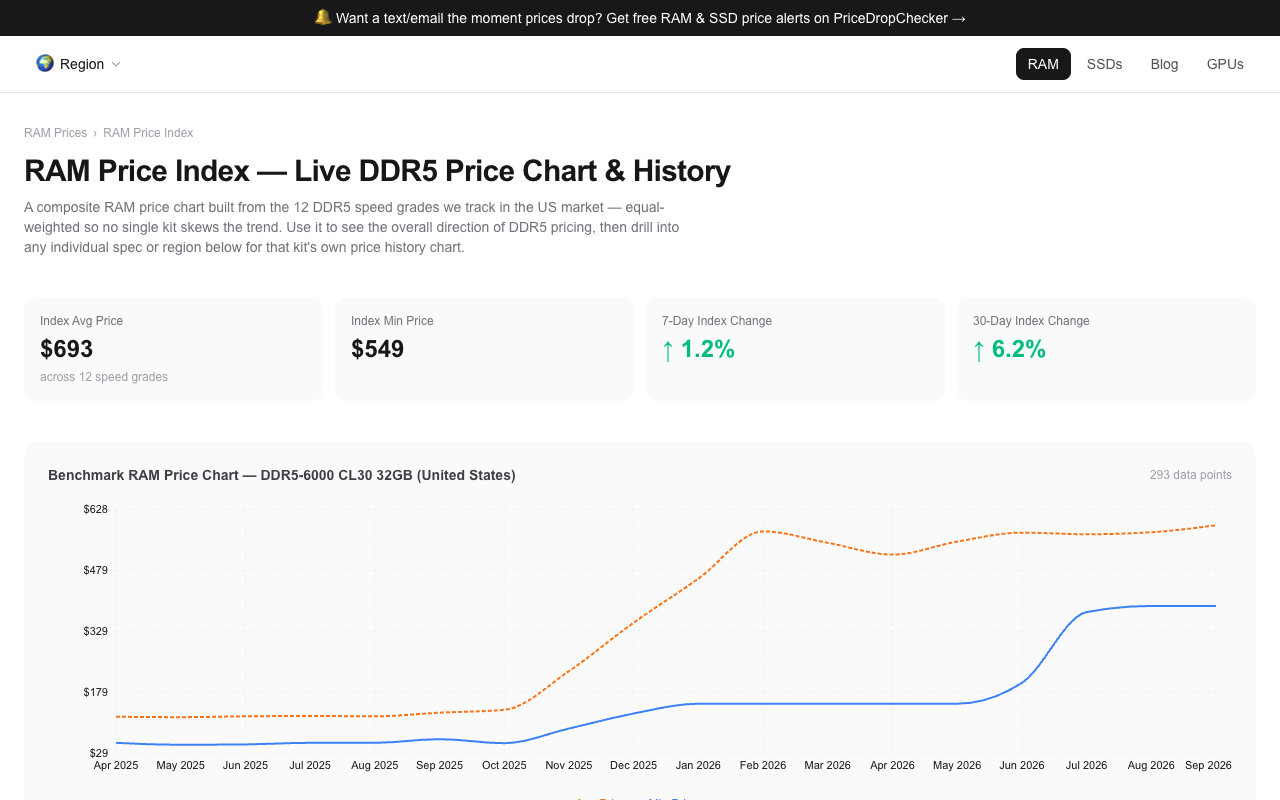
Our own memory sample is thin by design — around twenty canonical, high-liquidity parts rather than every listing in the market — so a finding that only held on our basket would not be worth publishing. Here is a much wider one.
| Grade | True latency | Cheapest listing | $/GB | Average listing | $/GB | 30-day |
|---|---|---|---|---|---|---|
| DDR5-5600 CL36 | 12.86 ns | $410.00 | $12.81 | $571.00 | $17.84 | +5.8% |
| DDR5-6000 CL30 | 10.00 ns | $420.00 | $13.13 | $589.00 | $18.41 | +3.5% |
| DDR5-6000 CL28 | 9.33 ns | $466.00 | $14.56 | $718.00 | $22.44 | +2.9% |
| DDR5-8000 CL38 | 9.50 ns | $490.00 | $15.31 | $674.00 | $21.06 | +16.3% |
The ordering is the point. DDR5-6000 CL28, the quickest grade on that list at 9.33 ns, is the dearest on average at $718 a kit. DDR5-8000 CL38 is within a sixth of a nanosecond of it and averages $44 less. And DDR5-5600 CL36, which is 38% slower than the CL28 part, has a cheapest listing only 13.7% below it.
One caveat we will not bury: that page publishes no sample size per grade and no observation date, so the levels should be read as indicative. We are citing it for its internal ordering, which does not depend on either. Our own equivalent figures, dated per part, are in the tables above and on the RAM price chart.
Why the premium compressed: you are buying dies, not bins
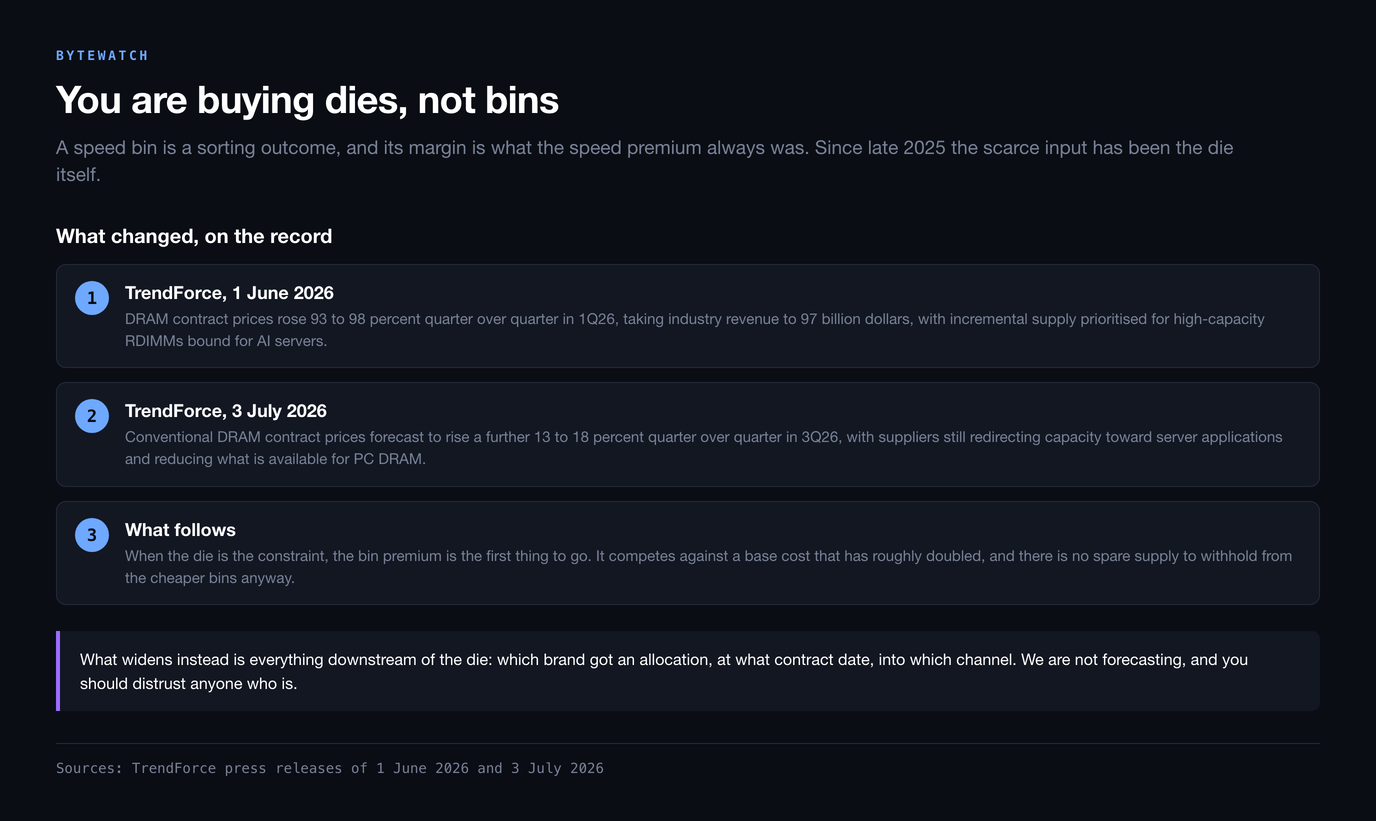

A speed bin is a sorting outcome. Fabs produce dies, testing sorts them by the speed they will hold, and in an ordinary market the faster bins are scarcer than demand for them, so they carry a margin. That margin is what the speed premium always was.
Since late 2025 the scarce input has stopped being the fast bin and started being the die itself. TrendForce reported on 1 June 2026 that DRAM contract prices rose 93–98% quarter over quarter in 1Q26, taking industry revenue to $97 billion, and that incremental supply was being prioritised for high-capacity RDIMMs bound for AI servers. In its 3 July 2026 outlook it forecast conventional DRAM contract prices rising a further 13–18% QoQ in 3Q26, with suppliers still redirecting capacity toward server applications and reducing what is available for PC DRAM.
When the die is the constraint, the bin premium is the first thing to go: it competes against a base cost that has roughly doubled, and there is no spare supply to withhold from the cheaper bins anyway. What widens instead is everything downstream of the die — which brand got an allocation, at what contract date, into which channel. That is precisely the dispersion both tables above are showing.
How these numbers are produced, and what we withhold
Per SKU we take the lowest in-stock price across the retailers we track inside a 30-day window, divide by the kit’s marketed capacity, and sort. Out-of-stock and null-priced observations are dropped rather than carried forward, so every part in every table above was something you could actually have bought when we saw it.
The 30-day window is wider than we would like: our scrape cadence is 48 to 240 hours per listing on the current preset, so a tighter one collapses most grades to a single observation. Every price carries its own date, and the oldest are the ones to re-check.
We publish a grade median only at 5 parts or more. Below that the table prints “withheld” and shows the two ends instead, which is why the comparisons on this page are built from named parts and spreads rather than from medians. Across categories rather than grades, where the samples are larger, DDR5 currently runs $14.37 to $20.31 per gigabyte with a median of $17.47 across 7 kits. Nothing here is a synthetic or modelled price; the database physically cannot serve one to a public page.
Related reading
FAQ
Is faster DDR5 more expensive in 2026?
Less than you would expect, and not reliably. On our tracked 32GB kits the quicker half of the shortlist averages a single-digit percentage more per gigabyte than the slower half, while two kits that compute to exactly the same true latency can sit further apart than that. The slowest grade we track is not the cheapest gigabyte in the basket. The speed premium still exists, but it is now smaller than the penalty for picking the wrong part at the speed you already chose.
What is a good price per GB for DDR5 right now?
On the parts we track, DDR5 runs from $14.37 to $20.31 per gigabyte with a median of $17.47 across 7 kits. Multiply the low end by the capacity you want and that is roughly what a good quote looks like; anything well above it needs a reason beyond the speed grade on the box. Every one of those figures is an observation from a live Newegg or B&H product page, dated on our RAM price chart.
Is DDR5-6000 CL30 worth it over CL36?
At the same transfer rate the comparison is fair, and CL30 is genuinely quicker: 10.00 ns against 12.00 ns. Whether it is worth paying for depends entirely on the gap on the day, and that gap is now wildly inconsistent between brands — we have observed a CL36 kit as the cheapest gigabyte in the whole DDR5 basket while two CL30 kits sat 10% apart from each other. Price both, convert to nanoseconds, and buy the cheaper one unless the difference is small enough to ignore.
Should I buy DDR5-6400 instead of DDR5-6000?
Only if it is not costing you much. A DDR5-6400 CL32 kit computes to 10.00 ns, exactly the same first-word latency as DDR5-6000 CL30 — the higher grade is buying bandwidth, not responsiveness. We have observed both at the same price to the cent, and we have observed the 6400 kit as the dearest gigabyte in the basket. Decide the grade your platform actually benefits from, then let price break the tie.
How do I compare CL30 and CL36 across different speeds?
Convert both to nanoseconds: CAS latency divided by half the transfer rate, times 1,000. DDR5-6000 CL36 is 12.00 ns; DDR5-4800 CL30 is 12.50 ns, so the CL36 kit is the faster part despite the larger CL number. Comparing raw CL across two transfer rates is not a comparison at all, which is the flaw in most "CL30 vs CL36" guidance — it is only valid inside one grade, and rarely says so.
Is DDR4 still cheaper per gigabyte than DDR5?
By a wide margin. On our observations the cheapest DDR4 gigabyte is $7.50 against $14.37 for DDR5 — a generational gap that dwarfs every speed premium on this page. If your motherboard takes either, that decision is worth multiples of any CAS latency choice. We measured it in full in our DDR4 vs DDR5 price comparison.
Why do RAM price trackers disagree about what a speed grade costs?
Because they price different baskets and almost never say which. A cheapest-in-market figure, an average across hundreds of listings and a single named kit are three different numbers for one grade, and on the baskets we checked in September 2026 the cheapest-to-average range inside a single grade ran 38% to 54%. Add an undated observation or an out-of-stock listing that still displays a price and the published figures can differ by more than the grades differ from each other.
Shop the part, not the badge
We track DDR5, DDR4 and NVMe listings at Newegg and B&H and tell you when one of yours moves. No deal scores, no affiliate links, no commission on anything you buy — observed prices, dated, with the sample size printed next to them.