RAM Brand Comparison 2026: What the Badge Actually Costs Per Gigabyte
Key takeaways
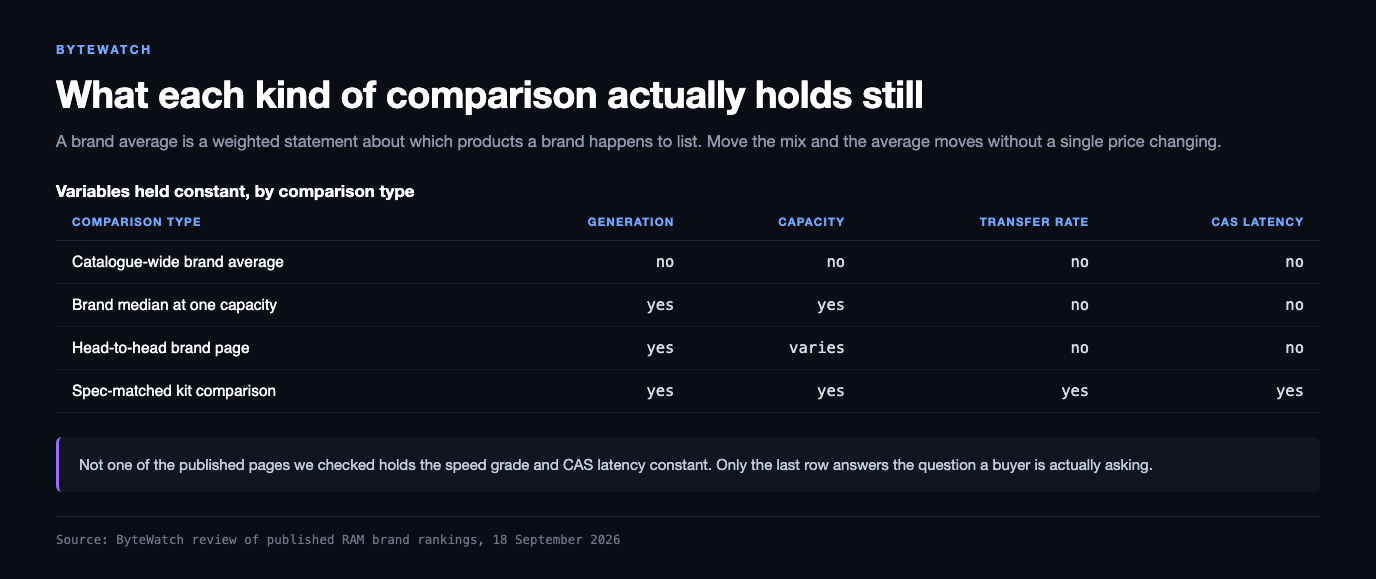
- Every published RAM brand ranking compares catalogues, not kits. Not one of the pages we checked holds the speed grade and CAS latency constant, so a brand’s average moves when its product mix moves and not when it reprices anything.
- Two brand rankings disagree about the same two brands on the same day. Read 18 September 2026, Corsair against Kingston comes out 8%, 13.0% and 14% apart on three pages, two of them from the same site.
- Hold the spec still and the badge premium is real and measurable. Our spec-matched pairs are identical on capacity, transfer rate and CAS, and the dearer badge still costs double-digit percentages more per gigabyte.
- One brand can hold both ends of one spec point. At a single capacity and transfer rate we have repeatedly observed the cheapest and the dearest gigabyte wearing the same name — which is the observation a brand average cannot survive.
- The die comes from one of three companies. Samsung, SK hynix and Micron took 87.6% of DRAM revenue in 2Q26 on TrendForce’s numbers. Everything else in the box is a PCB, a heatspreader, a validated profile and a warranty.
Every RAM brand comparison you can find ranks the badges by average price per gigabyte, and no two of them agree. That is an expensive disagreement in 2026, when a 32 GB DDR5 kit is a three-figure line item and the parts we track run from $14.37 to $20.31 a gigabyte. The reason they disagree is that a brand average is not a measurement of a brand, and this page is the version of the comparison that holds the specification still: same capacity, same transfer rate, same CAS latency, then price the name on the box.
We can do that because we are not summarising anyone. We scrape live product pages at tracked US retailers, store every observation with a timestamp and a stock flag, and compute price per gigabyte from those records — every figure in our own tables below rendered from that database when this page was built, with the part count printed beside it. Where a sample is too thin to carry a median you will see the word withheld rather than a number.
What follows is the spec-matched comparison, the wider cohort that shows what the money is and is not buying, the three published rankings that disagree with each other, and the supply-side reason the badge explains less than it used to.
What the badge costs when the specification is identical
Start with the narrowest comparison our data can make: two kits of the same capacity, the same transfer rate and the same CAS latency, observed in stock at a tracked retailer, priced per gigabyte. Everything that could explain a price difference on a spec sheet has been held still. What is left is the name on the box.
| Specification | Brand | Part | Best price | $/GB | Observed | Badge premium |
|---|---|---|---|---|---|---|
| DDR4-3200 CL16, 32 GB | Corsair | Corsair Vengeance LPX DDR4-3200 CL16 32GB (2x16GB) | $249.99 | $7.81 | Sep 17, 2026 | — |
| Kingston | Kingston Fury Beast DDR4-3200 32GB (2x16GB) | $299.99 | $9.37 | Sep 17, 2026 | +20.0% | |
| DDR5-6000 CL30, 32 GB | Corsair | Corsair Vengeance DDR5-6000 CL30 32GB (2x16GB) | $559.99 | $17.50 | Sep 24, 2026 | — |
| G.Skill | G.Skill Trident Z5 Neo DDR5-6000 CL30 32GB (2x16GB) | $649.99 | $20.31 | Sep 17, 2026 | +16.1% |
The widest of those is DDR4-3200 CL16, 32 GB, where Kingston’s Fury Beast DDR4-3200 32GB (2x16GB) runs +20.0% per gigabyte above Corsair’s Vengeance LPX DDR4-3200 CL16 32GB (2x16GB) — $50.00 on the kit for a part that reports the same three numbers to your motherboard. Both were observed in stock, both dated, both at a retailer we track.
Hold that number, because the rest of this piece is about how it compares with the brand gaps that get published — and with the spread inside a single brand.
One capacity, one speed grade, several badges
Two kits is a pair, not a finding. So widen it by exactly one degree: hold capacity and transfer rate constant, let CAS vary, and put the true latency of every part beside its price so you can see what the extra money is buying.
| Part | Brand | CAS | True latency | Best price | $/GB | Observed |
|---|---|---|---|---|---|---|
| G.Skill Flare X5 DDR5-6000 CL36 32GB (2x16GB) | G.Skill | CL36 | 12.00 ns | $506.00 | $15.81 | Sep 20, 2026 |
| Kingston Fury Beast DDR5-6000 32GB (2x16GB) | Kingston | CL40 | 13.33 ns | $559.00 | $17.47 | Sep 20, 2026 |
| Corsair Vengeance DDR5-6000 CL30 32GB (2x16GB) | Corsair | CL30 | 10.00 ns | $559.99 | $17.50 | Sep 24, 2026 |
| G.Skill Trident Z5 Neo DDR5-6000 CL30 32GB (2x16GB) | G.Skill | CL30 | 10.00 ns | $649.99 | $20.31 | Sep 17, 2026 |
That is 4 kits, 3 brands, one capacity and one transfer rate, spanning 28.5% per gigabyte for a true-latency range of 10.00 to 13.33 ns. Read it top to bottom and ask whether it is sorted by anything on the spec sheet.
And the finding that decides the argument: one brand owns both ends of this cohort. G.Skill’s Flare X5 DDR5-6000 CL36 32GB (2x16GB) is the cheapest gigabyte here at $15.81, and its Trident Z5 Neo DDR5-6000 CL30 32GB (2x16GB) is the dearest at $20.31 — 28.5% apart, same badge, same capacity, same transfer rate. A single average for that brand would sit somewhere in the middle and describe neither kit.
Why two brand rankings disagree on the same day
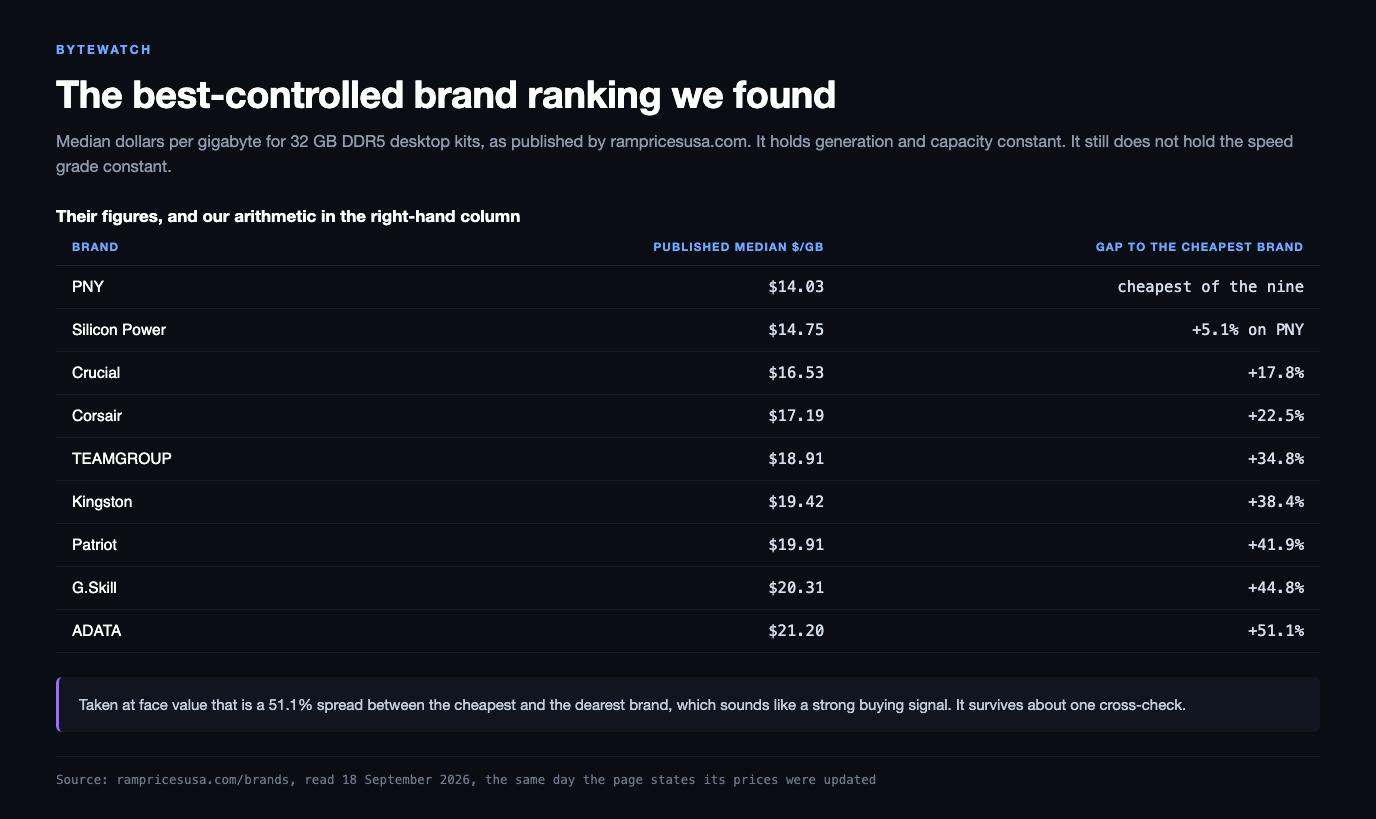
Now put our basket down and look at what is published. Three pages, all updated 18 September 2026, all ranking the same brands on price per gigabyte, all reading US retail.
| Brand | Published median $/GB | Gap to the cheapest brand |
|---|---|---|
| PNY | $14.03 | cheapest of the nine |
| Silicon Power | $14.75 | +5.1% on PNY |
| Crucial | $16.53 | +17.8% |
| Corsair | $17.19 | +22.5% |
| TEAMGROUP | $18.91 | +34.8% |
| Kingston | $19.42 | +38.4% |
| Patriot | $19.91 | +41.9% |
| G.Skill | $20.31 | +44.8% |
| ADATA | $21.20 | +51.1% |
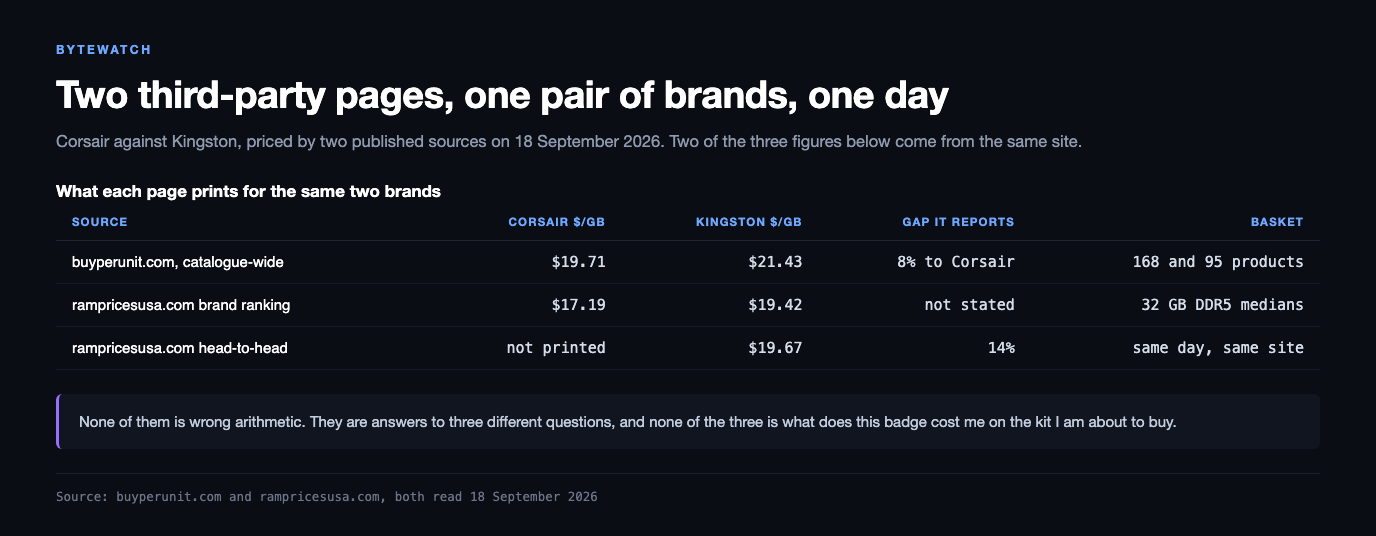
Taken at face value that is a 51.1% spread between the cheapest and dearest brand, which sounds like a strong buying signal. It survives about one cross-check. buyperunit.com prices the same two brands catalogue-wide the same month and gets $19.71/GB for Corsair across 168 products against $21.43/GB for Kingston across 95, calling it 8% in Corsair’s favour. The table above makes the same pair 13.0% apart. And rampricesusa’s own head-to-head page for those two brands, on the same day as its own ranking, prints Kingston at $19.67/GB rather than $19.42 and calls the gap 14%.
Three numbers for one pair of brands on one day: 8%, 13.0%, 14%. None of them is wrong arithmetic. They are answers to three different questions, and none of the three is “what does this badge cost me on the kit I am about to buy”.
A brand average measures the catalogue, not the brand
Here is the mechanism. A brand’s average price per gigabyte is a weighted statement about which products that brand happens to list. Move the mix — more high-bin kits, more low-capacity legacy modules, more laptop SO-DIMMs — and the average moves without a single price changing.
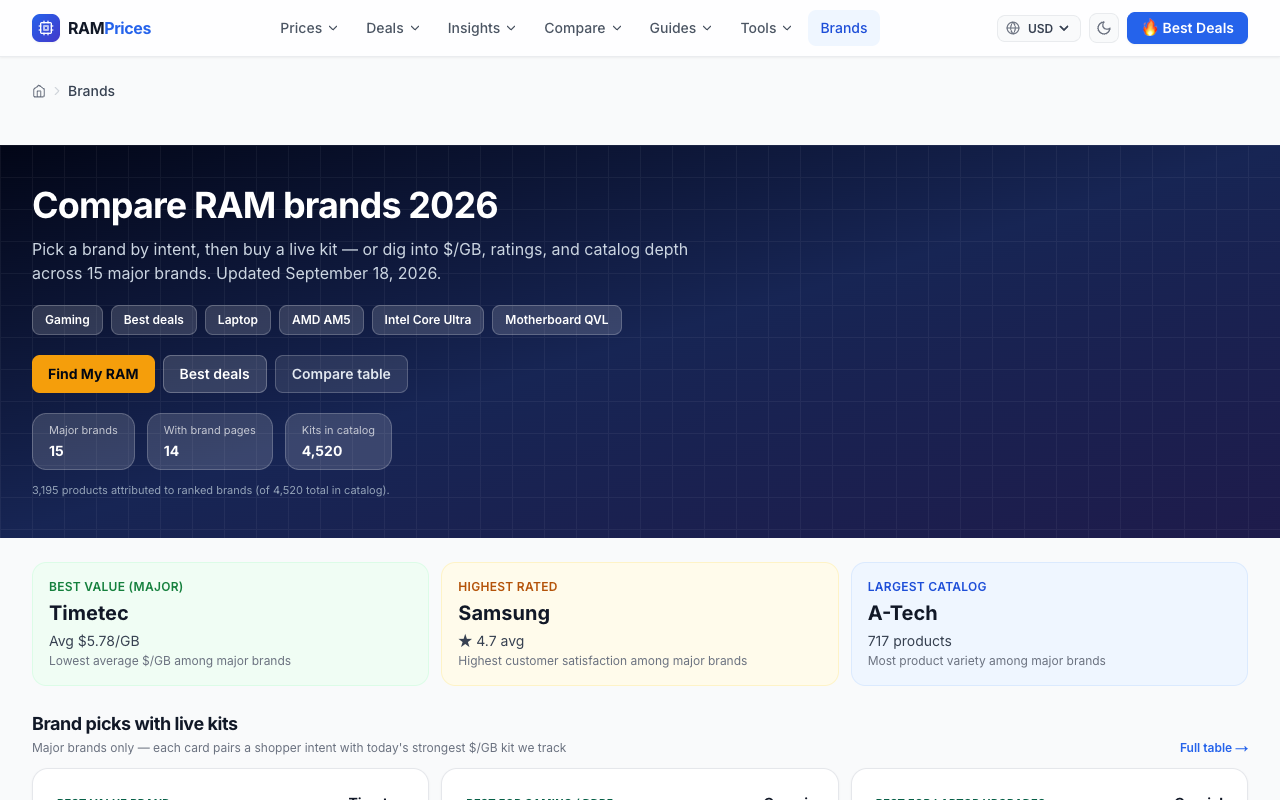
The clearest evidence is on the ranking page itself. Alongside its brand table, rampricesusa’s comparison hub names a best-value DDR4 pick at $1.52/GB and a best-value DDR5 pick at $1.80/GB, on a page whose DDR5 32 GB brand medians run $14.03 to $21.20. Multiply the first out: $1.52 × 128 GB is $194.56 for a 128 GB DDR4-3600 kit. Our own observed DDR4 range this month is in the single-digit dollars per gigabyte, so those two figures and that brand table cannot both be measuring the same market. Its catalogue-wide ranking has the same shape: HyperX at $5.54/GB and Timetec at $5.78/GB sitting above Corsair at $14.82/GB is a statement about who lists cheap legacy modules, not about who prices DDR5 keenly.
So we built the same ranking on our basket, and published the columns that make it readable.
| Brand | Parts | Specs | Median $/GB | Cheapest | Dearest | Own spread |
|---|---|---|---|---|---|---|
| Crucial | 2 | 2 | withheld | $9.37 | $17.19 | +83.3% |
| Kingston | 2 | 2 | withheld | $9.37 | $17.47 | +86.3% |
| Corsair | 3 | 3 | withheld | $7.81 | $17.50 | +124.0% |
| G.Skill | 4 | 3 | withheld | $7.50 | $20.31 | +170.8% |
Look at what the “own spread” column does there, because it is the whole argument in one column. Those figures are enormous, and they are enormous for the same reason every published brand ranking is unreliable: with more than one spec behind a row, that column is measuring the distance from a brand’s DDR4 kit to its DDR5 kit and calling it a property of the brand. It is our own table failing in exactly the way we are describing, left in rather than quietly dropped. The “specs” column beside it is what tells you not to read the row as a price signal — and it is the column no published ranking prints.
Three companies make the die inside every badge
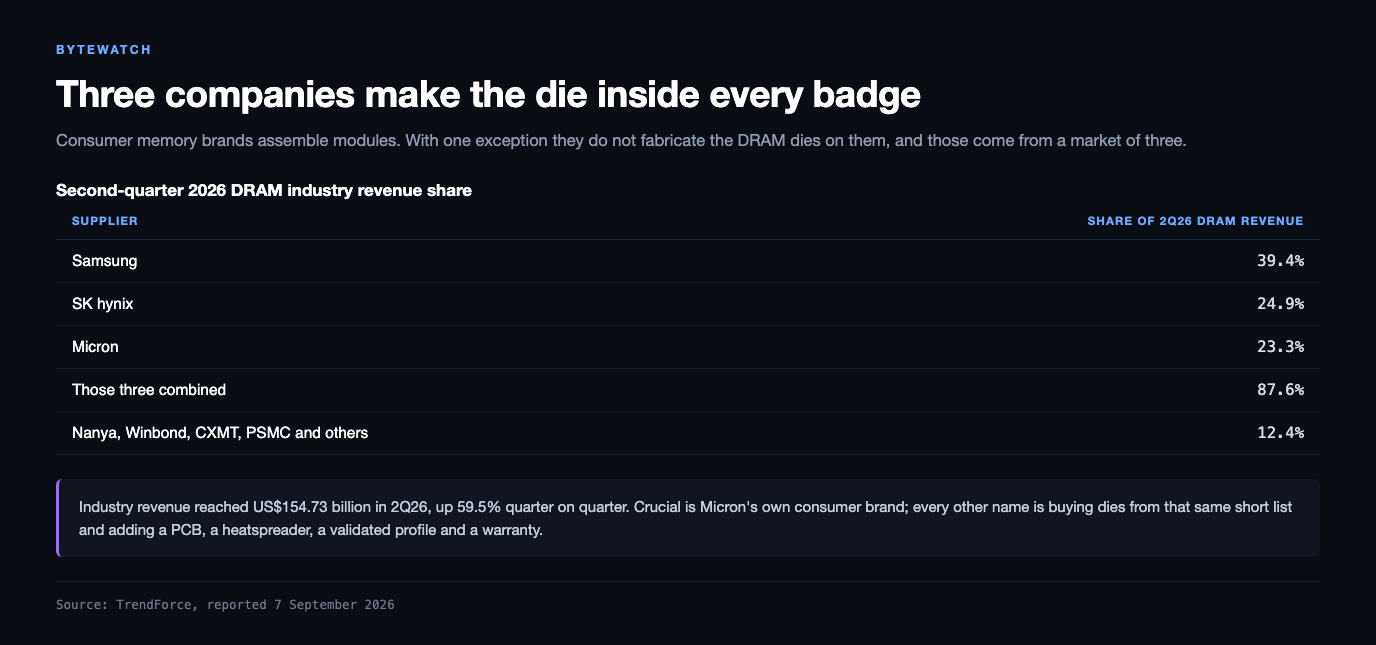
There is a supply-side reason the badge explains so little, and it is not a secret. Consumer memory brands assemble modules; with one exception they do not fabricate the DRAM dies on them. Those come from a market of three.
TrendForce reported on 7 September 2026 that 2Q26 DRAM industry revenue reached US$154.73 billion, up 59.5% quarter on quarter, split Samsung 39.4%, SK hynix 24.9% and Micron 23.3% — 87.6% of the industry between three suppliers, with Nanya, Winbond, CXMT and PSMC dividing the rest. Crucial is Micron’s own consumer brand; every other name in our table is buying its dies from that same short list and adding a PCB, a heatspreader, a validated XMP or EXPO profile and a warranty.
That is a real product and it is worth something. It is not worth an unbounded amount, and it is certainly not worth an amount you can infer from a brand average — which is why the same three suppliers’ contract pricing, not the badge, is what actually moves these numbers. TrendForce put conventional DRAM contract prices up 13–18% quarter on quarter for 3Q26, which is the force behind every figure on this page.
DDR4 repeats the pattern at a third of the price
The badge premium is not a DDR5 artefact. On DDR4-3200 CL16, 32 GB our two tracked kits are Corsair’s Vengeance LPX DDR4-3200 CL16 32GB (2x16GB) at $7.81 and Kingston’s Fury Beast DDR4-3200 32GB (2x16GB) at $9.37 — +20.0%, or $50.00 on the kit, for parts identical on capacity, transfer rate and CAS.
That gap is larger in percentage terms than the DDR5 pair and smaller in cash, which is the useful way round: the percentage is what a brand ranking would try to capture, and the cash is what you actually hand over. On a generation where a gigabyte costs a third of what DDR5 costs, a fifth on top of the right kit is still the cheapest mistake on this page. The generational decision is the expensive one, and we priced it separately in our DDR4 vs DDR5 comparison.
What to do instead of shopping by brand
One: shortlist on the specification, then ignore it. Decide the capacity, the transfer rate and the CAS latency your platform benefits from — performance coverage is genuinely good at this, and your motherboard’s qualified vendor list is worth a look. Then treat every part that meets it as interchangeable and buy the cheapest gigabyte on the list. On our cohort that step was worth 28.5%.
Two: convert CAS to nanoseconds before you compare. CAS divided by half the transfer rate, times a thousand. CL36 at DDR5-6000 is 12.00 ns and beats CL30 at DDR5-4800 at 12.50 ns, so comparing raw CL across two grades is not a comparison. We worked this through in the DDR5 speed premium.
Three: price the gigabyte, not the kit. Divide by capacity every time, because capacity does not price the way folklore expects — we measured that in price per GB by capacity.
Four: check the listing is in stock, not merely priced. An out-of-stock listing keeps displaying a number, and carrying those forward is the single biggest source of phantom figures in published price tables. Every observation on this page was in stock when we recorded it.
How these numbers are produced, and what we withhold
We scrape live product pages at tracked US retailers and store every observation with a timestamp and a stock flag. A part’s price here is the lowest in-stock observation across those retailers inside a 30-day window, divided by the kit’s capacity in gigabytes. Out-of-stock and null-priced rows are excluded rather than carried forward. Nothing on this page is a synthetic or modelled price; the database physically cannot serve one to a public page.
The 30-day window is wider than we would like and we would rather say so than hide it: our scrape cadence runs to several days per listing, so a tighter window collapses most comparisons to a single observation. Every date in every table is printed for that reason. Where two observations in one row are days apart, the comparison is weaker than one taken on the same afternoon, and you can see which is which.
Our basket is around twenty canonical, high-liquidity parts rather than every listing in the market. That is small, deliberately, and it is why the third-party baskets are on this page too: a finding that only held on our list would not be worth publishing. It is also why every brand median above reads “withheld”. A ranking is a promise about a sample, and ours cannot keep it at the brand level — so we print the spread and the sample instead of a number that would look more authoritative than it is.
Related reading
FAQ
Does RAM brand matter in 2026?
For price, more than it should, and not in a direction you can predict from a brand ranking. Hold capacity, transfer rate and CAS latency identical and the dearer badge still costs double-digit percentages more per gigabyte on the pairs we track. For the memory itself it matters much less: Samsung, SK hynix and Micron took 87.6% of DRAM revenue in the second quarter of 2026 on TrendForce figures, so the dies inside almost every consumer kit come from the same three suppliers. What the brand adds is the PCB, the heatspreader, the validated XMP or EXPO profile and the warranty behind them.
Which RAM brand is cheapest per GB?
The question has no stable answer, which is the finding rather than a dodge. Published rankings put the cheapest brand anywhere from PNY to HyperX depending on whether they average a whole catalogue or a single capacity, and they disagree about the gap between one pair of brands by a factor of nearly two on the same day. At a single capacity and transfer rate we have observed one brand holding both the cheapest and the dearest gigabyte in the cohort. Shortlist on the specification and buy the cheapest gigabyte that meets it.
Is expensive RAM worth it over a cheap kit with the same specs?
If the capacity, the transfer rate and the CAS latency all match, the two kits present the same three numbers to your motherboard, and the premium is buying build, cooling, appearance, warranty and support rather than performance. Those are real, and on our observations they have been priced anywhere from nothing to a fifth of the kit. Decide what that package is worth to you as a fixed amount, then check the actual gap on the day rather than assuming a brand tier.
Why do RAM brand price comparisons disagree with each other?
Because they price different baskets and rarely say so. A catalogue-wide average, a median restricted to one capacity and generation, and a single named kit are three different numbers for one brand. Catalogue averages are the worst offenders: a brand that lists many small legacy modules will appear cheap per gigabyte without pricing a current kit keenly. On 18 September 2026 one comparison site published a best-value DDR4 pick at $1.52 per gigabyte on the same page as brand medians running $14 to $21 for DDR5.
What is a good price per GB for DDR5 right now?
On the parts we track, DDR5 runs from $14.37 to $20.31 per gigabyte with a median of $17.47 across 7 kits. Multiply the low end by the capacity you want and that is roughly what a good quote looks like; anything well above it needs a reason beyond the name on the heatspreader. Every one of those figures is an observation from a live retailer product page, dated on our RAM price chart.
Is Crucial memory made by Micron?
Crucial is Micron’s consumer brand, which makes it the one mainstream name selling modules built on dies its own parent fabricates. Every other consumer brand in our basket assembles modules around dies bought from Samsung, SK hynix or Micron. That vertical integration is a genuine structural difference between the brands; on our observations it has not translated into a consistent price advantage at a matched specification, so treat it as context rather than as a buying rule.
Is DDR4 still cheaper per gigabyte than DDR5?
By a wide margin. On our observations the cheapest DDR4 gigabyte is $7.50 against $14.37 for DDR5 — a generational gap that dwarfs every badge premium on this page. If your motherboard takes either, that decision is worth multiples of the brand choice. We measured it in full in our DDR4 vs DDR5 price comparison.
Shop the spec, not the badge
We track DDR5, DDR4 and NVMe listings at US retailers and tell you when one of yours moves. No deal scores, no affiliate links, no commission on anything you buy — observed prices, dated, with the sample size printed next to them.