Warranty Turnaround Time in 2026: 11 to 19 Days, If Anyone Will Say
- The warranty turnaround time nobody publishes is 11 to 19 days. That is the door-to-door wait built from the only two published figures in the chain: the USPS standard for the parcel you post, and G.SKILL’s 7-10 business days after receipt. Neither publishes the total.
- 2 of the 8 makers we read commit to any window at all. 5 state no service time whatsoever, and the one maker that publishes a full stage-by-stage timeline — AMP — says in the same document that it does “not constitute a contractual guarantee”.
- The only guaranteed leg of a warranty claim is the postage. USPS Priority Mail Express carries a money-back guarantee; not one maker’s repair does. You can buy a promise about the days in transit, not about the weeks at the depot.
- Skipping the wait costs the part’s full value, frozen. Mushkin will cross-ship a replacement before yours arrives, but the hold is “for the FULL VALUE of the product being cross-shipped to you” — today’s price, not the one you paid, which on a kit bought for $90 and replaced at $390 is 4.3× what the part cost you.
- And the clock never stops. Mushkin requires the parcel to be “received on or before the warranty expiration date” — so the 5 days in transit come out of your cover, not theirs, and the replacement inherits only what is left of the term.
A module fails, the warranty has years left on it, and the only question that matters is how long you will be without the machine. So you look for the warranty turnaround time, and discover that almost nobody will give you one: we read 8 memory and storage makers’ own RMA and warranty documents on November 11, 2026, and 5 state no service time at all. Add the postage to the one window that runs end to end and the answer is 11 to 19 days — a figure nobody publishes, because each party owns only its own leg. We built it from the documents that commit to anything, priced what the wait spends out of your own cover, and read the one cross-ship programme in the set.

Three clocks run during a claim, and only one is yours
A warranty claim is usually described as one wait. It is three, governed by different documents and measured in different units. First, the deadline you have to meet: the term has an end date, and some makers want the parcel in their hands before it, not merely posted. Second, transit — the only leg in the business with an enforceable promise attached. Third, the depot: diagnosis, replacement and the trip back, which is the longest of the three and the one almost nobody commits to.
That split matters because the costs land in different places. Transit you pay for in cash, and we priced that bill in full a few days ago — freight, insurance, and what the refund is measured against — just as the proof-of-purchase problem has its own article. The depot wait you pay for in cover, because the term keeps running while the part is on a bench. And the deadline you pay for in eligibility, which is the expensive one: missing it converts a warranty claim into a purchase at today’s price.
Who publishes a warranty turnaround time, and who says nothing
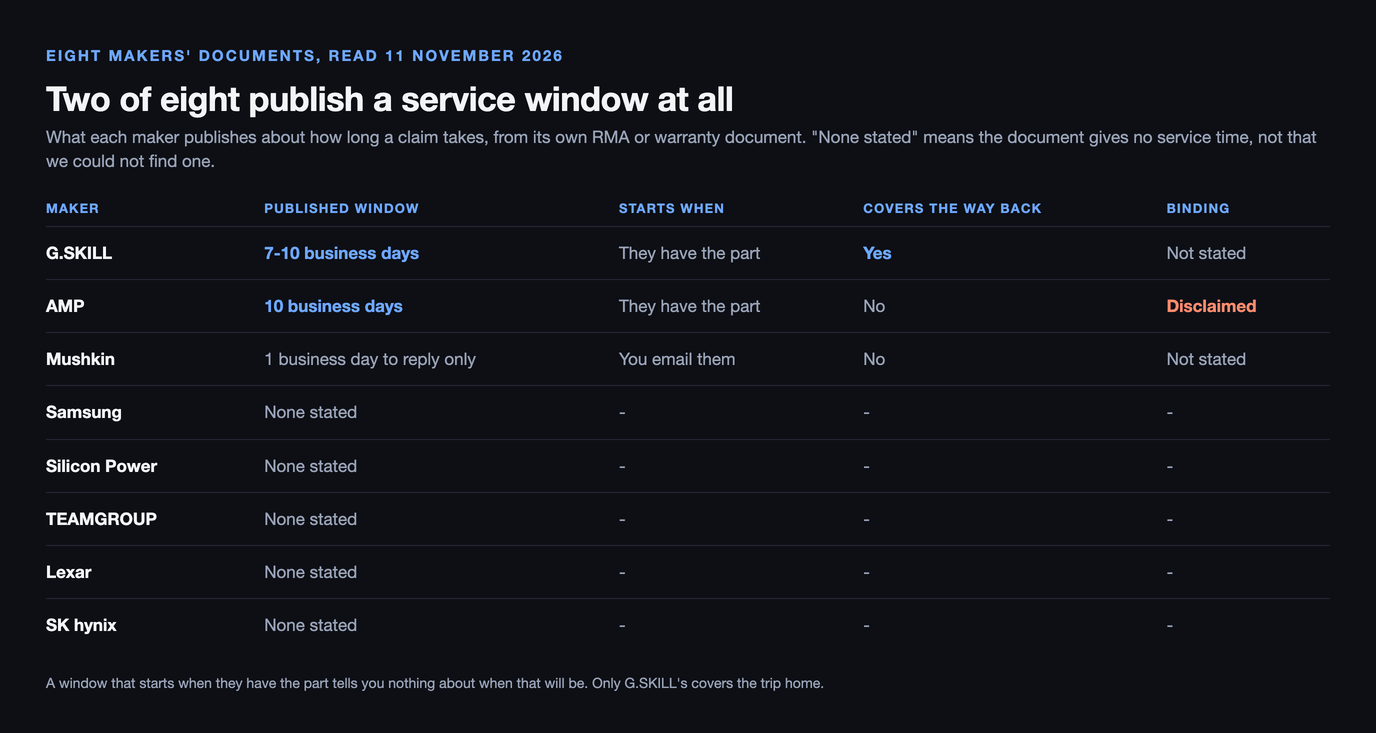
We read 8 makers’ documents for a service window: AMP, G.SKILL, Lexar, Mushkin, SK hynix, Samsung, Silicon Power, TEAMGROUP. Two publish one. The useful column below is the third: a window that starts when they have the part tells you nothing about when that will be.
| Maker | Published window | Starts when | Covers the way back | Binding |
|---|---|---|---|---|
| G.SKILL | 7-10 business days | They have the part | Yes | Not stated |
| AMP | 10 business days | They have the part | No | Disclaimed |
| Mushkin | 1 business day to reply only | You email them | No | Not stated |
| Samsung | None stated | — | — | — |
| Silicon Power | None stated | — | — | — |
| TEAMGROUP | None stated | — | — | — |
| Lexar | None stated | — | — | — |
| SK hynix | None stated | — | — | — |
G.SKILL is the only maker in the set with a single end-to-end commitment: “Please allow at least 7-10 business days for processing and shipping after the receipt of defective product(s)”. It covers processing and shipping, so it is the one figure here that gets a part all the way back to you — and it is hedged with “at least” rather than capped.
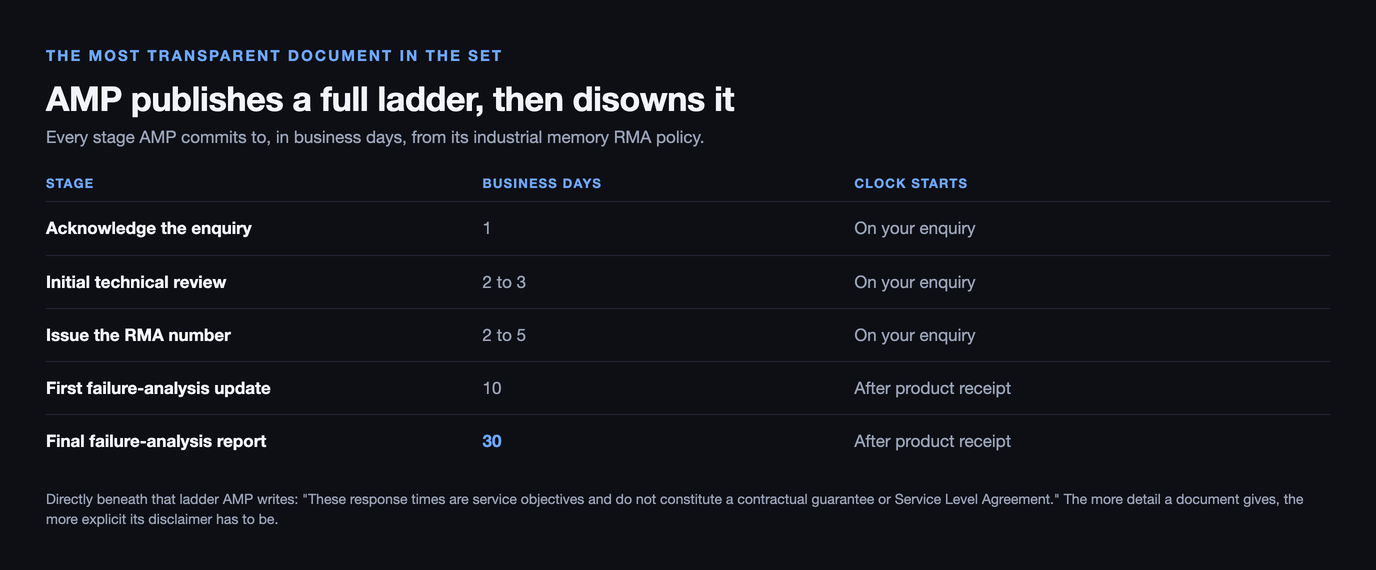
AMP, an industrial memory and storage supplier, goes further and publishes a full ladder: acknowledgement, technical review, RMA number, first analysis update, final report. It is the most transparent document we have read on this subject — and the only one that tells you its figures are worthless as a promise.
| Stage | Published | In calendar days | Clock starts |
|---|---|---|---|
| Acknowledge the enquiry | 1 business day | 1 to 3 days | On your enquiry |
| Initial technical review | 2-3 business days | 2 to 5 days | On your enquiry |
| Issue the RMA number | 2-5 business days | 2 to 7 days | On your enquiry |
| First failure-analysis update | 10 business days | 12 to 14 days | On receipt of the part |
| Final failure-analysis report | 30 business days | 40 to 42 days | On receipt of the part |
The 5 silent documents — Samsung, Silicon Power, TEAMGROUP, Lexar, SK hynix — are not evasive about everything. TEAMGROUP is specific that “Customers handle freight and insurance costs”, and Lexar that “Returned products must be shipped prepaid”. They will tell you exactly who pays. They will not tell you when you get the part back.
What the door-to-door warranty turnaround time adds up to

No document in this set describes the whole wait, because each owns a different piece of it. But the pieces are published, so the total can be assembled rather than guessed: the carrier publishes the transit standard for the parcel you post, and G.SKILL the window covering everything after it arrives.
| Leg | Fastest | Slowest | Who publishes it |
|---|---|---|---|
| Your parcel in, by USPS Ground Advantage | 2 days | 5 days | USPS |
| The maker’s published window, processing and shipping | 9 days | 14 days | G.SKILL |
| Door to door | 11 days | 19 days | nobody publishes this total |
11 to 19 days, then, for the one maker-published path that runs end to end — and the shape of that range is the lesson. The depot leg is 74% of the worst case, so paying for faster postage barely moves it: swapping Ground Advantage for USPS Priority Mail Express on the way in takes exactly 2 days off a 19 days wait. Express postage is worth buying to beat a deadline, which is a different problem, and we come back to it below.
And this is the optimistic branch. It assumes a swap rather than an investigation: AMP’s ladder puts a final failure-analysis report up to 42 days after receipt on a calendar, before a replacement is even settled. It also assumes nothing comes back untouched — Samsung notes that “in the case of NTF (No Trouble Found) through a diagnosis, Your Product will be sent back to You”, which is the same wait for no result.
Business days and days are not the same promise
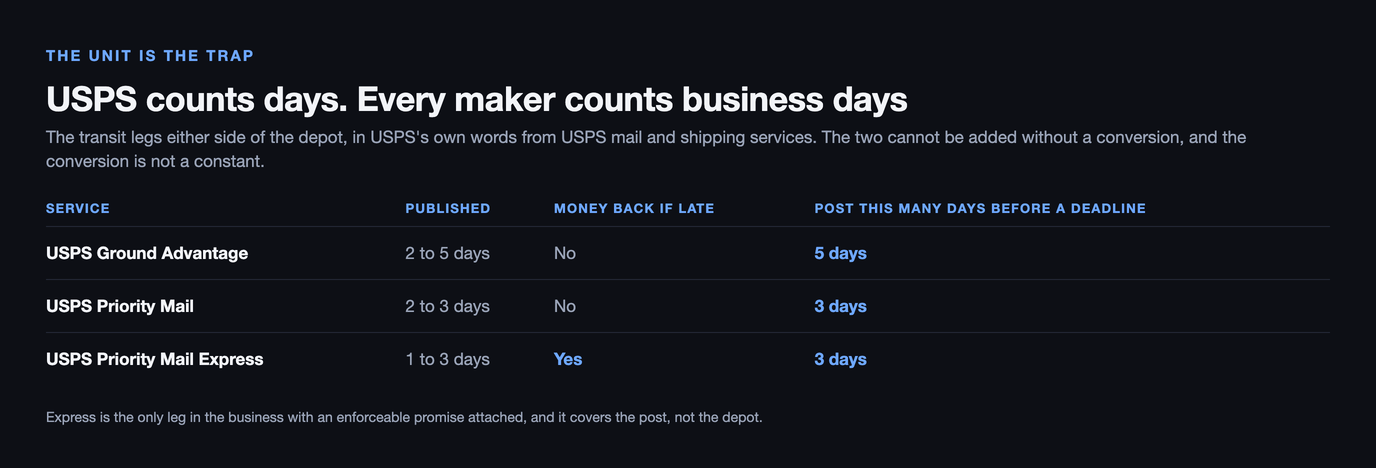
One detail deserves its own section, because it is where a plausible-looking sum goes wrong. Every maker that commits to a window counts in business days. USPS counts in plain days — its wording for the cheapest service is “Low rates for packages with expected delivery in 2-5 days”, with no qualifier. The two cannot be added without a conversion, and the conversion is not a constant.
| Service | Published | Money back if late | Post this many days before a deadline |
|---|---|---|---|
| USPS Ground Advantage | 2 to 5 days | No | 5 days |
| USPS Priority Mail | 2 to 3 days | No | 3 days |
| USPS Priority Mail Express | 1 to 3 days | Yes | 3 days |
7 business days starting on a Monday is 9 days on a calendar; the same figure starting on a Friday is 11 days. So 7-10 business days is anywhere from 9 days to 14 days of waiting, decided by the weekday your parcel lands on. We quote both ends rather than a midpoint, because a midpoint here is a fiction.
The one way to skip the wait, and what it freezes
There is a way out of the depot leg, and exactly one maker in our read offers it. Mushkin runs an advance replacement: the new part ships before the broken one arrives, so the only wait is the inbound post. The other 7 do not mention such a thing, and it is the one thing neither document we read for the kit article would promise.
It is not free, though nothing is charged. “The "hold" on your credit or debit card will be for the FULL VALUE of the product being cross-shipped to you.” The release is conditional and clearly stated: “The amount held on your card will be released once the defective product is received.” Shipping in is still yours, and the programme is bounded to the US and Canada only — USPS 1st class at home, FEDEX International Economy across the border.
So the choice between waiting and cross-shipping is not really about time. It is whether you would rather be short a part for 19 days or short the cash for the length of the inbound post. For a machine earning money the second is usually cheaper; for a spare desktop, obviously the first.
What the hold costs on our own shelf today
Both branches are priced by the same number: what the part costs now. That is the one figure here we measure ourselves rather than read, so here is our own tracked shelf as it stands at the moment you loaded this page — new retail listings only, latest observed price.
| Part | Price today | The hold | Cover spent in 19 days |
|---|---|---|---|
| Crucial Pro DDR5-5600 64GB (2x32GB) (64 GB) | $1299.77 | $1299.77 | $13.52 (1.04%) |
| Kingston Fury Beast DDR5-5200 32GB (2x16GB) (32 GB) | $804.94 | $804.94 | $8.37 (1.04%) |
| Samsung 990 Pro 4TB NVMe Gen4 SSD (4000 GB) | $764.99 | $764.99 | $7.96 (1.04%) |
| G.Skill Trident Z5 Neo DDR5-6000 CL30 32GB (2x16GB) (32 GB) | $709.99 | $709.99 | $7.39 (1.04%) |
The dearest part we track lists at $1299.77 — the size of the hold a cross-ship on it would place — against a $497.90 median. The last column is the other half of the bill: a 19-day wait spends 1.04% of a 5-year warranty, or $13.52 of cover on that dearest part.
Those cover figures are small in cash terms, and that is the honest reading of them: a fortnight out of five years is a rounding error and we are not going to inflate it. The reason to put a number on it is that it is the one part of the wait you can never recover. With our tracked DDR5 observations spanning $16.53 to $25.15 per gigabyte, the part you send away and the part that comes back are rarely the same money.
The deadline that is yours is measured on arrival
The clock you control decides whether you are eligible at all, and the documents are far more specific about this one than about their own obligations. One of them measures it in a way that quietly takes the transit time out of your cover.
| Maker | The deadline | Measured on | Their words |
|---|---|---|---|
| Mushkin | The parcel must arrive before the warranty expires | Arrival | “All warranty returns must be received on or before the warranty expiration date.” |
| Silicon Power | Three days to report a wrong or short delivery | Submission | “Please note that we’re unable to process claims submitted after this timeframe.” |
| G.SKILL | Thirty days sends you to the retailer first | Submission | “during the first thirty (30) days after purchase” |
| G.SKILL | One year to answer a notification, or the parts are forfeit | Submission | “within one (1) year from the date of notification” |
| Lexar | Authorisation must be obtained inside the term | Unstated | “within the applicable warranty period” |
Mushkin is the one to plan around: “All warranty returns must be received on or before the warranty expiration date.” Not posted by, not authorised by — received. The slowest published transit for the cheapest service is 5 days, so a part whose term ends inside a week needs to be in the post today, or on a faster service: USPS Priority Mail Express is the only thing in this article that owes you anything if it is late.
The others are shorter than people expect, and not all about failure. Silicon Power gives three days from delivery to raise a quantity or specification problem, and is “unable to process claims submitted after this timeframe” — a clock running on a part you have not installed. G.SKILL sends you to the retailer for the first “thirty (30) days after purchase”, then holds you to “within one (1) year from the date of notification” before it stops being responsible for your parts.
The replacement does not restart the clock
One last piece of time, and the one most people get wrong: the part that comes back is not covered for a fresh term. All 3 documents that address it give the replacement what was left of the original, and 3 different answers to the follow-up — what happens when there is almost nothing left.
| Maker | Floor | What the replacement gets | Their words |
|---|---|---|---|
| Samsung | 90 days | Whatever is left, or 90 days, whichever is longer | “The warranty period for repaired and replaced products will be applied for the longest of the remainder of the origina…” |
| Mushkin | 30 days | Whatever is left, or 30 days, whichever is longer | “the balance of the applicable period of the original warranty, or thirty (30) days from the date of return shipment fr…” |
| Silicon Power | None | Whatever is left of the original term | “The new, refurbished or functionally equivalent product provided by SP under the Warranty Service will be warranted fo…” |
The 60 days between the published floors decides whether a part replaced in the last month of its term comes back with ninety days of cover, thirty, or none. Silicon Power is the one with no floor at all: its replacement is warranted “for the remainder of the original warranty period”, so a drive replaced two weeks before expiry is a new drive with two weeks of cover. Samsung’s “ninety (90) days” and Mushkin’s “thirty (30) days” exist to stop exactly that.
Put the three clocks together and the asymmetry is the finding. The owner is held to hard dates measured on arrival; the maker commits, in two cases out of 8, to a window it either hedges with “at least” or disowns as a non-guarantee; and the cover keeps running throughout. None of it is hidden — it is simply never printed on one page.
How to plan a claim in 2026, in five steps
None of this argues against claiming. It argues for filing with a calendar in front of you:
- Find the expiry date and work backwards. If the deadline is measured on arrival, subtract the slowest published transit — 5 days for the cheapest service, 3 days for the only guaranteed one.
- Ask for the window in writing before you post. 5 of 8 documents do not publish one, which does not mean support cannot give you one for your RMA.
- If a cross-ship exists, price the hold first. It is the replacement’s full value at today’s price — look that up before you authorise it, not after.
- Buy speed on the deadline leg, not the depot leg. Express postage moves the total by 2 days, but it is the only leg where lateness is refundable.
- Read the remedy clause before the box goes out. A wait that ends in a refund at what you paid is a different decision from one that ends in a part, and the remedy wording decides which.
Related reading
FAQ
How long does a RAM or SSD warranty claim take?
11 to 19 days door to door, on the only maker-published path that runs end to end: USPS Ground Advantage's "2-5 days" for the parcel you post, plus G.SKILL's "7-10 business days for processing and shipping after the receipt of defective product(s)" — 9 to 14 calendar days. No maker publishes the total; each owns only its own leg. Read 2026-11-11.
Do manufacturers guarantee a warranty turnaround time?
No. Of the 8 documents we read, 5 state no service time at all, G.SKILL hedges its window with "at least", and AMP states that "These response times are service objectives and do not constitute a contractual guarantee or Service Level Agreement." The only guaranteed leg is the postage: USPS Priority Mail Express carries a money-back guarantee; no maker's repair does.
What is an advance replacement or cross-ship RMA?
The maker ships the replacement before your broken part arrives, so the only wait is the inbound post. Mushkin is the one maker in our read offering it, in the US and Canada only, by USPS 1st class domestically. The other 7 do not mention such a programme.
How big is the hold for an advance replacement?
The full value of the part being sent to you, at today's price. Mushkin: "The 'hold' on your credit or debit card will be for the FULL VALUE of the product being cross-shipped to you", released "once the defective product is received". There is no permanent charge, but in a risen market the hold reflects what the replacement lists for now rather than what you paid; our tracked DDR5 observations currently span $16.53-$25.15 per gigabyte.
Does the warranty clock pause while my part is being repaired?
Not in any document we read. The term runs from the original purchase or manufacture date and keeps running while the part is at the depot, so the wait comes out of cover you already bought: on a 5-year term, 19 days is 1.04% of it.
Does a replacement part get a new warranty?
No. All 3 documents that address it give the replacement the remainder of the original term, differing only in the floor beneath it: Samsung "the longest of the remainder of the original warranty period or ninety (90) days", Mushkin "thirty (30) days from the date of return shipment ... whichever period is longer", and Silicon Power no floor at all — a 60-day spread on one question.
What if my warranty expires while the parcel is in transit?
That depends how the maker measures its deadline, and at least one measures it on arrival. Mushkin: "All warranty returns must be received on or before the warranty expiration date." The slowest published transit for the cheapest service is 5 days, so a part whose term ends inside a week should go out today or on a faster service. Posting on the last day is not enough where the clause says "received".
Is it faster to claim through the retailer or the manufacturer?
Early on, the retailer — G.SKILL directs claims to the original point of purchase "during the first thirty (30) days after purchase". After that the manufacturer is the only route, and AMP's ladder warns that an investigation runs far longer than a swap: its final failure-analysis report sits at "Typically within 30 business days".
Know what the replacement costs before you authorise the hold
We track DDR5, DDR4 and NVMe listings at US retailers and tell you when one of yours moves. New retail stock only, no deal scores, no affiliate links, no commission on anything you buy — observed prices, dated, with the sample size printed next to them. A cross-ship hold is quoted at the market’s price, so it is worth knowing what that is first.