Warranty Claim Cost in 2026: What You Pay, and What You Get Back
- All 4 makers we read put the trip in on you. The warranty claim cost for a 1 lb parcel to zone 4 is $14.60 all-in, and $24.35 for a 2 lb kit coast to coast — postage from the USPS retail price list effective October 4, 2026.
- The cheapest flat rate is the one you are not allowed to use. G.SKILL’s RMA policy says “DO NOT use standard mailing envelopes”, which rules out the $13.90 Flat Rate Envelope and makes the $14.65 Small Flat Rate Box the real floor.
- The expensive half is not the freight — it is the basis. The makers we read publish 3 different things a refund can be measured against, and Samsung publishes two of them on one page: market value for internal SSDs, purchase price for memory cards.
- Under a purchase-price basis, the breakeven is the postage. A 2 lb zone-4 claim costs $18.00, so any part bought for less than that returns less than it costs to claim. A $20 module nets $2.00 — on a part the shelf now prices at $200.
A memory module fails eighteen months in, the warranty has years left on it, and the claim is free. Then you read the RMA page and discover the warranty claim cost is yours: the postage in, the insurance on it, and a packaging rule that disqualifies the cheapest box in the post office. That is the bill everyone expects to be small, and at $14.60 to $24.35 it mostly is. The bill nobody reads for is the second one — what the maker is permitted to hand back — and in a year when DRAM has run away from its own price history, that one can cost more than the part. We read four makers’ RMA and warranty documents and the USPS retail price list on November 9, 2026, and priced both bills instead of describing them.

A warranty claim has two bills, and only one is obvious
Every page we found on this subject answers one question: who pays the postage. The answer is almost always you, and the two article-shaped pages ranking for it contain, between them, no dollar figures at all.
But postage is a fixed cost in the teens. What decides whether a claim was worth making is the remedy: whether you get the part back, a different part, or money — and if money, measured against what. The two bills pull in opposite directions. Freight makes a claim on a cheap part not worth filing. The basis makes a claim on an appreciated part not worth filing, which is the new one, and the one a price tracker is placed to notice.
Who pays which leg, in each maker’s own words
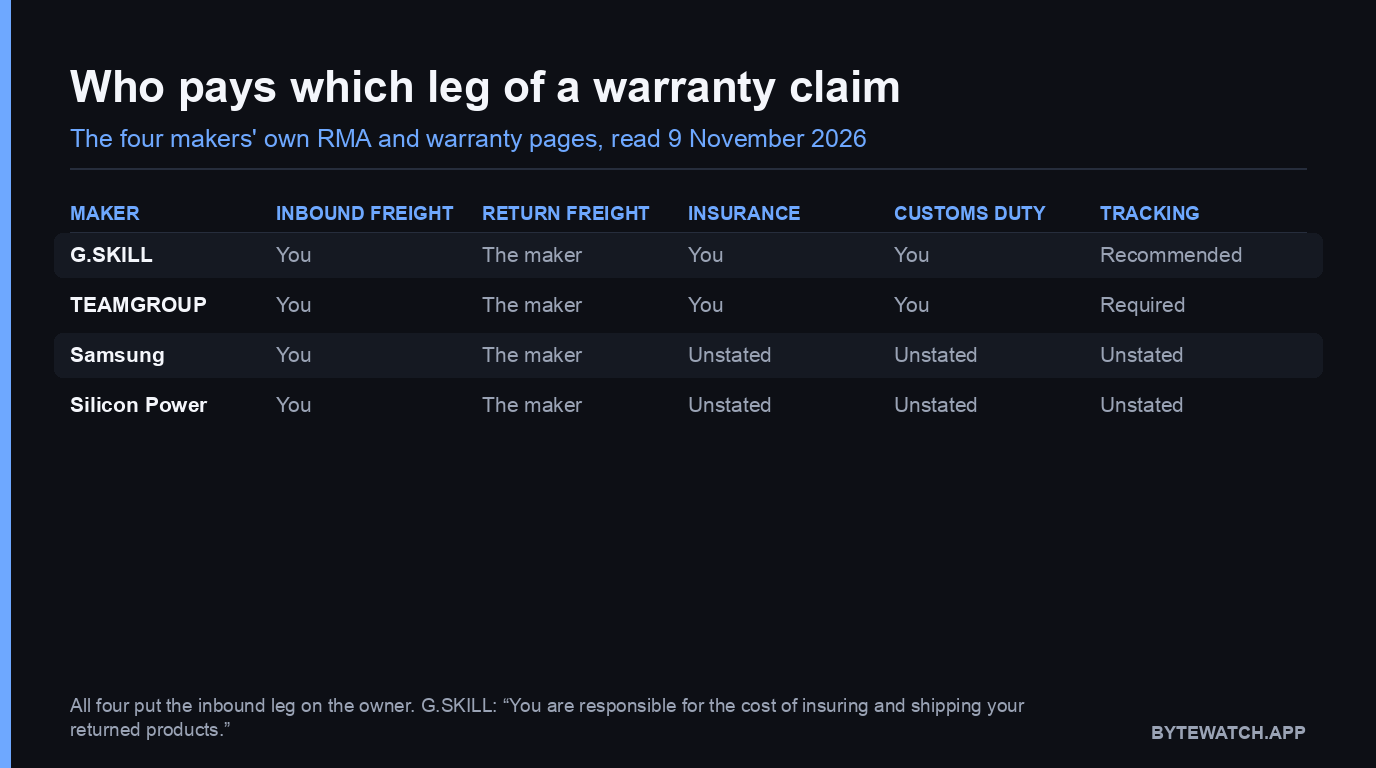
Four documents were readable from this machine tonight. All 4 of them put the inbound leg on the owner, and all four pay to send the replacement back — the split the whole industry runs on. 2 of the four go further and name the insurance as yours too.
| Maker | Send it in | Insure it | Duties | Replacement back | Tracking |
|---|---|---|---|---|---|
| G.SKILL | You | You | You | G.SKILL | recommended |
| TEAMGROUP | You | You | You | TEAMGROUP | required |
| Samsung | You | Unstated | Unstated | Samsung | unstated |
| Silicon Power | You | Unstated | Unstated | Silicon Power | unstated |
G.SKILL is the blunt one: “You are responsible for the cost of insuring and shipping your returned products”, followed by “G.SKILL is not responsible for any items damaged or lost in transit”. TEAMGROUP says it in one sentence — “Customers handle freight and insurance costs. Post-RMA, we cover return expenses, excluding local customs duty” — and is the only one of the four to require a tracked service rather than recommend it. Both also hand you the customs bill: a G.SKILL replacement ships from Taiwan or the Netherlands as often as from the US.
Two further clauses are worth more than the shipping line. A parcel arriving without a valid RMA number “will be returned at the sender’s expense”, so a claim filed in the wrong order costs the postage twice and returns nothing. And G.SKILL wants “all modules of a memory kit”, which is why the parcel priced below is often 2 lb rather than 1 — we costed what surrendering the working module is worth separately.
What the freight actually costs
Nobody publishes this, so here it is from the source. The USPS retail price list — Notice 123, effective October 4, 2026 — prices parcels by weight and zone, and an owner posting one module at a counter pays the retail column, not a commercial rate.
| Parcel | Zone 1 | Zone 4 | Zone 8 | Zone 1 to 8 |
|---|---|---|---|---|
| 1 lb, one module or one M.2 drive | $10.05 | $11.10 | $13.65 | 1.36× |
| 2 lb, a kit or a 2.5" drive | $11.30 | $13.50 | $19.80 | 1.75× |
| 1 lb, Priority Mail instead | $11.50 | $12.40 | $17.95 | 3.07× |
| 2 lb, Priority Mail instead | $12.45 | $14.85 | $22.55 | 3.49× |
A single module or an M.2 drive, boxed, lands in the 1 lb row at $10.05 across the state and $13.65 coast to coast — a spread of only 1.36×. Weight hurts more than distance: the 2 lb row opens $11.30 but reaches $19.80 at zone 8, a 1.75× spread. Priority Mail buys speed for roughly a dollar at the near end and four at the far end, and nothing in any warranty document asks for it.
One trap worth naming, because it is where the published tables bite: Priority Mail’s zone 9 is the offshore step, and it nearly doubles a 1 lb parcel to $35.25. If you are posting from Hawaii, Alaska or a territory, none of the figures above apply to you.
The insurance line, and why two makers ask for it
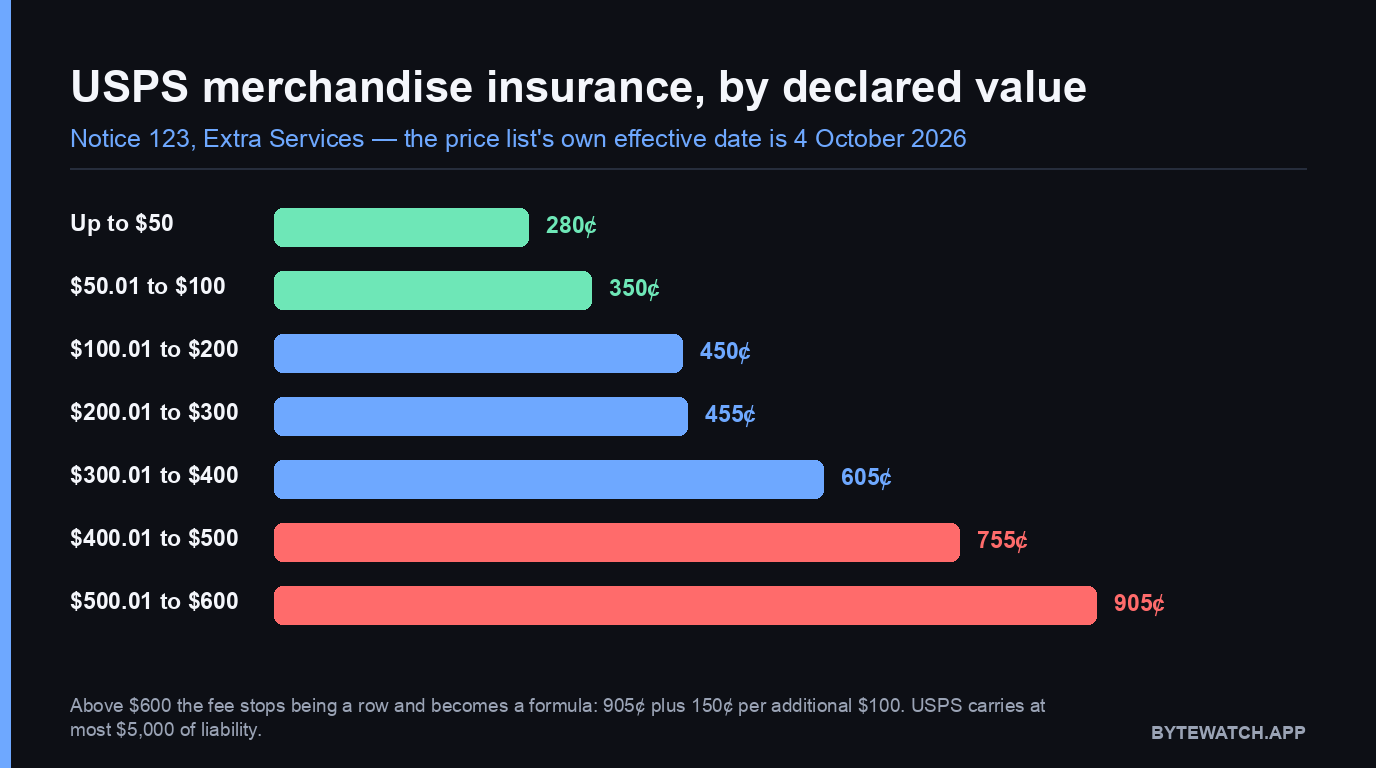
G.SKILL and TEAMGROUP both name insurance as the owner’s cost, and G.SKILL explains why in the next sentence: it accepts no liability for a parcel lost in transit. So an uninsured claim on a working-but-faulty part is a bet that the post never loses anything.
| Declared value | Fee | Fee as % of value |
|---|---|---|
| Up to $50.00 | $2.80 | 5.6% |
| Up to $100.00 | $3.50 | 3.5% |
| Up to $200.00 | $4.50 | 2.3% |
| Up to $300.00 | $4.55 | 1.5% |
| Up to $400.00 | $6.05 | 1.5% |
| Up to $600.00 | $9.05 | 1.5% |
| Over $600 | $9.05 + $1.50 per $100 | falls with value, capped at $5,000 liability |
The fee is a ladder, not a percentage, and it has one flat spot worth knowing. Declaring $200.00 costs $4.50 and declaring $300.00 costs $4.55 — five cents more for fifty per cent more cover. Then it steps hard: $400.00 costs $6.05 and $600.00 costs $9.05. Above $600 it becomes “$9.05 plus $1.50 per $100.00 or fraction thereof”, and or fraction thereof is doing real work — a declared value of $600.01 already costs $10.55. Liability stops at $5,000 whatever you declare.
The packaging rule that raises the floor
This is the clause that turns a postage table into a real cost, and it is in both the memory document and the storage one.
- G.SKILL: “DO NOT use standard mailing envelopes.” Parcels that appear inadequately packaged are refused and returned to the sender at the sender’s own expense, so the envelope costs the postage twice and returns nothing.
- Samsung: “Improperly packaged or shipped, including use of non-qualified shipping container” This sits in the list of warranty exclusions, beside a line saying products are inspected upon receipt — so the container can end the claim rather than delay it.
Read together they close off the cheap options. USPS sells a Flat Rate Envelope at $13.90 and a Small Flat Rate Box at $14.65, both flat-rate and both zone-independent — but every envelope in that list is a “standard mailing envelope”, so the $0.75 difference is not a choice. It is the price of the clause. And Samsung makes the stake higher than postage: “Improperly packaged or shipped, including use of non-qualified shipping container” sits in its list of warranty exclusions, next to “Products will be inspected upon receipt”. The wrong container does not delay that claim, it ends it.
The all-in warranty claim cost for one part
Postage plus insurance at the part’s own value, for the shapes a real claim takes. Packaging materials are deliberately absent: we could not read a dated box price tonight, so every figure here is a floor.
| Scenario | Postage | Insurance | All-in | Share of a $200 part |
|---|---|---|---|---|
| One module, nearby | $10.05 | $3.50 | $13.55 | 6.8% |
| One module, across the country | $13.65 | $3.50 | $17.15 | 8.6% |
| A kit, mid-haul | $13.50 | $4.50 | $18.00 | 9.0% |
| A kit, across the country | $19.80 | $4.55 | $24.35 | 12.2% |
| A kit, across the country, uninsured | $19.80 | none | $19.80 | 9.9% |
So the honest range for filing one claim is roughly $13.55 to $24.35, and it is almost entirely decided by weight and distance rather than by the value of what you are sending. That has a useful consequence: the cost is effectively fixed, so it falls as a share of the part the dearer the part gets. On a $200 part a mid-haul kit claim is 9.0%. On a $40 module it is the same dollars and a quarter of the value.
The second bill: what the refund is based on
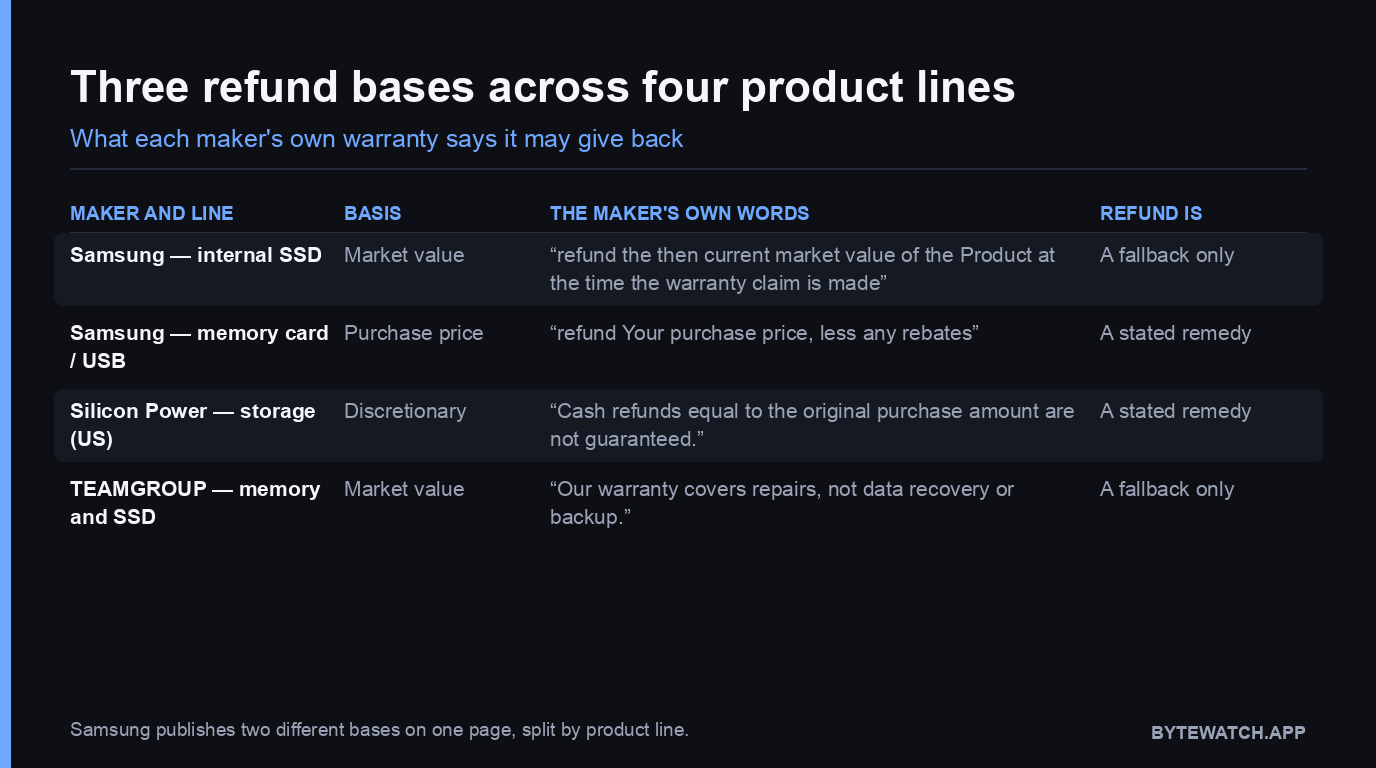
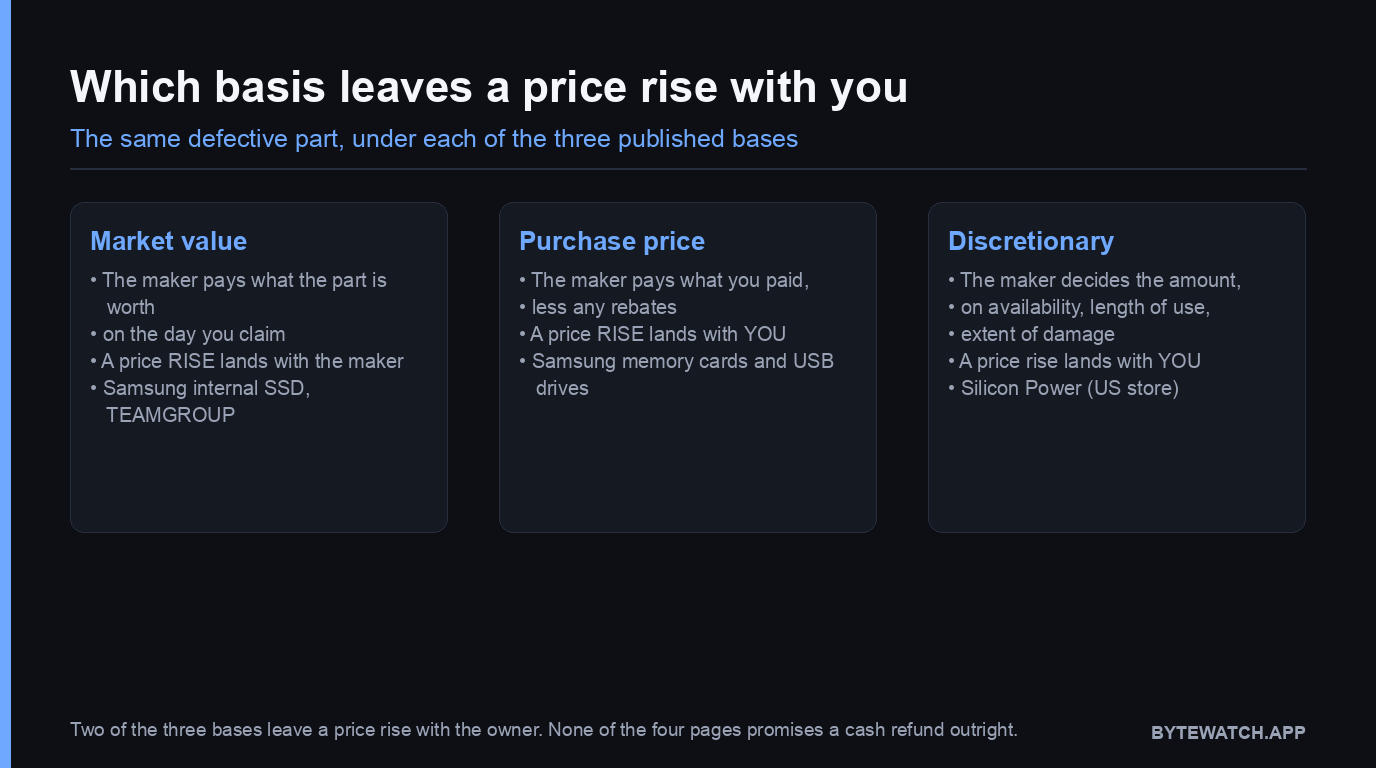
Now the half nobody writes about. Every one of these documents reserves the right to give you money instead of a part, and they do not measure the money the same way. Between the makers we read there are 3 distinct bases.
| Maker and line | Basis | A price rise is... | Cash is a fallback only |
|---|---|---|---|
| Samsung Internal SSD | Market value at claim | the maker’s problem | Yes |
| Samsung Memory card / USB flash drive | Original purchase price | yours | No — cash is an option outright |
| Silicon Power Storage products (US store) | Maker's discretion | yours | No — cash is an option outright |
| TEAMGROUP Memory and SSD | Market value at claim | the maker’s problem | Yes |
The find is that Samsung publishes two of them on a single page. For internal SSDs the clause reads “refund the then current market value of the Product at the time the warranty claim is made” — today’s price, so a rise is Samsung’s problem, and cash is explicitly the fallback only “if Samsung is unable to repair or replace”. Scroll down to the memory card and flash drive statement and the same remedy reads “refund Your purchase price, less any rebates”. Same manufacturer, same page, and in a rising market those are not the same number.
Silicon Power is the most explicit about discretion. Its published remedies are a replacement, a “full refund of the original purchase price” or a “partial refund of the original purchase price”, and the amount “shall be determined by us based on factors including, but not limited to, product availability, length of product use, the extent of damage”. It then says the part out loud: “Cash refunds equal to the original purchase amount are not guaranteed”. Note the first of those factors. Availability — the shortage itself — is written into the formula that sets your refund.
Why the basis stopped being academic
A purchase-price refund is a fair remedy in a market where parts get cheaper, which is the market memory and storage were in for thirty years. Buy a drive for $200, claim three years later when it is worth $90, take $200, and you are ahead. The basis was invisible because it was generous.
It is not that market now, and the evidence sits on the same page as the shipping clause. G.SKILL’s RMA policy carries its own notice: “DRAM prices are experiencing significant industry-wide volatility, due to severe global supply constraints and shortages, driven by unprecedented high demand from the AI industry.” It adds that its pricing “is subject to change without notice based on market conditions”. That is a manufacturer telling buyers, on its returns page, that the price of the thing they are returning is moving.
Flip the arithmetic and the cost is plain. If a part is worth $200 today and the market has risen 50% since you bought it, you paid about $133 — so a purchase-price refund is $66.67 short of replacing it, or 33.3% of the replacement, before a cent of postage. Note that the shortfall is 33.3% and not 50%: the rise has to be inverted, because today’s price is the number you know. We track why memory got expensive and what the chip headline does to shelf prices separately; what matters here is only that the arrow points up.
What this is worth on our own shelf tonight
The figures above are published rates and published clauses. Here is the freight bill set against parts we are actually tracking, which is the only part of this page that changes between visits.
| Part | Observed price | Claim costs | Share of the part | Observed |
|---|---|---|---|---|
| Crucial Pro DDR5-5600 64GB (2x32GB) Crucial · 64 GB | $1299.77 | $33.05 | 2.5% | Newegg Nov 19 |
| Kingston Fury Beast DDR5-5200 32GB (2x16GB) Kingston · 32 GB | $804.94 | $27.05 | 3.4% | Newegg Nov 16 |
| Samsung 990 Pro 4TB NVMe Gen4 SSD Samsung · 4000 GB | $764.99 | $25.55 | 3.3% | Newegg Nov 16 |
| G.Skill Trident Z5 Neo DDR5-6000 CL30 32GB (2x16GB) G.Skill · 32 GB | $709.99 | $25.55 | 3.6% | Newegg Nov 16 |
| G.Skill Trident Z5 RGB DDR5-6400 CL32 32GB (2x16GB) G.Skill · 32 GB | $679.99 | $24.05 | 3.5% | Newegg Nov 16 |
On the dearest row the freight is 2.5% of the part and easy to justify. On the cheapest priced row in the basket it is 9.8%, and that is the number that decides whether a claim is worth filing at all — before anyone asks what the refund will be based on.
When the warranty claim cost exceeds what you get back
Put the two bills together and a decision rule falls out. Filing is worth it when what comes back is worth more than what it costs to send — and under a purchase-price basis, what comes back is measured against a price from the past.
| Paid | Market-value basis nets | Purchase-price basis nets | Purchase-price basis is short by |
|---|---|---|---|
| $15.00 | $182.00 | -$3.00 | $203.00 |
| $20.00 | $182.00 | $2.00 | $198.00 |
| $40.00 | $182.00 | $22.00 | $178.00 |
| $80.00 | $182.00 | $62.00 | $138.00 |
| $200.00 | $182.00 | $182.00 | $18.00 |
Read the third column top to bottom and note where it changes sign. The crossover is not a judgement call: it is exactly the all-in cost, so anything bought for less than $18.00 returns less than it costs to claim. The top row is negative — paying for the privilege of giving up a part the shelf prices at $200. One rung up, a $20 module nets $2.00. Under a market-value basis the same claim nets $182.00 and the decision is not close.
- Find the remedy clause, not the warranty length. Search the document for “market value” and “purchase price”. Those two phrases are worth more than the number of years.
- Check whether cash is a fallback or an option. 2 of the 4 lines we read offer money only when a replacement is impossible. The rest can simply choose it.
- Get the RMA number first. A parcel without one comes back at your expense, so the cheapest mistake here costs a whole postage.
- Box it, do not sleeve it. The $0.75 between an envelope and the smallest flat-rate box is the cheapest insurance on the page — for Samsung the container is an exclusion, not a preference.
- Price the replacement before you claim, not after. If the part has appreciated and the basis is the price you paid, the claim is a sale at an old price. Sometimes the right move is to keep the dead module as evidence and check what a kit costs today first.
None of this makes warranties worthless. All 4 makers pay the replacement’s way back, two of four measure the money against today’s price, and on any part over about $100 the freight is noise. It does mean the warranty is worth reading for its remedy rather than its term, because with our tracked DDR5 observations spanning $16.53 to $25.15 per gigabyte, the price you paid and the price today are rarely the same number.
Related reading
FAQ
Who pays shipping on a warranty claim?
You pay to send it in; the maker pays to send the replacement back. That split holds in all 4 documents we read on 2026-11-09. G.SKILL: "You are responsible for the cost of insuring and shipping your returned products." TEAMGROUP: "Customers handle freight and insurance costs. Post-RMA, we cover return expenses, excluding local customs duty."
How much does it cost to send a RAM kit or SSD back?
$14.60 for a 1 lb parcel to zone 4 insured at $100, and $24.35 for a 2 lb kit coast to coast insured at $300 — USPS retail prices from Notice 123, effective 2026-10-04, plus insurance. Packaging is extra, so treat both as a floor.
Can I just use a padded envelope to save money?
No. G.SKILL's RMA policy says "DO NOT use standard mailing envelopes", and inadequately packaged parcels are "refused and returned to the sender at the sender's expense". For Samsung the container is worse than a delay: "improperly packaged or shipped, including use of non-qualified shipping container" sits in its warranty exclusions. The cheapest flat rate you can use is the $14.65 Small Flat Rate Box.
Do I have to insure a warranty return?
Two of the four makers name it as your cost, and G.SKILL says why in the next sentence: it accepts no liability for items "damaged or lost in transit". USPS merchandise insurance is $2.80 up to $50 of declared value and $4.50 up to $200 — a few dollars against the whole value of the claim.
Will I get a replacement or a refund?
Either, at the maker's option, and they differ on which comes first. 2 of the 4 lines we read offer cash only when a replacement is impossible — Samsung's internal SSD clause refunds "if Samsung is unable to repair or replace". The rest can choose money outright.
Is a warranty refund based on what I paid or what the part is worth now?
It depends on the document, and it is the most expensive detail on this page. Samsung's internal SSD warranty refunds "the then current market value of the Product at the time the warranty claim is made"; its own memory card statement refunds "Your purchase price, less any rebates". Silicon Power sets the amount at its discretion on factors "including, but not limited to, product availability", and says "cash refunds equal to the original purchase amount are not guaranteed".
Why does the refund basis matter more in 2026?
Because prices rose, so a purchase-price refund quietly became worse than a replacement. G.SKILL publishes the reason on its own RMA page: "DRAM prices are experiencing significant industry-wide volatility, due to severe global supply constraints and shortages, driven by unprecedented high demand from the AI industry." On a part worth $200 after a 50% rise, a purchase-price refund is $66.67 short of replacing it; our tracked DDR5 observations span $16.53-$25.15 per gigabyte.
When is a warranty claim not worth filing?
Under a purchase-price basis, whenever you paid less than the claim costs — and the breakeven is exactly that cost. A 2 lb zone-4 claim is $18.00 all-in, so a part bought for $15 nets -$3.00 and one bought for $20 nets $2.00 — on a part the shelf now prices at $200. Under a market-value basis the same claim nets $182.00. Read the remedy clause before you pay for the box.
Know what the part is worth before you argue about the refund
We track DDR5, DDR4 and NVMe listings at US retailers and tell you when one of yours moves. New retail stock only, no deal scores, no affiliate links, no commission on anything you buy — observed prices, dated, with the sample size printed next to them. A refund clause that says “market value” is only as good as your evidence of the market.