SSD Warranty Terms in 2026: What a Claim Actually Pays
Key takeaways
- 3 of the 5 SSD warranties behind our tracked drives pay cash at the lower of what you paid and what it is worth — Crucial (Micron), Kingston and SK hynix all use that construction, which can never settle above what you paid.
- One of the five pays no cash at all — the WD and SanDisk policy makes repair or replacement your “exclusive remedy”, and 4 say the replacement may be a used unit.
- 3 of the five put the shipping on you — and one publishes a 20% restocking fee if the drive turns out not to be faulty.
- All 5 warranties die with the first owner — and the two that cover a factory-recertified drive give it 1 year instead of 5 years.
- 3 of the 7 drives we can price at both ends of the window cost more today than at the start of it — so a “whichever is lower” settlement pays $210.93 less than replacing them.
- What the five documents actually promise
- The cash remedy: three ways to say “the lower one”
- Why “whichever is lower” only costs you in a rising market
- What a claim costs before anything is replaced
- What your drive is worth today, on our own shelf
- Second-hand, recertified, and the authorised-channel line
- What voids it, in the vendors’ own lists
- How to read an SSD warranty in five steps
- Related reading
- FAQ
A five-year SSD warranty is part of what you pay for, and almost nobody reads the document that defines it. That matters more than usual in 2026: the drives we track have repriced fast enough that what a claim settles for — what you paid, or what the drive is worth the day you claim — are two different numbers, and three of the five documents behind our basket pick the smaller one on purpose. We read all five on Oct 22, 2026 from 5 vendor documents, quote the clauses rather than summarising them, and price them against our own observed retail prices. None of it is legal advice: the question is what the document promises, and what that promise is worth at today’s prices.
What the five documents actually promise
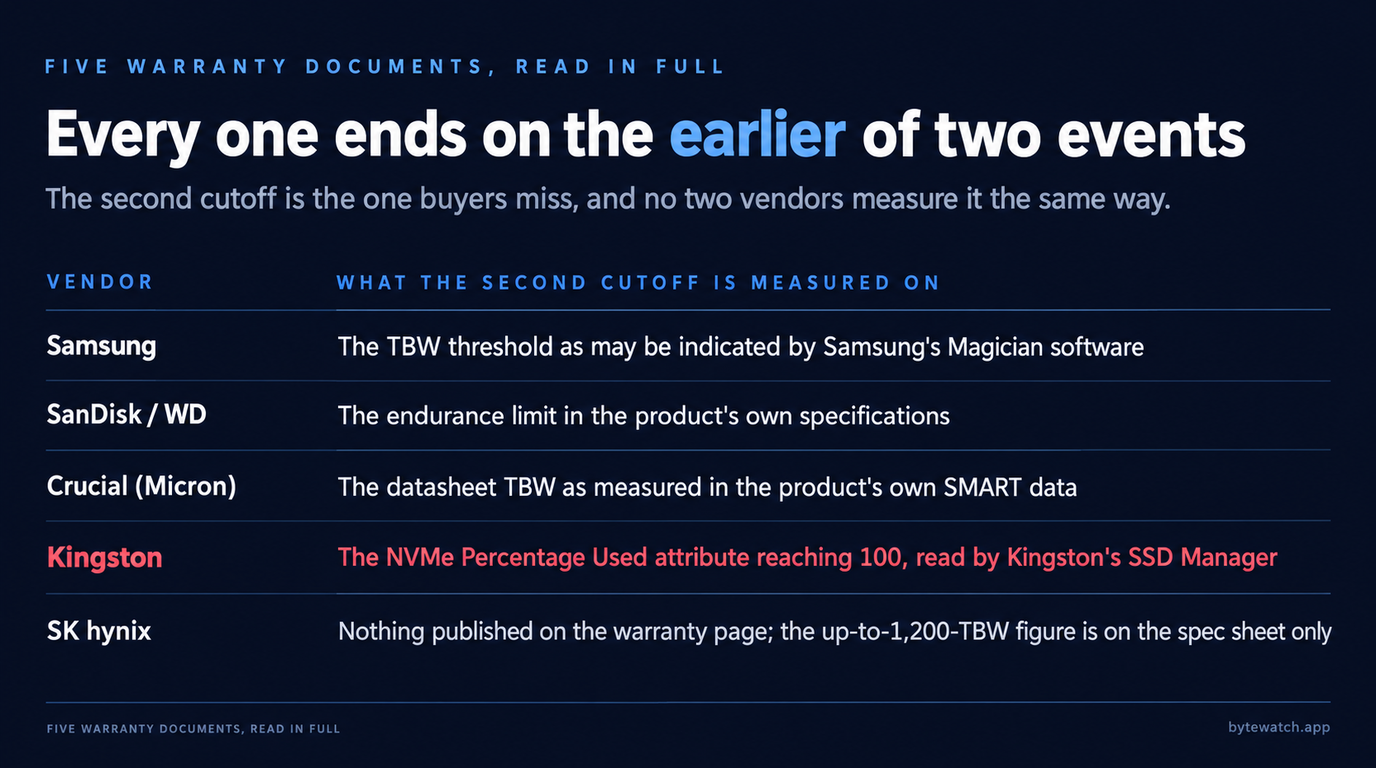
Every one of them warrants the drive against “defects in material and workmanship”, and every one ends on the earlier of two events: the term running out, or the drive passing a write limit. The second half is the one buyers miss, and the five vendors do not measure it the same way.
| Vendor | Cover ends on | The cutoff is measured by | Drives we track |
|---|---|---|---|
| Samsung | the shorter of the warranty period or the date the TBW threshold is exceeded | the TBW threshold “as may be indicated by SAMSUNG’s Magician software” | 2 |
| WD (SanDisk) | the earlier of the warranty term or the point the SSD “exceeds its endurance limit(s)” | the endurance limit in the product’s own specifications | 2 |
| Crucial (Micron) | three or five years from purchase, “or before writing the maximum total bytes written (TBW) … whichever comes first” | the datasheet TBW “as measured in the product’s SMART data”, defaulting to the datasheet version valid at purchase | 2 |
| Kingston | whichever happens first of five years from purchase or the drive reporting its wear limit | the NVMe “Percentage Used” health attribute reaching a normalized value of one hundred (100), read by Kingston’s own SSD Manager | 1 |
| SK hynix | five years from the original date of purchase, with no write ceiling stated | none published on the warranty page — the “up to 1,200 TBW” figure appears only on the product specification | 1 |
Two rows are worth stopping on. Kingston does not bound the KC3000 with the 1.6PBW figure on its datasheet at all: cover ends when the drive’s own “Percentage Used” attribute “reaches or exceeds a normalized value of one hundred (100)”, read with Kingston’s SSD Manager. And Crucial adds a clause nobody quotes: where a datasheet has been revised, “the warranty shall default to the version that was valid at time of purchase” — the ceiling on your drive is the one printed the week you bought it.
SK hynix is the outlier the other way: its warranty page states a five-year term and no write ceiling at all, the “up to 1,200 TBW” figure living only on the product specification. We priced those ceilings in the TBW article; here the question is what happens when you use one.
The cash remedy: three ways to say “the lower one”
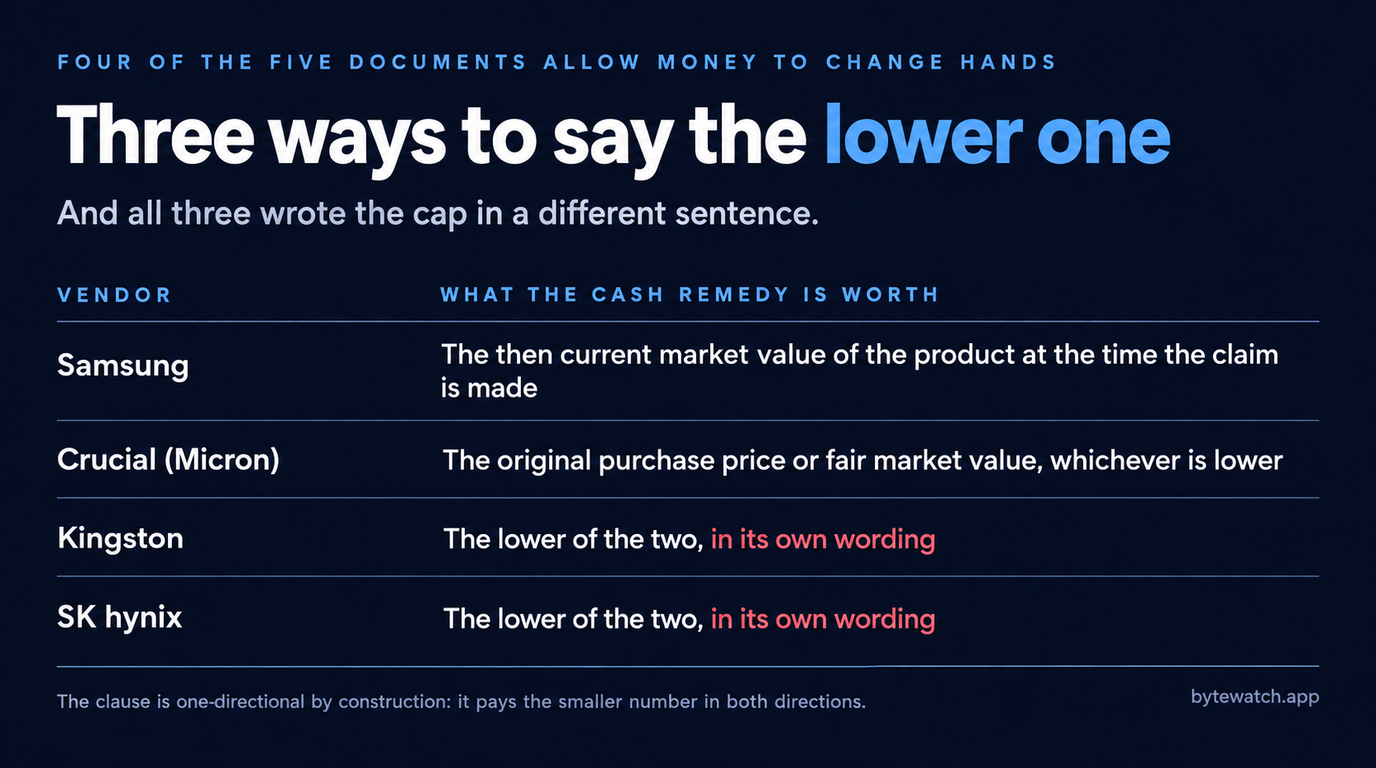
Four of the five documents allow money to change hands, and they are not the same offer. Samsung pays the market value at the time of the claim. Crucial, Kingston and SK hynix each cap the cash at the smaller of two figures — and all three wrote that cap in a different sentence.
| Vendor | Cash remedy pays | The clause |
|---|---|---|
| Samsung | what it is worth when you claim | “refund the then current market value of the Product at the time the warranty claim is made to SAMSUNG if SAMSUNG is unable to repair or replace the Product” |
| WD (SanDisk) | no cash remedy at all | exclusive remedy is repair or replacement |
| Crucial (Micron) | the lower of what you paid and what it is worth | “an in-store credit or refund of either the original purchase price or fair market value, whichever is lower” |
| Kingston | the lower of what you paid and what it is worth | “If Kingston is unable to repair or replace the product, it will refund or credit the lesser of either the current value of the product at the time the warranty claim is made or the purchase price” |
| SK hynix | the lower of what you paid and what it is worth | “In lieu of a Product repair or replacement, the original purchaser may receive a refund of either the original purchase price or the fair market value, whichever is lower” |
3 of 5 — Crucial (Micron), Kingston and SK hynix — settle at the lower of what you paid and what the drive is worth when you claim. Read it once and it sounds like anti-fraud boilerplate. Read it twice and notice which way it can move: never above your purchase price, never above the current value. You cannot profit from a failure, and you cannot be made whole in a market that has moved up.
Why “whichever is lower” only costs you in a rising market
Here is the sum the buying guides cannot do, because it needs dated prices. If a drive is cheaper today than when you bought it, the lower-of clause pays today’s price and you carry the depreciation. If it is dearer, the clause pays the old price and the gap to the replacement you have to buy is yours too. The clause is one-directional by construction.
| Drive | Window start | Window end | A lower-of claim pays | Gap |
|---|---|---|---|---|
| Kingston KC3000 2048GB | $353.65 | $499.00 | $353.65 | $145.35 short |
| WD Black SN850X 2TB | $328.30 | $374.92 | $328.30 | $46.62 short |
| Samsung 990 Pro 2TB | $389.99 | $408.95 | $389.99 | $18.96 short |
| Samsung 990 Pro 4TB | $798.90 | $796.50 | $796.50 | nothing |
| Crucial T500 2TB | $419.50 | $369.00 | $369.00 | nothing |
| SK hynix Platinum P41 2TB | $499.00 | $446.35 | $446.35 | nothing |
| Crucial P3 Plus 1TB | $227.00 | $187.46 | $187.46 | nothing |
3 of the 7 drives we can price at both ends are dearer now than at the window's start and 4 are not. Across the ones that rose, a lower-of settlement lands $210.93 below the cost of replacing them today. The widest single gap is the Kingston KC3000 2048GB: $145.35, or 29.1% of what the drive now costs, on a warranty written by Kingston.
What a claim costs before anything is replaced
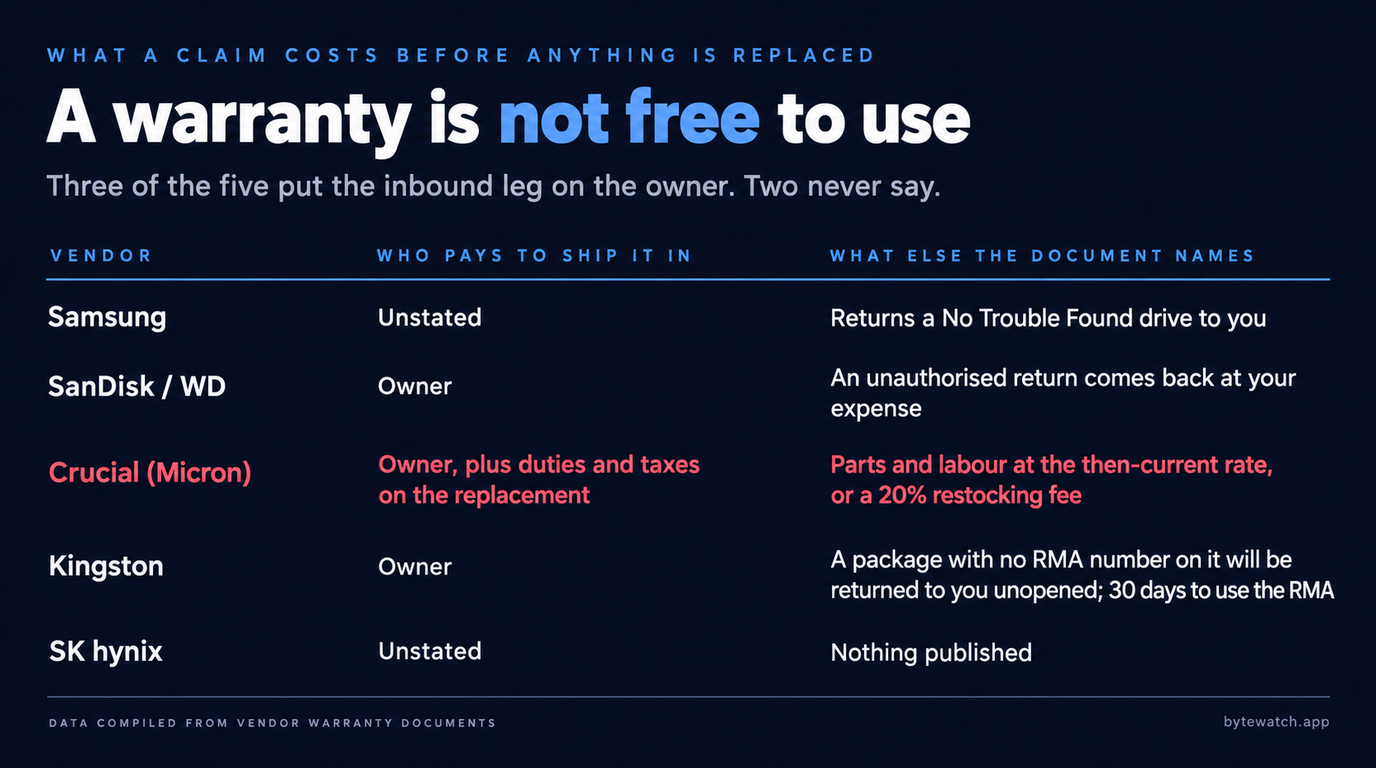
A warranty is not free to use. Three of the five say plainly that getting the drive to the service centre is your expense, one starts a 30-day clock the moment you have an RMA number, and one publishes a fee for the case where it finds nothing wrong.
| Vendor | Drive in | Drive back | If no defect is found | Deadline |
|---|---|---|---|---|
| Samsung | not stated | not stated | nothing published | none published |
| WD (SanDisk) | you | not stated | an unauthorised return comes back “at your expense” | none published |
| Crucial (Micron) | you | you | parts and labour at the “then-current labor rate”, or a 20% restocking fee | none published |
| Kingston | you | the vendor | a package with no RMA number on it “will be returned to you unopened” | 30 days after the RMA |
| SK hynix | not stated | the vendor | nothing published | none published |
WD (SanDisk), Crucial (Micron) and Kingston put the inbound leg on the owner — Kingston in as many words (“You are responsible for the cost of insuring and shipping your returned products”), with the return leg “shipped at Kingston’s expense”. Crucial charges you both ways in effect: the drive goes in “at your risk and expense” and you owe “any duties and taxes due on replacement product sent from Micron CPG”. Samsung, WD (SanDisk) and SK hynix set no shipping terms at all, which is not the same as free.
It is the only percentage fee in the five documents, and the clearest reason term length is a poor proxy for the quality of a warranty: two drives can both say “5 years” and only one can bill you for being wrong about a fault. The other 2 documents that publish anything here are softer — an unauthorised return comes back “at your expense” from SanDisk, and Kingston returns a package “to you unopened” if the RMA number is not on the outside.
What your drive is worth today, on our own shelf
Three of the five clauses turn on “fair market value” or “current value” and none says who measures it. We are not the arbiter of that figure; we do record what each drive sells for, dated, at a named US retailer.
| Drive | Cheapest in stock | Retailer | Observed | Warranty written by |
|---|---|---|---|---|
| Samsung 990 Pro 2TB | $408.95 | Newegg | Oct 27, 2026 | Samsung |
| Samsung 990 Pro 4TB | $796.50 | Newegg | Oct 27, 2026 | Samsung |
| WD Black SN850X 2TB | $374.92 | Newegg | Oct 20, 2026 | WD (SanDisk) |
| Crucial T500 2TB | $369.00 | Newegg | Oct 20, 2026 | Crucial (Micron) |
| Kingston KC3000 2048GB | $499.00 | Newegg | Oct 27, 2026 | Kingston |
| SK hynix Platinum P41 2TB | $446.35 | Newegg | Oct 20, 2026 | SK hynix |
| Crucial P3 Plus 1TB | $187.46 | Newegg | Oct 20, 2026 | Crucial (Micron) |
Keep the receipt: under three of these clauses the settlement is the lower of two numbers, and the only one you can evidence is what you paid. Samsung is blunt about the alternative — “In the event that a valid proof of purchase is not available, the limited warranty period will be determined by the date of manufacture”. A drive that sat in a warehouse for months has already spent part of your term.
Second-hand, recertified, and the authorised-channel line
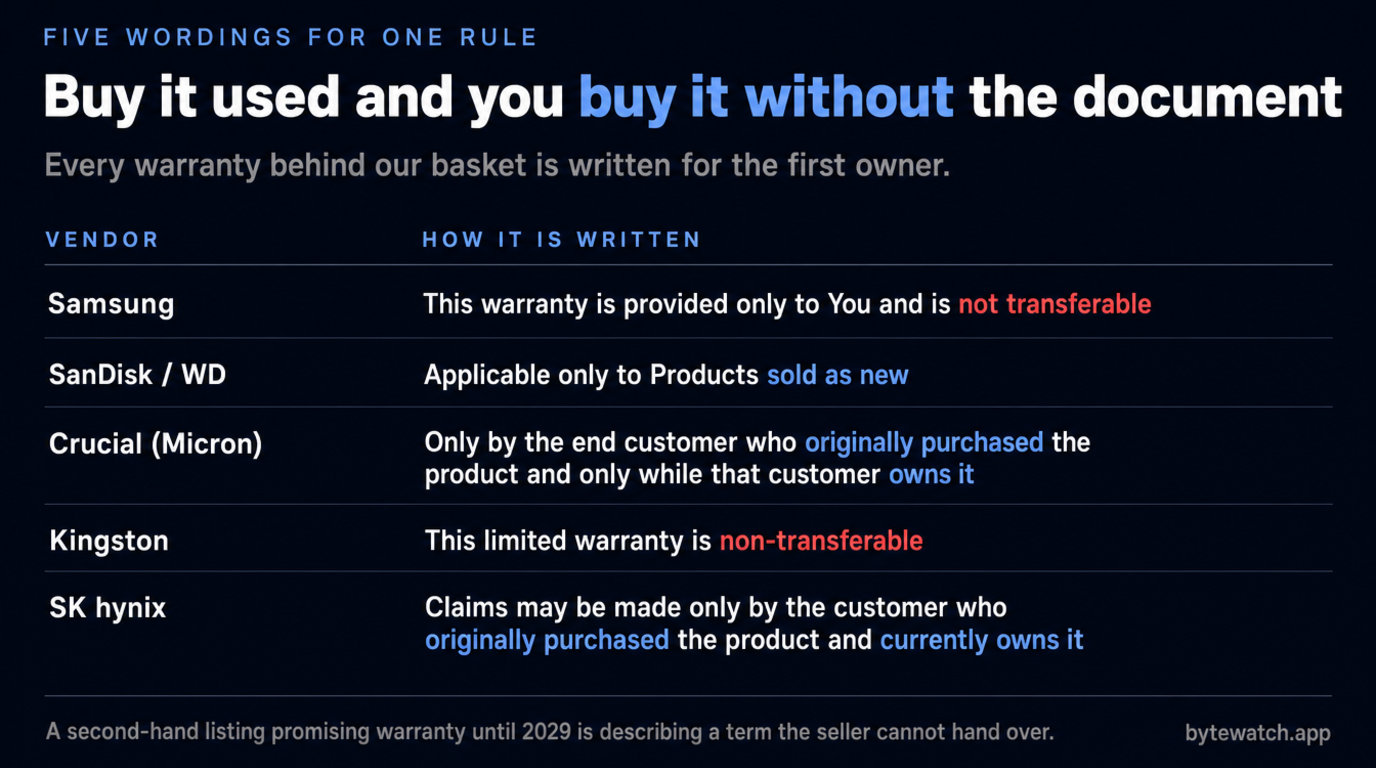
Buy used and you are buying the drive without the document. All 5 warranties behind our basket are written for the first owner, in five different wordings — so a second-hand listing promising “warranty until 2029” is describing a term the seller cannot hand over.
| Vendor | Who may claim | Recertified term |
|---|---|---|
| Samsung | “This warranty is provided only to You and is not transferable.” | none published |
| WD (SanDisk) | “This warranty … is applicable only to Products sold as new.” | 1 year of 5 — 20.0% of the new term |
| Crucial (Micron) | “may be made only by the end customer who originally purchased such product and only while such customer owns such product” | 1 year of 5 — 20.0% of the new term |
| Kingston | “This limited warranty is non-transferable.” | none published |
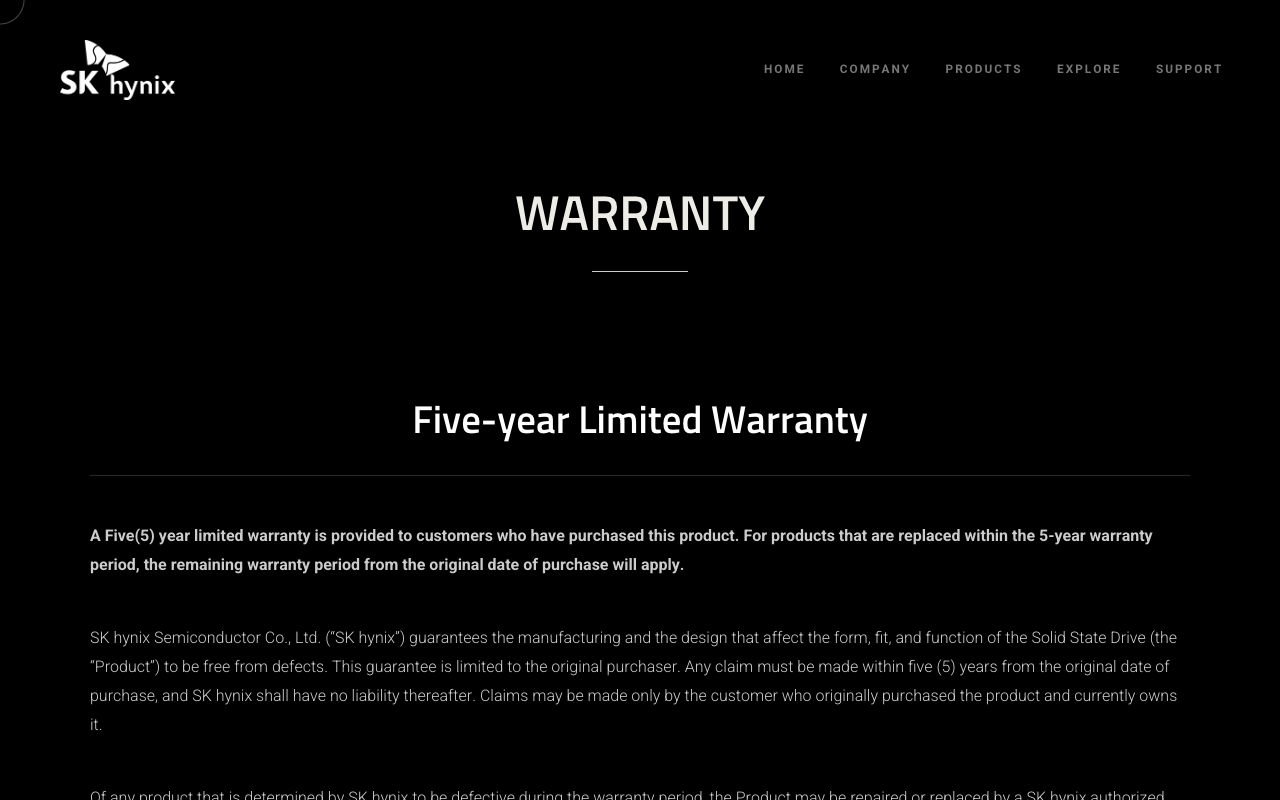
| SK hynix | “Claims may be made only by the customer who originally purchased the product and currently owns it.” | none published |
Kingston excludes the product rather than the claimant: its warranty does not apply to anything “that has been sold as second-hand”. SanDisk arrives from the other side — “applicable only to Products sold as new”. The two vendors publishing a term for a factory-recertified drive give it 1 year rather than 5: 20.0% of the cover, on hardware discounted by rarely 80.0%. That is the arithmetic the refurbished discount has to beat.
The channel condition catches new drives too: all 5 documents condition cover on where you bought it. Samsung’s is in capitals — “THIS LIMITED WARRANTY SHALL NOT APPLY TO ANY SAMSUNG PRODUCTS PURCHASED FROM UNAUTHORIZED RESELLERS OR RETAILERS” — and SK hynix adds a requirement we found nowhere else: the claimant must produce “a certificate of authenticity that was provided at the time of purchase”, failing which “SK hynix will not provide any warranty coverage”. It is the dull reason we quote only named US retailers.
What voids it, in the vendors’ own lists
The exclusion lists are more specific than the summaries of them. Samsung names an “opened SSD casing”, a “tampered or missing tape seal or serial number” and “removal of any SAMSUNG labels or barcodes”; SK hynix excludes “disassembly, manipulation or damage of labels, physical damage to the exterior, and damage to the connector pins”. SanDisk’s list is the longest, and one entry should change how you handle a failing drive: “No tape seal – (non-authorized data recovery sticker)”.
Which brings up the exclusion all five share: not one covers your data. Samsung does not cover “any costs and expenses relating to SSDs’ overhaul/assembly and data recovery”, SK hynix “shall not be liable for any loss of data stored on the Product”, and SanDisk states that “Data Recovery is not covered under this warranty”. The drive is not coming back either: “The returned Product for replacement service will not be sent back to You” is Samsung’s, and SK hynix takes the “ownership rights of the Product returned for exchange” outright.
How to read an SSD warranty in five steps
- Find the second cutoff. Each document ends on a term or a write limit — and Kingston’s limit is a SMART attribute you can read today, not the petabyte figure on the box.
- Find the word “lower” or “lesser”. It decides what a settlement is worth in a market that has moved, and it is in 3 of the 5 documents.
- Check who pays the postage. Three of five say you do; one adds duties and taxes; one charges 20% for a drive it finds no fault with.
- Check whether it is yours to claim. All five are first-owner only, two exclude second-hand hardware, and all five condition cover on an authorised channel.
- Keep the receipt, with a date and a price. It is the only input to the settlement you control — and without it, one vendor measures your term from the date of manufacture.
None of this makes a five-year warranty worthless. It makes it a contract with a cash value you can estimate before you buy — the same job as pricing the brand, done on the half of the product that only shows up when something breaks.
Related reading
FAQ
What does an SSD warranty actually cover?
Defects in material and workmanship, and nothing else. All five documents behind the drives we track cover hardware only: they exclude your data, physical damage, opened casings and tampered seals, and each caps liability at what you paid. Cover ends at the earlier of the term or a published write limit.
Does an SSD warranty pay out in cash?
Rarely, and never generously. Four of the five allow money: 3 pay the lower of your purchase price and the drive's current value, and the cash line usually triggers only when the vendor cannot repair or replace. The WD and SanDisk policy has no cash remedy at all — repair or replacement is your "exclusive remedy", from "new and serviceable used parts".
Is an SSD warranty transferable to a second owner?
No, on all five. Samsung writes "This warranty is provided only to You and is not transferable" and Kingston "This limited warranty is non-transferable"; Crucial and SK hynix restrict claims to the customer who bought the drive and still owns it. Kingston also excludes products "sold as second-hand" outright, and SanDisk's policy applies "only to Products sold as new". A factory-recertified drive gets its own, shorter term where one is published at all: 1 year rather than 5.
Who pays shipping on an SSD warranty claim?
You pay to send it in, under 3 of the five documents. Kingston states it plainly — "You are responsible for the cost of insuring and shipping your returned products" — then ships the replacement at its own expense. Crucial has you return the drive "at your risk and expense", plus duties and taxes on the replacement. Samsung and SK hynix set no shipping terms.
What happens if the manufacturer finds no fault with my drive?
Crucial (Micron) publishes the sharpest version: it reserves the right to charge either its then-current labour rate or a 20% restocking fee when the failure was not a defect. Samsung returns an NTF ("No Trouble Found") drive to you, Kingston returns a package unopened if the RMA number is not on the outside, and WD (SanDisk) sends an unauthorised return back "at your expense".
Does the TBW rating really end the warranty?
Yes, and the measurement differs by vendor. Samsung ends cover at the TBW threshold "as may be indicated by SAMSUNG's Magician software". Crucial uses the datasheet TBW "as measured in the product's SMART data", following the version valid when you bought it. Kingston ignores its datasheet figure: the cutoff is the NVMe "Percentage Used" attribute reaching 100 in its SSD Manager. SK hynix names no ceiling.
Does data recovery void an SSD warranty?
The documents do not cover data recovery, and they do penalise physical evidence of it. SanDisk's exclusion list includes "No tape seal – (non-authorized data recovery sticker)", and Samsung excludes an "opened SSD casing" and a "tampered or missing tape seal". Recovery costs are excluded outright by Samsung, SK hynix and SanDisk. What a vendor does with one drive is not something a price tracker can tell you — back up first. Our tracked NVMe cohort medians $0.199 a gigabyte from 7 SKUs.
Know what the drive is worth before you claim
We track NVMe, DDR5 and DDR4 listings at US retailers and tell you when one of yours moves. New retail stock only, no deal scores, no affiliate links, no commission on anything you buy — observed prices, dated, with the sample size printed next to them.