SSD TBW in 2026: What a Terabyte of Writes Actually Costs
Key takeaways
- An SSD TBW figure is the write ceiling on a warranty, not a forecast of how long a drive lasts — every vendor in our basket bounds it with the same clause, and the clause is “whichever comes first”.
- Exactly 6 of the 8 drives we track are rated at 600 TBW/TB of capacity — so for most of the shelf the endurance column is the capacity column with a different label on it.
- The cheapest and dearest drive we price are 32.1% apart per gigabyte and 177.1% apart per terabyte written — same shelf, same day. Dividing by the rating instead of the capacity widens the gap 5.52x.
- One figure covers 9 of the 14 2TB rows in Samsung’s own warranty table — 1,200 TBW — every NVMe model among them, and the only 2TB drive it rates higher is a SATA drive.
- Two of the 8 warranties behind these ratings are written by a vendor leaving the consumer market — Micron announced the Crucial exit on Dec 3, 2025 and promised to honour them anyway.
- What a TBW rating actually promises
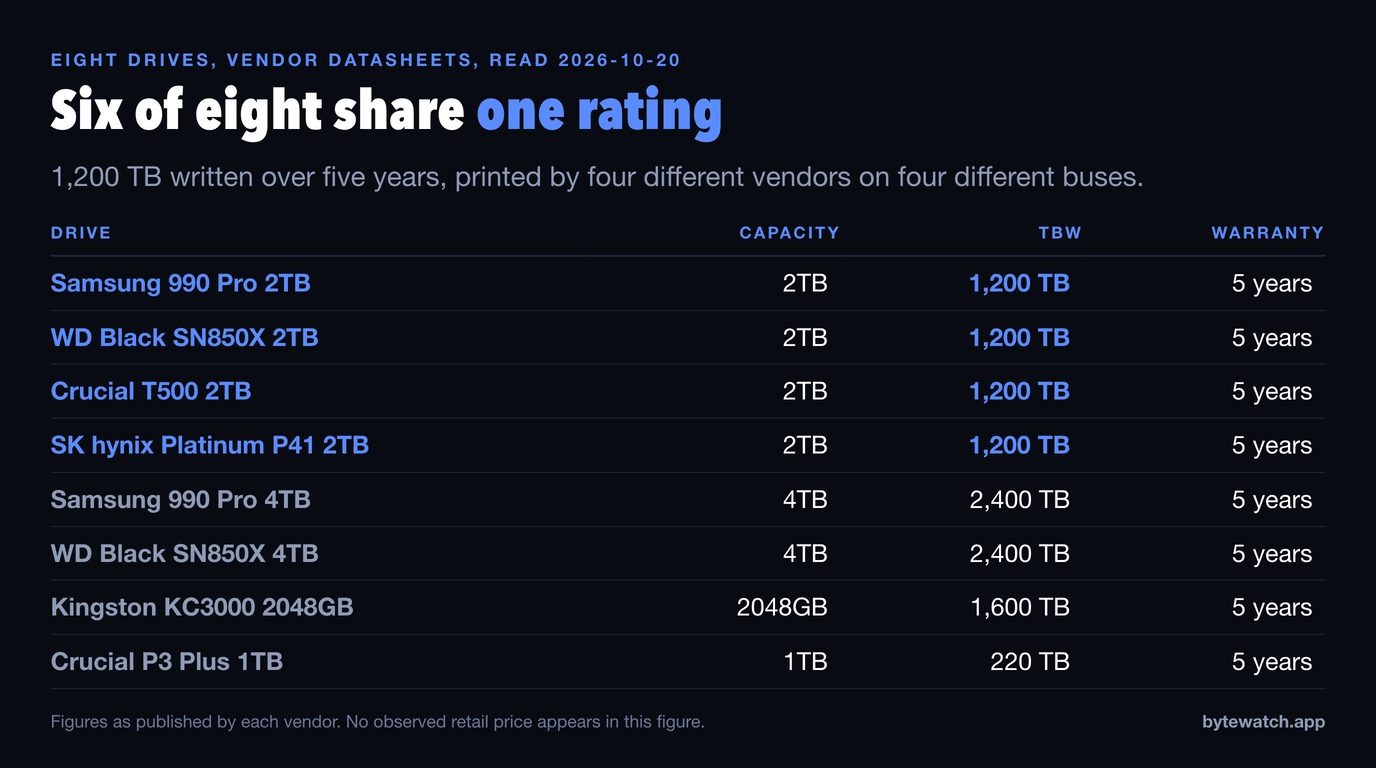
- Six of our eight drives share one rating
- What a terabyte written costs on our shelf
- What pricing endurance changes, and what it does not
- What you would have to write to use the rating up
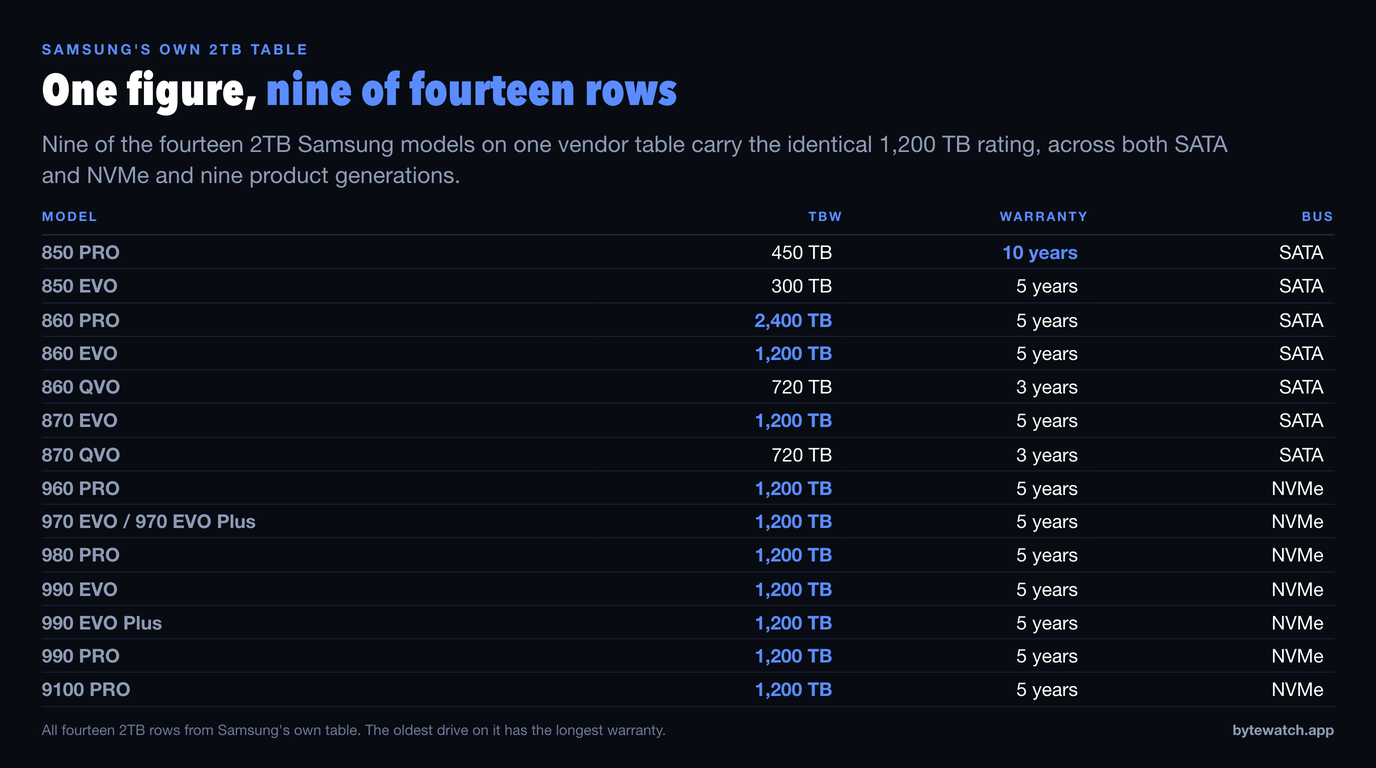
- Samsung's own table: one figure, nine rows
- Five vendors, five ways of printing one number
- A bigger drive is not rated harder
- Who is actually behind the promise
- How to read a TBW number in four steps
- Related reading
- FAQ
Every buying guide tells you to check the SSD TBW rating and none of them prices it. The drives on our own shelf are rated from 220 to 1,600 terabytes written — a span wide enough to look decisive — and nobody answers whether paying for the bigger number changes which drive you should buy. Every rating below was copied from the manufacturer’s own datasheet or warranty table on Oct 20, 2026; every price is a dated observation at a named US retailer; the two are divided into each other by code that ships with a test.
The short answer, before the tables: the Crucial P3 Plus 1TB and the Crucial T500 2TB cost 1.02x each other per gigabyte and 2.77x each other per terabyte written.
What a TBW rating actually promises
TBW stands for terabytes written. It is not a measurement of how long a drive survives, and no manufacturer claims it is: it is the point at which the warranty stops. Samsung puts it on the warranty table itself — coverage runs for “the stated time period or the TBW, whichever comes first”. Sandisk puts it in footnote six of the SN850X data sheet: “5 years or Max Endurance [TBW] limit, whichever occurs first”. Micron measures the ceiling off the drive’s own SMART counter.
So the number is not a physical property being disclosed to you; it is a liability being capped. A rating twice as large is a warranty that accepts twice as much writing before it expires — a real thing to buy, just not the thing most pages selling you a drive imply you are buying.
| Drive | As the vendor prints it | In TBW | Term | The vendor’s stated basis |
|---|---|---|---|---|
| Samsung 990 Pro 2TB | 5 years or 1,200 TB TBW | 1,200 | 5 years | endurance test results follow JEDEC JESD218 |
| Samsung 990 Pro 4TB | 5 years or 2,400 TB TBW | 2,400 | 5 years | endurance test results follow JEDEC JESD218 |
| WD Black SN850X 2TB | ENDURANCE [TBW] 1,200 | 1,200 | 5 years | calculated using JEDEC client workload JESD219 |
| WD Black SN850X 4TB | ENDURANCE [TBW] 2,400 | 2,400 | 5 years | calculated using JEDEC client workload JESD219 |
| Crucial T500 2TB | 1,200TB (TBW) | 1,200 | 5 years | measured in the product's own SMART data |
| Kingston KC3000 2048GB | 1.6PBW | 1,600 | 5 years | published as a capacity row in the datasheet, no method named |
| SK hynix Platinum P41 2TB | up to 1,200 TBW | 1,200 | 5 years | published as an "up to" figure, no method named |
| Crucial P3 Plus 1TB | 220TB (TBW) | 220 | 5 years | measured in the product's own SMART data |
Two things there are worth pausing on. Kingston publishes petabytes where everyone else publishes terabytes, so the KC3000 row reads 1.6PBW. And the basis column holds four different answers for one column of one spec sheet: Samsung names JEDEC JESD218, Sandisk the JEDEC client workload JESD219, Micron the drive’s own SMART data, and SK hynix hedges with “up to” and names nothing.
Six of our eight drives share one rating
Divide each rating by the capacity it rates and the spread collapses: 6 of our 8 tracked NVMe drives come out at exactly 600 TBW/TB — two Samsungs at two capacities, two Sandisks at two capacities, the Crucial T500 and the SK hynix P41. Four vendors, four controllers, four price points, one number.
| Rating per terabyte | Drives | Which |
|---|---|---|
| 600 TBW/TB | 6 of 8 | Samsung 990 Pro 2TB, Samsung 990 Pro 4TB, WD Black SN850X 2TB, WD Black SN850X 4TB, Crucial T500 2TB, SK hynix Platinum P41 2TB |
| 781.25 TBW/TB | 1 of 8 | Kingston KC3000 2048GB |
| 220 TBW/TB | 1 of 8 | Crucial P3 Plus 1TB |
Two drives sit outside that cluster, on opposite sides of it. The Kingston KC3000 2048GB is rated 781.25 TBW/TB; the Crucial P3 Plus 1TB is rated 220 TBW/TB, which is 3.55x below the top of the basket and the only figure far enough out to change an answer.
What a terabyte written costs on our shelf
Here is the sum nobody in the search results does: our cheapest recorded in-stock price per drive, divided once by capacity and once by the published rating. The prices render from our database when you load the page, so each date is when we recorded it — not when this article was written.
| Drive | Best price | Per GB | Per TBW | Retailer | Observed |
|---|---|---|---|---|---|
| Crucial T500 2TB | $369.00 | $0.184 | $0.307 | Newegg | Oct 20, 2026 |
| Kingston KC3000 2048GB | $499.00 | $0.244 | $0.312 | Newegg | Oct 27, 2026 |
| WD Black SN850X 2TB | $374.92 | $0.187 | $0.312 | Newegg | Oct 20, 2026 |
| Samsung 990 Pro 4TB | $796.50 | $0.199 | $0.332 | Newegg | Oct 27, 2026 |
| Samsung 990 Pro 2TB | $408.95 | $0.204 | $0.341 | Newegg | Oct 27, 2026 |
| SK hynix Platinum P41 2TB | $446.35 | $0.223 | $0.372 | Newegg | Oct 20, 2026 |
| Crucial P3 Plus 1TB | $187.46 | $0.187 | $0.852 | Newegg | Oct 20, 2026 |
On that reading the dearest gigabyte costs 32.1% more than the cheapest one — $0.244 against $0.184 — while the dearest written terabyte costs 177.1% more than the cheapest, $0.852 against $0.307. Same shelf, same day, same observations. The second spread is 5.52x the first. For reference, our whole tracked NVMe cohort medians $0.199 a gigabyte from 7 SKUs.
What pricing endurance changes, and what it does not
We ranked the same drives twice, once by cost per gigabyte and once by cost per terabyte written, and compared the two orders. This is the test that decides whether the endurance column is worth your attention or just worth a paragraph.
| Drive | Rank by $/GB | Rank by $/TBW | Move |
|---|---|---|---|
| Crucial T500 2TB | 1 | 1 | held |
| Kingston KC3000 2048GB | 7 | 2 | up 5 |
| WD Black SN850X 2TB | 2 | 3 | down 1 |
| Samsung 990 Pro 4TB | 4 | 4 | held |
| Samsung 990 Pro 2TB | 5 | 5 | held |
| SK hynix Platinum P41 2TB | 6 | 6 | held |
| Crucial P3 Plus 1TB | 3 | 7 | down 4 |
3 of the 7 priced drives change place, 4 hold, and the largest move is 5 places — Kingston KC3000 2048GB, Crucial P3 Plus 1TB and WD Black SN850X 2TB. Kingston KC3000 2048GB is the seventh-cheapest gigabyte on this shelf and the second-cheapest written terabyte. The movement is not noise: it is the drives outside the rating cluster changing places with the 5 inside it.
There is a happy accident on our shelf today worth naming, because it will not always hold: the cheapest gigabyte and the cheapest written terabyte are the same drive. The Crucial T500 2TB is first on both lists, at $0.184 a gigabyte and $0.307 a written terabyte. When the drive with the highest rating is also the cheapest, the endurance question answers itself and you can go back to reading the price.
What you would have to write to use the rating up
A ceiling you cannot reach is not a feature you are buying. So divide each rating by the term it is bounded by and read it as a daily allowance. All eight drives here quote five years, which makes this the cleanest comparison in the article: the term is a constant and only the rating moves.
| Drive | Rating | To use it all | Drive writes/day | Rating per TB |
|---|---|---|---|---|
| Kingston KC3000 2048GB | 1,600 TBW | 876 GB a day | 0.428 | 781.25 TBW/TB |
| Samsung 990 Pro 2TB | 1,200 TBW | 657 GB a day | 0.329 | 600 TBW/TB |
| Samsung 990 Pro 4TB | 2,400 TBW | 1,314 GB a day | 0.329 | 600 TBW/TB |
| WD Black SN850X 2TB | 1,200 TBW | 657 GB a day | 0.329 | 600 TBW/TB |
| WD Black SN850X 4TB | 2,400 TBW | 1,314 GB a day | 0.329 | 600 TBW/TB |
| Crucial T500 2TB | 1,200 TBW | 657 GB a day | 0.329 | 600 TBW/TB |
| SK hynix Platinum P41 2TB | 1,200 TBW | 657 GB a day | 0.329 | 600 TBW/TB |
| Crucial P3 Plus 1TB | 220 TBW | 120 GB a day | 0.120 | 220 TBW/TB |
The premium drives ask for 329 GB a day per terabyte of capacity, every day, for five years — 657 GB a day on a 2TB drive. Desktop use does not write a tenth of that, so on a 600 TBW/TB drive the five-year clock expires long before the write ceiling, and the rating is not the binding half of the warranty.
The budget drive is where that stops being true. Crucial P3 Plus 1TB allows 120 GB a day, which a nightly full-disk backup or a video scratch disk can genuinely spend. It is the one drive here where the rating rather than the calendar ends the cover — and the one the per-gigabyte ranking calls mid-table.
Samsung’s own table: one figure, nine rows
One more test, and it needs no basket of ours: Samsung publishes every consumer SSD warranty on one page, so the line can be read at a single capacity across a decade of parts. We took every 2TB row, because holding capacity fixed is the only way to see what the rating has done over time.
| Model | Bus | Rated TBW | Term | Against the modal figure |
|---|---|---|---|---|
| 850 PRO | SATA | 450 | 10 years | 0.38x — lower |
| 850 EVO | SATA | 300 | 5 years | 0.25x — lower |
| 860 PRO | SATA | 2,400 | 5 years | 2.00x — higher |
| 860 EVO | SATA | 1,200 | 5 years | the same |
| 860 QVO | SATA | 720 | 3 years | 0.60x — lower |
| 870 EVO | SATA | 1,200 | 5 years | the same |
| 870 QVO | SATA | 720 | 3 years | 0.60x — lower |
| 960 PRO | NVMe | 1,200 | 5 years | the same |
| 970 EVO / 970 EVO Plus | NVMe | 1,200 | 5 years | the same |
| 980 PRO | NVMe | 1,200 | 5 years | the same |
| 990 EVO | NVMe | 1,200 | 5 years | the same |
| 990 EVO Plus | NVMe | 1,200 | 5 years | the same |
| 990 PRO | NVMe | 1,200 | 5 years | the same |
| 9100 PRO | NVMe | 1,200 | 5 years | the same |
In that table, 9 of the 14 rows carry the identical 1,200 TBW figure, and every NVMe model in the table is one of them — from the 960 PRO through the 9100 PRO. Four controller generations, two NAND process shifts and a tripling of sequential read speed later, the rated endurance of a 2TB Samsung NVMe flagship is the number it was at the start.
The only 2TB row rated higher is the 860 PRO, a SATA drive, at 2.00x the flagship figure. And the longest term anywhere in that table belongs to the 850 PRO at 10 years: the oldest drive on the page, rated at a fraction of today’s TBW and covered for twice as long. The two dials trade against each other, and the TBW figure alone hides which one moved.
Five vendors, five ways of printing one number
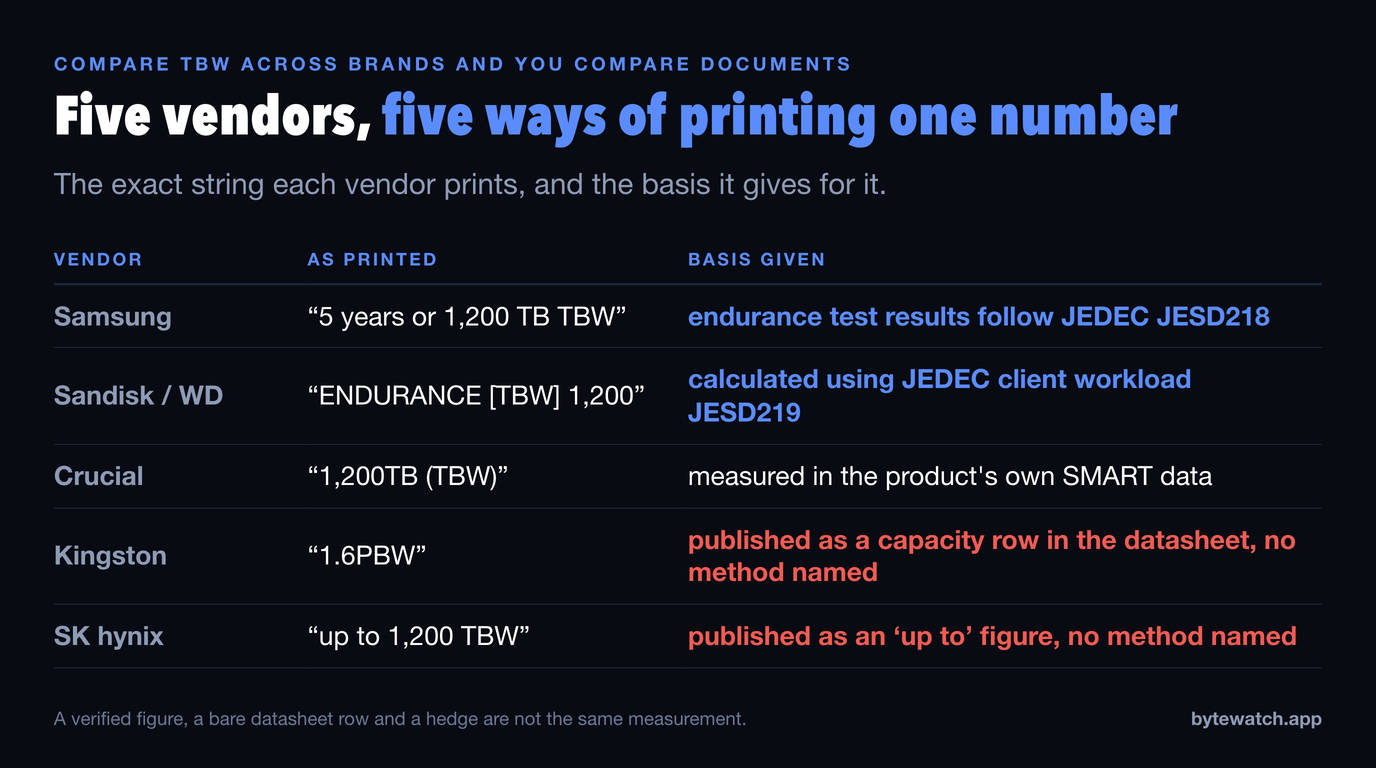
If you compare TBW figures across brands you are comparing documents, not measurements. Here is every vendor in our basket, with the exact string it prints and the basis it gives for it.
| Vendor | Printed as | Basis given | Document |
|---|---|---|---|
| Samsung | 5 years or 1,200 TB TBW | endurance test results follow JEDEC JESD218 | Samsung's SSD product warranty table |
| WD | ENDURANCE [TBW] 1,200 | calculated using JEDEC client workload JESD219 | the WD_BLACK SN850X data sheet, stamped July 2025 |
| Crucial | 1,200TB (TBW) | measured in the product's own SMART data | Micron's Crucial T500 product flyer |
| Kingston | 1.6PBW | published as a capacity row in the datasheet, no method named | the Kingston KC3000 datasheet |
| SK hynix | up to 1,200 TBW | published as an "up to" figure, no method named | SK hynix's Platinum P41 specification table |
None of this is careless: JESD218 is the endurance verification method and JESD219 the client workload it runs, so Samsung and Sandisk name two halves of one JEDEC framework. But a reader comparing “1,200 TBW” to “1.6PBW” to “up to 1,200 TBW” is comparing a verified figure, a bare datasheet row and a hedge. Treat the unqualified ones as the vendor’s intent rather than its measurement.
A bigger drive is not rated harder
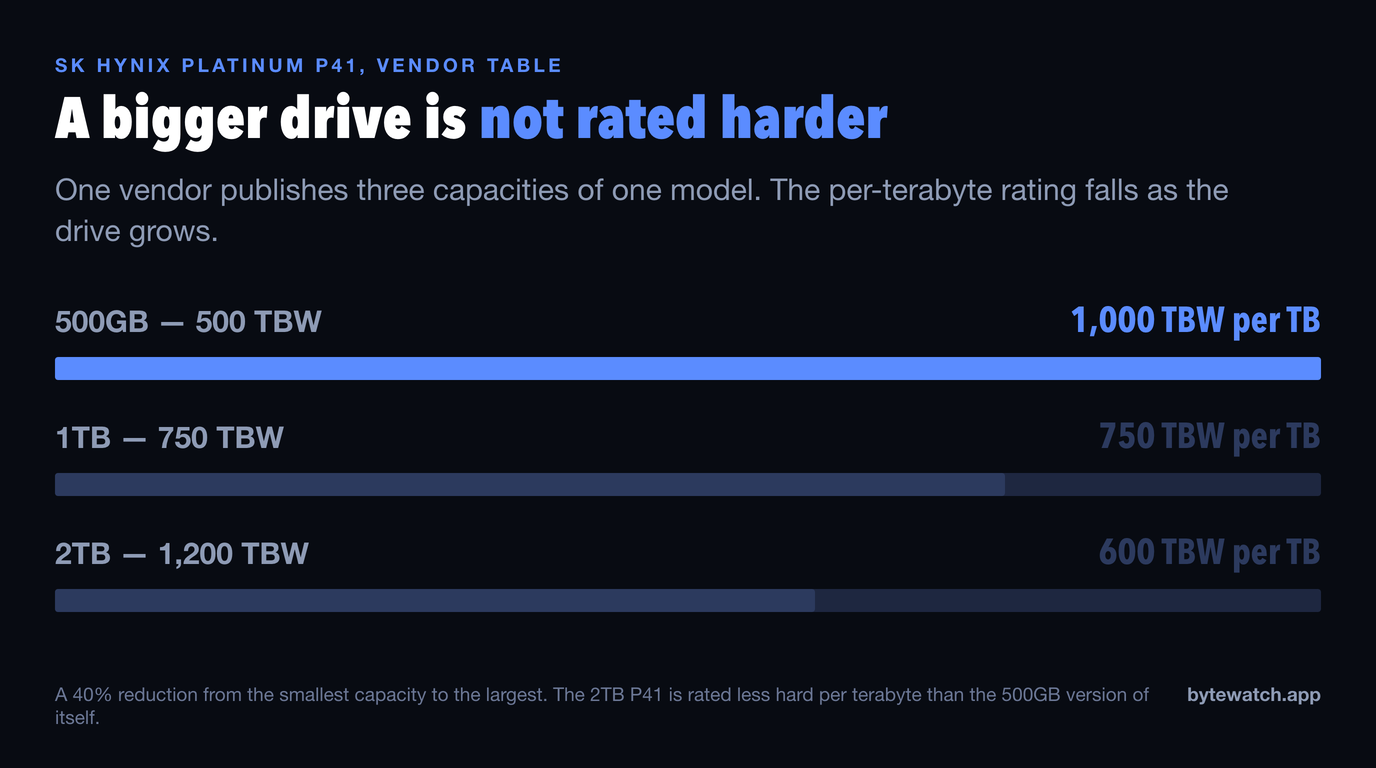
The common shorthand is that bigger drives get proportionally more endurance. Our own basket can neither confirm nor deny it: the Samsung and Sandisk pairs scale exactly linearly, 1,200 TBW at 2TB and 2,400 at 4TB, which is the same per-terabyte figure twice. One vendor does publish three capacities of one model, and it goes the other way.
| Capacity | Rated TBW | Rating per TB | Against the 500GB row |
|---|---|---|---|
| 500GB | 500 | 1,000 TBW/TB | the reference row |
| 1TB | 750 | 750 TBW/TB | 25.0% lower |
| 2TB | 1,200 | 600 TBW/TB | 40.0% lower |
On SK hynix's own table the per-terabyte rating falls as the drive grows — 1,000 TBW/TB at the smallest capacity down to 600 TBW/TB at the largest, a 40.0% reduction. The 2TB P41 we track is rated less hard per terabyte than the 500GB version of itself, so this is not a rule you can apply to a drive you have not looked up — the same point the per-capacity price curve makes about dollars.
Who is actually behind the promise
If the rating is a warranty term rather than a physical property, then it is worth exactly as much as the company writing it. Two of the 8 drives in this basket — Crucial T500 2TB and Crucial P3 Plus 1TB — carry a Crucial warranty, and Crucial is leaving.
We are not telling you a Crucial drive is a bad buy, and the pledge above is explicit. The narrower, checkable point: a TBW figure is the ceiling on a contract, so pricing one prices a counterparty as well as a component. No spec sheet carries that column — and it is worth knowing before the rest of the market reprices around it.

How to read a TBW number in four steps
- Divide it by the capacity. A 2,400 TBW 4TB drive and a 1,200 TBW 2TB drive are the same drive on this axis. Most of a shelf collapses into one number the moment you do this.
- Divide it by the term. If the daily allowance is larger than you could plausibly write, the clock expires first and the rating is not what you are buying.
- Check which document it came from. A verified JEDEC figure, a bare datasheet row and an “up to” are three different kinds of statement printed in the same column.
- Then price it. Only after the three steps above does cost per terabyte written mean anything — and on our shelf it usually agrees with cost per gigabyte, except where it violently does not.
It is short because the data is thinner than the buying guides imply. The honest answer to “how much TBW do I need” is: more than you will write, which nearly every current NVMe drive already provides. Spend the attention on the price and the warranty you can collect on instead.
Related reading
FAQ
What does TBW mean on an SSD?
TBW is terabytes written: the total volume of writes the manufacturer's warranty will accept before it expires. It is a contractual ceiling, not a prediction of failure. Samsung's warranty table bounds it with "the stated time period or the TBW, whichever comes first" and Sandisk's SN850X data sheet with "5 years or Max Endurance [TBW] limit, whichever occurs first" — same clause, two vendors.
How much TBW do I actually need?
Work from what you write, not from a recommended figure. A 1,200 TBW rating over its 5-year term is 657 gigabytes a day, every day — far more than desktop, gaming or office use produces. It binds only on low-rated drives: the Crucial P3 Plus 1TB allows 120 gigabytes a day, which a nightly full backup or a video scratch disk can spend.
Is a higher TBW rating worth paying for?
Rarely, on our basket: 6 of 8 drives are rated at the same 600 TBW per terabyte of capacity, so for most of the shelf cost per terabyte written is cost per gigabyte rescaled. The exception is the low-rated budget drive, where a modest premium per gigabyte becomes a very large one per terabyte written. Check the per-terabyte rating before paying for the headline number.
How do you calculate cost per terabyte written?
Divide the price you can actually pay by the published rating. A 300-dollar drive rated 1,200 TBW costs 0.250 dollars per terabyte written; the same 300 dollars on a 220 TBW drive costs 1.364. The only trap is using a list price or a capacity the vendor does not rate: we use the cheapest in-stock observation we recorded at a named retailer, and the rating for that exact part number. Our tracked NVMe cohort medians 0.199 dollars a gigabyte from 7 SKUs.
Why do two drives with different TBW ratings have the same endurance per gigabyte?
Because vendors scale the rating with capacity. A 2TB drive at 1,200 TBW and a 4TB drive at 2,400 TBW are both rated 600 TBW per terabyte, so the bigger figure buys you nothing per gigabyte stored. 9 of the 14 2TB rows in Samsung's own warranty table carry the identical 1,200 TBW number for this reason.
Do larger SSDs always get proportionally more TBW?
No. SK hynix's Platinum P41 table publishes 500 TBW at 500GB, 750 TBW at 1TB, 1200 TBW at 2TB — which is 1000, 750, 600 TBW per terabyte respectively. The per-terabyte rating falls as the drive gets bigger, so the shorthand that bigger drives are rated harder does not survive a look at one vendor's own table.
Does QLC flash get a lower TBW rating than TLC?
On the drives we track, by a wide margin: the Crucial P3 Plus 1TB is rated 220 TBW per terabyte against 600 for the TLC drives, and Samsung's own table rates its 2TB QVO lines at 720 TBW with a three-year term rather than 1,200 with five. These are published ratings, not a measurement of cell wear, which a price tracker cannot observe.
What happens to my warranty if the manufacturer stops selling consumer drives?
Micron announced its exit from the Crucial consumer business on December 3, 2025, with shipments running until the end of fiscal Q2 (February 2026), and said it "will provide continued warranty service and support for Crucial products". So the published pledge is that nothing changes. The general point stands regardless: a TBW figure is the ceiling on a contract, so it is worth what the counterparty behind it is worth, and no spec sheet carries that column.
Price the drive, not the spec sheet
We track NVMe, DDR5 and DDR4 listings at US retailers and tell you when one of yours moves. New retail stock only, no deal scores, no affiliate links, no commission on anything you buy — observed prices, dated, with the sample size printed next to them.