32GB vs 64GB RAM in 2026: What the Second 32 Gigabytes Actually Costs
Key takeaways
- Doubling a DDR5 kit from 32 GB to 64 GB costs $670.99 more than the cheapest 32 GB kit — +126.8% for twice the memory. Every figure on this page is an in-stock retailer observation with the date attached, and re-renders when the shelf moves.
- Two 32 GB kits are currently the cheaper route to 64 GB, and that is not how it is meant to work. On DDR5 the two totals sit $141.99 apart (11.8%). The configuration is cheaper; it is not necessarily better, and the last section says why.
- One route has stayed cheaper across our whole window. At the open, two 32 GB kits undercut one 64 GB kit by $75.57. The large kit has moved +15.9% since, against +10.2% for the small one.
- The socket moves more money than the capacity: the same 32 GB costs 2.20x on DDR5 as on DDR4. The 32-to-64 step on DDR4 is $343.89, against $670.99 on DDR5.
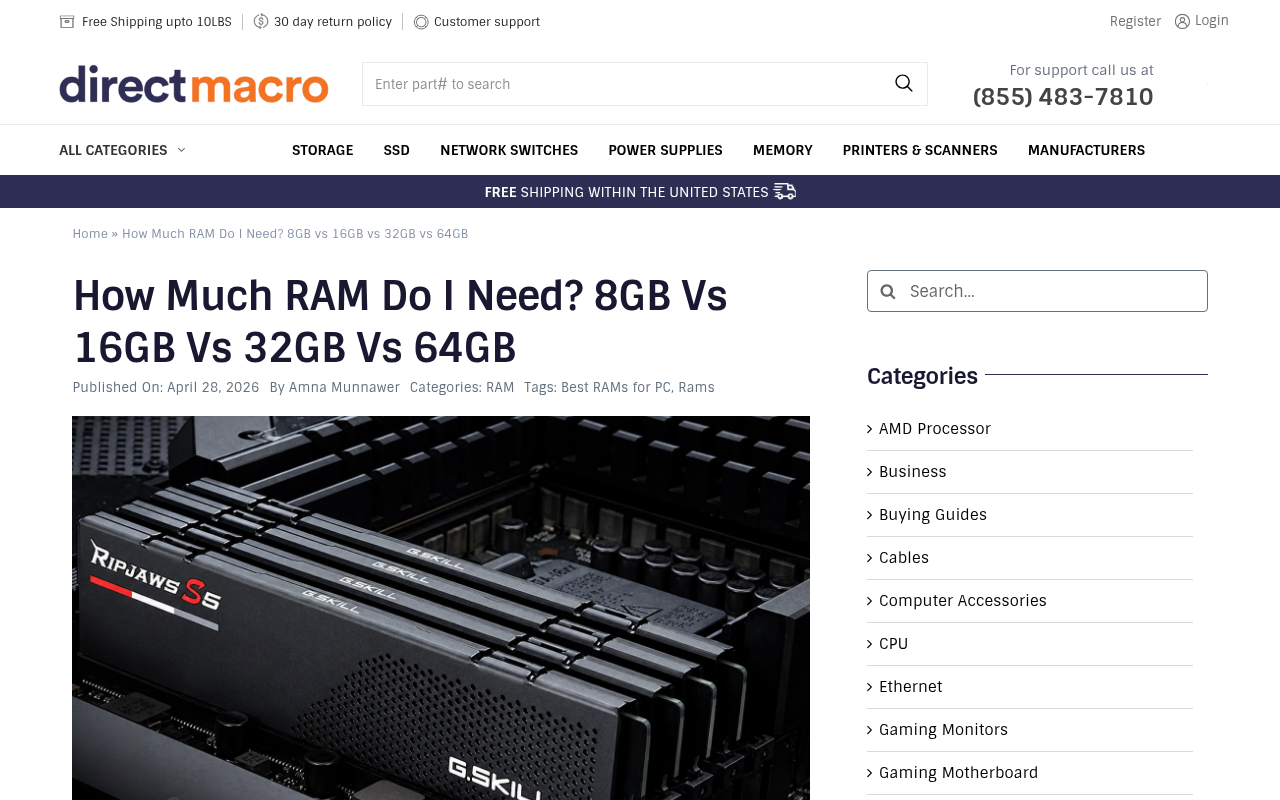
- Page one answers this question on workload and publishes no usable price. Four pages we read on 28 September 2026 total roughly 10,100 words and three data tables between them. The only dollar figure on any of them is “8 GB DDR5 RAM costs roughly $20–$35”, published 28 April 2026.
Every page answering 32GB vs 64GB RAM answers it on workload, and not one of the four ranking above us publishes a price you could act on. That was a forgivable omission when the step cost forty dollars. It is not one now: the second 32 gigabytes of DDR5 currently costs $670.99 on our own observations, which is +126.8% on top of the cheapest 32 GB kit we can find in stock, so the capacity question has quietly become a budget question and the advice in circulation has not noticed. This page prices it: what the step costs in cash and per gigabyte, whether one kit or two is the cheaper route, and how both answers have moved. We priced every kit in our basket at one retailer with a date on each figure, and read the four pages ranking above us to see what they charge the question with.
The longest of the four prices 8 GB of DDR5 at “roughly $20–$35”. Read at its most generous, that is 3.78x below the cheapest gigabyte of DDR5 we can find in stock. Start with the step itself.
32GB vs 64GB RAM: what the step actually costs
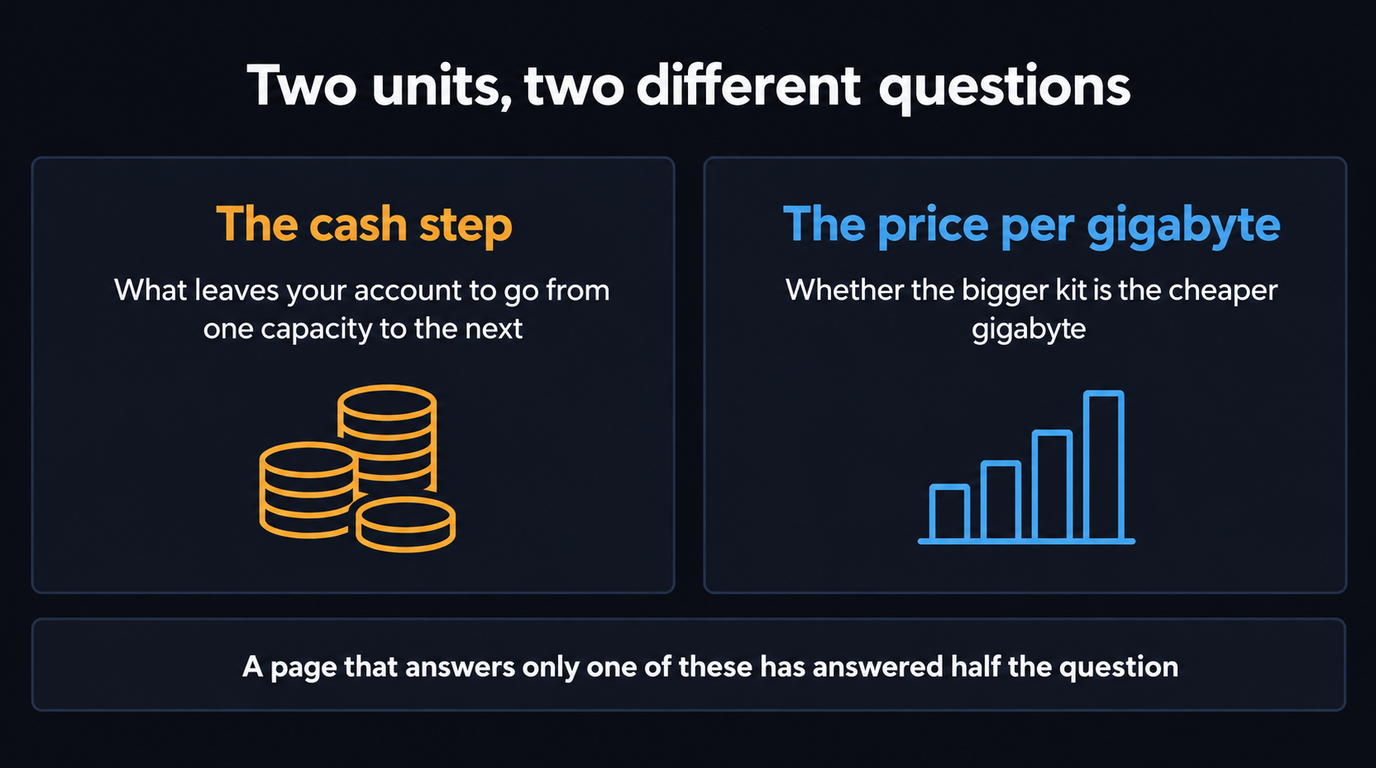
The comparison needs two units side by side, because they answer different questions. The cash step is what leaves your account. The per-gigabyte step says whether the larger kit is a bulk discount or a density premium — and on memory in 2026 it is not the discount the buying guides assume.
| Generation | Cheapest 32 GB | Cheapest 64 GB | Cash step | Step % | Per-GB step |
|---|---|---|---|---|---|
| DDR5 | G.Skill Flare X5 DDR5-6000 CL36 32GB (2x16GB) $529.00 · $16.53/GB · Newegg · Oct 20, 2026 · n=6 | Crucial Pro DDR5-5600 64GB (2x32GB) $1,199.99 · $18.75/GB · Newegg · Oct 20, 2026 · n=1 | $670.99 | +126.8% | +13.4% |
| DDR4 | G.Skill Ripjaws V DDR4-3600 CL18 32GB (2x16GB) $239.99 · $7.50/GB · Newegg · Oct 20, 2026 · n=3 | Crucial Pro DDR4-3200 64GB (2x32GB) $583.88 · $9.12/GB · Newegg · Oct 20, 2026 · n=1 | $343.89 | +143.3% | +21.6% |
Read the DDR5 row slowly. Twice the capacity costs +126.8%, not +100%, which means the larger kit carries a per-gigabyte penalty of +13.4% rather than a discount. The cheapest 32 GB kit we can see in stock is G.Skill Flare X5 DDR5-6000 CL36 32GB (2x16GB) at $529.00 ($16.53/GB, Oct 20, 2026), against Crucial Pro DDR5-5600 64GB (2x32GB) at $1,199.99 ($18.75/GB).
Two honest caveats before anything is built on it. Our 64 GB DDR5 cohort is one kit deep right now, so that row is a named observation rather than a band, and we print the count in the cell rather than dressing it as an average. The 32 GB side has 6 kits and a 32.3% spread between its cheapest and dearest, which is the larger uncertainty of the two. And a cheapest-to-cheapest step is the best case: want a specific kit and the number is larger.
One 64 GB kit, or two 32 GB kits
Both routes reach 64 gigabytes, so the difference between them is pure waste on one side or the other. It is also the half nobody on page one prices: the longest of the four gives the configuration advice (“buy two 16GB RAMs or four 8GB RAMs instead of one 32GB”) and attaches no cost to either option.
| Generation | One 64 GB kit | Two 32 GB kits | Difference | Cheaper route |
|---|---|---|---|---|
| DDR5 | $1,199.99 ($18.75/GB) | $1,058.00 ($16.53/GB) | $141.99 · 11.8% | Two 32 GB kits |
| DDR4 | $583.88 ($9.12/GB) | $479.98 ($7.50/GB) | $103.90 · 17.8% | Two 32 GB kits |
Two smaller kits winning is the wrong way round. A larger module is meant to be the cheaper gigabyte, because it is one PCB, one label and one line on the invoice. On DDR5 the pair comes in $141.99 under the single kit — 11.8% of the price — and on DDR4 the same comparison runs 17.8% the same way. The reason is worth stating precisely rather than guessed at: a 64 GB consumer kit is two 32 GB modules, and a 32 GB module needs roughly twice the die density of a 16 GB one.
That density is what the server market is bidding for. TrendForce, reporting on 22 September 2026, put the DRAM module market at $21.2 billion in 2025 on 59% year-on-year revenue growth, and named the mechanism directly: “This demand surge limited DRAM suppliers’ allocations for PC and consumer applications, leading to higher overall DRAM prices”, with module makers reprioritising toward server RDIMM products in the second half. That is their reporting on an allocation market, not our measurement of a shelf, and the two should not be added together. What we can say is that the shelf now prices the denser module above two sparser ones — the inverse of how capacity pricing normally works.
The answer changed hands inside our window
A configuration recommendation reads like a fact about hardware. It is a fact about prices, and prices moved. Both ends of the next table are anchored on parts still in stock today, so what changes across it is price rather than basket — the failure mode that makes most published price histories unusable.
| Generation | At the open | Cheaper then | Now | Cheaper now | Changed hands |
|---|---|---|---|---|---|
| DDR5 | $1,035.55 vs $959.98 (Aug 1 / Aug 1) | Two 32 GB kits, by $75.57 | $1,199.99 vs $1,058.00 (Oct 20, 2026 / Oct 20, 2026) | Two 32 GB kits, by $141.99 | No |
| DDR4 | $539.00 vs $413.20 (Aug 1 / Aug 1) | Two 32 GB kits, by $125.80 | $583.88 vs $479.98 (Oct 20, 2026 / Oct 20, 2026) | Two 32 GB kits, by $103.90 | No |
On DDR5 the same route has been cheaper at both ends of the window, by $75.57 then $141.99. That is a more comfortable result than the inversion we found in September, and it is still a fact about prices rather than about hardware — the large kit has moved +15.9% against +10.2% for the small one.
This is the most useful thing our data says here, and it is not a number: the answer has a shelf life. Any page telling you which configuration to buy without printing the two prices it compared and the day it compared them is describing a market that may no longer exist. Ours will go stale too — the difference is that this table re-renders, and prints the date it re-rendered on.
Is the bigger kit the cheaper gigabyte? Not on this basket
Sort every kit we track by the unit you actually pay in and the capacity ladder falls apart. Below is every memory kit with a live in-stock price, cheapest gigabyte first — and capacity is not what orders it.
| Kit | Generation | Capacity | Price | Per GB | Observed |
|---|---|---|---|---|---|
| G.Skill Ripjaws V DDR4-3600 CL18 32GB (2x16GB) | DDR4 | 32 GB | $239.99 | $7.50/GB | Newegg · Oct 20, 2026 |
| Corsair Vengeance LPX DDR4-3200 CL16 32GB (2x16GB) | DDR4 | 32 GB | $259.99 | $8.12/GB | Newegg · Oct 24, 2026 |
| Crucial Pro DDR4-3200 64GB (2x32GB) | DDR4 | 64 GB | $583.88 | $9.12/GB | Newegg · Oct 20, 2026 |
| Kingston Fury Beast DDR4-3200 32GB (2x16GB) | DDR4 | 32 GB | $319.99 | $10.00/GB | Newegg · Oct 27, 2026 |
| G.Skill Flare X5 DDR5-6000 CL36 32GB (2x16GB) | DDR5 | 32 GB | $529.00 | $16.53/GB | Newegg · Oct 20, 2026 |
| Kingston Fury Beast DDR5-6000 32GB (2x16GB) | DDR5 | 32 GB | $559.00 | $17.47/GB | Newegg · Oct 20, 2026 |
| Corsair Vengeance DDR5-6000 CL30 32GB (2x16GB) | DDR5 | 32 GB | $559.99 | $17.50/GB | Newegg · Oct 28, 2026 |
| Kingston Fury Beast DDR5-5200 32GB (2x16GB) | DDR5 | 32 GB | $599.99 | $18.75/GB | Newegg · Oct 27, 2026 |
| Crucial Pro DDR5-5600 64GB (2x32GB) | DDR5 | 64 GB | $1,199.99 | $18.75/GB | Newegg · Oct 20, 2026 |
| G.Skill Trident Z5 RGB DDR5-6400 CL32 32GB (2x16GB) | DDR5 | 32 GB | $659.99 | $20.62/GB | Newegg · Oct 27, 2026 |
| G.Skill Trident Z5 Neo DDR5-6000 CL30 32GB (2x16GB) | DDR5 | 32 GB | $699.99 | $21.87/GB | Newegg · Oct 27, 2026 |
Two things to take from the ordering. First, the spread inside one capacity is wider than the step between capacities — the 32 GB DDR5 band alone runs 32.3% from cheapest to dearest across 6 kits, against a 13.4% per-gigabyte step up to 64 GB. Choosing the right kit is worth more than choosing the right capacity, which is the opposite of how the question is usually framed. Second, the generations do not interleave: every DDR4 kit sits below every DDR5 kit on a per-gigabyte basis, whatever its capacity.
32GB vs 64GB RAM on DDR4: the socket moves more money
Almost every page on this question writes as though the reader were choosing capacity on a blank platform. Most are not: they have a board, the board takes one generation, and that fork was settled before capacity came into it. It is also the larger number.
| Capacity | Cheapest DDR4 | Cheapest DDR5 | Cash gap | DDR5 multiple |
|---|---|---|---|---|
| 32 GB | G.Skill Ripjaws V DDR4-3600 CL18 32GB (2x16GB) $239.99 · $7.50/GB | G.Skill Flare X5 DDR5-6000 CL36 32GB (2x16GB) $529.00 · $16.53/GB | $289.01 | 2.20x |
| 64 GB | Crucial Pro DDR4-3200 64GB (2x32GB) $583.88 · $9.12/GB | Crucial Pro DDR5-5600 64GB (2x32GB) $1,199.99 · $18.75/GB | $616.11 | 2.06x |
At 32 GB the newer generation costs 2.20x as much — $289.01 more for the identical capacity. At 64 GB the multiple narrows to 2.06x but the cash gap widens to $616.11. So $583.88 buys 64 GB of DDR4, while the same money buys one 32 GB DDR5 kit and change.
None of which means buy DDR4. It is a finished product line — we priced that market separately and its wafer allocation is being cut, so it is cheap on the way out, and the board caps the CPUs you can ever fit. Tom’s Hardware made the case for a 2026 DDR4 build and put the same condition on it: worth considering mainly if you already have memory to carry over. What the table does mean is that on DDR4, 64 GB is a much smaller decision than the DDR5 conversation implies — and on DDR5, 32 GB is a much larger one.
What page one recommends, priced
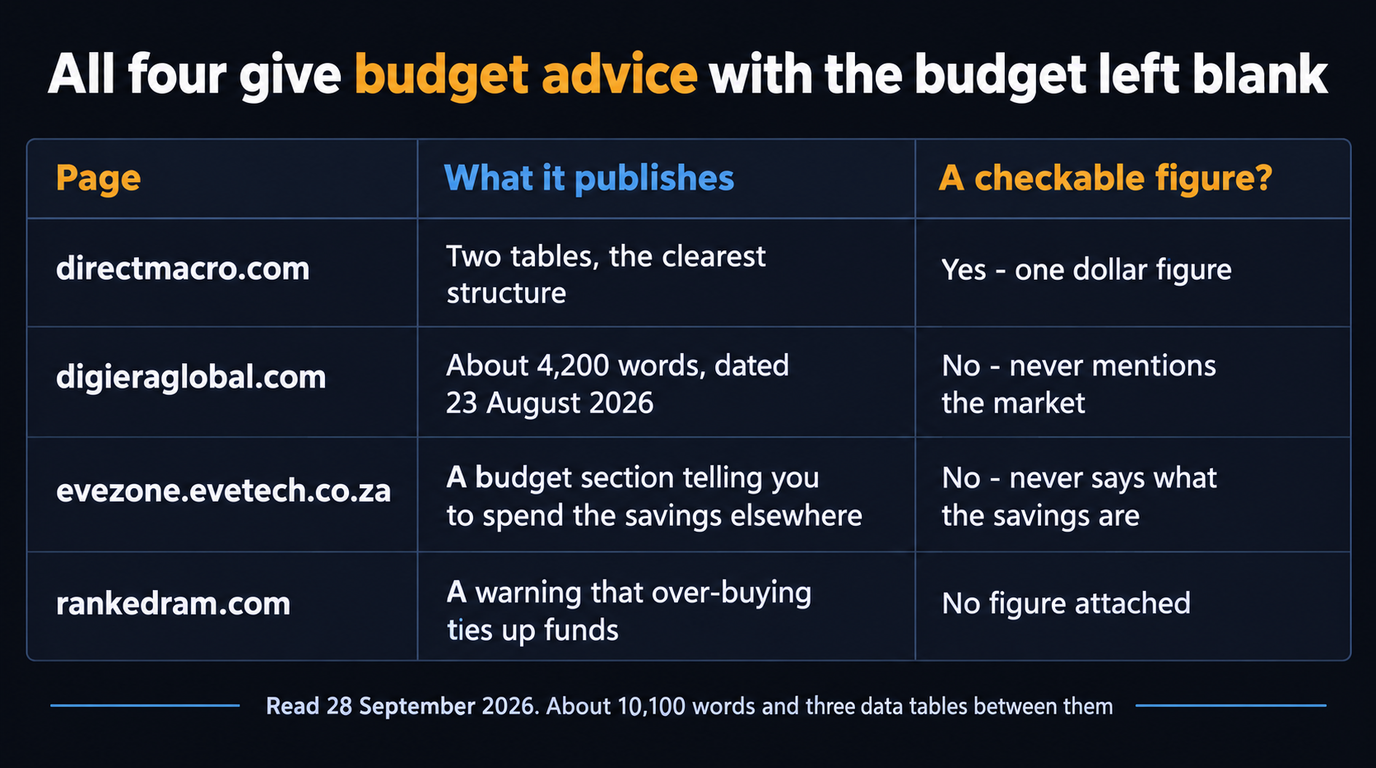
We read the four non-forum pages ranking for this question on 28 September 2026. All four returned 200 and all are real attempts at the topic. Between them they run about 10,100 words and three data tables. Here is every price any of them publishes.
| Page | Dated | Words | Tables | Prices published |
|---|---|---|---|---|
| directmacro.com | 28 Apr 2026 | ~3,500 | 2 | One: 8 GB DDR5 "roughly $20–$35" |
| digieraglobal.com | 23 Aug 2026 | ~4,200 | 0 | None, and no mention of the DRAM market |
| evezone.evetech.co.za | 22 Sep 2026 | ~1,300 | 0 | None — links products instead |
| rankedram.com | 1 Jun 2026 | ~1,100 | 1 | None |
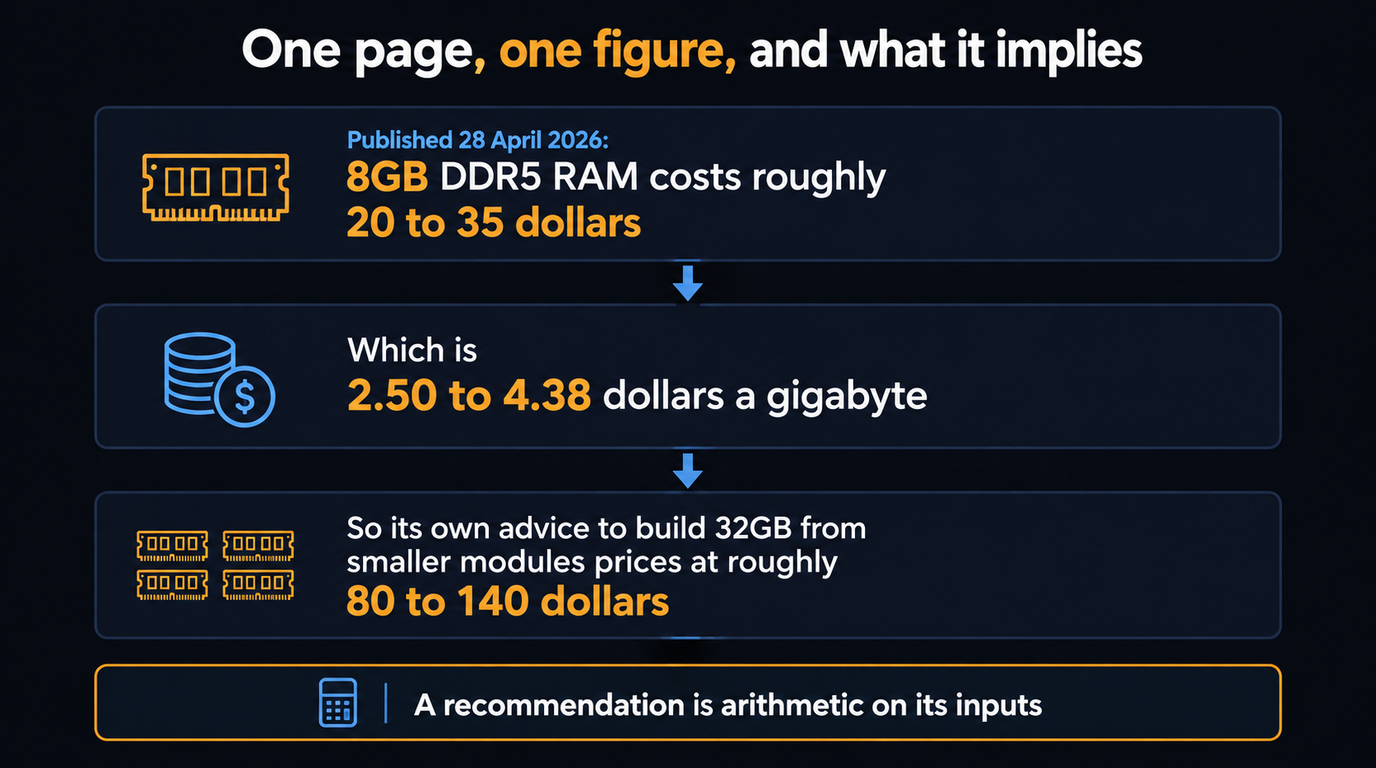
The strongest of them is directmacro.com: two tables, the clearest structure, and the only page with a dollar figure on it. That figure is “8GB DDR5 RAM costs roughly $20–$35”, published 28 April 2026, which works out at $2.50 to $4.38 a gigabyte. Our cheapest observed DDR5 gigabyte is $16.53/GB, from G.Skill Flare X5 DDR5-6000 CL36 32GB (2x16GB) at Newegg on Oct 20, 2026. The gap is not a rounding error and not merely a stale sentence: the page then advises building 32 GB out of smaller modules, which its own figure prices at roughly $80 to $140. A recommendation is arithmetic on its inputs, so a wrong input is a wrong answer.
The other three publish nothing checkable. digieraglobal.com spends roughly 4,200 words on the capacity question, dated 23 August 2026, without mentioning the memory market at all. evezone.evetech.co.za, six days old when we read it, has a budget section that tells you to spend the savings on a GPU or faster storage and never says what the savings are. rankedram.com warns that over-buying memory ties up funds, with no figure attached. All four give budget advice with the budget left blank.
The half of this we cannot measure
We price parts; we do not benchmark them. How much memory your workload needs is a measurement you take on your own machine under load, not a number anyone can look up, and the pages above are right about that much.
Three limits, stated rather than buried. Our basket is around 20 high-liquidity parts at US retail and it starts at 32 GB — we track no 16 GB or 8 GB kits, so this page cannot price the lower rungs and does not try. Our kits are consumer unbuffered DIMMs; registered server memory has a different per-gigabyte curve entirely. And four modules is not simply two of two: it puts two modules on each channel, a load your board and memory controller have to drive, and whether yours will at the kit’s rated speed is a question for its QVL.
We will not fill those gaps with a forecast. Whether the step gets cheaper is what every reader wants and what nobody can honestly supply.
How these numbers are produced, and what we withhold
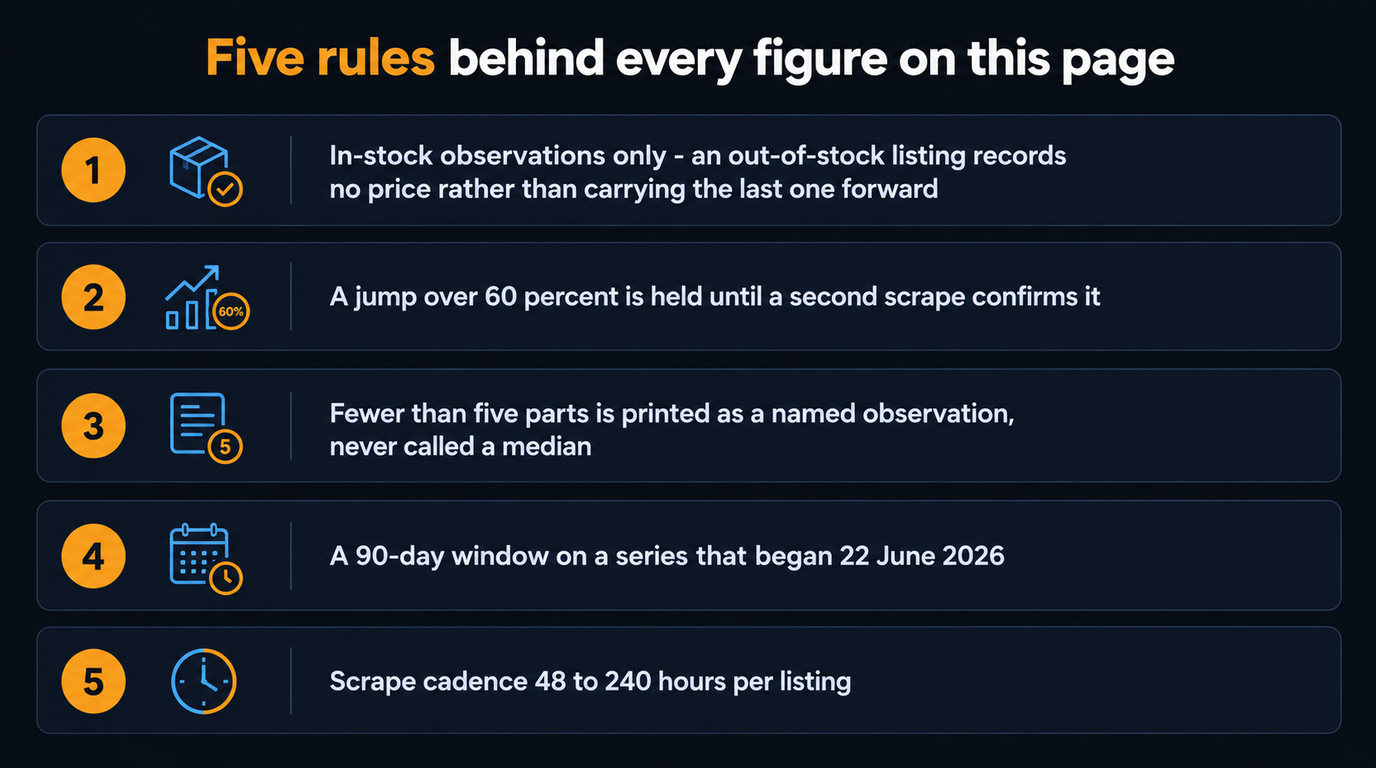
Every price here is an in-stock observation from a live retailer product page, with the retailer and date attached. An out-of-stock listing records no price rather than carrying the last one forward, so a kit that has gone dark drops out of the comparison instead of quietly anchoring it. A jump over 60% is held until a second scrape confirms it, and demo rows are blocked at the database layer rather than filtered in the template.
Where a capacity carries fewer than five parts we print the count beside the figure and refuse to call it a median, which is why the 64 GB rows above are named observations rather than bands. Our window is 90 days on a series that began 22 June 2026, so nothing here speaks to 2025 levels. Scrape cadence runs from 48 to 240 hours per listing, so a short-lived price can fall between two observations. The live RAM chart plots every series behind this page with its observation count, and the SKU list carries each part with the date of its last observation.
Related reading
FAQ
Is 64GB of RAM worth it in 2026?
As a price question, which is the half we can answer: the second 32 gigabytes currently costs more than the first 32 did, because a 64 GB consumer kit is two high-density modules and density is what the server market is bidding for. So the step is not the modest top-up the older buying guides assume. As a performance question we have no view — that is a measurement you take on your own machine under real load, and if 32 GB is not running out, our figures say the money buys a great deal more storage than memory.
Is it cheaper to buy two 32GB kits or one 64GB kit?
On our current observations two 32 GB kits are the cheaper invoice, which is the inverse of how capacity pricing is meant to work. But it was the other way round at the start of our 90-day window, so this is a fact about today rather than about hardware, and the table on this page re-renders with the date. It is also the cheaper invoice rather than the better buy: Corsair and Kingston both publish guidance against combining separately validated kits, because the modules are only tested for their rated speed against the others in the same box.
Why does a 64GB kit cost more than double a 32GB kit?
Because the modules inside it are denser, not just more numerous. A 64 GB consumer kit is usually two 32 GB modules, and a 32 GB module needs roughly twice the die density of a 16 GB one. TrendForce reported on 22 September 2026 that server demand "limited DRAM suppliers’ allocations for PC and consumer applications", with module makers reprioritising toward server RDIMM products — and the denser modules are the ones that competition reaches first. That is their reporting on the contract and allocation market, not our measurement of a shelf price.
How much does 32GB of DDR5 cost right now?
Our cheapest current in-stock observation puts DDR5 at $16.53 per gigabyte, so a 32 GB kit starts a little over thirty-two times that, and the dearest kit in the same band runs considerably higher for identical capacity. The table on this page names each kit, its retailer and the day we observed it, because a memory price quoted without a date is not comparable with the one next to it.
Is DDR4 still a cheaper way to get 64GB?
Per gigabyte, yes, and by a wide margin — our cheapest DDR4 observation is $7.50 per gigabyte against a DDR5 figure several times that. The catch is not the price. DDR4 is a finished product line whose wafer allocation is being cut, so it is cheap on the way out rather than cheap and improving, and the board that takes it caps the processors you can ever fit. If you already own a DDR4 platform, 64 GB is a far smaller decision than the DDR5 conversation implies.
Will the price of 64GB kits come down?
We do not publish forecasts and we have no view to offer. What we can tell you is what has already happened to the parts we track, with a date on every figure, and that the two configurations on this page have already swapped places once. If you can wait, a threshold on the specific kit you want is more useful than a date, because a threshold fires on a move that actually occurred.
Can I mix two RAM kits of the same model?
The vendors say not to, including for two kits of the same part number. Corsair’s support page on combining kits and Kingston’s guidance for its overclockable FURY line both state that modules are validated only against the others in the same box, and that combining kits risks instability, an overclock profile that will not enable, or a system that will not boot. People do it successfully all the time; the point is that it is untested rather than supported, so the saving on this page comes with a rebuild as its downside.
Watch the kit you actually want
We track DDR5, DDR4 and NVMe listings at US retailers and tell you when one of yours moves past your threshold. No forecasts, no deal scores, no affiliate links, no commission on anything you buy — observed prices, dated, with the sample size printed next to them.
Context: DDR5 from $16.53/GB, NVMe Gen4 from $0.184/GB, cheapest in-stock observations in the last 30 days.