RAM Prices in 2026: Buy Now or Wait? What Waiting Has Actually Cost
Key takeaways
- We will not tell you where prices go next, and we can tell you what waiting has cost. The tables below measure every tracked kit and drive from the first observation in our window to the latest one, with the observation count next to each figure.
- Picking the right part beats timing the market, by a multiple. The cheapest-to-dearest spread inside one capacity band, available any day, is several times the median part’s drift across the whole 90-day window.
- Not everything went up, and one drive fell while its bandmate rose. Inside one capacity band the price order inverted: the dearer part is now the cheaper one. An aggregate that hides that is a summary, not a purchase decision.
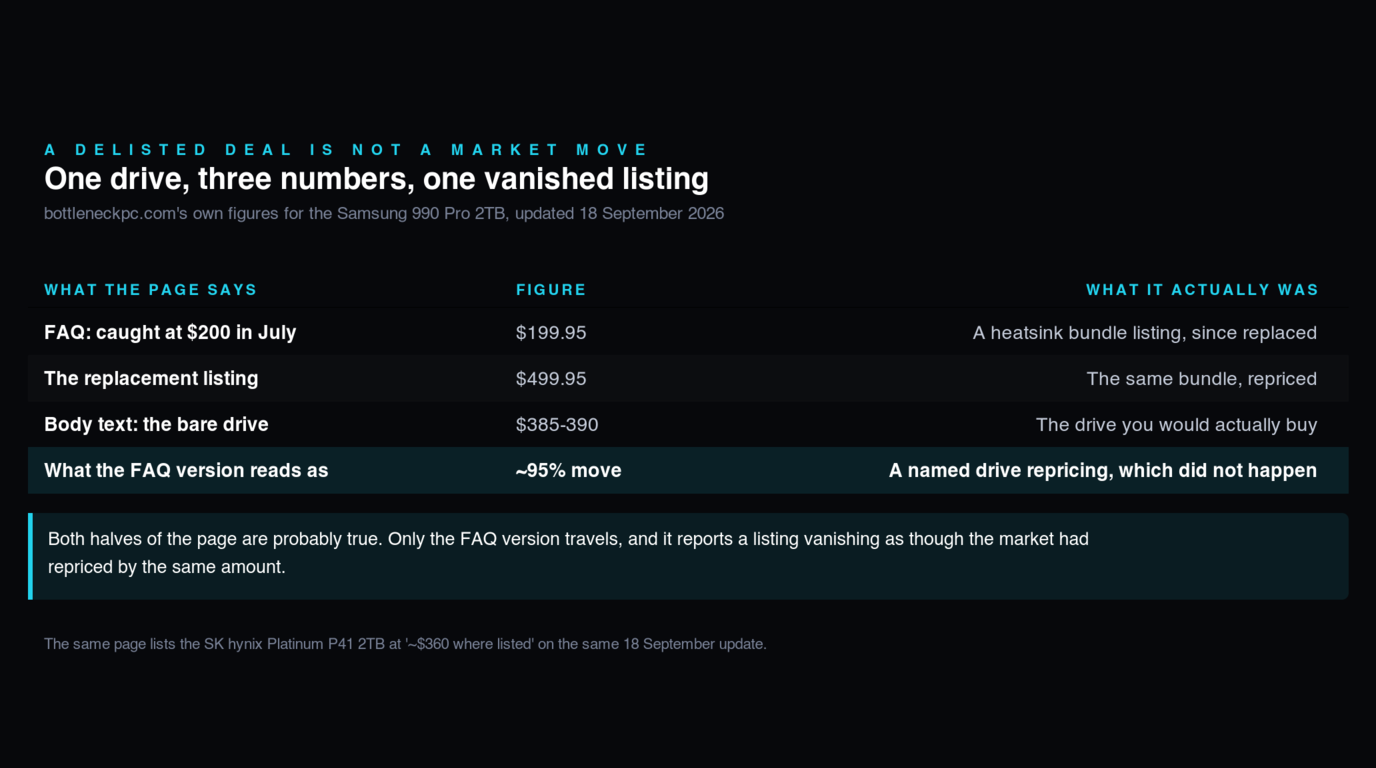
- A delisted deal is not a market move. bottleneckpc.com, updated 18 September 2026, tells readers a Samsung 990 Pro 2TB it “caught at $200 in July now sits near $390”. Our own series on that exact SKU — our deepest — shows a single-digit move over the same weeks.
- The percentages everyone quotes are contract prices, not shelf prices. TrendForce put server DRAM on a cumulative +270% path for 2026 and enterprise SSD on +235% on 25 August 2026 — hyperscaler procurement figures, an order of magnitude above our observed retail moves.
Everybody answering the RAM prices question — buy now or wait — answers it by predicting, and the predictions in circulation for 2026 disagree with each other by more than the sums involved. The stakes are real: a 32 GB DDR5 kit that sold for around $110 in 2025 now runs several hundred dollars, so getting this wrong by a month costs more than a graphics card used to. This page answers the half that can be checked, from our own dated observations: what waiting has cost so far, kit by kit, against the money sitting on the shelf today. We measured every tracked part from the first observation in our window to the latest, and read the pages ranking above us to see what they charge the question with.
One of them turned out to be reporting a vanished promotional listing as a 95% market move on a drive whose real series we hold, 44 observations deep. Start with what waiting cost.
What the last 90 days of waiting actually cost
Our series run on a rolling 90-day window, which is short, and we would rather say so than dress it up. What it holds is every observation we recorded on a named kit at a named retailer, so “what would waiting have cost me?” has an arithmetic answer for each one: the first day of the window against the last.
| Part | Type | Opened | Latest | Move | Obs. |
|---|---|---|---|---|---|
| Corsair Vengeance LPX DDR4-3200 CL16 32GB (2x16GB) | DDR4 · 32 GB | $206.60 (Aug 1) | $259.99 (Oct 24) | +25.8% | 8 |
| G.Skill Trident Z5 Neo DDR5-6000 CL30 32GB (2x16GB) | DDR5 · 32 GB | $599.99 (Aug 8) | $699.99 (Oct 27) | +16.7% | 9 |
| Crucial Pro DDR5-5600 64GB (2x32GB) | DDR5 · 64 GB | $1,035.55 (Aug 1) | $1,199.99 (Oct 20) | +15.9% | 9 |
| G.Skill Flare X5 DDR5-6000 CL36 32GB (2x16GB) | DDR5 · 32 GB | $479.99 (Aug 1) | $529.00 (Oct 20) | +10.2% | 9 |
| G.Skill Trident Z5 RGB DDR5-6400 CL32 32GB (2x16GB) | DDR5 · 32 GB | $599.99 (Aug 1) | $659.99 (Oct 27) | +10.0% | 9 |
| Crucial Pro DDR4-3200 64GB (2x32GB) | DDR4 · 64 GB | $539.00 (Aug 1) | $583.88 (Oct 20) | +8.3% | 9 |
| Corsair Vengeance DDR5-6000 CL30 32GB (2x16GB) | DDR5 · 32 GB | $519.99 (Aug 1) | $559.99 (Oct 28) | +7.7% | 41 |
| Kingston Fury Beast DDR5-6000 32GB (2x16GB) | DDR5 · 32 GB | $559.00 (Aug 1) | $559.00 (Oct 20) | 0.0% | 7 |
| G.Skill Ripjaws V DDR4-3600 CL18 32GB (2x16GB) | DDR4 · 32 GB | $239.99 (Aug 1) | $239.99 (Oct 20) | 0.0% | 9 |
| Kingston Fury Beast DDR4-3200 32GB (2x16GB) | DDR4 · 32 GB | $349.99 (Aug 8) | $319.99 (Oct 27) | −8.6% | 9 |
The median memory move across those 10 kits is +9.2%. That is the number the timing question is really being asked about, and it is worth holding next to the headline percentages further down this page, which run into the hundreds. It is also an average over kits that did different things: 7 rose, 1 fell and 2 held flat.
Storage did something different over the same days, from the same scrapes.
| Part | Type | Opened | Latest | Move | Obs. |
|---|---|---|---|---|---|
| Kingston KC3000 2048GB NVMe Gen4 SSD | NVMe Gen4 · 2 TB | $358.65 (Aug 1) | $499.00 (Oct 27) | +39.1% | 9 |
| WD Black SN850X 2TB NVMe Gen4 SSD | NVMe Gen4 · 2 TB | $328.38 (Aug 1) | $374.92 (Oct 20) | +14.2% | 9 |
| Samsung 990 Pro 2TB NVMe Gen4 SSD | NVMe Gen4 · 2 TB | $388.55 (Jul 31) | $408.95 (Oct 27) | +5.3% | 44 |
| Samsung 990 Pro 4TB NVMe Gen4 SSD | NVMe Gen4 · 4 TB | $789.00 (Aug 1) | $796.50 (Oct 27) | +1.0% | 9 |
| SK hynix Platinum P41 2TB NVMe Gen4 SSD | NVMe Gen4 · 2 TB | $449.00 (Aug 1) | $446.35 (Oct 20) | −0.6% | 9 |
| Crucial T500 2TB NVMe Gen4 SSD | NVMe Gen4 · 2 TB | $389.95 (Aug 1) | $369.00 (Oct 20) | −5.4% | 9 |
| Crucial P3 Plus 1TB NVMe Gen4 SSD | NVMe Gen4 · 1 TB | $227.00 (Aug 1) | $187.46 (Oct 20) | −17.4% | 9 |
Median storage move: +1.0% across 7 drives, with 4 up and 3 down. Both medians describe the same weeks and the same retailers. If somebody tells you what “prices” did this quarter without saying which of these two markets they mean, they are describing a mood.
The clean experiment: the cheapest part changed identity
The strongest thing a young series can say about timing needs no forecast at all. Inside a single capacity band, where every part does the same job in the same slot, the price order can invert — the drive that was the expensive one becomes the cheap one. When that happens, “wait for the price to come down” and “buy the cheapest one” stop being the same instruction, and only the second one was answerable on the day.
| Band | Was dearer, now cheaper | Was cheaper, now dearer | Gap at open | Gap now |
|---|---|---|---|---|
| NVMe Gen4 · 2 TB | Crucial T500 2TB NVMe Gen4 SSD (−5.4%) | Kingston KC3000 2048GB NVMe Gen4 SSD (+39.1%) | $31.30 | $130.00 |
| NVMe Gen4 · 2 TB | SK hynix Platinum P41 2TB NVMe Gen4 SSD (−0.6%) | Kingston KC3000 2048GB NVMe Gen4 SSD (+39.1%) | $90.35 | $52.65 |
| NVMe Gen4 · 2 TB | Samsung 990 Pro 2TB NVMe Gen4 SSD (+5.3%) | Kingston KC3000 2048GB NVMe Gen4 SSD (+39.1%) | $29.90 | $90.05 |
| NVMe Gen4 · 2 TB | Crucial T500 2TB NVMe Gen4 SSD (−5.4%) | WD Black SN850X 2TB NVMe Gen4 SSD (+14.2%) | $61.57 | $5.92 |
It is also the cleanest answer to the “rising or falling” framing: on our observations it did both at once, inside one product class.
The spread you can capture today against the drift you cannot predict
Every page arguing about timing is arguing about the number in the last section. Almost none prices the number in this one: what the cheapest and the dearest listing in a band costright now. That figure needs no waiting, no forecast and no luck.
| Band | Cheapest | Dearest | Spread | Cash gap | Parts |
|---|---|---|---|---|---|
| DDR4 · 32 GB | G.Skill Ripjaws V DDR4-3600 CL18 32GB (2x16GB) $239.99 · Newegg · Oct 20, 2026 | Kingston Fury Beast DDR4-3200 32GB (2x16GB) $319.99 · Oct 27, 2026 | +33.3% | $80.00 | 3 |
| DDR5 · 32 GB | G.Skill Flare X5 DDR5-6000 CL36 32GB (2x16GB) $529.00 · Newegg · Oct 20, 2026 | G.Skill Trident Z5 Neo DDR5-6000 CL30 32GB (2x16GB) $699.99 · Oct 27, 2026 | +32.3% | $170.99 | 6 |
| NVMe Gen4 · 2 TB | Crucial T500 2TB NVMe Gen4 SSD $369.00 · Newegg · Oct 20, 2026 | Kingston KC3000 2048GB NVMe Gen4 SSD $499.00 · Oct 27, 2026 | +35.2% | $130.00 | 5 |
So the comparison that matters comes out like this: the widest same-day spread we can see is 33.3% ($80.00 on 32 GB DDR4), against a median 90-day drift of +9.2%. Choosing the right part inside one band is worth 3.6x the whole quarter’s typical movement — and unlike the movement, it is a decision you get to make.
Cross-retailer shopping is the weaker version of the same lever. Where we see one part in stock at both Newegg and B&H the gap has been small — far smaller than the gap between two different parts of identical specification. The money is in which part, not which shop; the brand comparison finds the same thing with capacity, speed and CAS latency all held still.
The dip that existed, and the day it closed
“Wait for a dip” is the most common advice on this question and the hardest to act on, because a dip is only visible once it has gone. Our window shows several, and it also shows what happened next.
| Part | Opened | Low point | Depth | Latest | From the low |
|---|---|---|---|---|---|
| Kingston Fury Beast DDR4-3200 32GB (2x16GB) | $349.99 | $249.99 (Sep 7) | −28.6% | $319.99 | +28.0% |
| Crucial Pro DDR4-3200 64GB (2x32GB) | $539.00 | $519.99 (Sep 10) | −3.5% | $583.88 | +12.3% |
| Kingston KC3000 2048GB NVMe Gen4 SSD | $358.65 | $349.95 (Sep 20) | −2.4% | $499.00 | +42.6% |
| Samsung 990 Pro 2TB NVMe Gen4 SSD | $388.55 | $379.99 (Sep 19) | −2.2% | $408.95 | +7.6% |
| Corsair Vengeance DDR5-6000 CL30 32GB (2x16GB) | $519.99 | $509.99 (Aug 9) | −1.9% | $559.99 | +9.8% |
The deepest one bottomed at $249.99 on Sep 7 and sits at $319.99 now. A buyer who was watching that part got 28.6% off the window’s opening price; a buyer who waited for the next one is still waiting. The other end is worth the same attention: SK hynix Platinum P41 2TB NVMe Gen4 SSD peaked 66.0% above its opening price on Sep 30. Waiting is not a one-way bet on the way down — it is exposure, and some of these series spent weeks above where they started.
A threshold is the only mechanical way to act on a dip you cannot see coming, and it has floors underneath it that most alert tools never mention — the numbers a RAM alert actually needs.
A delisted deal is not a market move
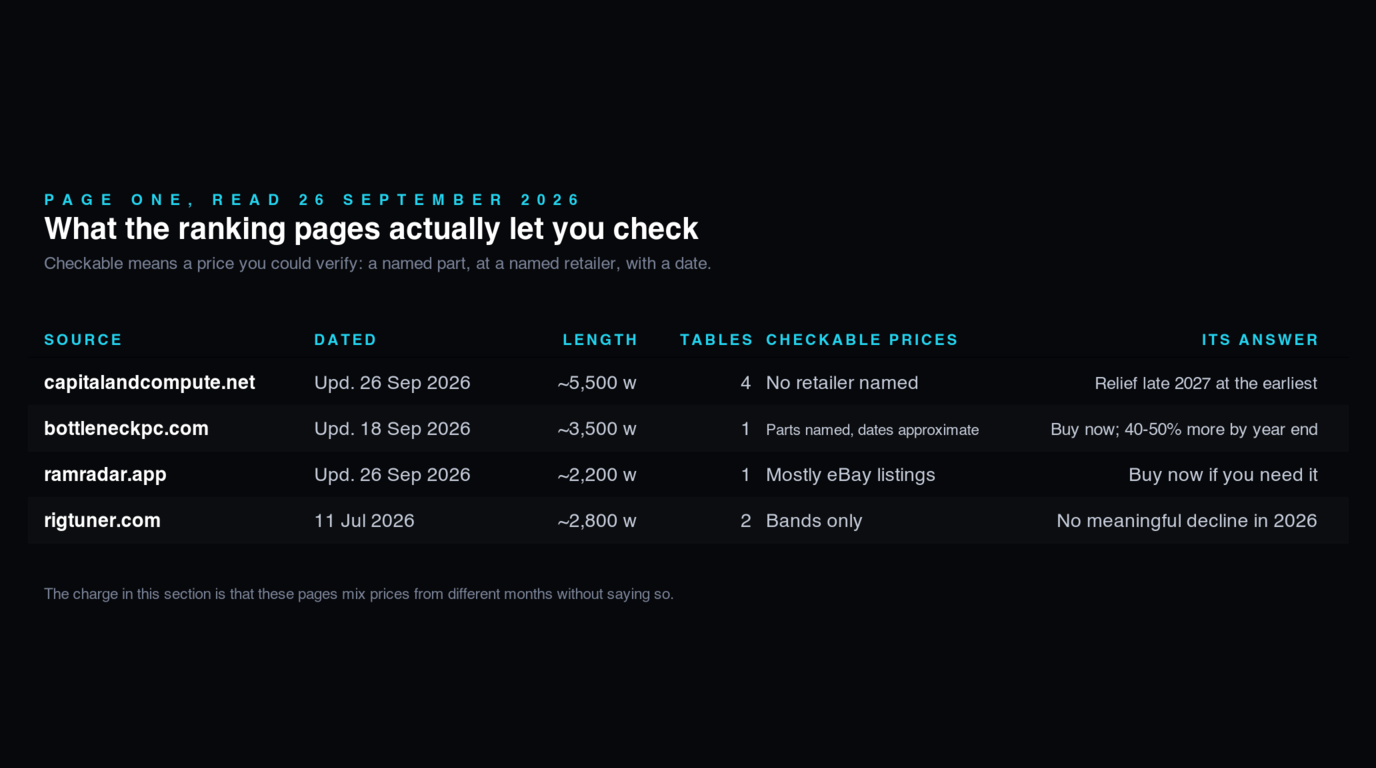
Here is where the published advice goes wrong in a way you can check. Several of the pages ranking for this question draw their price history from listings that no longer exist — a promotional bundle, a clearance SKU, a marketplace seller — and report the disappearance as though the market had repriced by the same amount.
| Source | Dated | Length | Tables | Checkable prices | Its answer |
|---|---|---|---|---|---|
| capitalandcompute.net | Upd. 26 Sep 2026 | ~5,500 w | 4 | No retailer named | Relief late 2027 at the earliest |
| bottleneckpc.com | Upd. 18 Sep 2026 | ~3,500 w | 1 | Parts named, dates approximate | Buy now; another 40-50% before year end |
| ramradar.app | Upd. 26 Sep 2026 | ~2,200 w | 1 | Mostly eBay listings | Buy now if you need it |
| rigtuner.com | 11 Jul 2026 | ~2,800 w | 2 | Bands only | No meaningful decline in 2026 |
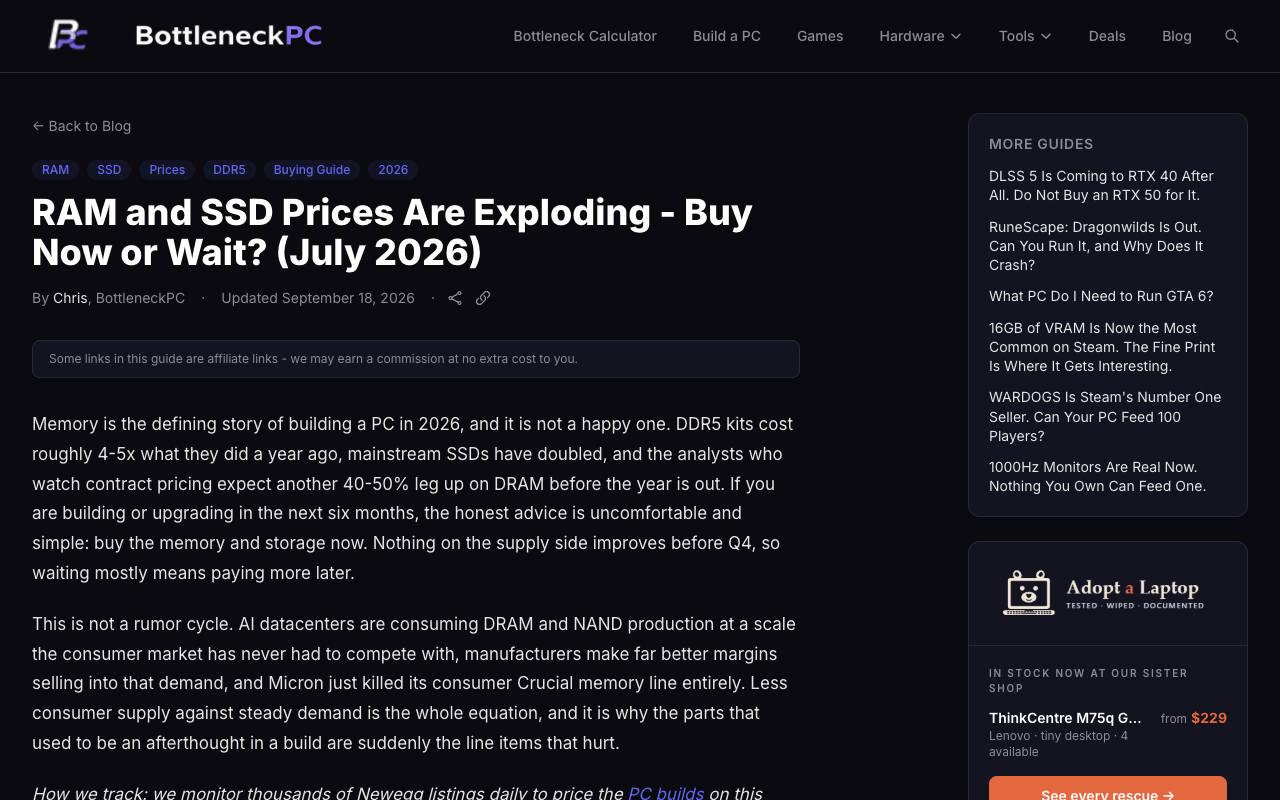
Take the clearest case. bottleneckpc.com, updated 18 September 2026, tells readers that “the Samsung 990 Pro 2TB we caught at $200 in July now sits near $390”. Its own body text is more careful: the $199.95 figure was a heatsink bundle listing, since replaced at $499.95, while “the bare drive floats around $385-390”. Both halves are probably true. But the FAQ version reads as a 95% move on a named drive, and our series for that exact SKU — the deepest we hold — shows nothing like it.
The same page lists the SK hynix Platinum P41 2TB at “~$360 where listed” on an 18 September update. Our observation for that drive is materially higher and rising through the window — both are in the storage table above. A price printed without its observation date is not a stale sentence, it is a wrong answer: the same failure we found in the RAM versus SSD comparisons, which priced memory at 2026 levels and storage at 2025 levels in one article.
What the forecasts say, and what they are worth
We do not publish forecasts. That is a rule this site was built on, not a gap in the data, and this is the query where it costs us the most traffic, so it is worth explaining. A forecast is an unfalsifiable input to a decision you make today; an observed price is a falsifiable one. We would rather be the site that hands you the second kind.
| Claim | Market it describes | Source | Published |
|---|---|---|---|
| +270% cumulative in 2026 | Server DRAM contract | TrendForce | 25 Aug 2026 |
| +235% cumulative in 2026 | Enterprise SSD contract | TrendForce | 25 Aug 2026 |
| +13-18% QoQ in 3Q26 | Server DRAM contract | TrendForce | 9 Jul 2026 |
| +40-50% before year end | DDR5 retail, unspecified basket | bottleneckpc.com | 18 Sep 2026 |
| Relief no earlier than late 2027 | Memory generally | capitalandcompute.net | 26 Sep 2026 |
| Nothing | US retail shelf, single unit | ByteWatch | Observed only, dated per row |
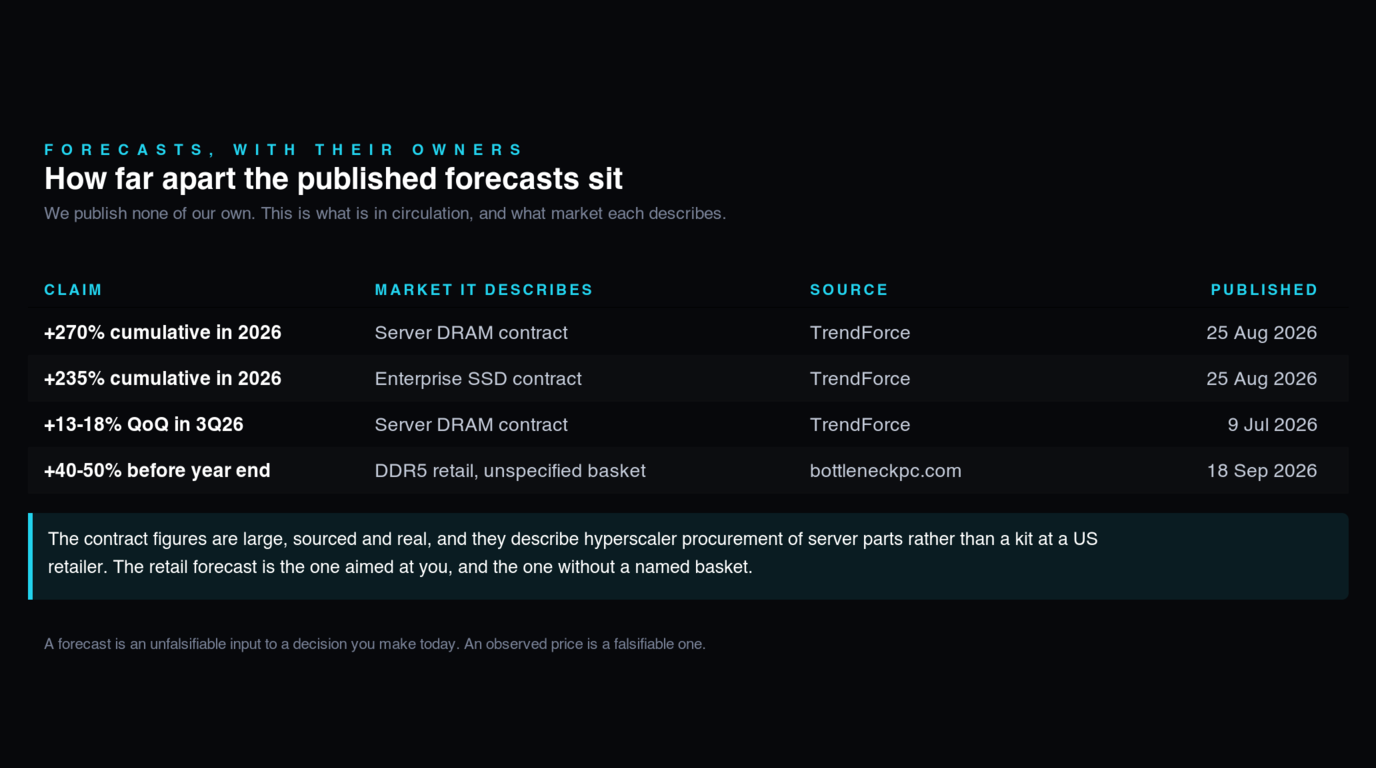
Read down that table and the range is the finding. The contract figures are large, sourced and real — and they describe hyperscaler procurement of server parts, not a kit at a US retailer, which is the commonest confusion in this year’s memory coverage. The retail forecasts are the ones aimed at you, and the ones without a named basket. Our measured retail moves, above, are an order of magnitude smaller.
Why the upstream numbers do not reach the shelf at the same size is a longer story about wafer allocation and AI demand: why RAM prices are so high.
Five rules that work without a forecast
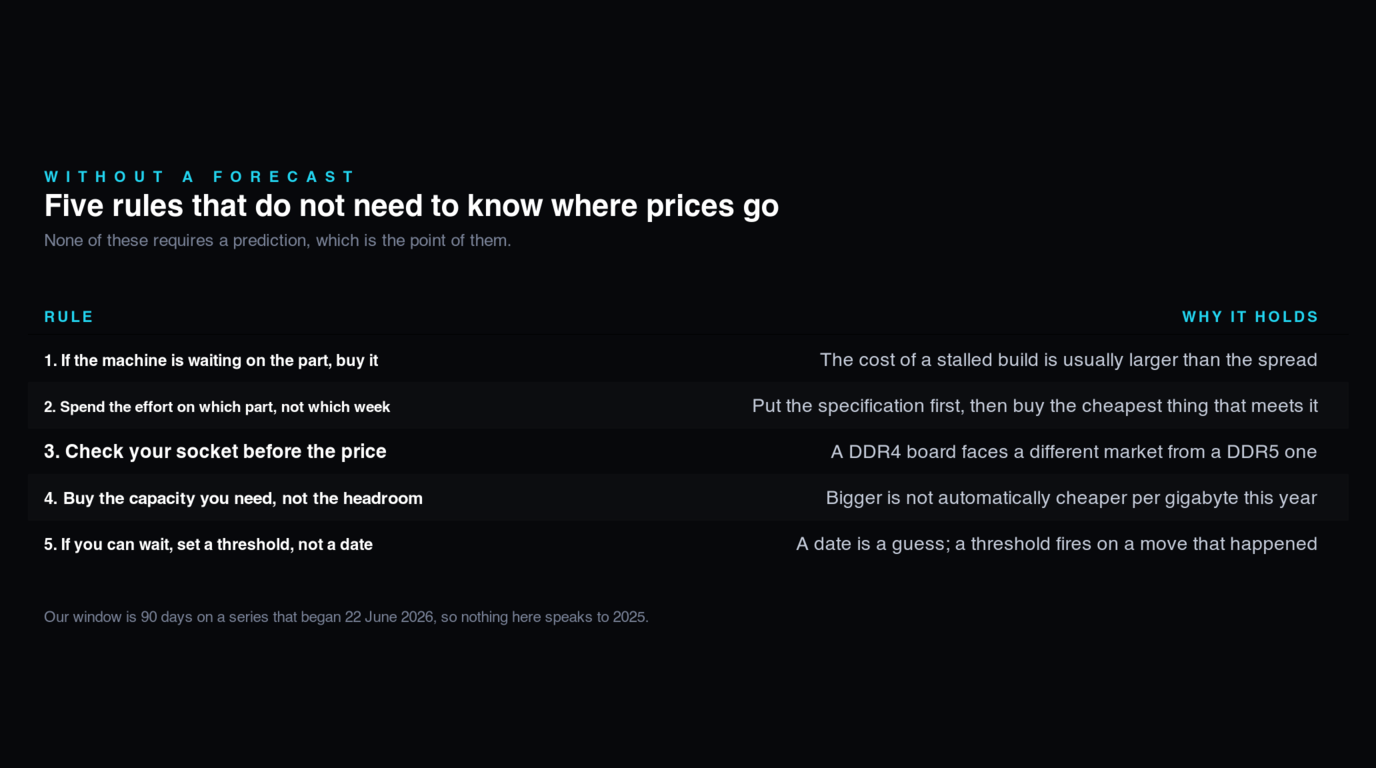
None of these needs to know where prices go next, which is the point of them.
2. Spend the effort on which part, not which week. Put the specification first, then buy the cheapest thing that meets it.
3. Check your socket before the price. A DDR4 board faces a different market from a DDR5 one, and the gap between the two outweighs anything timing will get you.
4. Buy the capacity you need, not the headroom. The extra 32 GB “for later” is real money now, and bigger is not automatically cheaper per gigabyte on memory this year.
5. If you can wait, set a threshold, not a date. A date is a guess; a threshold fires on a move that actually happened.
What these numbers are, and what they cannot tell you
Every price above is an in-stock observation from a live retailer product page, with the retailer and the date attached. Out-of-stock listings record no price rather than carrying the last one forward, so a “move” here is never an artefact of a listing going dark. A jump over 60% is held until a second scrape confirms it, and demo rows are blocked from public pages at the database layer.
The limits matter as much. Our window is 90 days on a series that began 22 June 2026, so nothing here speaks to 2025 — the large year-on-year multiples in circulation describe a period we did not observe. Our basket is around 20 high-liquidity parts at US retail, and says nothing about a part we do not track. Scrape cadence runs from 48 to 240 hours per listing, so a short-lived price can fall between two observations. And where a category sits below our five-part floor we withhold the aggregate rather than publish a thin one. None of that is fixable by writing a forecast instead.
Related reading
FAQ
Should I buy RAM now or wait in 2026?
If the machine cannot run without the part, buy it: the cost of a stalled build is larger than any spread in this article. If you can genuinely wait, set a threshold rather than a date, because a threshold fires on a move that actually happened. What we will not do is tell you where prices go next. On our own observations the money available from choosing the right part inside one capacity band, on any given day, is several times the median part’s drift across our whole 90-day window.
How much have RAM prices moved in the last three months?
Our DDR5 index requires at least five SKUs with current observations before it will publish a point, and it is currently below that floor, so we withhold the aggregate rather than print a thin one. The per-kit table in this article shows each series individually, which is the honest version of the same question.
Will RAM prices go down in 2027?
We do not publish forecasts, so we have no view to offer, and the forecasts in circulation have disagreed with each other by large multiples all year. For context rather than prediction: TrendForce put server DRAM contract prices on a cumulative path of roughly 270% for 2026 as of 25 August 2026, and the consumer-facing pages we read in September 2026 put the earliest relief anywhere between late 2027 and 2028. Those are their claims, dated, and they describe contract markets and general sentiment rather than the shelf price of a desktop kit.
Is it better to wait for a dip or buy the cheapest kit now?
A dip is only visible after it has closed, which is why our window shows several that came and went and none that are coming. The spread between the cheapest and dearest part of identical capacity and generation is visible today, and is usually the larger number: on our observations it runs into the tens of percent inside one band, more than most of our series moved over the whole window.
Why do published RAM price histories disagree so much?
Because they are drawn from different baskets, and a basket built from promotional or marketplace listings behaves nothing like one built from current retail stock. A listing that is withdrawn does not reprice the market, but in a price history it looks identical to one that did. The other cause is undated figures: a price quoted without the day it was observed cannot be compared with the one next to it, and several of the pages ranking here mix months without saying so.
Are the 200% and 270% memory price increases real?
They are real figures about a market you cannot buy in. TrendForce’s cumulative 2026 figures of roughly +270% for server DRAM and +235% for enterprise SSD, published 25 August 2026, are contract prices negotiated between memory makers and very large buyers for server parts. US retail moves in the same direction on a lag and at a different magnitude. Treating a contract percentage as a retail one is the single most common error in this year’s memory coverage, and it runs in both directions.
Does shopping at a different retailer help?
Much less than choosing a different part. Where we observe one SKU in stock at more than one tracked retailer the gap has been small — low single digits — while two kits of identical capacity and speed can sit tens of percent apart at the same retailer on the same day. Check more than one shop, but spend the effort on the specification first.
What is a good price for a 32GB DDR5 kit right now?
Our cheapest in-stock DDR5 observation currently works out at $16.53 per gigabyte, with a median of $18.75 across 7 kits. The tables in this article print the actual cheapest kit with its retailer and observation date rather than a computed estimate, because kits are priced as kits. If the quote in front of you sits at or below our cheapest observed kit in that band, it is a good price relative to what the shelf has actually been doing — which is a question you can answer today, unlike a forecast.
Stop guessing at the date and watch the price
We track DDR5, DDR4 and NVMe listings at US retailers and tell you when one of yours moves past your threshold. No forecasts, no deal scores, no affiliate links, no commission on anything you buy — observed prices, dated, with the sample size printed next to them.
Context: DDR5 from $16.53/GB, NVMe Gen4 from $0.184/GB, cheapest in-stock observations in the last 30 days.