DDR4 Prices in 2026: What a New Desktop Kit Really Costs
Key takeaways
- The DDR4 price you find first is almost never the price of a new kit. Read 22 September 2026, published DDR4 figures started at $1.58 per gigabyte — several times below any new-in-box desktop kit we observe, because that basket is eBay modules and refurbished server memory.
- Three different product classes get quoted as “the DDR4 price”. Marketplace DDR4-2133 to DDR4-2666 modules, refurbished registered server DIMMs that will not boot in a consumer board, and new retail kits. None of the sources we checked states which one it is pricing.
- Identical specifications, materially different money. Kits of the same capacity, the same transfer rate and the same CAS latency sit double-digit percentages apart per gigabyte at one retailer, and the grade on the box does not predict which is cheaper.
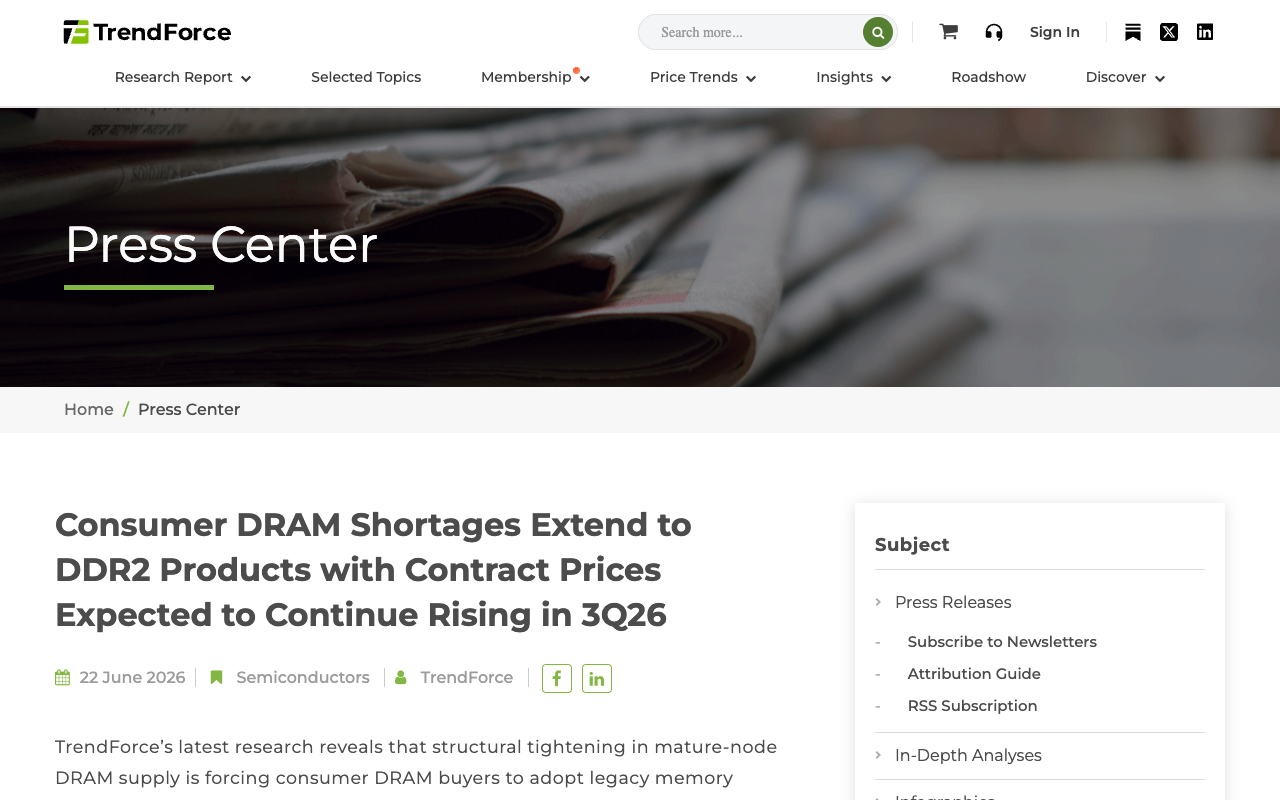
- DDR4 is being withdrawn, not marked down. TrendForce reported on 22 June 2026 that wafer allocations for DDR4 and other mature-node products have been reduced, and that DDR4 designs are being replaced with DDR3 while some DDR3 products move to DDR2.
- We publish a range and a kit count, not a DDR4 market average. Our DDR4 cohort holds 4 kits, which is below the five-part floor this site requires before printing a median, so the tables say withheld where a median would go.
Look up the DDR4 price in 2026 and the figures disagree by several hundred percent, which is a problem when a 32 GB kit has become a three-figure line item and the platform in front of you takes nothing else. The reason they disagree is not that anyone is lying. It is that a second-hand market, a refurbished server-memory market and a shrinking new-retail market all get reported as one number, and nobody says which they mean.
This page is the new-retail one, with the money in it: every DDR4 kit we track, priced per gigabyte, at a named US retailer, with the day each price was observed printed beside it. We are not summarising anyone else. We scrape live product pages, store every observation with a timestamp and a stock flag, and compute the figures below from those records at the moment this page is built — with the kit count printed next to them, and the word withheld wherever the sample is too thin to carry a statistic.
What follows is what a new kit costs today, the three baskets that explain every cheaper figure you will find, the kits that are identical on paper and not in price, the capacity step that runs the wrong way, and what the supply side has actually said — quoted, dated, and with no forecast attached.
What a new DDR4 kit costs right now
Here is the whole DDR4 side of our basket, with the retailer and the observation date on every row. It is a small basket — 4 kits, which is below the five-part floor this site requires before it will print a median — so what follows is a range and a set of named kits rather than a market average. That is a weaker claim than the ones you will read elsewhere, and it is the one the data supports.
| Kit | Spec | Capacity | Best price | $/GB | True latency | Retailer | Observed |
|---|---|---|---|---|---|---|---|
| G.Skill Ripjaws V DDR4-3600 CL18 32GB (2x16GB) | DDR4-3600 CL18 | 32 GB | $239.99 | $7.50 | 10.00 ns | Newegg | Sep 20, 2026 |
| Corsair Vengeance LPX DDR4-3200 CL16 32GB (2x16GB) | DDR4-3200 CL16 | 32 GB | $249.99 | $7.81 | 10.00 ns | Newegg | Sep 17, 2026 |
| Crucial Pro DDR4-3200 64GB (2x32GB) | DDR4-3200 CL22 | 64 GB | $599.95 | $9.37 | 13.75 ns | Newegg | Sep 20, 2026 |
| Kingston Fury Beast DDR4-3200 32GB (2x16GB) | DDR4-3200 CL16 | 32 GB | $299.99 | $9.37 | 10.00 ns | Newegg | Sep 17, 2026 |
The cheapest gigabyte we can currently observe is $7.50, on G.Skill Ripjaws V DDR4-3600 CL18 32GB (2x16GB) at $239.99 (Newegg, Sep 20, 2026). The dearest is $9.37 on Kingston Fury Beast DDR4-3200 32GB (2x16GB). That is a spread of 25.0% across kits a buyer would consider interchangeable, and it is the first sign that DDR4 is no longer priced like a commodity with a settled market rate.
Why every published DDR4 price is lower than the shelf
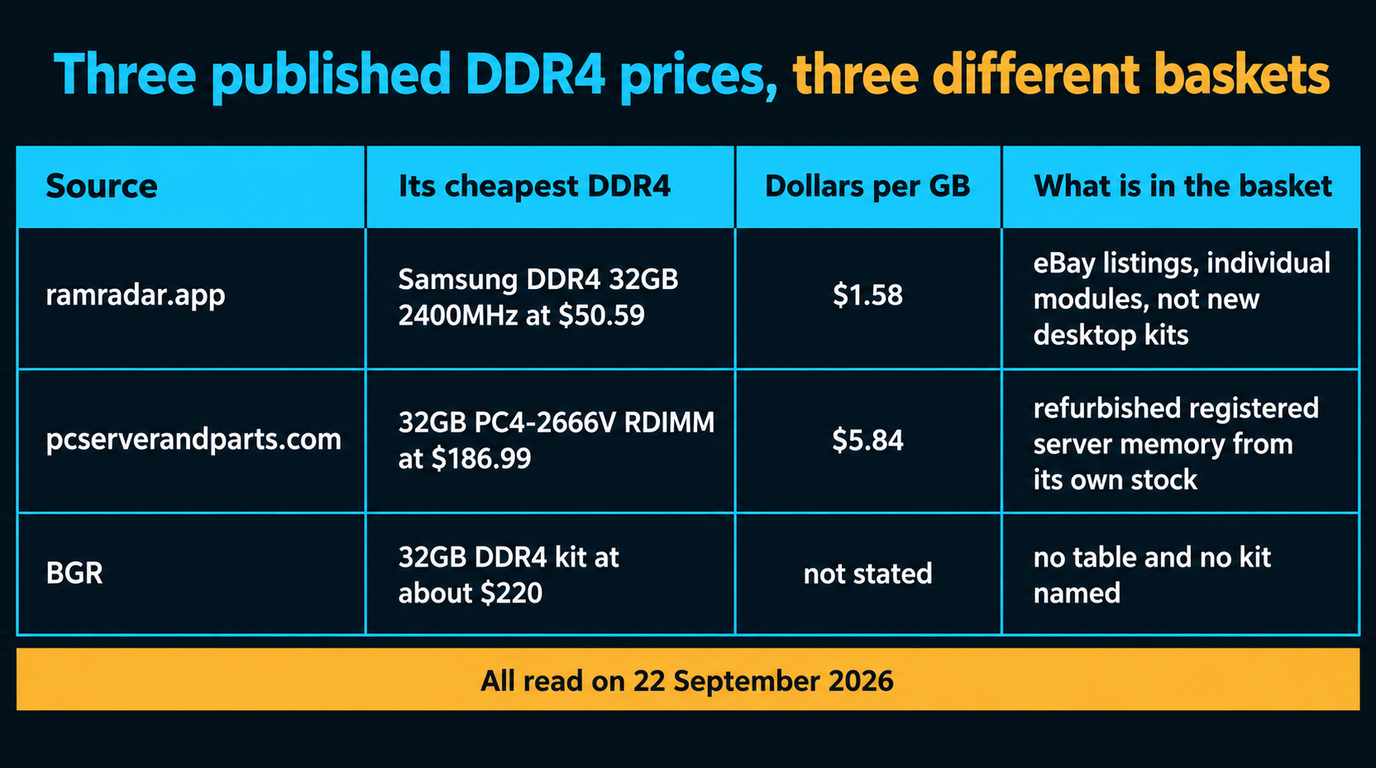
Search for a DDR4 price and the first figures you meet are far below the table above. They are not wrong. They are answers to a different question, and the difference is never stated.
| Source | Its cheapest DDR4 | $/GB | What's in the basket |
|---|---|---|---|
| ramradar.app | Samsung DDR4 32GB 2400MHz — $50.59 | $1.58 | every DDR4 row we could read was an eBay listing; the cheap end is DDR4-2133 to DDR4-2666 modules sold individually, not new desktop kits |
| pcserverandparts.com | 32GB PC4-2666V RDIMM — $186.99 | $5.84 | refurbished registered server memory from the publisher’s own stock; its desktop-kit row is a separate figure at $7.81/GB |
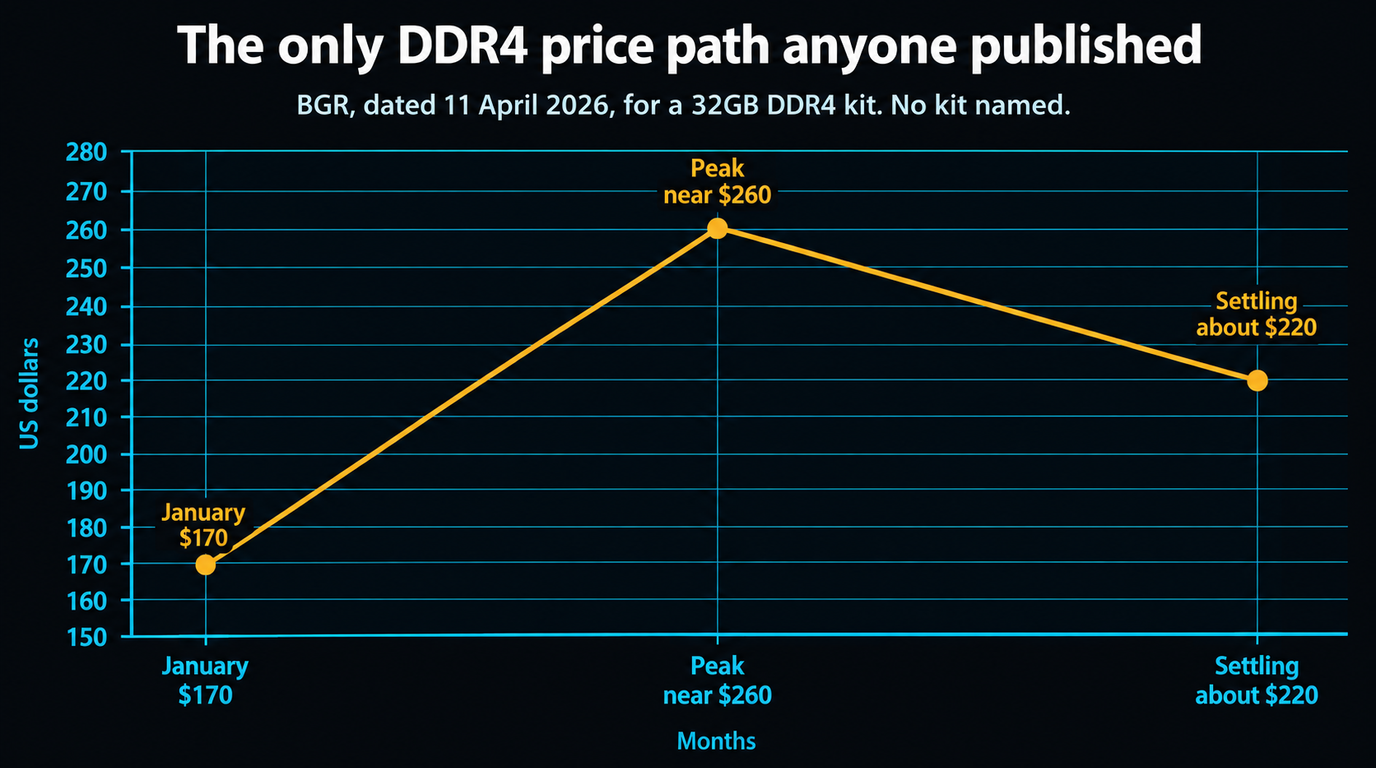
| BGR (syndicated to Yahoo, AOL) | 32GB DDR4 kit — about $220 | not stated | no table and no kit named; prices described as $170 in January, peaking near $260, then settling — read on 22 September, dated 11 April 2026 |
Read straight down that $/GB column and DDR4 appears to cost anything from $1.58 to our $7.50 — a factor of 4.7x between the cheapest published gigabyte and the cheapest new kit we can observe. Nothing in that gap is a deal. It is three different product classes stacked in one column: marketplace modules, mostly DDR4-2133 to DDR4-2666 parts sold individually on eBay; refurbished registered server memory, which will not boot in a consumer motherboard at all; and new-in-box desktop kits at a US retailer, which is what our basket tracks.
This is the same trap we measured on the storage side, where every cheapest-SSD list put a SATA or Gen3 drive at the top of a Gen4 comparison. On memory it bites harder, because a second-hand DDR4 market has grown up around a standard leaving production, so the cheap listings are abundant and genuinely available — just not comparable.
One cross-check worth having, because it cuts the other way: pcserverandparts, updated 5 September 2026, prices a Corsair Vengeance LPX 32GB DDR4-3200 kit at $249.99 at Newegg, verified 21 August 2026. That is the same kit, retailer and price we observe. Two independent baskets agreeing on a named SKU is the sort of check that should be routine and almost never is, and it is only possible because both sides named the kit.
The same speed, three prices
Now hold the specification still. 3 of the kits above have identical true latency — 10.00 ns in first-word terms — despite wearing different speed grades on the box, and they are 25.0% apart per gigabyte.
| Kit | Grade on the box | True latency | Best price | $/GB | Observed |
|---|---|---|---|---|---|
| G.Skill Ripjaws V DDR4-3600 CL18 32GB (2x16GB) | DDR4-3600 CL18 | 10.00 ns | $239.99 | $7.50 | Sep 20, 2026 |
| Corsair Vengeance LPX DDR4-3200 CL16 32GB (2x16GB) | DDR4-3200 CL16 | 10.00 ns | $249.99 | $7.81 | Sep 17, 2026 |
| Kingston Fury Beast DDR4-3200 32GB (2x16GB) | DDR4-3200 CL16 | 10.00 ns | $299.99 | $9.37 | Sep 17, 2026 |
The cheapest of them is G.Skill Ripjaws V DDR4-3600 CL18 32GB (2x16GB) at $7.50, and the grade printed on its box is not the slowest one in the group. Whatever is setting these prices, it is not performance.
We met this first on the newer generation, in the DDR5 speed premium, where the gap between two kits of identical latency came out wider than the gap between the grades themselves. That page treats DDR4 as a footnote to a DDR5 argument. Here it is the subject, because a DDR4 buyer has no DDR5 alternative to weigh it against — the socket already decided — so the only lever left is which DDR4 kit, and that lever turns out to be worth a quarter of the bill.
The bigger DDR4 kit is not the cheaper gigabyte
Buying in bulk is supposed to lower the unit price. On DDR4 right now it does the opposite, on the kits we can see.
| Capacity | Kits priced | Cheapest $/GB | Dearest $/GB | Spread | Cheapest kit |
|---|---|---|---|---|---|
| 32 GB | 3 | $7.50 | $9.37 | 25.0% | G.Skill Ripjaws V DDR4-3600 CL18 32GB (2x16GB) |
| 64 GB | 1 | $9.37 | — | — | Crucial Pro DDR4-3200 64GB (2x32GB) |
Going from 32 GB to 64 GB moves the cheapest gigabyte by +25.0%. The bigger kit is the dearer gigabyte, which is the reverse of the standing advice. One end of that step rests on a single kit, so treat it as a data point rather than a curve — and note that the kit at the larger capacity differs in brand and CAS latency too, so this is not a clean within-model measurement. We did the clean version across a much larger basket in price per gigabyte by capacity, where the bigger-kit discount on memory turned out to be folklore this year.
DDR4 is being discontinued, not discounted
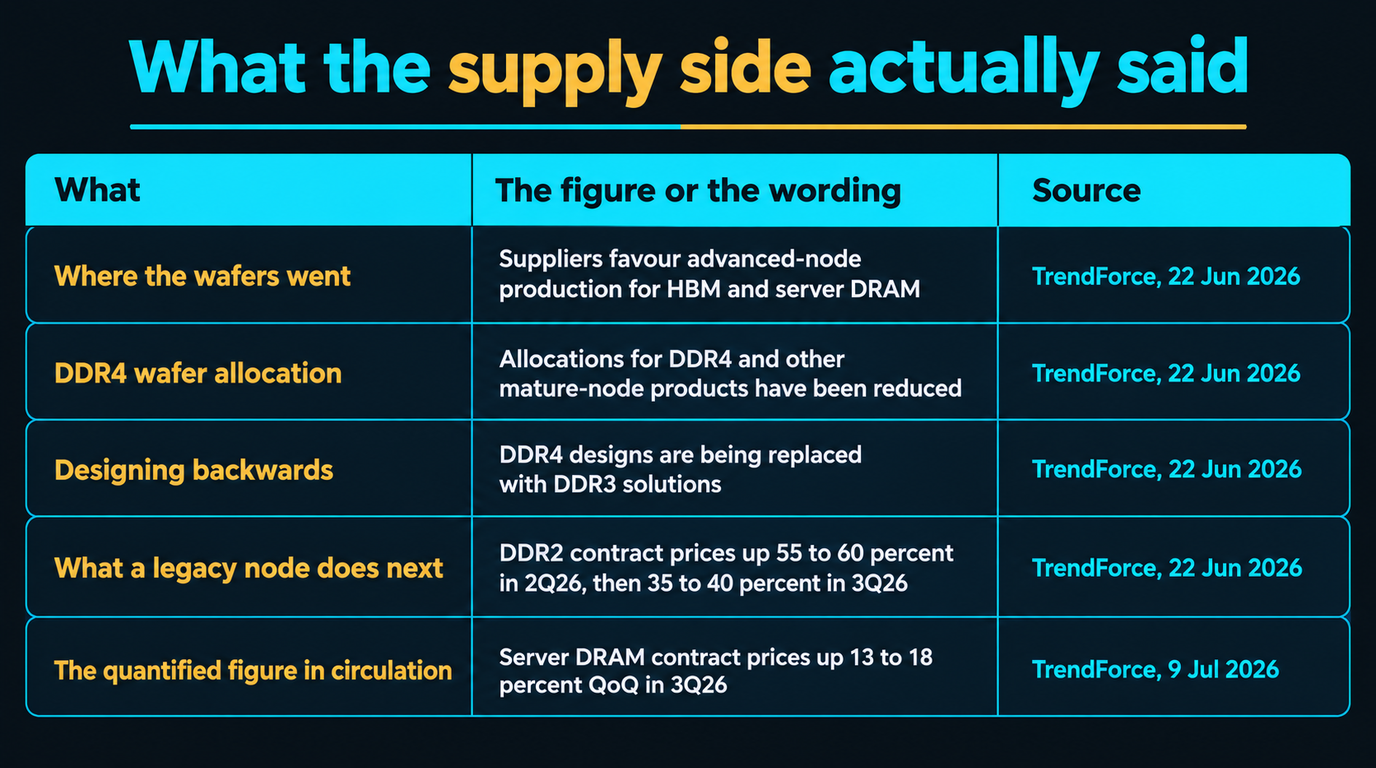
Every other explanation of DDR4 pricing eventually reaches for a forecast. We are not allowed to publish one and would not trust ours if we were, so here is the alternative: the supply side in its own words, with dates, and nothing inferred.
| What | The figure or the wording | Source |
|---|---|---|
| Where the wafers went | The three major suppliers “continue to prioritize advanced-node production to support growing demand for HBM and server DRAM driven by AI infrastructure investments”. | TrendForce, 22 Jun 2026 |
| DDR4 wafer allocation | “Wafer allocations for DDR4 and other mature-node products have been reduced.” | TrendForce, 22 Jun 2026 |
| Designing backwards | “DDR4 designs are being replaced with DDR3 solutions, while certain DDR3-based products are being redesigned to use DDR2.” | TrendForce, 22 Jun 2026 |
| What a legacy node does next | DDR2 contract prices up roughly 55–60% in 2Q26, followed by a further 35–40% in 3Q26. | TrendForce, 22 Jun 2026 |
| The quantified figure in circulation | Server DRAM contract prices up 13–18% QoQ in 3Q26 — a server number, not a DDR4 one. | TrendForce, 9 Jul 2026 |
The third row is the one worth reading twice. Products designed for DDR4 are being redesigned around DDR3, and DDR3 products around DDR2. Engineering teams do not walk a product backwards through two generations of memory for performance reasons. They do it when the part they specified is not obtainable at a price the bill of materials survives, which tells you more about DDR4’s position than any percentage.
The DDR2 line underneath it is the same story one generation further along: a standard nobody markets any more, with contract prices quoted in double-digit quarterly increases because almost nothing is being fabricated. That is what the far end of a mature node looks like. What happens to DDR4 next is genuinely not something we know — and a page that told you confidently would be guessing.
What DDR4 still saves you against DDR5
On the cheapest gigabyte in each generation, DDR5 currently costs 1.92x DDR4: $14.37 on Corsair Vengeance DDR5-5600 64GB (2x32GB) against $7.50 on G.Skill Ripjaws V DDR4-3600 CL18 32GB (2x16GB), both observed in stock at a named retailer. Measured against the DDR5 median of $17.47 across 7 kits — DDR5 is the one generation where our basket clears the sample floor — the multiple is 2.33x. So the headline advantage survives: a gigabyte of DDR4 is still the cheaper gigabyte, by a wide margin.
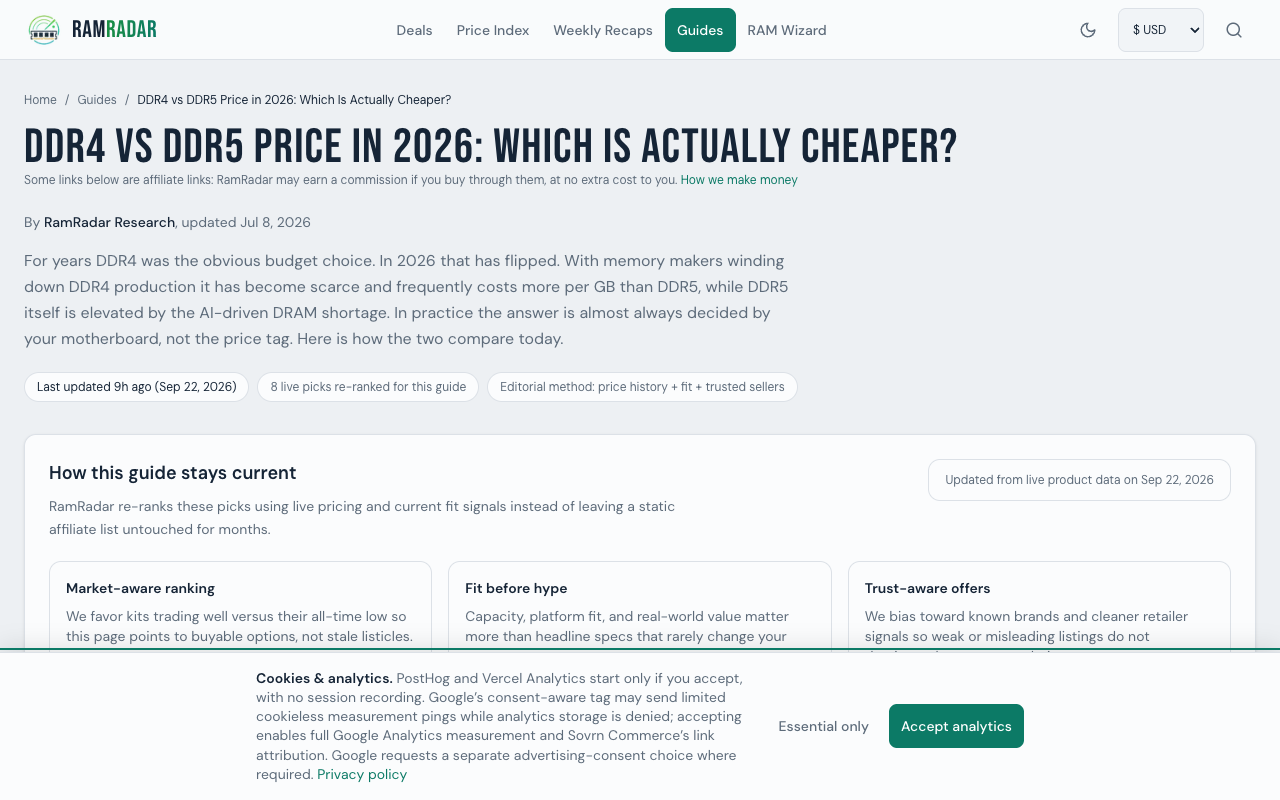
What that figure does not settle is whether to buy DDR4. A cheaper gigabyte on a platform you cannot upgrade is not the same product as a dearer gigabyte on one you can, and the per-GB advantage has never been the whole decision. We went through the socket side of it properly in DDR4 vs DDR5 prices in 2026, and the supply story behind both generations in why RAM prices are so high.
What to pay, and four checks before you buy
Turning the tables above into something usable this afternoon. These figures render from the same observations as everything else on the page, so they are never staler than the dates printed beside them.
| Capacity | Good $/GB | Typical $/GB | Good total | Kits priced |
|---|---|---|---|---|
| 32 GB | $7.50 | withheld | $239.99 | 3 |
| 64 GB | $9.37 | withheld | $599.95 | 1 |
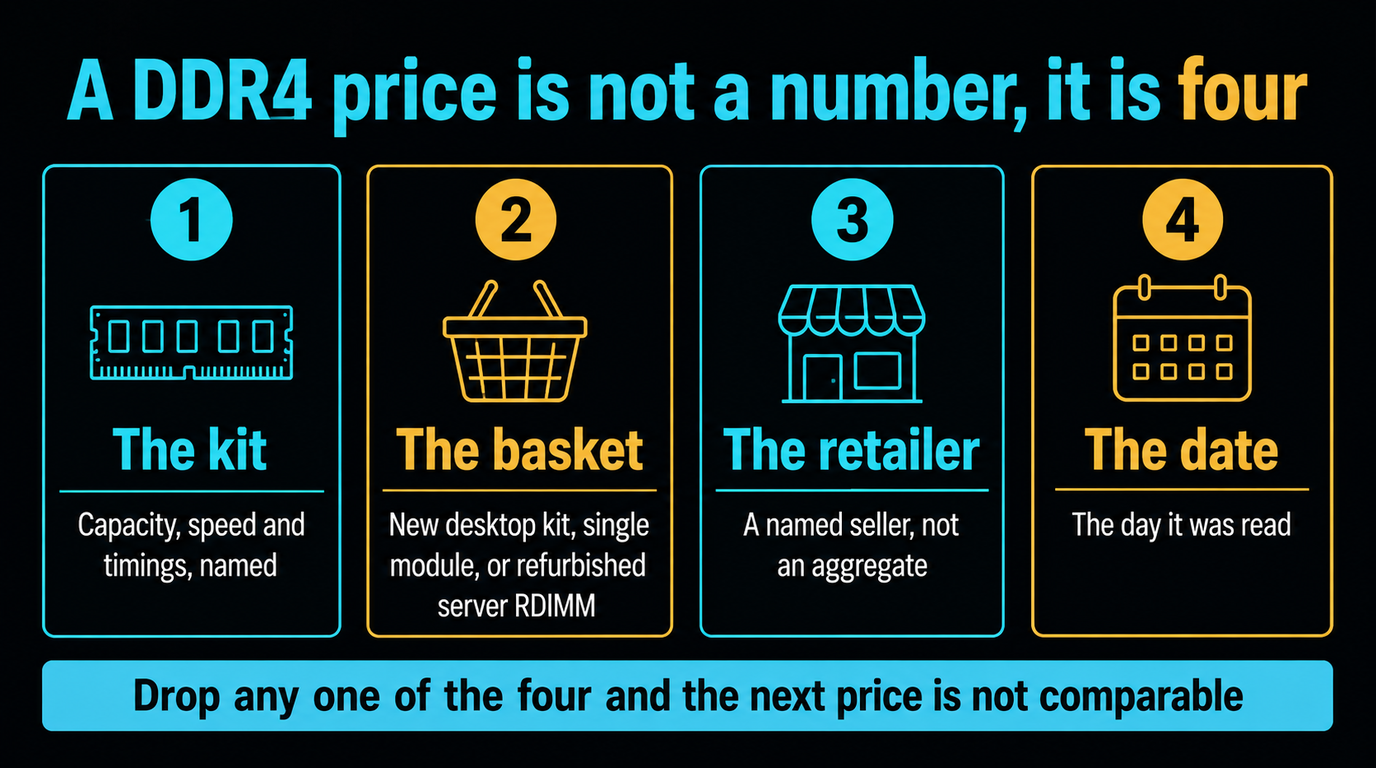
One. Establish what class of part you are looking at before you compare anything. A DDR4 price that beats the table above by a factor of two is a marketplace module or refurbished server memory, and for most buyers a registered DIMM is not a cheaper option but a non-functioning one. Two. Price the gigabyte, not the kit, and do it for every candidate — a 64 GB kit is not automatically better value, as the capacity table shows. Three. Convert CAS latency to nanoseconds before paying for a faster grade: CL divided by half the transfer rate, times 1,000. Kits that sound a grade apart are routinely identical. Four. Check the date on every figure you are using, including ours — each of our prices carries the day we saw it, and an undated DDR4 price from earlier this year is not a small error.
And the check that is easiest to skip: confirm the kit is in stock at the price you are quoting. A listing showing a price while showing no stock is the biggest single source of phantom figures in published memory tables. We drop those observations rather than carrying them forward, which is why some rows on the tracked SKU list read “awaiting scrape” instead of repeating an old number.
How these numbers are produced, and what we withhold
We scrape live product pages at tracked US retailers and store every observation with a timestamp and a stock flag. Per kit we take the cheapest in-stock observation across those retailers inside a 30-day window and divide by the kit’s capacity; that is the $/GB figure in every table above. Out-of-stock and null-priced rows are excluded rather than carried forward, and true latency is computed from the listed spec, not taken from marketing copy.
The window is 30 days rather than something tighter because our scrape cadence runs from two to ten days per listing. At 48 hours most kits would have no observation at all and every figure here would collapse to a single listing. That is a real limitation, and it is why each price prints the day it was seen.
A median prints only where a group holds five or more kits, and our DDR4 cohort does not, so you will see the word withheld where other pages would show an average. What a basket this size can support is a range, a spread, and named kits with dates against them; what it cannot support is a market-wide DDR4 average, and the difference is the whole reason this page reads the way it does. Every figure here is an observation or arithmetic over observations. None of it is a forecast, and we do not publish one.
Related reading
FAQ
What does DDR4 RAM cost in 2026?
At US retail, for a new-in-box desktop kit, our observations run $7.50 to $9.37 per gigabyte across the 4 kits we currently price — every one a cheapest in-stock price at a named retailer inside a 30-day window. Multiply the per-gigabyte figure by the capacity you want for a rough target. You will find DDR4 quoted far below that elsewhere, but those figures come from eBay listings of individual low-speed modules or from refurbished registered server memory, which are different products rather than better prices.
Why do DDR4 prices differ so much between websites?
Because they price different baskets and almost never say so. On 22 September 2026 one tracker we read started its DDR4 list at $1.58 per gigabyte, and every row we could read was an eBay listing of an individual DDR4-2133 to DDR4-2666 module; a second source, itself a refurbished-memory vendor, put its cheapest gigabyte at $5.84 on a registered server DIMM. Neither is comparable with a new retail kit. Insist on four things beside any DDR4 price: the retailer, the date, the capacity, and whether the part is new, used or refurbished.
Is DDR4 still cheaper than DDR5?
Yes, by a wide margin at the gigabyte. On our observations the cheapest DDR4 gigabyte is $7.50 against $14.37 for the cheapest DDR5 one, with a DDR5 median of $17.47 across 7 kits. What that does not settle is whether to buy it: a cheaper gigabyte on a platform with no upgrade path is a different purchase from a dearer one on a current socket.
Is DDR4 being discontinued?
Production is being wound down rather than switched off on a date. TrendForce reported on 22 June 2026 that wafer allocations for DDR4 and other mature-node products have been reduced while the three major suppliers prioritise advanced-node output for HBM and server DRAM, and that DDR4 designs are being replaced with DDR3 solutions while certain DDR3 products are being redesigned around DDR2. Kits remain on shelves; what has changed is that new supply is no longer being added at the old rate.
Should I buy DDR4 now or wait for prices to drop?
We do not publish forecasts, so we will not tell you which way prices go, and the pages that do are guessing. What we can tell you is the position: DDR4 is a mature node whose wafer allocation has been cut, which is not the setup that usually produces a discount, and the useful question is whether the quote in front of you is above or below the observed range in the tables on this page. If the kit is for a machine you need working, the size of the range across near-identical kits is a bigger lever than timing.
Is a faster DDR4 kit worth paying more for?
Check it in nanoseconds first, because CAS latency is not comparable across speed grades. Divide CL by half the transfer rate and multiply by 1,000: a CL18 kit at DDR4-3600 and a CL16 kit at DDR4-3200 both come to 10.00 ns, so one of them only sounds faster. On our basket, kits with identical true latency sit double-digit percentages apart per gigabyte, and the cheapest of them is not the one with the lowest grade on the box.
Is a 64GB DDR4 kit better value than a 32GB one?
Not automatically, and on our observations not at all. The bigger-is-cheaper rule assumes the larger part carries a volume discount, and on memory this year it has frequently run the other way. The capacity table on this page prints the step between the capacities we track along with the number of kits behind each one, so you can see how thin the comparison is. Check the step for the specific kits you are choosing between rather than assuming the larger one wins.
Can I use cheap server DDR4 (RDIMM) in a desktop?
Generally no, and this is the reason the cheapest published DDR4 gigabyte is not available to most buyers. Registered and load-reduced DIMMs need a memory controller that supports them, which consumer desktop platforms do not provide, so the module will not work in a standard build. That is why we keep it out of our basket entirely: including it would halve our headline figure and make the number useless to the people reading it.
Watch the kit, not the market
We track DDR4, DDR5 and NVMe listings at US retailers and tell you when one of yours moves. No deal scores, no affiliate links, no commission on anything you buy — observed prices, dated, with the sample size printed next to them.