2TB vs 4TB SSD in 2026: What the Second Two Terabytes Actually Costs
Key takeaways
- Going from 2 TB to 4 TB costs $427.50 more than the cheapest 2 TB drive — +115.9% for twice the storage, and +7.9% per gigabyte. Every figure here is a dated in-stock retailer observation and re-renders when the shelf moves.
- Hold the drive family still and the bigger capacity is the cheaper gigabyte, by 2.6%. Every competing page compares a 4 TB leaderboard with a 2 TB leaderboard, which moves the brand and the controller along with the size.
- The cheapest gigabyte in our basket sits at 2 TB, at $0.184/GB. Stepping up to 2 TB takes −1.6% off the gigabyte; stepping up again adds +7.9%. The curve bends, and the published advice treats it as a slope.
- The premium has moved −4.1 points since the open, to −2.6%. That is two dated measurements of the same two parts, not a forecast — we do not publish those.
- Picking beats sizing: the 2 TB band runs 35.2% from cheapest to dearest across 5 drives. Take the dearest out and it is still 21.0% — so the spread is not one odd listing.
- What the second two terabytes costs
- Hold the drive still and the answer changes
- The per-gigabyte curve bends at 2 TB
- The premium is not sitting still
- Picking beats sizing inside one capacity
- Why the published tables disagree by nine times
- One 4 TB drive, or two 2 TB drives
- How these numbers are produced
- Related reading
- FAQ
Every page answering 2TB vs 4TB SSD answers it on how many games you keep installed, and the handful that mention money publish a number with no retailer and no date attached to it. That was harmless when the gap was forty dollars: the second two terabytes currently costs $427.50 on our own observations, +115.9% on top of the cheapest 2 TB drive we can find in stock. The capacity question has become a budget question and the advice in circulation has not priced it. This page does: what the step costs in cash and per gigabyte, what happens when you compare two capacities of the same drive instead of two leaderboards, and how far the answer has moved since July. We priced every drive in our basket at one retailer with a date on each figure, and read the six pages ranking for this comparison.
Four of those six publish no price at all. The two that do sit four to nine times below what we observe, on baskets neither of them states. None of the six holds the drive family still, which is the only version of this comparison that can be checked — and on the one family we can price at both capacities today, the 4 TB drive is −2.6% per gigabyte against its own 2 TB sibling.
What the second two terabytes costs
Start with the invoice, the part no competing page prints: the cheapest drive with a live in-stock price at each capacity, side by side. Doubling capacity for exactly double the money is +100% in cash and zero per gigabyte, so the two columns disagree by construction — and printing only the first is how a capacity premium hides inside a bigger number.
| Step | Cheapest smaller | Cheapest larger | Cash step | Step % | Per-GB step |
|---|---|---|---|---|---|
| 1 TB → 2 TB | Crucial P3 Plus 1TB NVMe Gen4 SSD $187.46 · $0.187/GB · Newegg · Oct 20, 2026 · n=1 | Crucial T500 2TB NVMe Gen4 SSD $369.00 · $0.184/GB · Newegg · Oct 20, 2026 · n=5 | $181.54 | +96.8% | −1.6% |
| 2 TB → 4 TB | Crucial T500 2TB NVMe Gen4 SSD $369.00 · $0.184/GB · Newegg · Oct 20, 2026 · n=5 | Samsung 990 Pro 4TB NVMe Gen4 SSD $796.50 · $0.199/GB · Newegg · Oct 27, 2026 · n=1 | $427.50 | +115.9% | +7.9% |
The two steps point opposite ways. Moving from 1 TB to 2 TB costs $181.54 and takes −1.6% off the gigabyte — the economy of scale the buying guides describe. Moving from 2 TB to 4 TB costs $427.50 and adds 7.9% to it. Same basket, same retailer, same day: the rule holds once and then reverses.
One caveat belongs here rather than in the footnotes: the cheapest drive at a capacity and the cheapest gigabyte at that capacity are not always the same drive. A drive sold as 2 TB may hold 2,000 GB or 2,048 GB, and the 48 is real storage. This table ranks on cash, the curve further down ranks on the gigabyte, and they name different drives.
Hold the drive still and the answer changes
Here is the flaw running through every page ranking above us. They compare the best 4 TB drive on their list with the best 2 TB drive on their list, and those are different products — different controller, different NAND tier, often a different brand. Whatever per-gigabyte number falls out is capacity plus everything else, and nothing says how much is which.
The fix is to compare two capacities of the same drive: same manufacturer, controller, interface and retailer, observed days apart. Then the only variable left between the columns is the one being argued about.
| Drive family | Its 2 TB | Its 4 TB | Cash step | Per-GB step | Verdict |
|---|---|---|---|---|---|
| Samsung 990 Pro NVMe Gen4 SSD | $408.95 $0.204/GB · Oct 27, 2026 | $796.50 $0.199/GB · Oct 27, 2026 | $387.55 · +94.8% | −2.6% | Bigger is the cheaper GB |
The bigger drive is the cheaper gigabyte by 2.6% against its own sibling, so on this family the bulk discount is real. The cash step is still $387.55. The honest limit: this is one family, because a family has to be priced at both capacities on the same shelf to qualify, and most of the basket is not. We print n rather than implying a survey.
The per-gigabyte curve bends at 2 TB
Widen it out from one family to the whole basket and the shape gets clearer. Plot the cheapest gigabyte we can find at each capacity and the line does not slope downward the way “bigger is cheaper” predicts. It falls, bottoms out, and climbs again.
| Capacity | Cheapest gigabyte | Per terabyte | Median $/GB | Drives priced | Step from previous |
|---|---|---|---|---|---|
| 1 TB | $0.187/GB | $187.46/TB | withheld (n<5) | n=1 | — |
| 2 TB | $0.184/GB | $184.50/TB | $0.204/GB | n=5 | −1.6% |
| 4 TB | $0.199/GB | $199.13/TB | withheld (n<5) | n=1 | +7.9% |
The floor sits at 2 TB, $0.184/GB, which is $184.50/TB. Below it the gigabyte is dearer because small drives carry a controller and a board that cost roughly the same whatever is soldered to them. Above it the gigabyte is dearer again, and for a different reason: the highest-density packages are the ones data-centre buyers are bidding for, so the parts that make a 4 TB consumer drive are the parts in shortest supply.
That bend is not our discovery, and it is worth saying so — buyperunit.com reached the same conclusion in March 2026 (“2TB NVMe drives hit the lowest per-GB cost in the entire lineup”), and so does hddhunt.com. What neither publishes is where the floor sits today, at which retailer, on which date, or across how many drives. A shape without a level cannot price a purchase.
The premium is not sitting still
Every page here states a level and none states a change — the more useful figure, because it says whether a number read in the spring still describes the shelf. Measuring it needs no forecast, only the same two parts priced twice.
| Drive family | At the open | Premium then | Now | Premium now | Change |
|---|---|---|---|---|---|
| Samsung 990 Pro NVMe Gen4 SSD | $388.55 vs $789.00 (Jul 31 / Aug 1 · n=9) | +1.5% | $408.95 vs $796.50 (Oct 27, 2026 / Oct 27, 2026) | −2.6% | −4.1 points · narrowed |
The premium has narrowed +4.1 points since the open, to −2.6%. The direction is the finding; we take no view on where it goes next. Both ends are anchored on parts that still carry a current offer, so a drive that has since been delisted cannot set one end and a live drive the other — that would report a change of basket as a change of price.
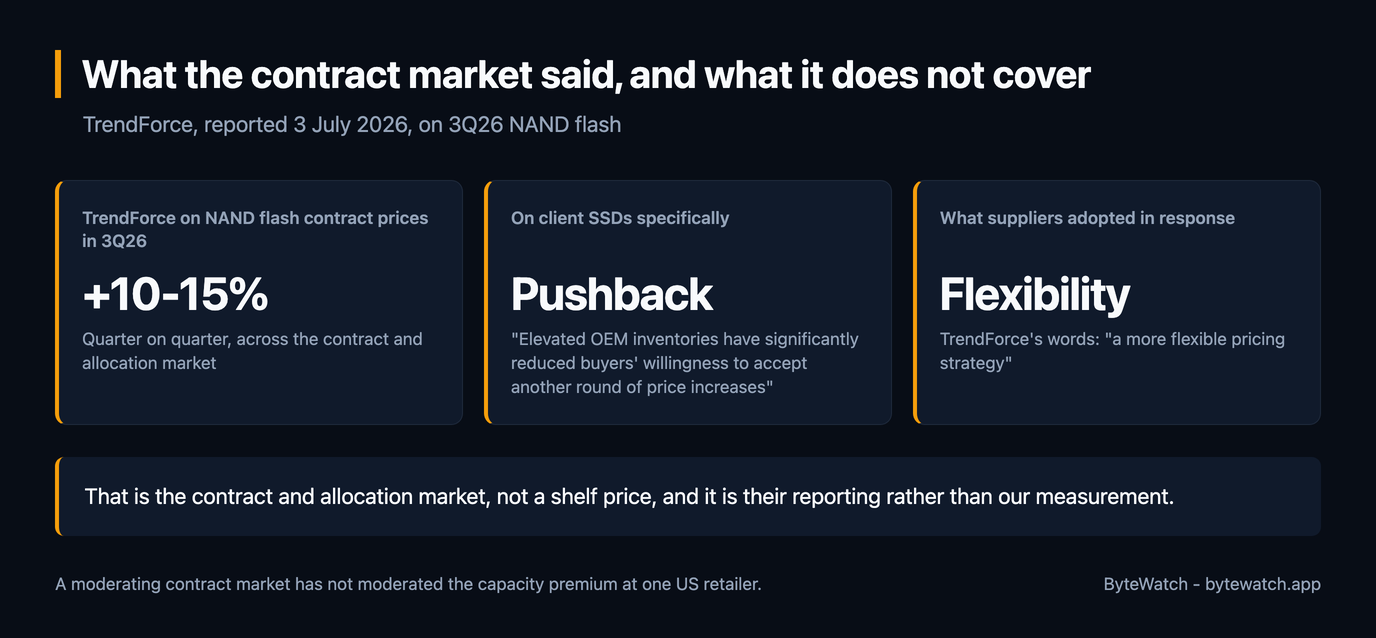
The upstream market is not obviously pushing this. TrendForce reported on 3 July 2026 that NAND flash contract prices would rise 10–15% quarter on quarter in 3Q26, and said of client SSDs specifically that “elevated OEM inventories have significantly reduced buyers’ willingness to accept another round of price increases”, with suppliers adopting “a more flexible pricing strategy”. That is the contract and allocation market, not a shelf price, and it is their reporting rather than our measurement. What we can say is that a moderating contract market has not moderated the capacity premium at one US retailer.
Picking beats sizing inside one capacity
There is a lever most of this SERP never mentions, and on our numbers it is worth several times more than the one it spends two thousand words on. Hold capacity completely still and look at what the drives inside it cost.
| Drive | Price | Per GB | Per TB | Vs cheapest | Observed |
|---|---|---|---|---|---|
| Crucial T500 2TB NVMe Gen4 SSD | $369.00 | $0.184/GB | $184.50/TB | — | Newegg · Oct 20, 2026 |
| WD Black SN850X 2TB NVMe Gen4 SSD | $374.92 | $0.187/GB | $187.46/TB | +1.6% | Newegg · Oct 20, 2026 |
| Samsung 990 Pro 2TB NVMe Gen4 SSD | $408.95 | $0.204/GB | $204.47/TB | +10.8% | Newegg · Oct 27, 2026 |
| SK hynix Platinum P41 2TB NVMe Gen4 SSD | $446.35 | $0.223/GB | $223.18/TB | +21.0% | Newegg · Oct 20, 2026 |
| Kingston KC3000 2048GB NVMe Gen4 SSD | $499.00 | $0.244/GB | $243.65/TB | +32.1% | Newegg · Oct 27, 2026 |
35.2% between the cheapest and the dearest 2 TB drive, across 5 of them, on the same day at the same retailer. One listing does carry a lot of that: drop Kingston KC3000 2048GB NVMe and the spread is 21.0%. Both figures are printed because a spread is a claim about a cohort, and a headline resting on a single outlier should say so rather than let the reader find out. Even the smaller of the two, 21.0%, is roughly 2.64x the per-gigabyte step you get for doubling the capacity.
So the order of operations is backwards in most buying guides. Choose the capacity you actually need, then spend the effort on which drive — that is where the money is. The value ranking does this at every capacity we track, and the live SSD chart shows how each of these series got where it is.
Why the published tables disagree by nine times
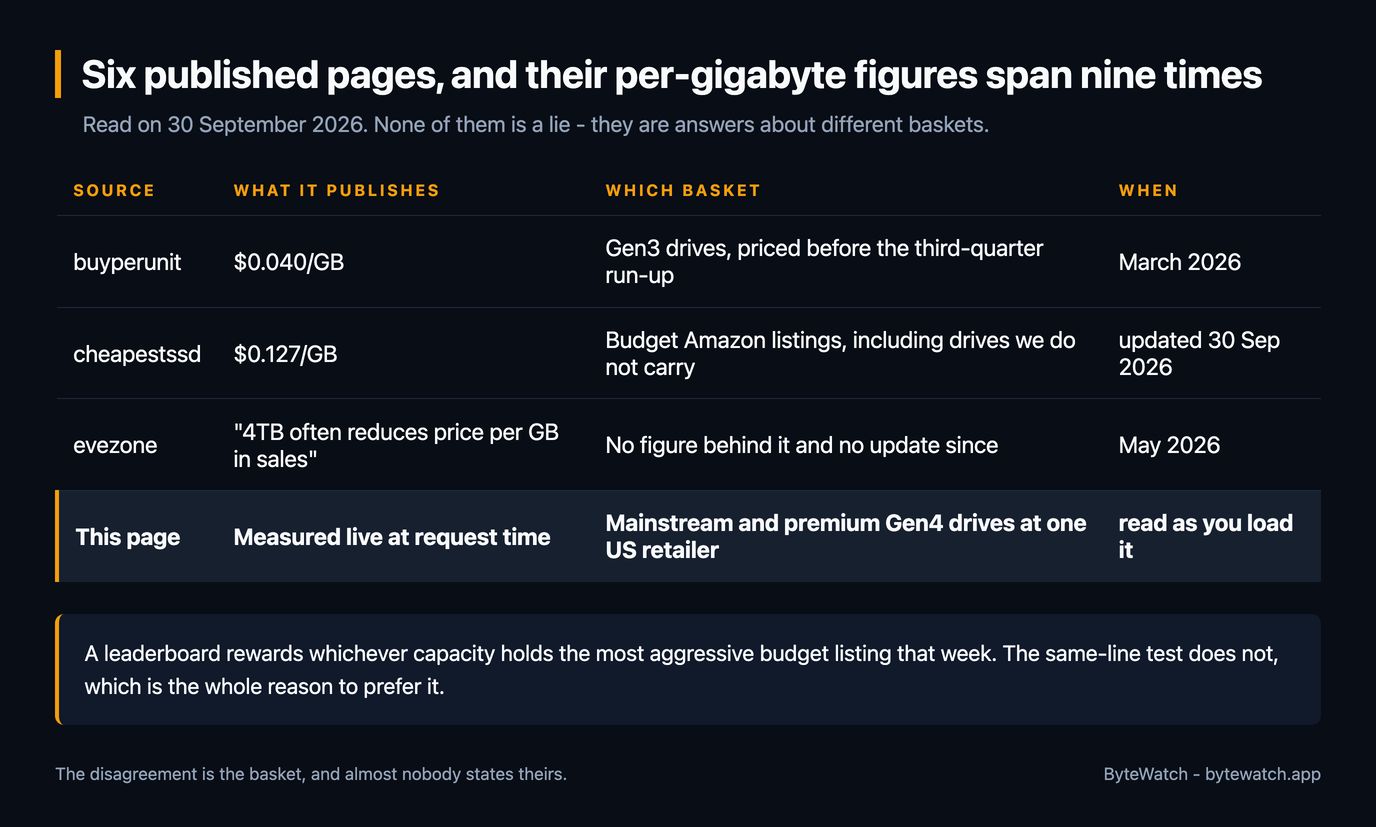
We read six pages for this comparison on 30 September 2026. Here is what each of them actually publishes, because the disagreement between them is invisible to anyone reading one of them.
| Page | Dated | Basket | Figure published | Its per-GB claim |
|---|---|---|---|---|
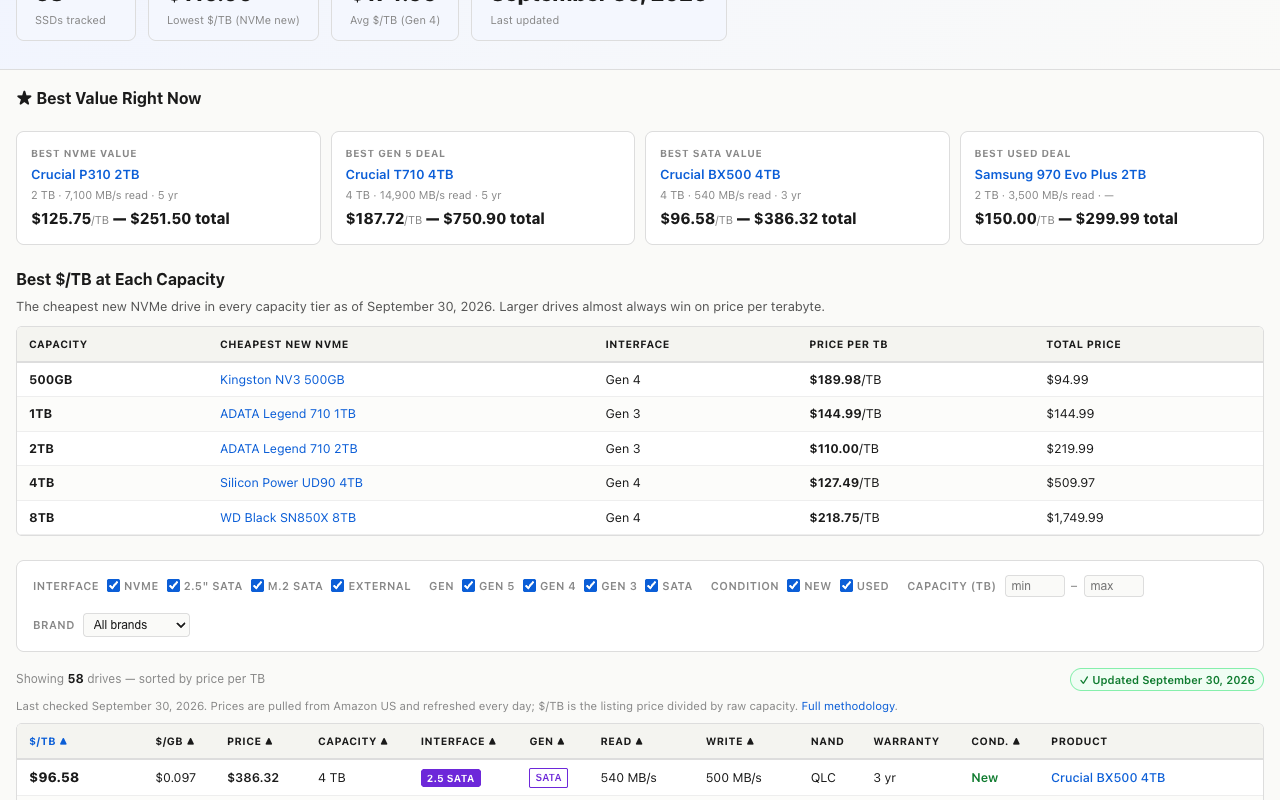
| cheapestssd.com/4tb-ssd | upd. 30 Sep 2026 | Amazon US, 14 drives | Cheapest 4 TB at $127.49/TB | 4 TB is "usually the best $/TB too" |
| buyperunit.com | 10 Mar 2026 | Amazon / Best Buy / Newegg, Gen3 | 2 TB $0.040–$0.058/GB; 4 TB $0.040–$0.055/GB | "2TB NVMe drives hit the lowest per-GB cost" |
| hddhunt.com/best-2tb-ssd | undated ("2026") | unstated, 8 drives per table | $85–$110/TB at 2 TB | 2 TB "usually gets the best price-per-TB" |
| evezone.evetech.co.za | 23 May 2026 | none | No prices at all | "4TB often reduces price per GB in sales" |
| cloudzat.com/2tb-vs-4tb-ssd-price | undated | none | No prices at all, on a page titled "Price" | "Sometimes" — declines to answer |
| americas.lexar.com | 8 May 2025 | none | No prices at all | 2 TB "typically offers better cost per gigabyte than 1TB" |
Line up the per-gigabyte figures and they span roughly nine times: $0.040/GB from buyperunit in March, $0.127/GB from cheapestssd updated today, and our own cheapest $0.184/GB at Newegg. None of these is a lie. They are answers about different baskets — buyperunit’s March figures are Gen3 drives before the third-quarter run-up, cheapestssd tracks budget Amazon listings including drives we do not carry, and ours are mainstream and premium Gen4 drives at one US retailer. The disagreement is the basket, and almost nobody states theirs.
Which is why cheapestssd can call a 4 TB drive “usually the best $/TB too” on the same day we measure a per-gigabyte premium at 4 TB, and both be right: a leaderboard rewards whichever capacity holds the most aggressive budget listing that week. The same-line test does not, which is the whole reason to prefer it. The one claim we can call outdated rather than differently-basketed is evezone’s “4TB often reduces price per GB in sales” — written in May, with no figure behind it and no update since.
One 4 TB drive, or two 2 TB drives
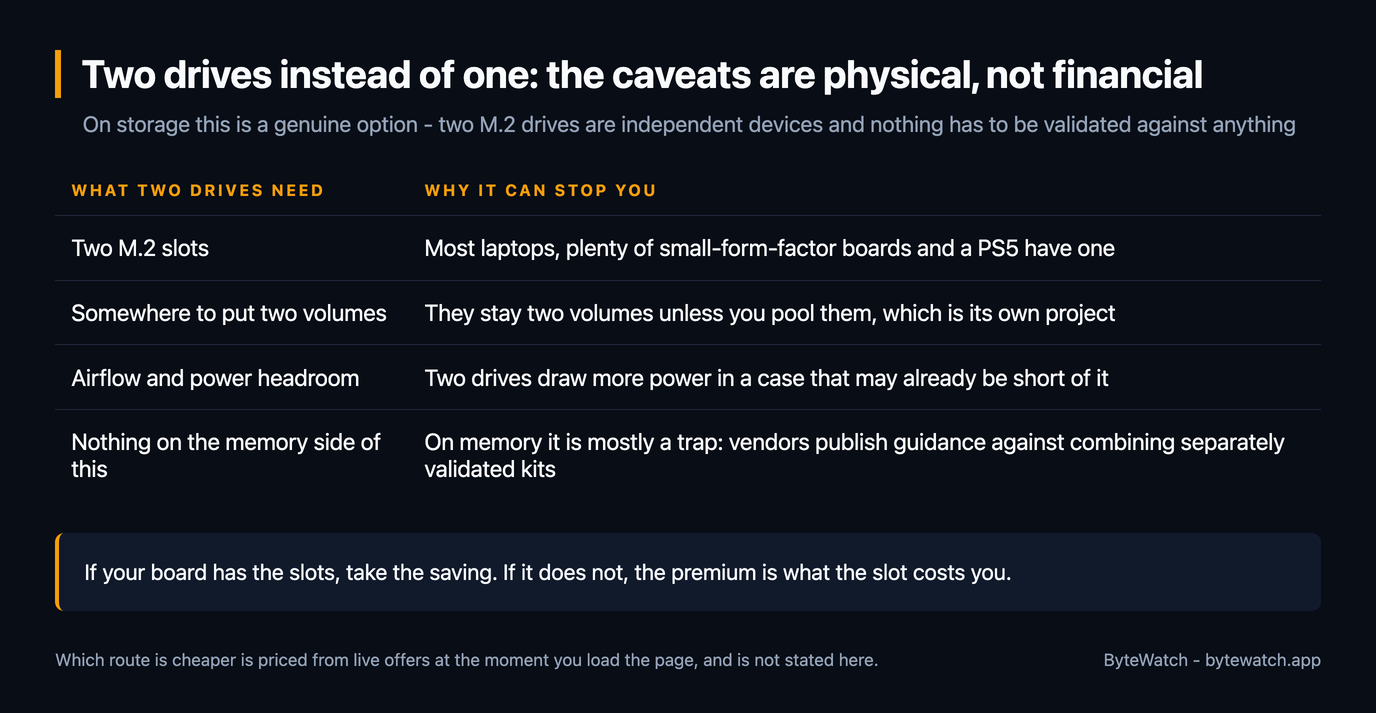
If the bigger drive carries a per-gigabyte premium, the obvious question is whether two smaller ones are cheaper. On memory this is mostly a trap, because vendors publish guidance against combining separately validated kits. On storage it is a genuine option: two M.2 drives are independent devices and nothing has to be validated against anything.
Cheaper is not automatically better, and the caveats are physical rather than financial. Two drives need two M.2 slots, and most laptops, plenty of small-form-factor boards and a PS5 have one. Two drives are two volumes unless you pool them, which is its own project. They also draw more power in a case that may already be short of airflow. If your board has the slots, take the saving; if it does not, the premium is what the slot costs you.
How these numbers are produced
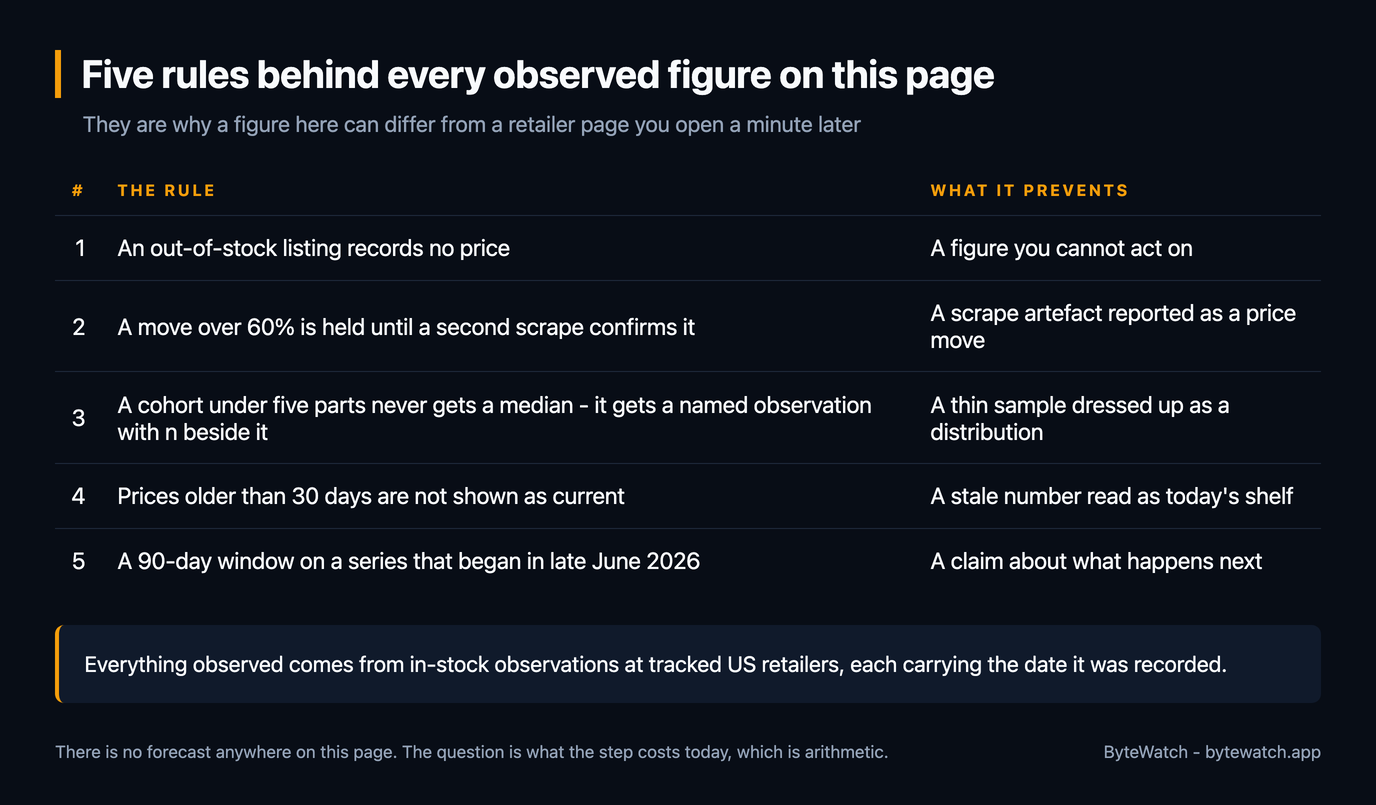
Everything above comes from in-stock observations at tracked US retailers, each carrying the date we recorded it. Five rules do the work, and they are why a figure here can differ from a retailer page you open a minute later.
An out-of-stock listing records no price, so nothing here is a figure you cannot act on. A move over 60% is held until a second scrape confirms it. A cohort under five parts never gets a median — it gets a named observation with n beside it, which is why the curve says withheld where it does. Prices older than 30 days are not shown as current. The window is 90 days on a series that began in late June 2026, so this page says what has happened, not what will.
Related reading
FAQ
Is a 4TB SSD worth it over a 2TB in 2026?
As a price question, which is the half we can answer: on the one drive family we can currently price at both capacities, the 4 TB costs more than double its 2 TB sibling and works out dearer per gigabyte, so it is not the bulk discount the buying guides assume. Whether the capacity is worth that is a question about your library, not about the market. If you only need the space, two 2 TB drives are currently the cheaper invoice where you have the slots for them.
Is a bigger SSD cheaper per gigabyte?
Up to a point, and then no. In our basket the cheapest gigabyte sits at 2 TB: stepping up from 1 TB takes roughly a fifth off the per-gigabyte price, and stepping up again to 4 TB adds about a fifth back. The reason the curve bends is that small drives carry fixed controller and board costs whatever their capacity, while the highest-density packages that make a 4 TB consumer drive are the ones data-centre buyers are competing for.
How much should a 2TB NVMe SSD cost right now?
Our cheapest current in-stock observation puts NVMe Gen4 at $0.184 per gigabyte, so a 2 TB drive starts around two thousand times that, and the dearest drive in the same capacity runs far higher for identical storage. The table on this page names each drive, its retailer and the day we observed it. Published figures for this vary by several times depending on basket and date, which is why we print both.
Why do different sites publish completely different SSD price-per-GB figures?
Because they are measuring different baskets and almost none of them says so. Of six pages we read on 30 September 2026, four published no price at all, and the two that did were four to nine times apart from each other and from our observations — one tracking budget Amazon listings updated daily, the other publishing March figures for an older drive generation. A per-gigabyte number without a retailer, a date and a drive count is not comparable with the one next to it.
Is it cheaper to buy two 2TB SSDs or one 4TB SSD?
On our current observations two 2 TB drives are the cheaper invoice, and unlike the same question on memory there is no compatibility argument against it — two M.2 drives are independent devices. The constraints are physical: you need two M.2 slots, which most laptops, many small-form-factor boards and a PS5 do not have, and you get two volumes rather than one unless you pool them. Where the slot exists, the saving is real; where it does not, the premium is what the slot costs you.
Will 4TB SSD prices come down?
We do not publish forecasts and have no view to offer. What we can tell you is what has already happened to the drives we track, with a date on every figure, and that the per-gigabyte premium on 4 TB has been widening rather than closing across our window. TrendForce reported on 3 July 2026 that NAND contract prices would rise 10–15% quarter on quarter in 3Q26 while client SSD increases moderate — but that is the contract market, not a shelf price, and the two have not moved together here.
Does a 2TB drive really hold 2TB?
Not exactly, and the difference is large enough to change a per-gigabyte ranking. Drives sold as 2 TB are built as either 2,000 GB or 2,048 GB, and your operating system will then report something smaller again because it counts in binary gibibytes. We divide each price by that drive’s own actual capacity rather than by its marketing label, which is why the cheapest drive at a capacity and the cheapest gigabyte at that capacity are sometimes two different drives on our tables.
Watch the drive you actually want
We track NVMe, DDR5 and DDR4 listings at US retailers and tell you when one of yours moves past your threshold. No forecasts, no deal scores, no affiliate links, no commission on anything you buy — observed prices, dated, with the sample size printed next to them.
Context: NVMe Gen4 from $0.184/GB, DDR5 from $16.53/GB, cheapest in-stock observations in the last 30 days.