RAM vs SSD Upgrade in 2026: What Each One Actually Costs
Key takeaways
- Storage is the cheaper upgrade, but by far less than page one implies. Compared at the capacity we track the most parts for in each component, the memory upgrade and the storage upgrade sit within a small multiple of each other — not the four-to-five times the published figures suggest.
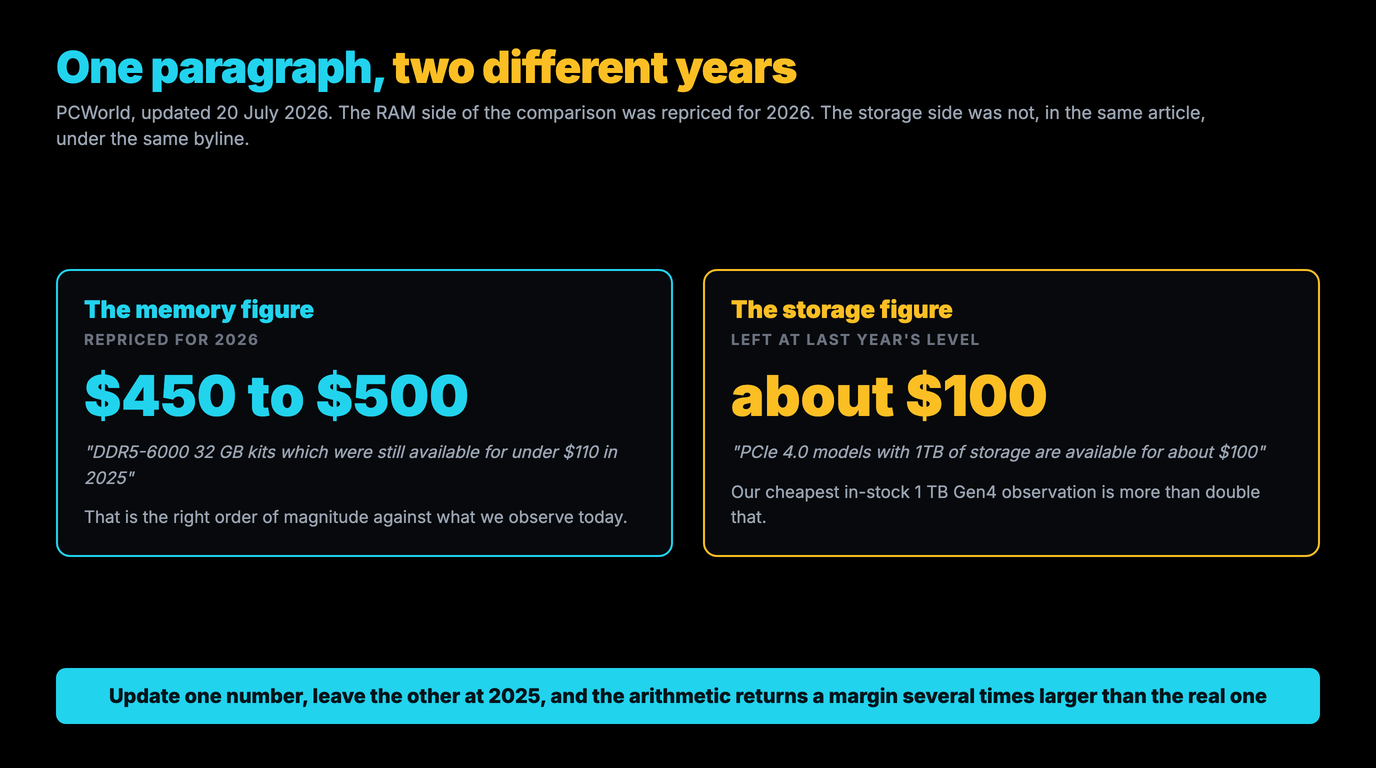
- The SSD side of the best-known comparison is priced at last year’s level. PCWorld, updated 20 July 2026, builds its storage advice on 1 TB PCIe 4.0 drives “for about $100” while pricing RAM at 2026 levels in the same article. Our cheapest in-stock 1 TB Gen4 observation is more than double that.
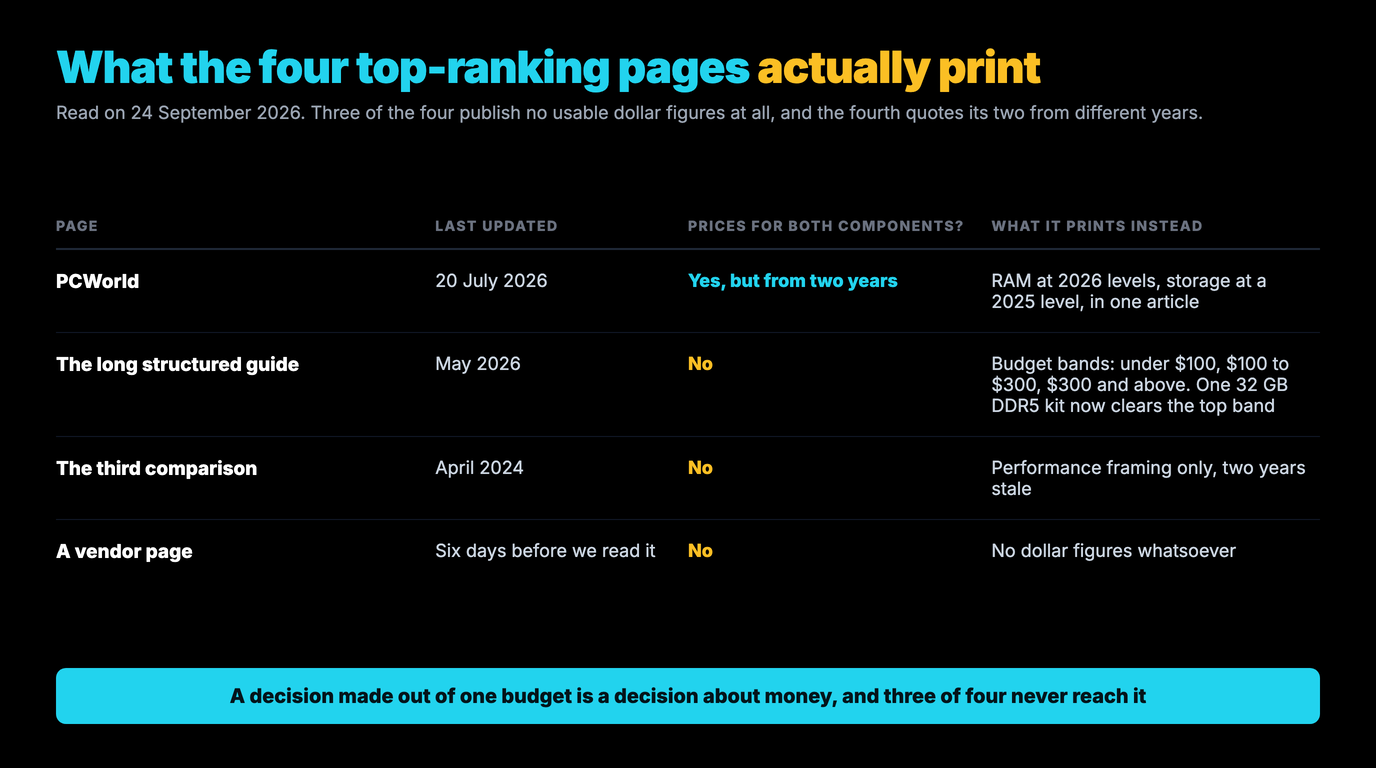
- Three of the four top-ranking pages publish no usable prices at all. Read 24 September 2026: one prices in budget bands written in May, one is dated April 2024, and a vendor page updated six days earlier contains no dollar figures whatsoever.
- The spread inside one capacity is wider than the gap between the two upgrades. Pick the right component and the wrong part and you give back more than the advice was worth.
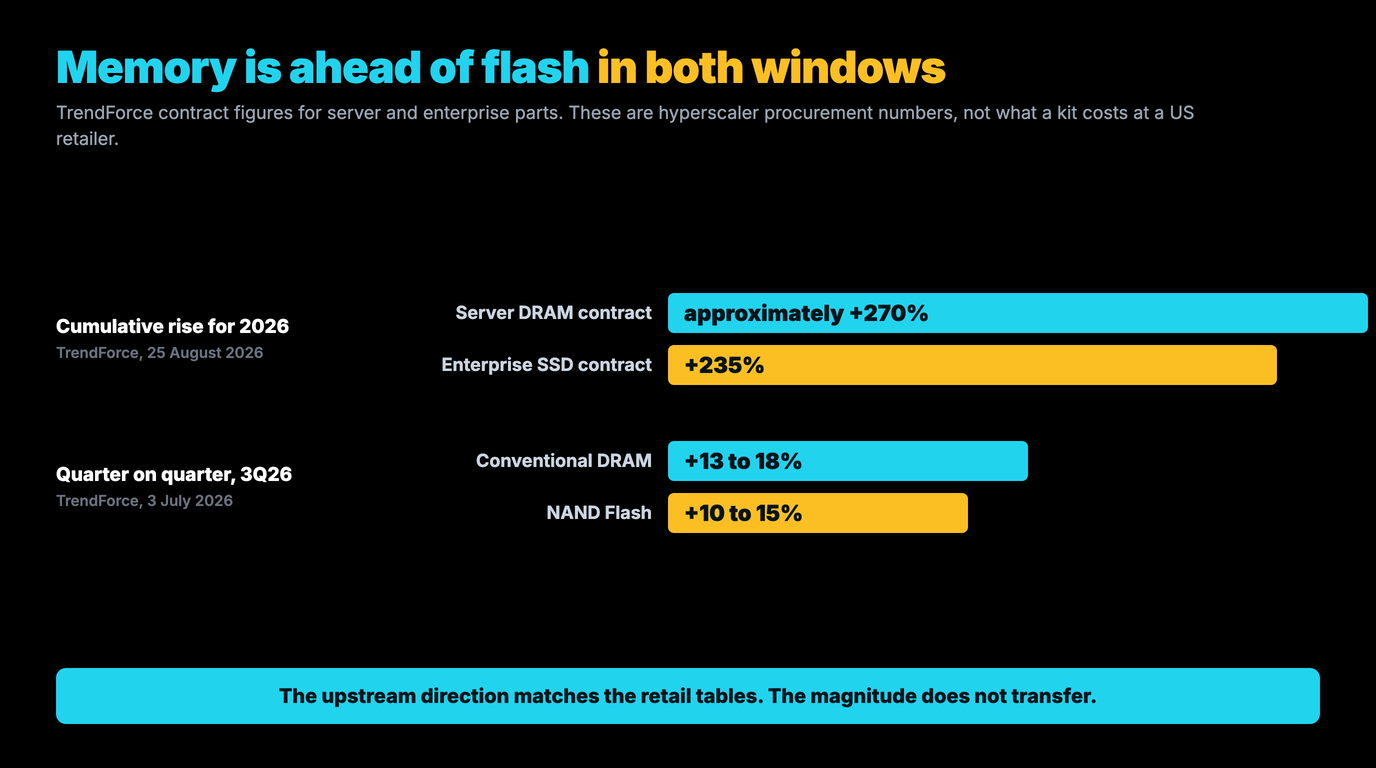
- The contract figures everyone quotes are not retail prices. TrendForce put server DRAM on a cumulative +270% path for 2026 and enterprise SSD on +235% on 25 August 2026. Those are hyperscaler procurement numbers, not what a kit costs at a US retailer.
Every guide to the RAM vs SSD upgrade question answers it on performance and then stops exactly where the decision starts, because a decision made out of one budget is a decision about money. The stakes changed this year: a 32 GB DDR5 kit that sold for around $110 in 2025 now runs several hundred dollars, which moves the choice from a preference into a real trade-off. This page gives you the half nobody publishes — what each upgrade costs at a named US retailer today, dated, with the sample size next to it. We priced both components on the same day from the same basket, and we read the four top-ranking pages to see what they charge the question with.
One of them turned out to be quoting its two prices from different years, which is enough on its own to change the answer people are walking away with. Start with the prices.
What each upgrade actually costs today
Here is the whole decision in one table, which is the thing none of the four pages above prints. Not a per-gigabyte index, not a band, not a forecast: the cheapest in-stock price we observed for each capacity of each component, with the retailer and the date attached, and the number of parts each figure came from.
| Upgrade | Cheapest part | Total | $/GB | Retailer | Observed | n |
|---|---|---|---|---|---|---|
| 32 GB DDR5 | G.Skill Flare X5 DDR5-6000 CL36 32GB (2x16GB) | $506.00 | $15.81 | Newegg | Sep 20, 2026 | 5 |
| 64 GB DDR5 | Corsair Vengeance DDR5-5600 64GB (2x32GB) | $919.99 | $14.37 | Newegg | Aug 28, 2026 | 2 |
| 32 GB DDR4 | G.Skill Ripjaws V DDR4-3600 CL18 32GB (2x16GB) | $239.99 | $7.50 | Newegg | Sep 20, 2026 | 3 |
| 64 GB DDR4 | Crucial Pro DDR4-3200 64GB (2x32GB) | $599.95 | $9.37 | Newegg | Sep 20, 2026 | 1 |
| 1 TB NVMe | Crucial P3 Plus 1TB NVMe Gen4 SSD | $227.00 | $0.227 | Newegg | Sep 20, 2026 | 1 |
| 2 TB NVMe | Kingston KC3000 2048GB NVMe Gen4 SSD | $349.95 | $0.171 | Newegg | Sep 20, 2026 | 5 |
| 4 TB NVMe | Samsung 990 Pro 4TB NVMe Gen4 SSD | $848.50 | $0.212 | Newegg | Sep 17, 2026 | 1 |
The two rows that matter are the ones most people are actually choosing between: the capacity we track the most parts for in each component. On the observations above, the 32 GB memory upgrade costs $506.00 and the 2 TB storage upgrade costs $349.95. Memory is the dearer of the two by $156.05, a multiple of 1.45x.
Note what that multiple is not. It is not four or five times, which is roughly what the prices quoted on page one imply when you put their RAM figure next to their SSD figure. It is much closer to one. That gap between the published ratio and the observed one is the subject of the next section, and it comes from one side of their comparison being older than the other.
The SSD half of every comparison is stale
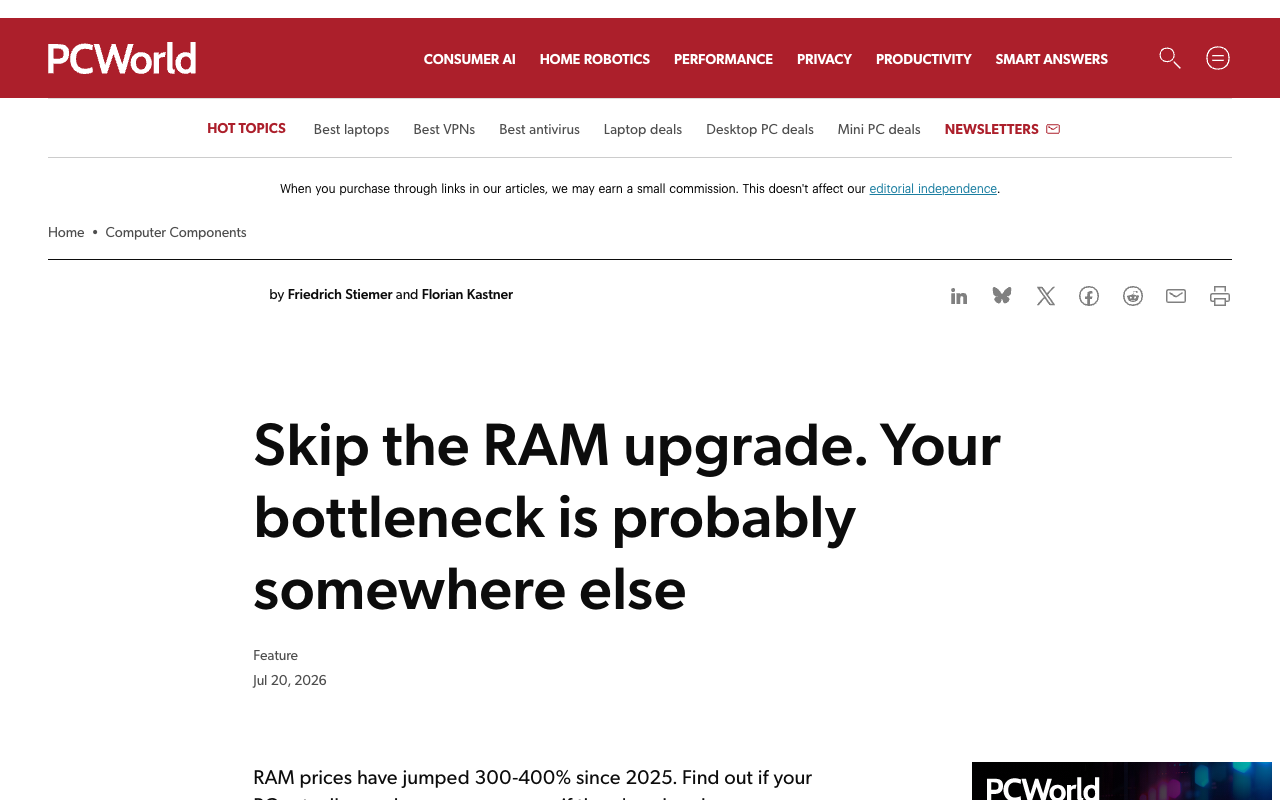
Only one of the four pages we checked prints concrete dollar figures for both components, and it prints them from two different years. PCWorld, updated 20 July 2026, quotes DDR5-6000 32 GB kits “which were still available for under $110 in 2025” as now costing “between $450 to $500” — which is the right order of magnitude against what we observe. In the same article, the storage recommendation is built on “PCIe 4.0 models with 1TB of storage are available for about $100”.
| Source | Dated | Length | Tables | Prices | What it says to buy |
|---|---|---|---|---|---|
| PCWorld | 20 Jul 2026 | ~1,400 w | 0 | RAM and SSD | SSD first; think hard before a DDR5 platform move |
| techupgradeguide.com | May 2026 | ~4,500 w | 2 | Bands only | SSD first, unless you are already on one with 8 GB |
| MiniTool | Apr 2024 | ~2,500 w | 1 | RAM and SSD | Check RAM usage first; if adequate, buy the SSD |
| Lexar | 18 Sep 2026 | ~1,500 w | 1 | None | Whichever matches your bottleneck |
The cheapest 1 TB Gen4 drive we observed in stock is Crucial P3 Plus 1TB NVMe Gen4 SSD at $227.00 (Newegg, Sep 20, 2026) — 2.27x the figure that article builds its advice on, from a sample of 1. The RAM side of that comparison has been repriced for 2026 and the SSD side has not, in the same paragraph, under the same byline.
The other three pages cannot make this mistake because they decline to make the calculation at all. The longest and best-structured of them, at roughly 4,500 words, prices in bands: under $100, $100–$300, $300 and above. Those bands were written in May 2026 and a single 32 GB DDR5 kit now clears the top of the highest one. A vendor page updated six days before we read it contains no prices whatsoever.
The same money, priced into each component
Total price answers “which upgrade can I afford”. It does not answer “where does my money go furthest”, and the second question is the one that shows how far apart these two components have drifted. So take one budget and spend all of it on each, at the best rate we observed.
| Component | Cheapest observed $/GB | $500.00 buys | Rate from | Observed |
|---|---|---|---|---|
| DDR5 memory | $14.37 | 35 GB | Corsair Vengeance DDR5-5600 64GB (2x32GB) | Aug 28, 2026 |
| DDR4 memory | $7.50 | 67 GB | G.Skill Ripjaws V DDR4-3600 CL18 32GB (2x16GB) | Sep 20, 2026 |
| NVMe Gen4 SSD | $0.171 | 2.9 TB | Kingston KC3000 2048GB NVMe Gen4 SSD | Sep 20, 2026 |
The same $500.00 buys 35 GB of DDR5 or 2.9 TB of NVMe Gen4 flash — 84.13x as many gigabytes. That ratio is the honest version of “storage is better value”, and it is enormous. It is also the wrong number to make an upgrade decision with, for a reason worth being blunt about: nobody needs the gigabytes to be interchangeable, and they are not. Doubling your working memory and quadrupling your file storage are different purchases that fix different problems. The per-gigabyte ratio tells you about the components. The total prices in the first table tell you about the decision.
We keep both units on the site for exactly this reason. The price per gigabyte by capacity piece is the per-gigabyte view, and it finds that bigger is no longer reliably cheaper on memory. This page is the total-price view. Neither replaces the other.
The spread inside one component is larger than the advice
Before you choose between RAM and an SSD, there is a choice you have already made without noticing: which part within the category. That choice is worth more than most of the cross-component guidance in circulation.
| Band | n | Cheapest | Dearest | Spread |
|---|---|---|---|---|
| 32 GB DDR5 memory | 5 | G.Skill Flare X5 DDR5-6000 CL36 32GB (2x16GB) — $506.00 | G.Skill Trident Z5 Neo DDR5-6000 CL30 32GB (2x16GB) — $649.99 | 28.5% |
| 2 TB NVMe Gen4 SSD | 5 | Kingston KC3000 2048GB NVMe Gen4 SSD — $349.95 | SK hynix Platinum P41 2TB NVMe Gen4 SSD — $467.60 | 33.6% |
Across the 5 32 GB DDR5 kits we can see in stock, the dearest costs 28.5% more than the cheapest — for the same advertised capacity, at the same retailer, inside one 30-day window. The 2 TB storage band runs 33.6% from cheapest to dearest across 5 drives. Those are not rounding errors. A reader who takes the “buy the SSD” advice and then picks the dearest drive in the band can easily give back more than the advice was worth. Getting the component right and the part wrong is a worse outcome than the reverse.
This is the same finding the DDR5 speed premium piece reached from the other direction: the dispersion inside one grade is now larger than the premium between grades. And the brand comparison shows how much of that dispersion is the badge rather than the specification.
Why memory repriced harder than storage
The upstream story explains the direction, and it is worth stating precisely because it is usually quoted at the wrong magnitude. TrendForce, on 25 August 2026, put server DRAM contract prices on a cumulative rise of approximately 270% for 2026, and enterprise SSD prices on a cumulative 235% for the same year. Earlier, on 3 July 2026, it had conventional DRAM contract prices rising 13–18% quarter on quarter in 3Q26 against NAND Flash at 10–15%. Memory is ahead of flash in both windows, which is the upstream shape of what the retail tables above show.
| Figure | Market it describes | Who pays it | Published |
|---|---|---|---|
| +270% cumulative, 2026 | Server DRAM contract | Hyperscalers and server makers | 25 Aug 2026 |
| +235% cumulative, 2026 | Enterprise SSD contract | Hyperscalers and server makers | 25 Aug 2026 |
| +13–18% QoQ, 3Q26 | Conventional DRAM contract | Module makers and OEMs | 3 Jul 2026 |
| +10–15% QoQ, 3Q26 | NAND Flash contract | Drive makers and OEMs | 3 Jul 2026 |
| See the tables above | US retail shelf, single unit | You | Observed, dated per row |
The reason memory moved further is not a mystery and does not need a forecast to state: HBM and server DRAM compete for the same wafer capacity as the DDR5 in a desktop kit, and AI server demand has been winning that allocation. We wrote that up in why RAM prices are so high. What is new on this page is the consequence for a buyer with one budget and two candidate upgrades.
One route around it survives, and it is the reason we track the older standard at all: DDR4 is a different market with its own second-hand supply, and a machine that takes it is not facing the same prices. The DDR4 price page has the detail, and the memory rows in the first table on this page show both generations side by side. If your board takes DDR4, the memory upgrade may still be the cheap one — that is a platform question, not a component question, and it is the single biggest fork in this decision.
What this changes about the standard advice
The standard advice is not wrong. On our observations storage is the cheaper upgrade in absolute dollars and is dramatically cheaper per gigabyte, so “buy the SSD first” survives contact with the data. What does not survive is the implied margin, and three of the conclusions people draw from it.
First: the gap in total price is narrow enough to lose. The difference between the two representative upgrades is smaller than the spread inside either band. Choose the component well and the part badly and you have spent the advantage.
Second: a price with no date on it is not evidence in this market. A 2026 RAM figure next to a 2025 SSD figure produced the ratio most readers are carrying around. Any comparison you rely on should state the retailer, the capacity, the interface generation and the day it was seen. Three of the four pages in our table drop at least two of those four, and one drops all of them by publishing no prices at all.
Third: we are not going to tell you whether to wait. We do not publish forecasts, and the ones in circulation for this market have disagreed with each other by large multiples all year. What we can give you is the observed range with a date against it, so you can tell whether the quote in front of you sits above or below what the shelf has actually been doing.
The practical version is short. Establish which memory generation your board takes, because that fork is worth more than everything else on this page. Price the specific upgrade you want, at the capacity you want, on the day you buy. Then check the quote against the band rather than against a number you read in an article — including this one, which is why every figure here renders live and carries its observation date.
How these numbers are produced
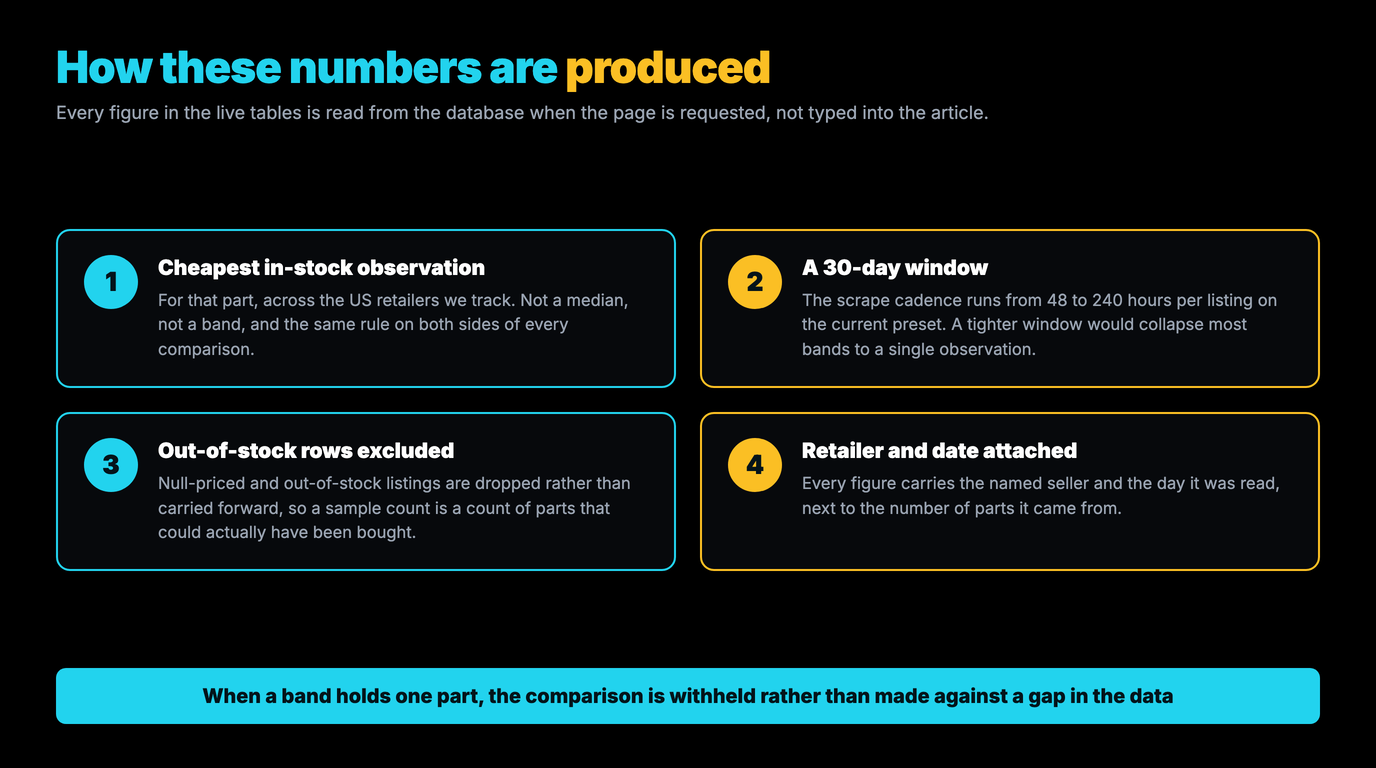
Every figure in the live tables is the cheapest in-stock observation for that part across the US retailers we track, inside a 30-day window, taken from the database when the page is requested. Out-of-stock and null-priced listings are excluded rather than carried forward, so a sample count is a count of parts that could actually have been bought. The window is 30 days because our scrape cadence runs from 48 to 240 hours per listing on the current preset; a tighter window would collapse most bands to a single observation.
The n column is there so you can discount a figure yourself. Bands below five parts do not get a median printed anywhere on this site, and where a comparison rests on a one-part band we say so in the sentence rather than in a footnote. The two representative upgrades are chosen by sample count, not hardcoded, so if our basket shifts the comparison shifts with it.
Third-party figures are typed, dated and attributed, and we link the source. The competitor table records what those pages published when we read them on 24 September 2026; pages get updated, and a fair reading of ours should assume the same about it. We do not take affiliate commission on anything in these tables, which is the only reason we can print a spread that makes several of the parts look bad.
Related reading
FAQ
Should I upgrade RAM or SSD first in 2026?
On price alone, storage is the cheaper upgrade in 2026 — both in total dollars for a typical capacity step and by a very large margin per gigabyte. But the total-price gap is narrower than the published comparisons suggest, and it is smaller than the spread between the cheapest and dearest part inside either category. The fork that matters more than either is which memory generation your motherboard takes: a DDR4 board faces a different market from a DDR5 one, and that single fact moves the answer more than any general rule.
How much does a 32GB DDR5 kit cost right now?
Our cheapest in-stock DDR5 observation currently works out at $14.37 per gigabyte with a median of $17.47 across 7 kits, so a 32GB kit lands near 32 times that figure. The table in this article prints the actual cheapest kit with its retailer and observation date rather than a computed estimate, because kits are priced as kits and the arithmetic does not always land where the per-gigabyte rate says it should.
Is an SSD really better value than RAM in 2026?
Per gigabyte, overwhelmingly yes, and by a multiple large enough that the comparison is not close. In total price for a realistic upgrade it is still yes on our observations, but by a modest margin rather than the four-to-five times implied by the prices quoted on the top-ranking pages. That inflated ratio comes from those pages pricing RAM at 2026 levels and SSDs at 2025 levels in the same article. The per-gigabyte ratio is also the wrong tool for the decision, because memory and storage gigabytes fix different problems and are not interchangeable.
Why do RAM and SSD prices differ so much between websites?
Because they are pricing different baskets on different dates and rarely say which. A price is only comparable to the one next to it if you know four things: the retailer, the capacity, the product class or interface generation, and the day it was observed. Most published comparisons drop at least two of those. Several of the pages we checked drop all four by quoting no prices at all, or by using budget bands that were written months earlier and have since been overtaken.
Did RAM prices really rise 270% in 2026?
Server DRAM contract prices are on a cumulative path of approximately 270% for 2026 on TrendForce figures published 25 August 2026, with enterprise SSD at around 235%. Those are contract prices negotiated between memory makers and large buyers for server parts — not the price of a desktop kit at a retailer. Retail moves in the same direction but at a different magnitude and on a lag. Mixing the two is the most common error in this year of memory coverage, and it works in both directions.
Is it worth upgrading an older DDR4 machine instead?
Often, yes, and it is the most underrated option in this decision. DDR4 sits in a separate market with its own second-hand supply, and the per-gigabyte prices we observe on it are a fraction of DDR5. If your existing board takes DDR4, a memory upgrade may still be the cheap one, whereas moving to DDR5 means a board, a CPU and the memory together. Check what your motherboard accepts before you price anything else.
Should I buy now or wait for memory prices to fall?
We do not publish forecasts, and the forecasts in circulation for this market have disagreed with each other by large multiples throughout 2026, so we would not repeat them either. What we can give you is the observed range with a date against it. If the quote in front of you sits below the band in the tables above, it is a good price relative to what the shelf has actually been doing; if it sits above, it is not. That is a question you can answer today, which a forecast is not.
How many gigabytes of storage does the price of a RAM kit buy?
At our cheapest observed rates — $14.37 per gigabyte of DDR5 against $0.171 per gigabyte of NVMe Gen4 — a gigabyte of memory costs roughly 84 times a gigabyte of flash. The budget table in this article works a single sum through both components so you can see the scale of it directly.
Price the upgrade on the day you buy it
We track DDR5, DDR4 and NVMe listings at US retailers and tell you when one of yours moves. No deal scores, no affiliate links, no commission on anything you buy — observed prices, dated, with the sample size printed next to them.
Context: DDR5 from $14.37/GB, NVMe Gen4 from $0.171/GB, cheapest in-stock observations in the last 30 days.