Best RAM Price Tracker in 2026: What Six of Them Publish, Checked
Key takeaways
- Of the 6 RAM price trackers we read, 2 put a date next to a price and 2 print a price per gigabyte at all. One advertises per-gigabyte comparison as a feature and prints no such figure anywhere.
- The same 32GB DDR5-6000 CL30 specification carries five published prices spanning 22.8%, from $456.00 to $559.99. Nobody is lying. They are pricing different shelves and saying so to different degrees.
- The cheapest figures carry the least attribution: 0 of 3 at the cheap end against 3 of 3 at the dear end. A price you cannot attribute is not a cheaper market. It is a weaker claim.
- One publisher, one day, one shelf: across 4 kits their figures came in up to 18.6% above our observations and up to 18.6% below them — a 37.3% span. So no single correction factor reconciles two trackers.
- We lose this comparison on coverage: only Newegg contributed in-stock memory observations in the last 30 days, across 11 priced memory SKUs, with history only since 22 June 2026. RamRadar prices more retailers and MemRadar holds far more history. Pick on what you need, not on who wrote the table.
- What a RAM price tracker is actually claiming
- Six RAM price trackers, side by side
- Four kits, one publisher, two shelves
- Why one correction factor cannot reconcile two trackers
- The cheapest figure carries the least attribution
- Who dates a price, and who does not
- Page one is not a stable set
- How to choose one — including where we lose
- How our own figures are produced
- Related reading
- FAQ
Searching for the best RAM price tracker gets you a page of tools and no way to tell them apart, because every one of them ranks itself. We read 6 of them on 10 October 2026, and put our own in the same table — last, with the columns where we are beaten filled in. The same 32GB DDR5-6000 CL30 specification came back at $456.00 from one and $559.99 from another, a 22.8% spread on nominally the same memory. Budget a build from the wrong end of that and you are a hundred dollars out before you open a retailer tab.
None of them is making the price up. They are pricing different shelves, with different refresh clocks, and they disclose that to very different degrees — so the useful question is not which number is lowest but how much of each number you can act on. We scored every figure on three things a buyer needs: which kit, which retailer, what date. Then we matched one publisher’s listed prices to our own dated observations of the same four kits, which is the comparison none of these pages runs on itself.

What a RAM price tracker is actually claiming
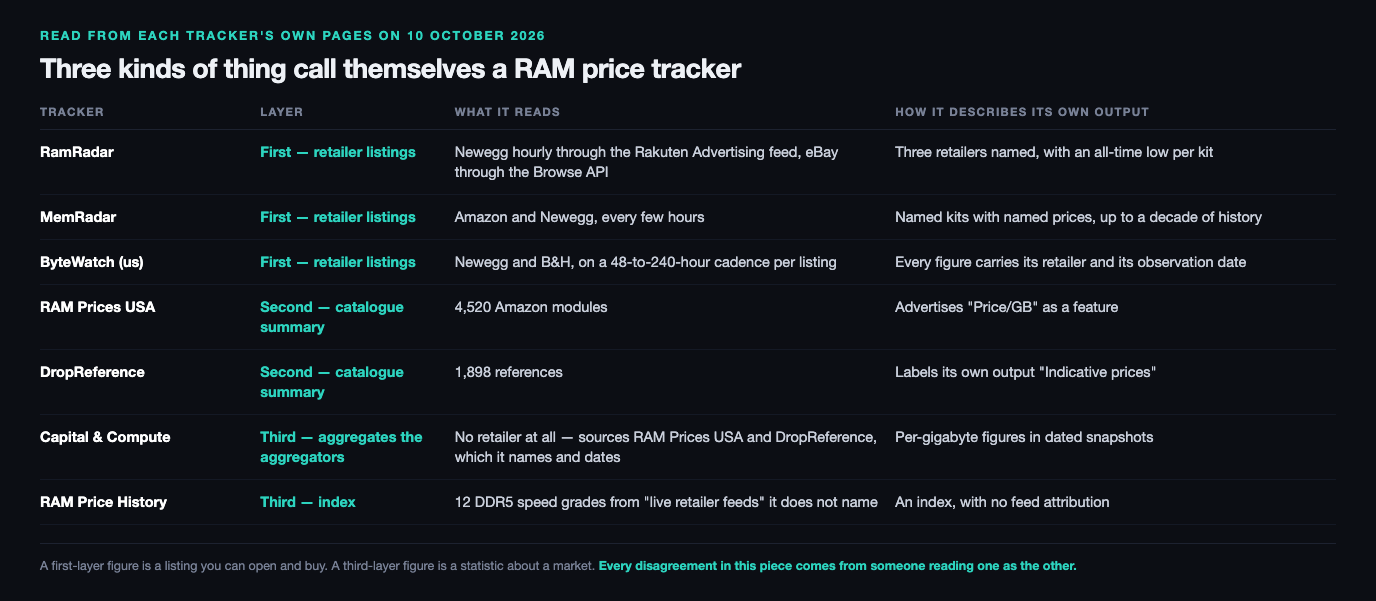
Three different kinds of thing call themselves a RAM price tracker, and the distinction decides what its numbers are good for. The first kind reads retailer listings directly, by feed or API: RamRadar takes Newegg hourly through the Rakuten Advertising feed and eBay through the Browse API, MemRadar reads Amazon and Newegg every few hours, and we scrape Newegg and B&H on a 48-to-240-hour cadence per listing.
The second kind aggregates a retailer’s whole catalogue and publishes a summary. RAM Prices USA tracks 4,520 Amazon modules; DropReference holds 1,898 references and labels its own output “Indicative prices”. The third kind aggregates the aggregators. Capital & Compute prices no retailer at all — its per-gigabyte figures come from RAM Prices USA and DropReference, which it names and dates. RAM Price History indexes 12 DDR5 speed grades from “live retailer feeds” it does not name.
Six RAM price trackers, side by side
Here is what each one says about itself, read from its own pages on the same day. There is no score column: the only honest ranking depends on whether you need retailer breadth, history depth, a per-gigabyte figure or a date.
| Tracker | Retailers priced | Refresh claim | $/GB printed? | Price dated? | Alerts | Commission |
|---|---|---|---|---|---|---|
| RamRadar 30d to all-time, with an all-time low and high | eBay, Newegg, B&H Photo | Newegg hourly (Rakuten feed); eBay and B&H a few times a day | no | no — charts dated, prices not | email at a target price | eBay Partner Network; Newegg via Rakuten |
| MemRadar up to a decade for long-tracked kits | Amazon and Newegg (every card we saw linked Amazon) | updated every few hours | yes | no | email, no account required | Newegg via Rakuten |
| Capital & Compute narrative, per post | none — it reads two other trackers | a dated snapshot per post | yes | yes — "Updated October 7, 2026" | none; email list for new posts | none found |
| RAM Price History 12 DDR5 grades, 9 countries, monthly | none named — "live retailer feeds" | page revalidates hourly | no every figure is a 32GB kit price | no | outsourced to pricedropchecker.com | none found |
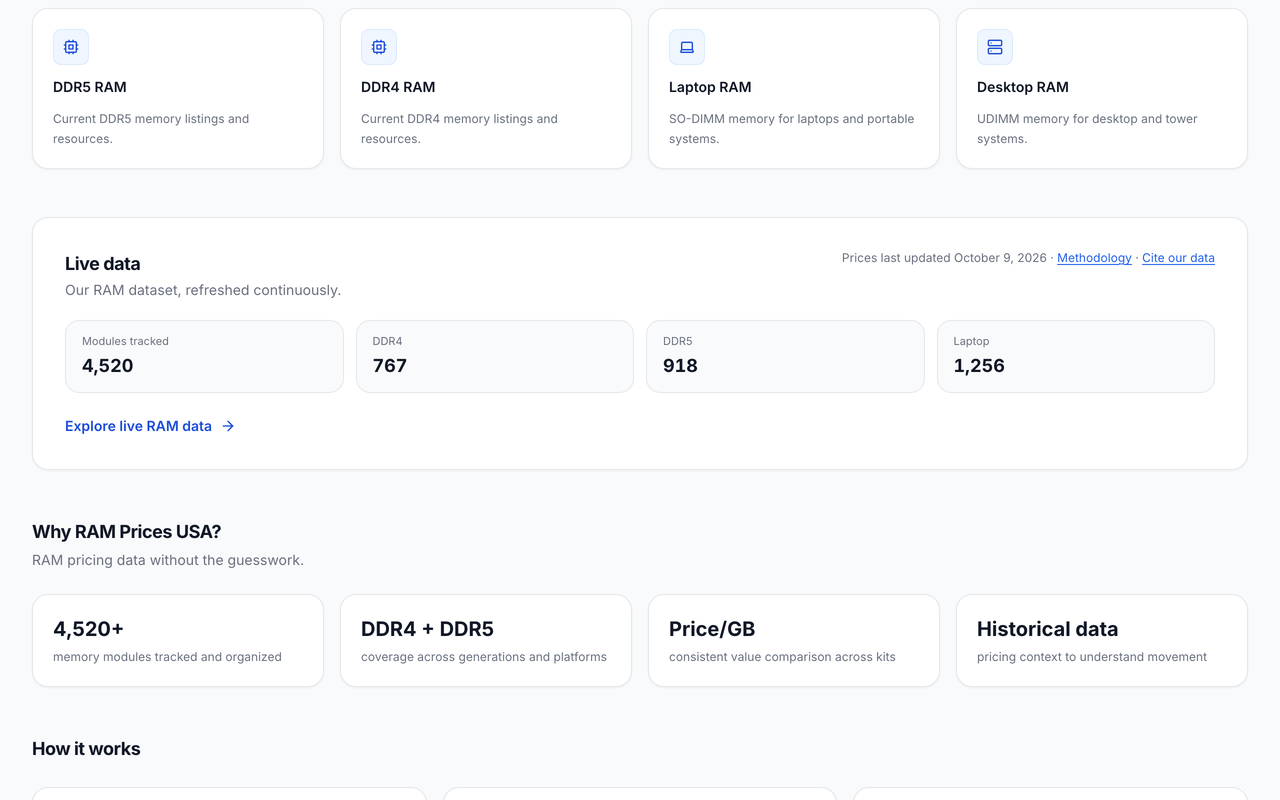
| RAM Prices USA 4,520 modules, current prices only | Amazon | prices updated daily | advertised, none printed | yes — site-wide, October 9, 2026 | none | Amazon Associates |
| DropReference 1,898 references, current prices only | none named; output "Indicative prices" | continuous; stock refreshed 5m ago | no | no — a relative "5m" refresh | none | none found |
| ByteWatch (us) since 22 June 2026 — shortest on this table | Newegg and B&H Photo | every 48 to 240 hours per listing | yes | yes — per price, as observed | free weekly digest; instant on a paid plan | none — no links, no commission |
Three things in that table are worth saying out loud. Only 2 of 6 print a price per gigabyte, the only unit that survives a comparison between a 32GB kit and a 64GB one — why, in price per GB by capacity. RAM Prices USA advertises “Price/GB” as a feature and prints no such figure anywhere on its front page, the third time this year we have read that page and found the same thing.
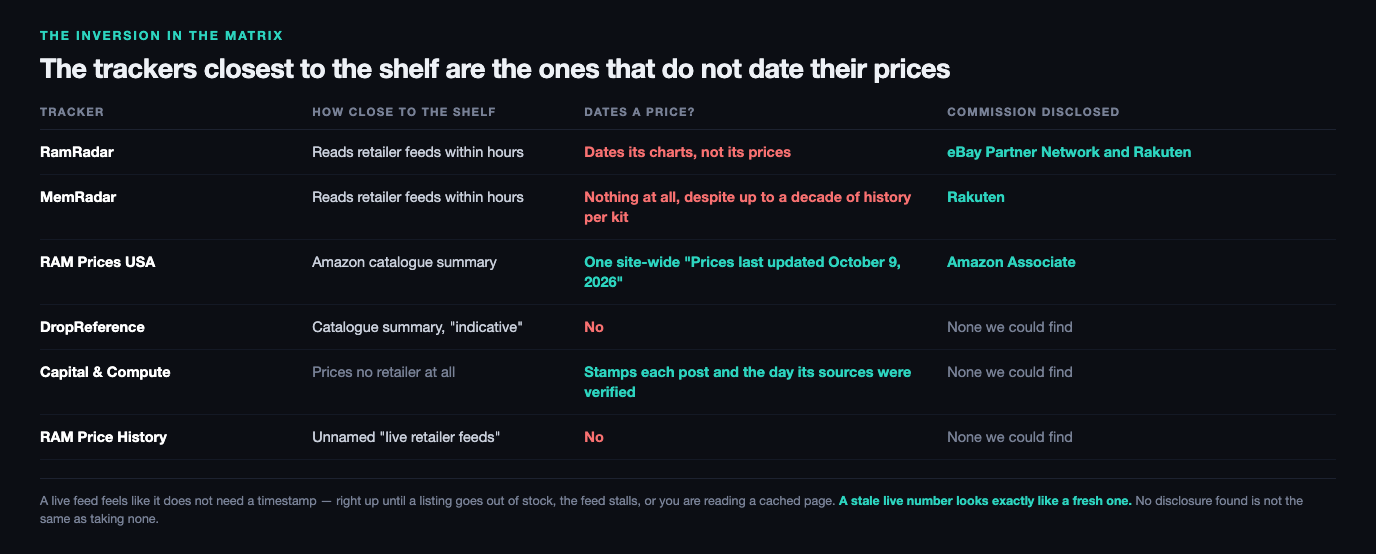
Only 2 of 6 attach a date to a price. RamRadar dates its charts and not its prices; MemRadar dates nothing at all despite holding up to a decade of history per kit. The two that do are RAM Prices USA, with one site-wide “Prices last updated October 9, 2026”, and Capital & Compute, which stamps each post and the day its sources were verified.
And commission is disclosed by three of the six: RamRadar via the eBay Partner Network and Rakuten, MemRadar via Rakuten, RAM Prices USA as an Amazon Associate. Three carried no disclosure we could find, which is not the same as taking none.
Four kits, one publisher, two shelves
A matrix of self-descriptions settles nothing, so we did the thing none of these pages does: took one publisher’s listed prices and matched them, kit by kit, to our own dated observations of the same parts. MemRadar is the natural choice because it names specific kits with specific prices, four of which are in our basket.
| Kit as they name it | Their price | We observe | Multiple | Direction |
|---|---|---|---|---|
| CORSAIR Vengeance DDR5 32GB 6000MHz CL30 | $529.99 Amazon, undated | $559.99 Newegg, Oct 28, 2026 | 1.06x | our shelf dearer by 5.7% |
| Kingston FURY Beast 32GB 6000MT/s DDR5 | $687.01 Amazon, undated | $559.00 Newegg, Oct 20, 2026 | 0.81x | our shelf cheaper by 18.6% |
| G.Skill Trident Z5 Neo RGB Series DDR5 32GB 6000MHz CL30 RGB variant of the kit we track | $589.99 Amazon, undated | $699.99 Newegg, Oct 27, 2026 | 1.19x | our shelf dearer by 18.6% |
| Crucial Pro 64GB DDR5 5600MHz | $1,085.00 Amazon, undated | $1,199.99 Newegg, Oct 20, 2026 | 1.11x | our shelf dearer by 10.6% |
One publisher on one day is deliberate: every figure in their column was read from the same page at the same time and prices the same shelf, so the only variable left between their numbers and ours is the retailer. Pull four publishers in and you can no longer tell a stale page from a different store.
The result is the part worth keeping. On the Kingston FURY Beast 32GB 6000MT/s DDR5 their Amazon figure of $687.01 sits 22.9% above the $559.00 we observed at Newegg on Oct 20, 2026. On the G.Skill Trident Z5 Neo RGB Series DDR5 32GB 6000MHz CL30 it runs the other way: $589.99 against our $699.99, so their shelf is the cheaper one by 18.6%. Same publisher, same hour, opposite directions.
Why one correction factor cannot reconcile two trackers
The obvious way to use two trackers is to learn an offset — “that one runs about 10% under, so add 10%” — and the table above is why it does not work. Across 4 kits read from one page in one sitting, the gap to our shelf ran from 18.6% one way to 18.6% the other, a span of 37.3%. An offset fitted to one kit is wrong on the next, and it is wrong by enough to matter on a single purchase.
The reason is that retailers reprice listing by listing. We counted the moves on our own basket in how often RAM prices change: repricing is a per-listing decision, not a market-wide event all shelves follow a day apart, so two stores can hold the same part at prices that cross over and back without either being wrong or stale.
The cheapest figure carries the least attribution
Hold the specification still and collect every published price for it, and a pattern falls out that none of these pages mentions. Below are five figures for a 32GB DDR5-6000 CL30 kit, cheapest first, each scored on whether it names the kit, names the retailer, and carries a date.
| Publisher | Figure as published | Price | Kit | Retailer | Date | Score |
|---|---|---|---|---|---|---|
| DropReference | DDR5–2×16Go–6000MHz–CL30, $456 (avg. $600, 134 in stock) page labels its own output "Indicative prices" | $456.00 | spec only | not named | none | 0 of 3 |
| Capital & Compute | cheapest tracked 32GB DDR5-6000 CL30 kit, $456 DropReference’s figure, re-published with a date | $456.00 | spec only | not named | October 7, 2026 | 1 of 3 |
| RAM Price History | DDR5-6000 CL30 US min price (avg. $595) min across unnamed "live retailer feeds" | $470.00 | spec only | not named | none | 0 of 3 |
| MemRadar | CORSAIR Vengeance DDR5 32GB 6000MHz CL30 listing links to Amazon | $529.99 | named | named | none | 2 of 3 |
| ByteWatch (us) | Corsair Vengeance DDR5-6000 CL30 32GB (2x16GB) | $559.99 | named | named | the observation date, printed per price | 3 of 3 |
The two cheapest figures score 0 of 3: a specification, a number, and nothing a buyer can open. The dearest scores 3 of 3 — a named kit at a named retailer on a named date. Averaged across the halves it is 0.5 against 2.5. The ordering is not a conspiracy and it is not evidence that anyone is wrong; it is what happens when a figure is allowed to be a minimum over an unnamed population.
Think about what it takes to act on each row. DropReference’s $456.00 is real in the sense that something somewhere is listed at it — 134 units in stock, the page says — but it names no store and calls itself indicative. Capital & Compute re-publishes that same figure with a date attached, which makes the citation checkable without making the price purchasable. A date on somebody else’s unattributed number does not attribute it.
Who dates a price, and who does not
There is a neat inversion in the matrix. The trackers closest to the shelf are the ones that do not date their prices, and the one that prices no retailer at all is the most carefully dated page of the six. RamRadar and MemRadar both read retailer feeds within hours and print a bare number; Capital & Compute reads other people’s trackers and stamps the post, the figures and the verification date.
It makes sense from the inside. A live feed feels like it does not need a timestamp — it is live, the number is now — right up until a listing goes out of stock, the feed stalls, or you are reading a cached page. A stale live number looks exactly like a fresh one. An essay is obviously a snapshot, so its author dates it.
Page one is not a stable set
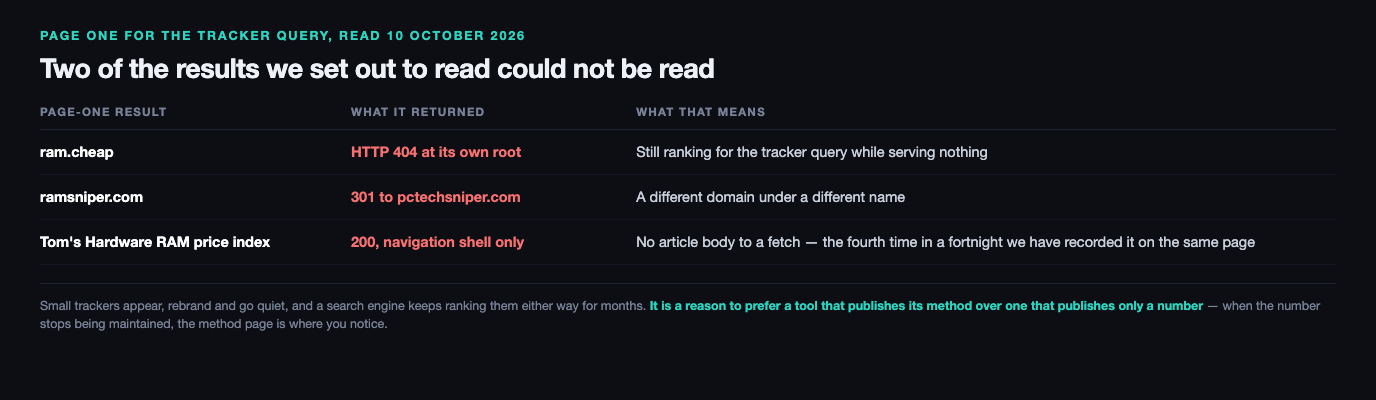
One more thing worth recording, because it affects which tool is worth learning. Of the page-one results we set out to read on 10 October 2026, two could not be read. ram.cheap returns HTTP 404 at its own root while still ranking for the tracker query, and ramsniper.com 301s to pctechsniper.com, a different domain under a different name. The Tom’s Hardware RAM price index returns 200 and serves a navigation shell with no article body to a fetch — the fourth time in a fortnight we have recorded that on the same page.
Small trackers appear, rebrand and go quiet, and a search engine keeps ranking them either way for months. It is a reason to prefer a tool that publishes its method over one that publishes only a number: when the number stops being maintained, the method page is where you notice.
How to choose one — including where we lose
There is no best RAM price tracker in the abstract — which is the honest answer, and the reason the search results are full of tools ranking themselves. There is a best one per job, and four jobs cover almost everybody:
- Buying one kit this week, widest net: RamRadar. Three retailers named, Newegg hourly through an official feed, and an all-time low to judge today against. We have none of that.
- Long history on a specific kit: MemRadar. Up to a decade on long-tracked parts against our 110 days. Whether today is dear by the standards of years is a question they can answer and we cannot.
- Market context for a budget conversation: Capital & Compute. Dated snapshots, named sources, per-gigabyte tiers and the chip-level backdrop retail lags.
- Pricing a purchase order against a dated, auditable floor: us. Every figure carries its retailer and observation date, medians are withheld below five SKUs, and we publish no forecasts.
Our weaknesses in that table are specific and worth having in writing. We name two retailers and, in the last 30 days, only Newegg contributed in-stock memory observations — so our memory prices are effectively one shelf, and a cross-retailer spread is something we can rarely show on the memory side. We hold 11 priced memory SKUs against four thousand at one aggregator, no Amazon at all, and no all-time low worth the name on a series that began in June. What we have instead is a date on every number and a basket small enough to check by hand.

How our own figures are produced
Our side of every table above is an observation, not a model. We scrape live Newegg and B&H listings on a 48-to-240-hour cadence per listing — the free-tier budget, stated rather than dressed up as hourly — and store each reading with a timestamp. A kit contributes its cheapest in-stock price from the last 30 days, which makes our figures a dated floor rather than a live quote.
A median is printed only where a band holds five or more kits; below that the page says withheld, because a median off two listings is one lucky listing wearing a statistic’s clothes. Nothing is interpolated, back-filled or forecast, and the RAM price chart prints the observation count under each series so a young line is visibly young. Where this page quotes another publisher the figure is theirs as printed, with the date we read it — re-read for this article rather than carried over, and recorded as unreadable where that is what happened.
Related reading
FAQ
What is the best RAM price tracker in 2026?
It depends on the job, and any tracker answering otherwise is ranking itself. Widest retailer net on a purchase this week: RamRadar, which names three retailers and reads Newegg hourly through an official feed. Deepest history on one kit: MemRadar, which claims up to a decade. Dated market context with its sources named: Capital & Compute. A dated, auditable floor for a purchase order: ours, where every figure carries its retailer and the day it was observed.
Why do RAM price trackers show different prices for the same kit?
Mostly because they price different shops. We matched one publisher’s Amazon listings to our own Newegg observations for four kits on 10 October 2026, read from one page in one sitting, and the gap ran in both directions — their shelf dearer on some kits, cheaper on others. Refresh clocks add to it: a tracker reading a feed hourly and one scraping every few days will disagree through any repricing. Neither is necessarily wrong.
Is the lowest price a RAM tracker shows the price I will pay?
Often not, and the reason is attribution rather than accuracy. The cheapest published figures we collected for a 32GB DDR5-6000 CL30 kit name no retailer and carry no date — one page labels its own output "indicative prices" — so there is nothing to open and buy. Across the DDR5 kits we track the gigabyte currently runs $16.53 to $21.87, every figure an in-stock observation at a named retailer on a stated day. Treat an unattributed minimum as a market statistic, and a named, dated listing as a price.
Which RAM price trackers put a date on their prices?
Two of the six we read on 10 October 2026. RAM Prices USA carries one site-wide "Prices last updated October 9, 2026", and Capital & Compute stamps each post and the day its sources were verified. RamRadar dates its charts but not its prices; MemRadar dates nothing despite holding years of history. We print the observation date next to every price, including the ones over a week old.
Do RAM price trackers earn affiliate commission?
Three of the six disclose it: RamRadar via the eBay Partner Network and Rakuten Advertising, MemRadar via Rakuten, and RAM Prices USA as an Amazon Associate. Three carried no disclosure we could find, which is not the same as taking none. We carry no affiliate links and earn nothing on a purchase — which is also why our basket is twenty parts rather than four thousand.
Can I just use one tracker and add a correction factor?
No, and that is the clearest finding here. Across four kits read from one publisher on one day, their prices sat up to about 19% above our observations on one kit and about 6% below on another — wide enough that an offset fitted to either is wrong on the other, because retailers reprice listing by listing rather than market-wide. Use a tracker for the ranking between kits, which transfers between shops, and open the listing for the price, which does not.
A date on every price
We track DDR5, DDR4 and NVMe listings at US retailers and tell you when one of yours moves. No deal scores, no affiliate links, no commission on anything you buy — observed prices, dated, with the sample size printed next to them.