Best Value DDR5 RAM in 2026: Priced Per Gigabyte, With the Badges Checked
Key takeaways
- The cheapest DDR5 gigabyte in our basket is $16.53, on the G.Skill Flare X5 DDR5-6000 CL36 32GB (2x16GB) at $529.00 (Newegg, Oct 20, 2026). Not a model name that stays true for a year.
- Inside one capacity, the dearest gigabyte costs +32.3% more than the cheapest — $170.99 on the same amount of memory. That gap is bigger than anything timing the market has offered us.
- Of 5 published picks we could check, 3 are priced at or below half the shelf — the worst at 4.47x, a $434.00 shortfall on one kit. A badge keeps its price long after the price stops being true.
- The kit badged "best value" ranks 2 of 6 in our ladder — genuinely on the cheap side — while the price printed beside it is 4.47x off. The pick survived the repricing. The budget did not.
- DDR5 costs 2.20x what DDR4 does per gigabyte at the floor — $7.50 against $16.53. If your board takes DDR4, that is the whole value question answered.
- Every kit at one capacity, priced per gigabyte
- What the "best value" badges are priced at
- A badge can be right while its number is wrong
- The per-gigabyte publishers agree with us
- The honest value answer is DDR4
- Four checks for a frozen page
- How this ladder is produced
- What to actually do at these prices
- Related reading
- FAQ
Searching for the best value DDR5 RAM in 2026 gets you a wall of award tables, and the prices in them are not the prices you will pay. We took 5 picks from 2 of those lists and matched each one to the same named kit in our own basket. 3 came back priced at or below half what we observe on the shelf — the worst of them a badge sitting over a figure 4.47x below the current price, a $434.00 shortfall on one kit. Budget from the wrong one and you are hundreds of dollars short before you open a browser tab.
This page does it the other way round. Every kit below is priced per gigabyte from a dated in-stock observation at a named retailer, every published claim is quoted with the date we read it, and the two are put in one table so you can see which lists are still live. We also check our own medians against the two publishers who do print per-gigabyte figures, because a number nobody else can reproduce is not much of a number.
Every kit at one capacity, priced per gigabyte
The only comparison that means anything is inside a single capacity. A 64 GB kit and a 32 GB kit are not competing for the same slot, and ranking them together turns the capacity step into a value judgement — which is a separate question we measure separately. So the ladder below holds capacity still and lets the gigabyte do the ranking.
| Kit | Best price | $/GB | Vs floor | Vs median | Retailer | Observed |
|---|---|---|---|---|---|---|
| G.Skill Flare X5 DDR5-6000 CL36 32GB (2x16GB) | $529.00 | $16.53 | — | −8.8% | Newegg | Oct 20, 2026 |
| Kingston Fury Beast DDR5-6000 32GB (2x16GB) | $559.00 | $17.47 | +5.7% | −3.6% | Newegg | Oct 20, 2026 |
| Corsair Vengeance DDR5-6000 CL30 32GB (2x16GB) | $559.99 | $17.50 | +5.9% | −3.4% | Newegg | Oct 28, 2026 |
| Kingston Fury Beast DDR5-5200 32GB (2x16GB) | $599.99 | $18.75 | +13.4% | +3.4% | Newegg | Oct 27, 2026 |
| G.Skill Trident Z5 RGB DDR5-6400 CL32 32GB (2x16GB) | $659.99 | $20.62 | +24.8% | +13.8% | Newegg | Oct 27, 2026 |
| G.Skill Trident Z5 Neo DDR5-6000 CL30 32GB (2x16GB) | $699.99 | $21.87 | +32.3% | +20.7% | Newegg | Oct 27, 2026 |
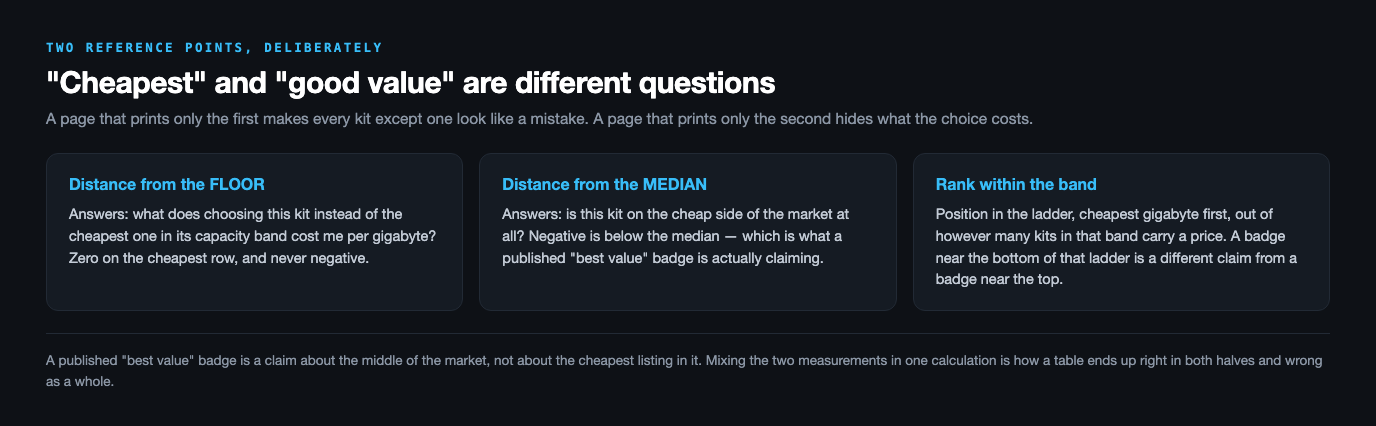
The spread is the finding. From $16.53 to $21.87 per gigabyte is +32.3%, and on a single kit that is $170.99 for the identical quantity of memory. For comparison, the whole basket’s price movement over three months has not offered a single buyer a discount that size. Choosing well on the day beats waiting, and it is the one lever you fully control.
Two things the ladder deliberately does not do. It does not rank on speed, because what faster memory costs is its own measurement and mixing it in here would smuggle a performance opinion into a price table. And it does not credit a badge, a heatspreader or an RGB strip — the brand premium at identical specification is large enough in this basket to deserve its own page, and it is already paid for inside these $/GB figures.
What the “best value” badges are priced at
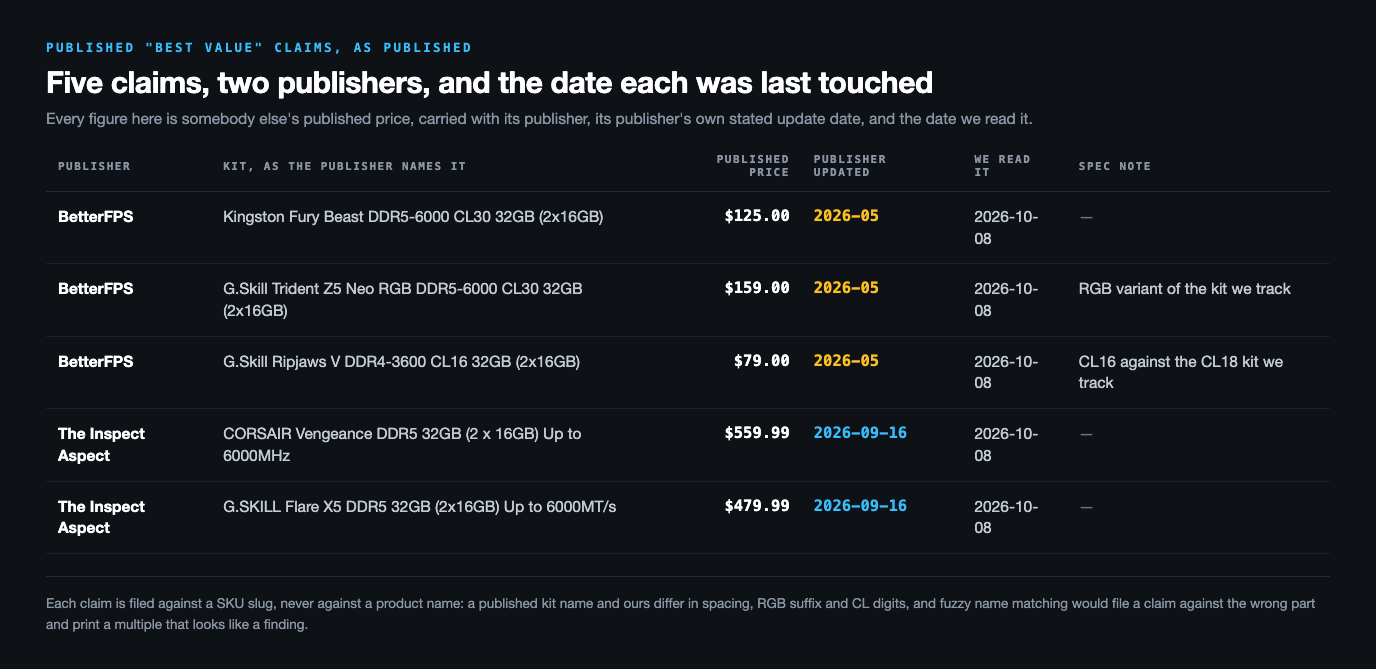
Here is the test nobody in this niche runs on themselves. Take the picks from the published lists, keep only the ones naming a kit we actually track, and put the published price next to our observation of that exact listing. No modelling, no estimating, no substituting a similar kit: a join on the product, or the row gets dropped.
| Publisher | Badge | Kit as named | Claimed | We observe | Multiple |
|---|---|---|---|---|---|
| BetterFPS | Best Value page updated May 2026 | Kingston Fury Beast DDR5-6000 CL30 32GB (2x16GB) | $125.00 | $559.00 Oct 20, 2026 | 4.47x |
| BetterFPS | Best DDR5 Overall page updated May 2026 | G.Skill Trident Z5 Neo RGB DDR5-6000 CL30 32GB (2x16GB) RGB variant of the kit we track | $159.00 | $699.99 Oct 27, 2026 | 4.40x |
| BetterFPS | Best DDR4 page updated May 2026 | G.Skill Ripjaws V DDR4-3600 CL16 32GB (2x16GB) CL16 against the CL18 kit we track | $79.00 | $239.99 Oct 20, 2026 | 3.04x |
| The Inspect Aspect | Quick Picks #5 page updated Sep 2026 | CORSAIR Vengeance DDR5 32GB (2 x 16GB) Up to 6000MHz | $559.99 | $559.99 Oct 28, 2026 | 1.00x |
| The Inspect Aspect | Quick Picks #2 page updated Sep 2026 | G.SKILL Flare X5 DDR5 32GB (2x16GB) Up to 6000MT/s | $479.99 | $529.00 Oct 20, 2026 | 1.10x |
3 of 5 checkable picks are priced at or below half what we observe, and 1 is within ten percent of it. The split is not random. The accurate ones come from a page that refreshes its table against a retailer feed; the inaccurate ones come from a hand-maintained awards list whose own footer says it was last updated in May 2026. Memory roughly tripled across 2025 and 2026. The list did not move with it, and its prices now describe a market that no longer exists.
A badge can be right while its number is wrong
The easy version of this article declares the award lists worthless and stops. Our own data will not support that, and the more useful finding is the narrower one.
The kit carrying BetterFPS's "Best Value" badge — the Kingston Fury Beast DDR5-6000 CL30 32GB (2x16GB) — ranks 2 of 6 in the ladder above, 3.6% below the band median. As a ranking, that is defensible: it is genuinely on the cheap side of the kits we can price. The price printed beside it is the part that has failed.
That is worth separating because the two failures want different responses from a reader. A wrong ranking sends you to the wrong kit. A wrong price sends you to the right kit with the wrong budget, which is how people end up buying 16 GB because they planned for 32 GB at last year’s rate. The ranking you can take from an older page. The number you cannot take from anywhere that will not tell you when it was last true.
The per-gigabyte publishers agree with us
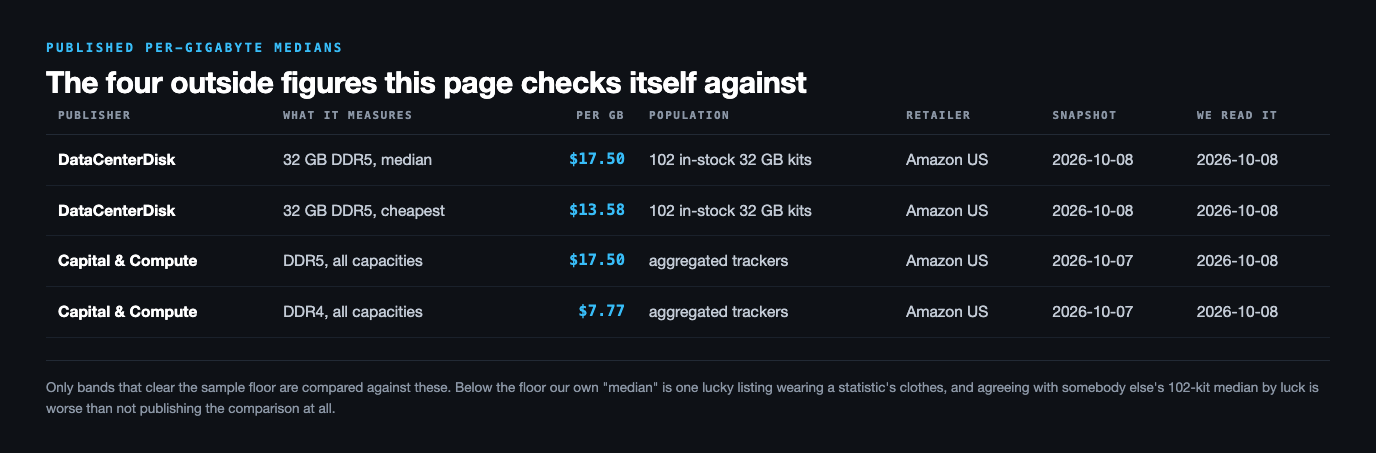
An obvious objection: maybe our figures are the odd ones. We price a different retailer set from almost everyone in this niche, so a four-fold gap could in principle be our basket rather than their dates. Two publishers do print per-gigabyte medians, which makes that checkable.
| Publisher | Figure | Population | Snapshot | Theirs $/GB | Ours $/GB | Gap |
|---|---|---|---|---|---|---|
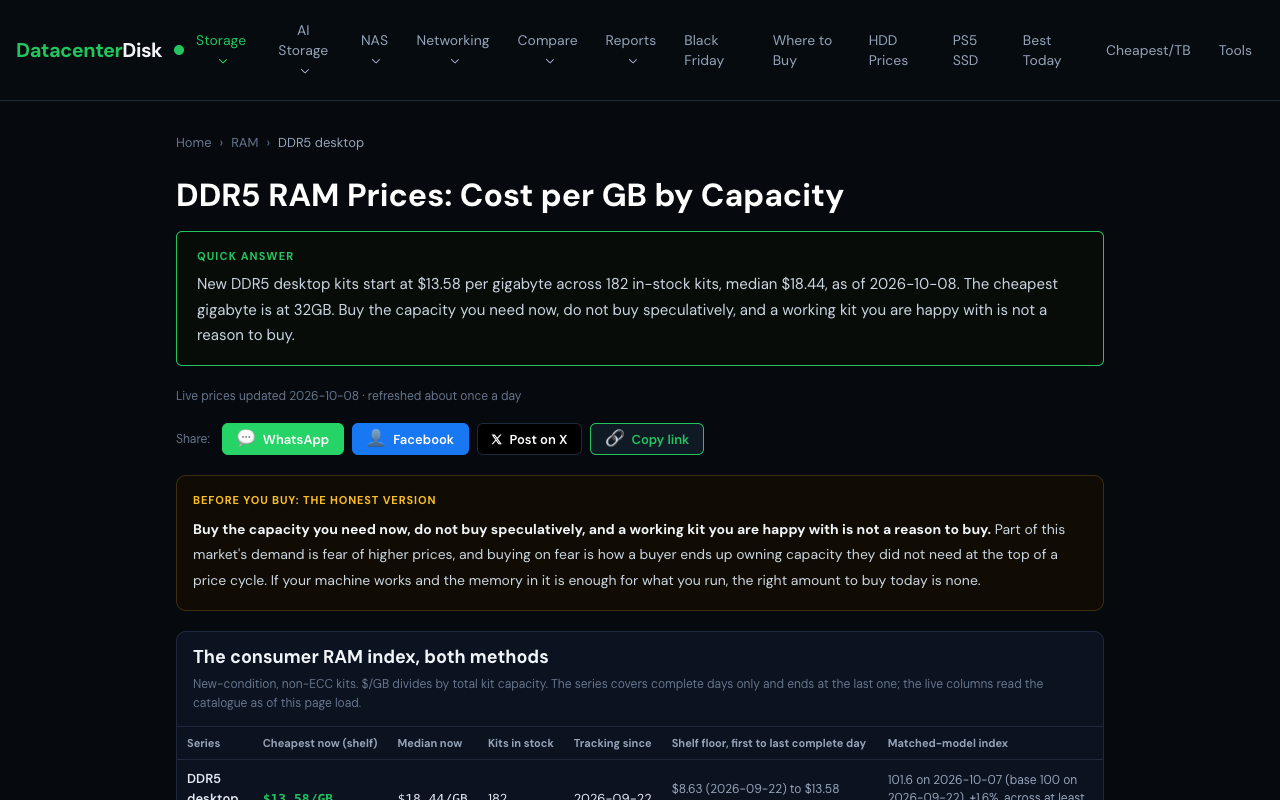
| DataCenterDisk | 32 GB DDR5, median | 102 in-stock 32 GB kits Amazon US | Oct 8, 2026 | $17.50 | $18.12 | +3.6% |
| DataCenterDisk | 32 GB DDR5, cheapest | 102 in-stock 32 GB kits Amazon US | Oct 8, 2026 | $13.58 | $18.12 | +33.5% |
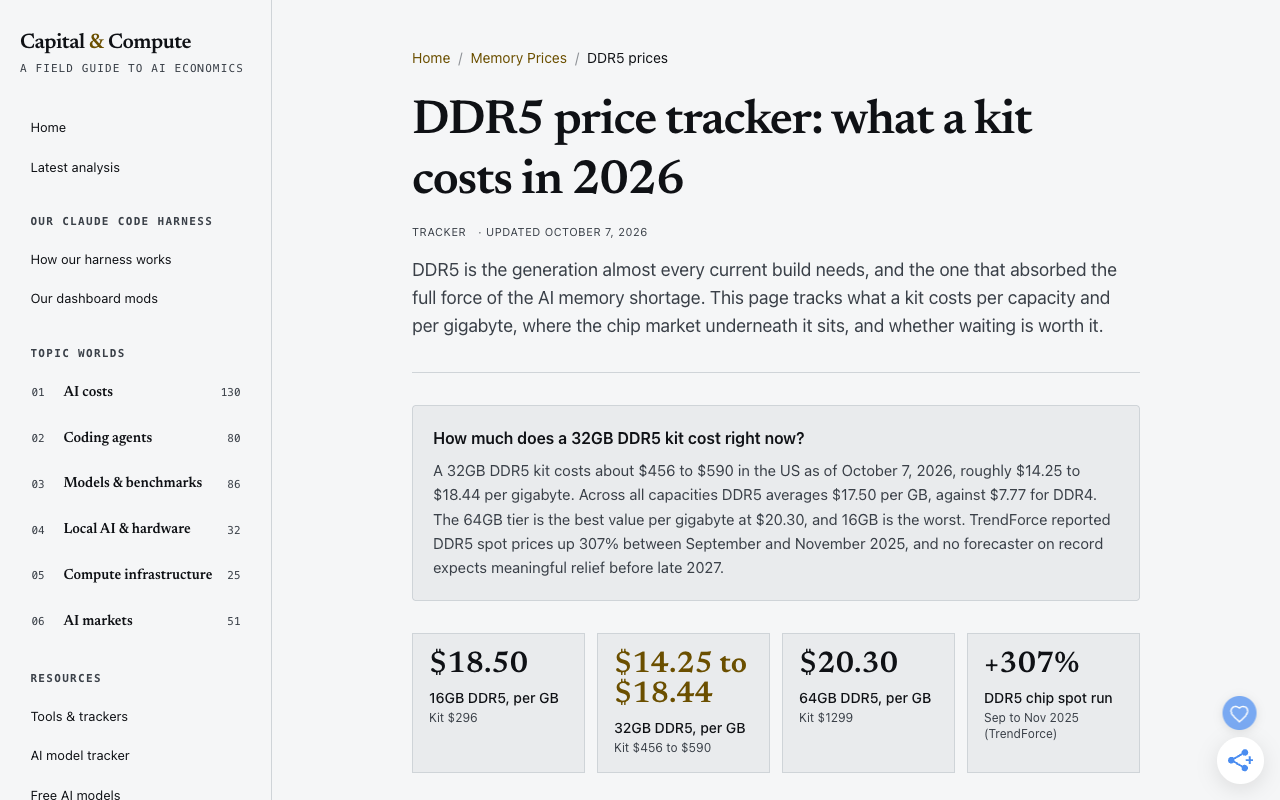
| Capital & Compute | DDR5, all capacities | aggregated trackers Amazon US | Oct 7, 2026 | $17.50 | $18.12 | +3.6% |
| Capital & Compute | DDR4, all capacities | aggregated trackers Amazon US | Oct 7, 2026 | $7.77 | withheld | — |
DataCenterDisk's 32 gb ddr5, median across 102 in-stock 32 GB kits, snapshot Oct 8, 2026, is $17.50. Ours is $18.12 — 3.6% apart, on a different retailer, a different method and a sample two orders of magnitude smaller. Two independent measurements of the same shelf converging is the strongest evidence either of us can offer, and it settles the objection: the picks priced at a quarter of the shelf are not a retailer artefact. They are old.
Worth noting what these two do and do not do. They publish numbers and no verdict: DataCenterDisk will tell you the median gigabyte at four capacities and never name a kit to buy, and Capital & Compute publishes per-tier figures whose own table contradicts its written verdict — it calls 64 GB the best value per gigabyte while listing it as the dearest of its three tiers. The lists with the verdicts have no per-gigabyte figures; the pages with the per-gigabyte figures have no verdict, or one their table does not support. Doing both at once is the gap this page is in.
The honest value answer is DDR4, if your board takes it
Every DDR5 kit in the ladder above is a bad deal next to the memory standard it replaced. That is not a recommendation to buy old parts — it is a constraint check most value articles skip, because the answer is awkward for a page whose job is to sell you new memory.
| Kit | Best price | $/GB | Vs floor | Retailer | Observed |
|---|---|---|---|---|---|
| G.Skill Ripjaws V DDR4-3600 CL18 32GB (2x16GB) | $239.99 | $7.50 | — | Newegg | Oct 20, 2026 |
| Corsair Vengeance LPX DDR4-3200 CL16 32GB (2x16GB) | $259.99 | $8.12 | +8.3% | Newegg | Oct 24, 2026 |
| Kingston Fury Beast DDR4-3200 32GB (2x16GB) | $319.99 | $10.00 | +33.3% | Newegg | Oct 27, 2026 |
At the floor of each generation that is $7.50 against $16.53 — DDR5 at 2.20x the price of DDR4 for the same gigabyte. The catch is that it is not a choice for most people: the socket decides, not the price, and a current AM5 or LGA1851 board will not take a DDR4 stick at any price. The full comparison works through when the decision is genuinely open — an older board, a second machine, a cheap capacity top-up — and in those cases the value answer is not close.
Four checks for a frozen page
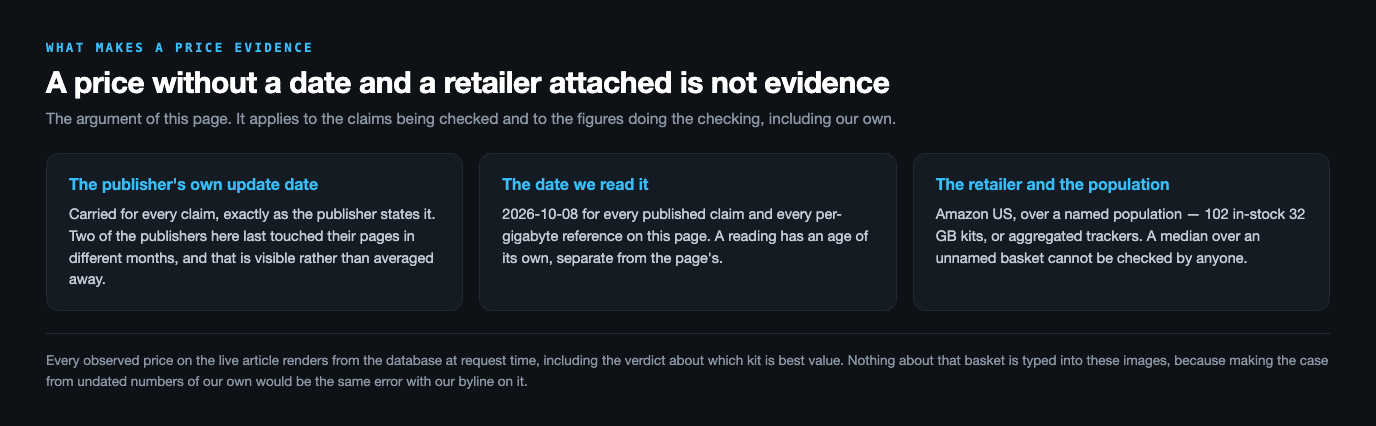
You should not have to take our word for which lists are live. Each of these four tests caught something real on a page we read for this article, and all four take seconds.
2. Is a retailer named next to each figure? An unattributed price cannot be checked and cannot be bought. Every published figure we could verify names where it came from.
3. Does the same kit carry the same price twice on the page? One roundup we read lists one Corsair kit at three different prices in three places — $499.99, $465.00 and $449.99 — which means at least two of its widgets stopped refreshing and nobody noticed.
4. Is there a price per gigabyte anywhere? Not one of the three award lists we read published one, which is why their rankings cannot be checked against anything. A site can even advertise “Price/GB” as a feature and print no such figure on its front page; one of the trackers we read does exactly that.
A page failing three of the four is not necessarily dishonest. It is usually just old, which is a thing a reader can detect in ten seconds and an awards table will never volunteer.
How this ladder is produced
Every price above is a real observation of a real listing, scraped from a retailer that allows it, stored with its timestamp, and rendered into this page when you load it. There are no estimates, no list prices and no forecasts anywhere on this site, which also means we cannot tell you whether to wait — what waiting has actually cost measures that backwards instead.
Four limits worth stating plainly. Each SKU contributes its cheapest in-stock observation in the last 30 days, so a kit that went out of stock at a low price keeps that price for up to a month — the ladder is a floor, not a live quote. Our scrape cadence is 48 to 240 hours per listing, so a discount that appears and vanishes between two visits is invisible to us. A median prints only at five or more kits in a band; below that it reads withheld, because a median off two listings is one lucky price wearing a statistic’s clothes. And our basket is twenty parts, not three thousand: it is wide enough to rank the kits in it and far too narrow to call a market floor.
That last limit is why the section above checks our medians against publishers with thousand-module samples rather than asserting ours is better. A small dated sample and a large undated one are different tools. The error we are trying not to make is the one this page is about — printing a figure that cannot be dated, sourced or reproduced.
What to actually do at these prices
Fix the capacity and the generation first, from your motherboard and your workload, not from a price table. Those two decisions are constraints, and treating them as value choices is how people end up with a “bargain” kit their board will not post with. What doubling to 64 GB costs covers the capacity step if that one is genuinely open for you.
Then buy the cheapest gigabyte in that shortlist on the day you buy. Not the badged kit, not last year’s consensus pick — the cheapest observed gigabyte that meets your constraints, with a date and a retailer attached to the price. In the ladder above that single choice is worth $170.99. If the quote in front of you sits above the dearest row in our table, you are being asked for an above-market price for mainstream memory, and the only remaining question is whether you need it today.
And whatever you use to check — us, a feed tracker, an awards list — run the four tests above on it first. A price you cannot date is not information. It is a number that was true once.
Related reading
FAQ
What is the best value DDR5 RAM in 2026?
The kit with the lowest observed price per gigabyte at the capacity your board and workload require — which is a different kit in different weeks, not a fixed model name. Across the DDR5 kits we track, the gigabyte currently runs from $16.53 to $21.87, median $18.75 across 7 kits, every figure an in-stock observation at a named US retailer. Shortlist on capacity and speed grade first, then take the cheapest gigabyte in that shortlist on the day.
Why do best-value RAM lists show prices far below what retailers charge?
Because the price was true when the list was written and nothing on the page degrades to show otherwise. We matched five published picks to the same named kits in our basket on 8 October 2026: the two from a feed-refreshed page were within about five percent of our observations, and the three from a hand-maintained awards list last updated in May 2026 were priced between about a third and a quarter of what we observe. Memory roughly tripled across 2025 and 2026, and an editorial award does not reprice itself.
How much should a 32GB DDR5 kit cost in 2026?
Multiply the observed price per gigabyte for the speed grade you want by 32 and that is roughly what a fair quote looks like; the ladder in this article prints both the floor and the dearest row, with the date each was seen. Two independent publishers of per-gigabyte medians — one pricing 102 Amazon kits on 8 October 2026, one aggregating trackers on 7 October 2026 — landed within a few percent of our own median on a completely different retailer set, so the figure is reproducible rather than ours alone.
Is a cheaper DDR5 kit worse memory?
Not reliably, and that is the point of ranking per gigabyte inside one capacity. The kits in our ladder sit within one or two speed grades of each other, and the spread between the cheapest and dearest gigabyte is far larger than any performance difference between them would justify. Three companies make the DRAM die inside every badge on the list. Where the specification is genuinely identical and the price is not, we measure that separately in our brand comparison.
Is DDR4 better value than DDR5 right now?
Substantially, on price alone: the cheapest DDR4 gigabyte in our basket is $7.50 against $16.53 for DDR5. But it is usually not a choice — the memory controller on your CPU and the slots on your board decide, and no current AM5 or LGA1851 platform accepts DDR4 at any price. It matters when the decision is genuinely open: an older board, a second machine, or a cheap capacity top-up.
Does buying a bigger RAM kit get cheaper per gigabyte?
Not dependably in our basket, and not according to the largest published sample we checked either — one tracker pricing 182 DDR5 kits on 8 October 2026 reported the gigabyte getting dearer at every step up its capacity ladder, from 32 GB to 128 GB. That is the reverse of the usual advice about bulk buying. Check the step for the capacities you are actually choosing between rather than assuming the bigger kit is the better deal.
Where do your RAM prices come from?
From observations of live retailer listings, scraped on a 48-to-240-hour cadence per listing, stored with a timestamp and rendered into this page at request time. Each kit contributes its cheapest in-stock observation from the last 30 days, so the ladder is a floor rather than a live quote, and a median is only printed where a band holds five or more kits. We publish no forecasts and no estimated prices, and we take no commission on anything you buy.
Price the gigabyte, not the kit
We track DDR5, DDR4 and NVMe listings at US retailers and tell you when one of yours moves. No deal scores, no affiliate links, no commission on anything you buy — observed prices, dated, with the sample size printed next to them.