DRAM and NAND Spot Prices in 2026: Why the Chip Headline Is Not the Price You Pay
Key takeaways
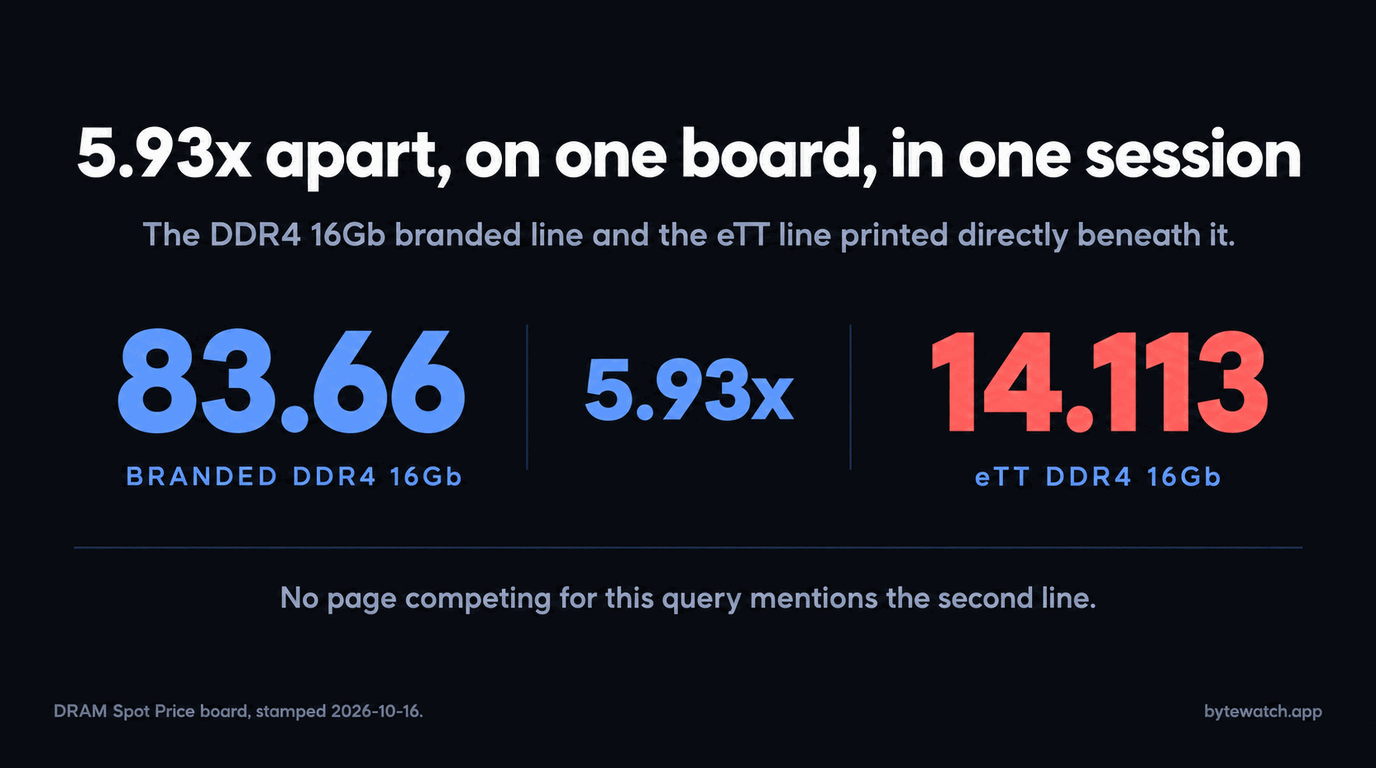
- The branded DDR4 16Gb line printed 83.66 and the eTT line directly beneath it printed 14.113 in the same session — 5.93x apart on one board, and no page competing for this query mentions the second line at all.
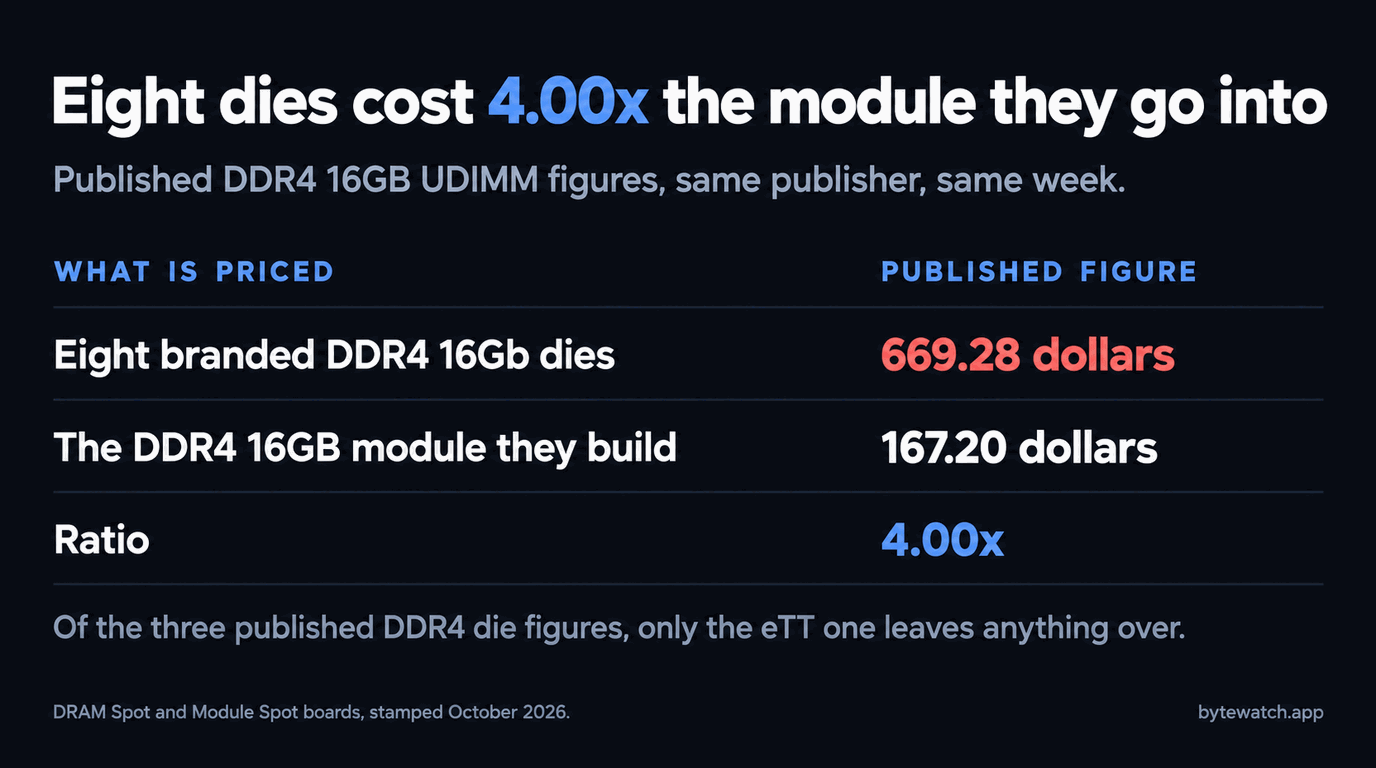
- Eight branded dies cost $669.28 against a $167.20 quote for the module they go into — 4.00x the price of the finished part. Of the three published DDR4 die figures, only the eTT one leaves anything over.
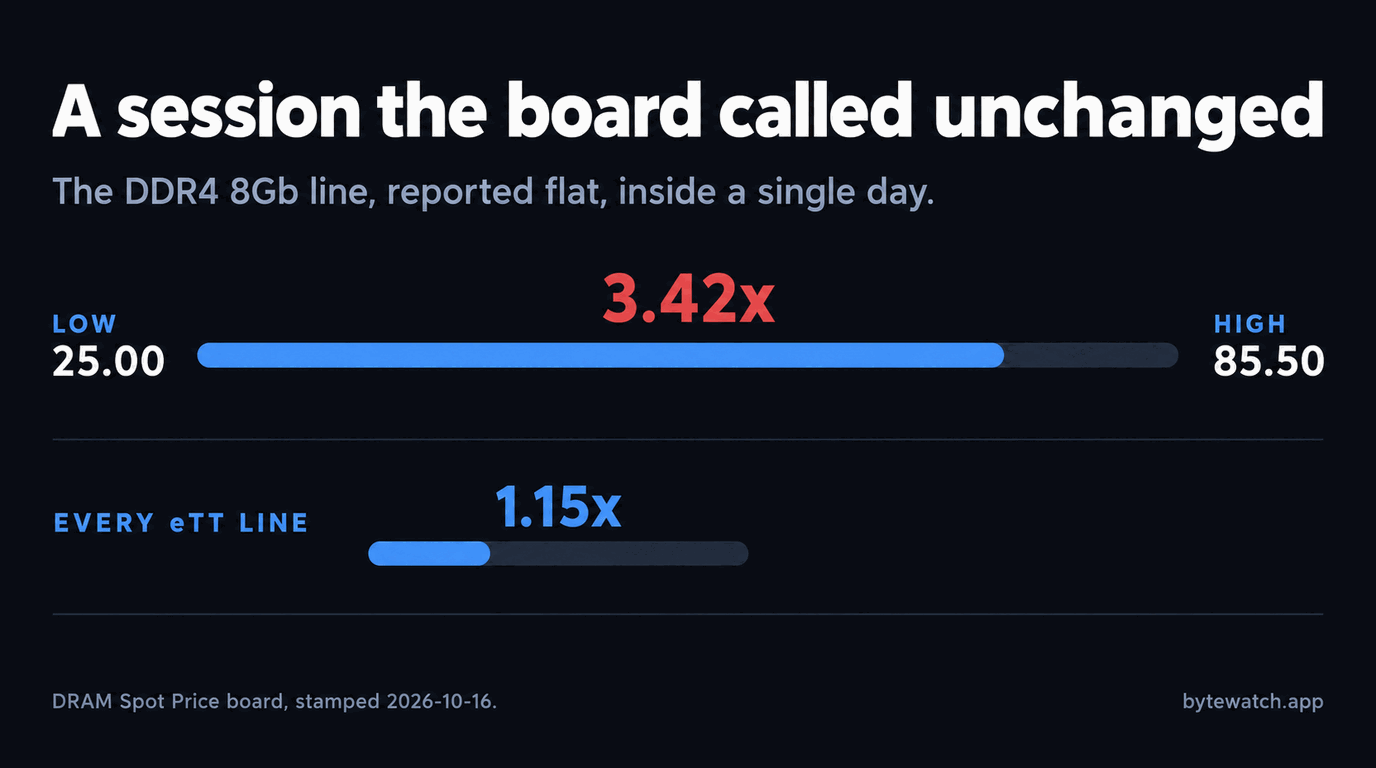
- A session the board reported as unchanged ran from 25.00 to 85.50 — 3.42x inside one day on the DDR4 8Gb line, while every eTT line stayed inside 1.15x.
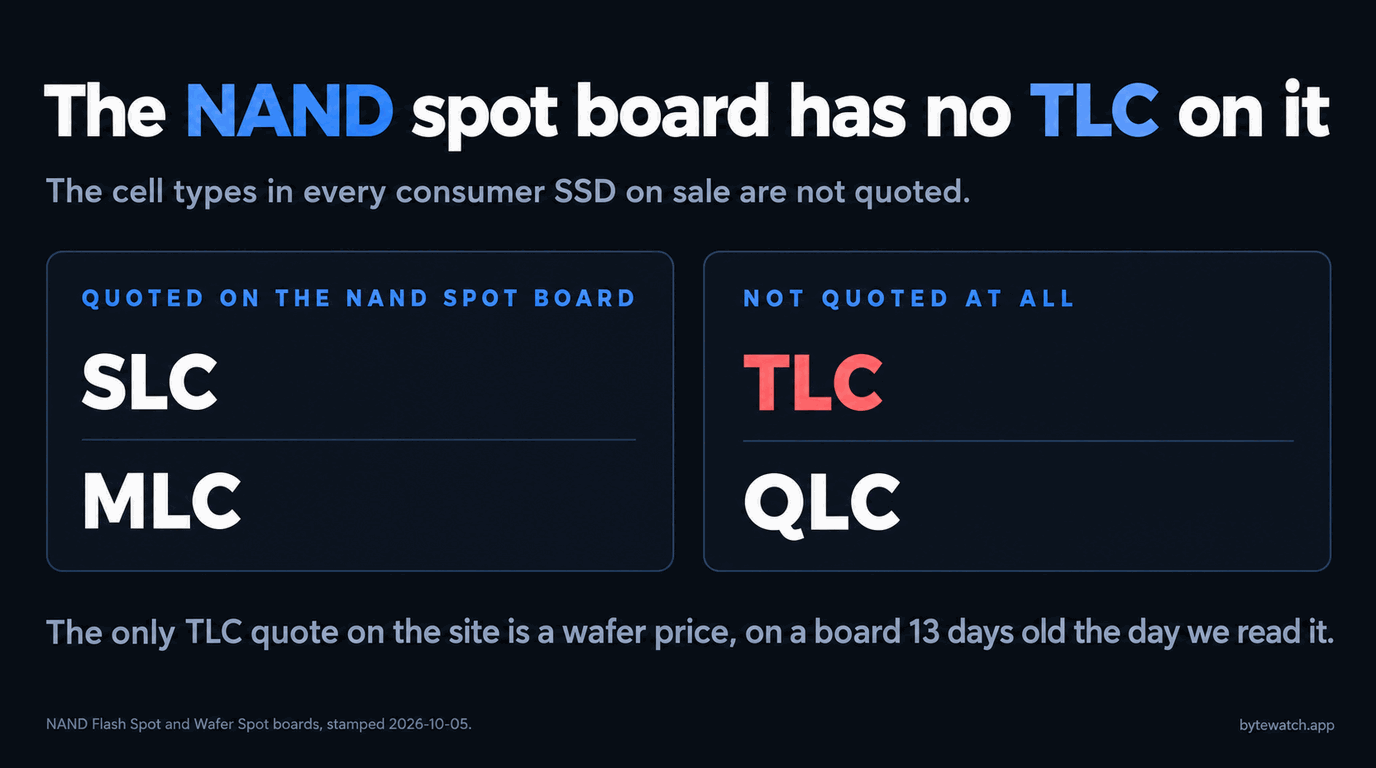
- The NAND spot board quotes SLC and MLC and not one line of TLC or QLC — the cell types in every consumer SSD on sale. The only TLC quote on the site is a wafer price, on a board 13 days old the day we read it.
- The bulk OEM contract price for a 1TB value-grade drive is 2.41x the cheapest 1TB drive on the same publisher’s street board — $321.00 against $133.00, and 28.4% above even its dearest.
- What a DRAM spot price is, and what the board actually prints
- The line underneath every branded line, and what eTT means
- A day the board called flat ran from 25.00 to 85.50
- What the DRAM spot price says a module should cost
- What our own shelf charges for the same module
- The NAND spot board has no TLC on it
- The flash in a drive, priced against the whole drive
- How to read a chip-price headline in four steps
- Related reading
- FAQ
Every headline about memory costs this year is built on a DRAM spot price, and the number underneath it is doing less work than the headline implies. A chip quote that has moved 3x in a year is the stakes: it is the figure a procurement team is asked to defend a budget against, and the figure a reader is expected to translate into what a kit costs on Saturday. Here is the translation, done properly — because the board that publishes the quote also publishes a module price, a contract price and a street price, and we multiplied them against each other instead of quoting one. Three of the four published figures for a DDR4 module cannot be true at the same time, and the one that survives is the line nobody reads.
What a DRAM spot price is, and what the board actually prints
A spot price is what a tray of chips traded for, right now, between brokers — not what a module maker pays under contract and not what you pay at a retailer. GamersNexus put the scale of it plainly last year: spot transactions are under 10% of the market, citing Nikkei. So the quote everyone reports is the thinnest, fastest-moving slice of a market, and the other 90% is settled on boards that update monthly or quarterly.
Here is the whole board, reproduced as TrendForce publishes it. It prints no unit, so we print none either; the companion piece on what a DDR5 kit really costs establishes the dollars-per-die reading from a second publisher’s label for the same series, and every conversion below rests on that.
| Item | Session low | Session high | Session average | Change |
|---|---|---|---|---|
| DDR5 16Gb (2Gx8) 4800/5600 | 46.00 | 71.00 | 60.60 | +0.3% |
| DDR5 16Gb (2Gx8) eTT | 27.50 | 29.50 | 28.00 | +0.7% |
| DDR4 16Gb (2Gx8) 3200 | 45.60 | 118.00 | 83.66 | 0.00% |
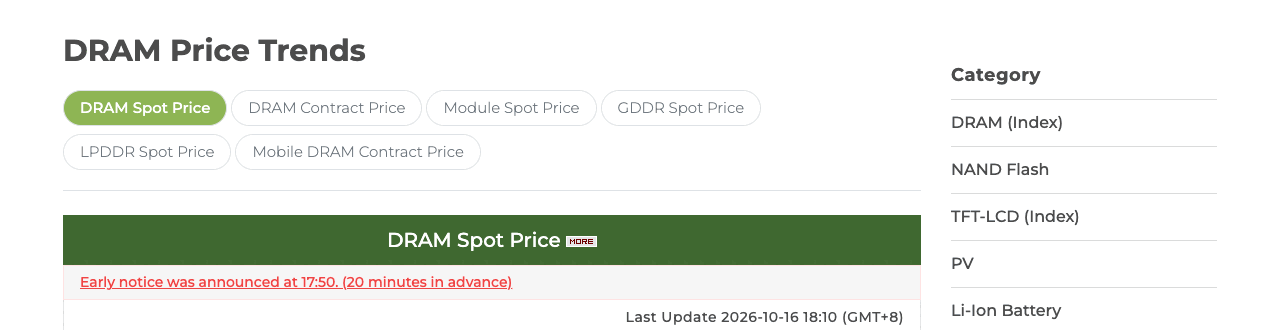
| DDR4 16Gb (2Gx8) eTT | 13.60 | 15.60 | 14.113 | 0.00% |
| DDR4 8Gb (1Gx8) 3200 | 25.00 | 85.50 | 45.971 | 0.00% |
| DDR4 8Gb (1Gx8) eTT | 5.80 | 6.30 | 5.968 | −0.0% |
| DDR3 4Gb 512Mx8 1600/1866 | 9.85 | 20.50 | 13.751 | +0.5% |
Two things jump out before any arithmetic. Seven lines cover only three densities, so most of what reads as variety is the same chip in a different grade. And the DDR4 rows — the ones that generate the headlines, on the generation being wound down — printed a flat session while spanning a range we come back to below.
The line underneath every branded line, and what eTT means
Read the board again and you will see each branded line shadowed by an eTT line. EE Times Asia, in a 2019 explainer written by the module maker Apacer, puts eTT third on a four-rung ladder: major ICs from the fabs “using the best quality wafers” and their “comprehensive testing procedures”, then eTT — “tested for effectiveness, but have not been fully tested” — then uTT with “no test after packaging”, then downgrade. The part of that page which matters here is not the definition. It is who buys them: “It’s primarily downstream DRAM module makers that buy these ICs and attach their own trademarks to them.”
| Die | Branded average | eTT average | Branded is | eTT sits |
|---|---|---|---|---|
| DDR5 16Gb | 60.60 | 28.00 | 2.16x the eTT line | 53.8% below |
| DDR4 16Gb | 83.66 | 14.113 | 5.93x the eTT line | 83.1% below |
| DDR4 8Gb | 45.971 | 5.968 | 7.70x the eTT line | 87.0% below |
The gap is not a rounding difference. On the withdrawn generation the branded die costs 5.93x the untested one at 16Gb and 7.70x at 8Gb; on the current generation it is 2.16x. That ordering is worth a moment: the quality premium is three times wider on DDR4 than on DDR5, which is what you would expect when branded supply of a standard is being withdrawn while the untested grade is not scarce at all.
A day the board called flat ran from 25.00 to 85.50
A session average is a mean over however many quotes a broker board collected, and on a thin market that mean can sit inside an enormous range. The DDR4 8Gb (1Gx8) 3200 line ran 3.42x low to high inside one session and reported no change at all.
| Item | Grade | Low to high | Session change |
|---|---|---|---|
| DDR4 8Gb (1Gx8) 3200 | branded | 3.42x | 0.00% |
| DDR4 16Gb (2Gx8) 3200 | branded | 2.59x | 0.00% |
| DDR3 4Gb 512Mx8 1600/1866 | branded | 2.08x | +0.5% |
| DDR5 16Gb (2Gx8) 4800/5600 | branded | 1.54x | +0.3% |
| DDR4 16Gb (2Gx8) eTT | eTT | 1.15x | 0.00% |
| DDR4 8Gb (1Gx8) eTT | eTT | 1.09x | −0.0% |
| DDR5 16Gb (2Gx8) eTT | eTT | 1.07x | +0.7% |
The split is clean, and it is the same split as the price table. Every branded line is wider than every eTT line: the widest eTT session is 1.15x and the narrowest branded one is 1.54x. A grade that is defined by incomplete testing trades in a tight band; the fully-tested, fab-marked part is the one whose price is all over the place. That is a market with very few branded trades in it, not a market with a volatile product.
What the DRAM spot price says a module should cost
Now the arithmetic nobody in this SERP does. A 16Gb die holds 2 GB, so a 16GB DDR4 UDIMM is eight of them. TrendForce publishes a spot quote for that exact module on a second board. Multiply the die price by eight and compare.
| Module | Die reading | Dies | Die content | Module quote | Content vs module |
|---|---|---|---|---|---|
| DDR4 UDIMM 16GB 3200 | branded spot | 8 | $669.28 | $167.20 | 4.00x — inverted |
| same module | die contract | 8 | $400.00 | $167.20 | 2.39x — inverted |
| same module | eTT spot | 8 | $112.90 | $167.20 | 48.1% left over |
| DDR5 UDIMM 16GB 4800/5600 | branded spot | 8 | $484.80 | $239.00 | 2.03x — inverted |
| same module | eTT spot | 8 | $224.00 | $239.00 | 6.7% left over |
At the branded quote, the dies inside the module cost $669.28 and the module costs $167.20. That is 4.00x the price of the finished part, before a PCB, an SPD chip, assembly, test, packaging or a distributor’s margin. At the die contract price it is still 2.39x. Only the eTT reading leaves anything over at all: $112.90 of die inside a $167.20 module, a 48.1% margin for everything else that has to happen.
So the figures reconcile one way only, and it is the way the trade press already described: the module maker is buying the unmarked grade. “DRAM chip prices hit a record” is therefore a statement about the branded line — the one the module in your machine was probably never built from.
What our own shelf charges for the same module
That is three wholesale boards. Here is the fourth number, and it is the only one in this article that is ours: what a US retailer charged for a finished, branded DDR4 kit, divided down to one module so it sits on the same footing as the board. A kit is sold as a matched pair and a single module is not the same product — the division is ours, and it is the only way to compare at all.
| Kit | Observed | Kit price | Per module | vs module board | Under board low? |
|---|---|---|---|---|---|
| G.Skill Ripjaws V DDR4-3600 CL18 32GB (2x16GB) | Newegg, Oct 20, 2026 | $239.99 | $120.00 | −28.2% | yes |
| Corsair Vengeance LPX DDR4-3200 CL16 32GB (2x16GB) | Newegg, Oct 24, 2026 | $259.99 | $130.00 | −22.3% | yes |
| Kingston Fury Beast DDR4-3200 32GB (2x16GB) | Newegg, Oct 27, 2026 | $319.99 | $160.00 | −4.3% | no |
The cheapest finished module on our shelf works out at $120.00, 28.2% below the module board’s own session average and with 2 of 3 under its session low. Read the stack from the top: branded die content 4.00x the wholesale module quote, and the retail module at or under that wholesale quote. Every step points the wrong way.
We will not print a DDR4 median off this sample: it is 4 priced SKUs, under our floor of five, which is the point at which a median is one lucky listing wearing a statistic’s clothes. The named observations above are the claim. The DDR4 price piece carries the capacity ladder, and the tracked list shows every observation behind it with a date.
The NAND spot board has no TLC on it
Flash has the same headline problem and a different cause. The NAND flash spot board carries four lines: SLC 2Gb, SLC 1Gb, MLC 64Gb, MLC 32Gb. Every one is SLC or MLC. There is no TLC line and no QLC line — and TLC and QLC are what every consumer SSD on sale is built from.
The only public TLC quotes sit on a separate wafer board, and they carry their own surprise: the 512Gb TLC die prices at $0.294 a gigabyte while the 256Gb TLC die — half the bits for 97.5% of the price — works out at 1.95x that. Add a quarterly OEM contract board and a weekly street board: four boards, one commodity, four stamps.
| Board | What it quotes | Figure | Cell type | Stamp |
|---|---|---|---|---|
| NAND Flash Spot Price | MLC 64Gb 8GBx8 | 42.087 | MLC | 2026-10-05 |
| Wafer Spot Price | 512Gb TLC | 18.833 | TLC | 2026-10-05 |
| PC-Client OEM SSD Contract Price (3Q'26) | 1TB-mSATA/M.2 TLC PCIe-Value Grade | $321.00 | TLC | 2026-08-05 |
| SSD Street Price | Kimtigo TP5000 1TB | $133.00 | not stated | 2026-10-16 |
The spread between those rows is the finding. A bulk OEM contract price for a 1TB value-grade drive is $321.00; the cheapest 1TB drive on the same publisher’s street board is $133.00, a comparable value-grade PCIe 4.0 part. The bulk price is 2.41x the retail one, and 28.4% above even the Samsung 990 Pro at $249.99. Some of that is the 74-day-old stamp on the contract board, in a market that has moved. It is still a factor of two between two numbers on one website for one capacity.
The flash in a drive, priced against the whole drive
Do the module sum again, on flash. A 512Gb TLC die holds 64 GB, so a 1TB drive is about sixteen of them at the wafer quote. Against our own observed drive prices:
| Drive | Capacity | Dies at the wafer quote | Flash content | Our observed price | Content vs drive |
|---|---|---|---|---|---|
| Crucial T500 2TB | 2000 GB | 31.25 | $588.53 | $369.00 | 1.59x — inverted |
| Crucial P3 Plus 1TB | 1000 GB | 15.63 | $294.27 | $187.46 | 1.57x — inverted |
| WD Black SN850X 2TB | 2000 GB | 31.25 | $588.53 | $374.92 | 1.57x — inverted |
| Samsung 990 Pro 4TB | 4000 GB | 62.50 | $1,177.06 | $796.50 | 1.48x — inverted |
| Samsung 990 Pro 2TB | 2000 GB | 31.25 | $588.53 | $408.95 | 1.44x — inverted |
| SK hynix Platinum P41 2TB | 2000 GB | 31.25 | $588.53 | $446.35 | 1.32x — inverted |
| Kingston KC3000 2048GB | 2048 GB | 32.00 | $602.66 | $499.00 | 1.21x — inverted |
On every drive we price, the wafer-quote flash alone comes to more than the finished drive: 1.21x to 1.59x of the retail price, across 7 drives at four capacities. The caveats are real and they all run the same way: a wafer quote is flash before dicing, packaging and test, a drive maker buys on contract rather than spot, and the wafer board is 11 days older than the DRAM board beside it. None of them turns a 1.59x inversion into a margin.
And here is the asymmetry that closes the argument. On memory, an inverted sum had a second line on the same board that resolved it — the untested grade, bought by exactly the people who build modules. Flash publishes no equivalent tier anywhere public: no eTT line, no grade column, nothing between a wafer quote and a finished drive. Our own NVMe cohort prices the gigabyte at a median of $0.199 from 7 SKUs, and nothing published explains how it gets there. The honest answer to “why is this drive cheaper than its flash?” is that the public boards do not contain the information, and our piece on rising SSD prices gets no further than that either.
How to read a chip-price headline in four steps
None of this makes the boards wrong. It makes them specific, and a headline strips the specificity out. Four questions recover it, all answerable from the free pages.
One: which line? Branded or eTT, and at which density. A quote with no grade attached is not comparable to anything. Two: which board? Die spot, module spot, contract or street — four different products, and the one nearest your wallet is the one quoted least. Three: what is the stamp? Not the article’s date, the board’s.
| Board | Publisher stamp | Days old |
|---|---|---|
| DRAM Spot Price | 2026-10-16 18:10 (GMT+8) | 2 |
| SSD Street Price | 2026-10-16 10:30 (GMT+8) | 2 |
| Module Spot Price | 2026-10-05 14:40 (GMT+8) | 13 |
| NAND Flash Spot Price | 2026-10-05 14:40 (GMT+8) | 13 |
| Wafer Spot Price | 2026-10-05 14:40 (GMT+8) | 13 |
| DRAM Contract Price (2H Aug) | 2026-08-31 14:00 (GMT+8) | 48 |
| PC-Client OEM SSD Contract Price (3Q'26) | 2026-08-05 11:00 (GMT+8) | 74 |
Four: does it multiply out? Eight dies in a 16GB module, sixteen 512Gb dies in a 1TB drive. If the chips cost more than the thing built from them, you are reading two different products, and the question is which one your purchase actually is. Our own RAM price piece and the live chart stay on the retail side of that line deliberately, because it is the only side a buyer transacts on.
Related reading
FAQ
What is a DRAM spot price?
It is the price a tray of memory chips traded at between brokers for immediate delivery, published as a session high, low and average. It is neither a contract price nor a retail price. GamersNexus, citing Nikkei, puts spot at under 10% of the market — the thinnest and fastest-moving slice of memory pricing, which is why it makes headlines and why it does not describe your purchase.
What does eTT mean on a DRAM spot board?
eTT is a quality grade of die. EE Times Asia's grade ladder, written by the module maker Apacer, puts major fab-marked ICs first, then eTT — "tested for effectiveness, but have not been fully tested" — then uTT with no test after packaging, then downgrade parts. Module makers buy the eTT and uTT grades and attach their own brand. On the board we read, the branded DDR4 16Gb line was 5.93x the eTT line in the same session.
Why is a DDR4 chip quoted higher than the module it goes into?
Because the two quotes are about different grades of chip. Eight branded 16Gb dies at the spot average come to 669.28 dollars against a 167.20 dollar quote for the 16GB module — 4.00x the finished part. The same sum on the eTT line comes to 112.90 dollars and leaves a 48.1% margin, which is the only reading the arithmetic allows.
Does a rising DRAM spot price mean retail RAM is about to rise?
Not reliably, and we do not forecast here. What the published layers did: spot sat 67.3% above contract on the same DDR4 16Gb die, on boards stamped 46 days apart, while finished branded modules sold at retail at or below the wholesale module quote. Those layers moved independently, so a spot move is a signal about the broker market first and your shelf only eventually.
Is there a NAND flash spot price for the SSD I want to buy?
Not on the public board. It quotes SLC and MLC parts only — no TLC and no QLC line — and every consumer SSD on sale uses TLC or QLC. The only public TLC quotes sit on a separate wafer board, which prices flash before dicing and packaging rather than a drive. So the figure a reader wants for storage is not the figure the "NAND spot price" headline is about.
Why is a bulk OEM SSD contract price higher than retail?
On the boards we read it is, and by a lot: 321.00 dollars for a 1TB value-grade drive under OEM contract against 133.00 dollars for a comparable 1TB drive on the same publisher's street board — 2.41x. The contract board is quarterly and its stamp is 74 days old, so some of the gap is time rather than terms. The rest we cannot account for, and we would rather say so than invent a mechanism.
Which number should I actually watch if I am buying memory or storage?
The retail price of the specific part, dated, at a named retailer — the only number you can transact on. For reference, our tracked NVMe Gen4 cohort medians 0.199 dollars a gigabyte from 7 SKUs. A spot board reports broker sentiment on a grade of chip you will probably never own. Set your alert on the kit or drive you intend to buy.
Why did the board report no change on a day its prices spanned 3.4x?
Because the change column compares session averages, and the average is a mean over however many quotes the board collected. The DDR4 8Gb (1Gx8) 3200 line ran from 25.00 to 85.50 — 3.42x — inside the session it reported as flat. On a thin market a stable mean and a wild range are entirely compatible, which is why the high and low columns are the ones worth reading.
A grade, a board and a stamp on every figure
We track DDR5, DDR4 and NVMe listings at US retailers and tell you when one of yours moves. New retail stock only, no deal scores, no affiliate links, no commission on anything you buy — observed prices, dated, with the sample size printed next to them.