DDR5 Price in 2026: What a Kit Really Costs
Key takeaways
- A DDR5 kit we track runs $529.00 to $699.99 today, at $16.53 to $21.87 a gigabyte. The kit price is what you pay; the gigabyte is what lets you compare.
- Across the published ladder the gigabyte barely moves — 8.3% cheaper over a 12x capacity range — while the kit price moves 11.00x. A per-gigabyte table is almost flat on DDR5 in 2026, so it cannot rank capacities for you.
- At one fixed capacity, the module configuration moves the gigabyte up to 61.4% — more than any step between adjacent capacities, which top out at 24.4%. Only one of the four publishers even records the configuration.
- TrendForce’s spot board — the source of every “DDR5 is up X%” headline — publishes no unit and no currency on any row. A second publisher labels the same series USD / die, which is the only reason the figure converts into a gigabyte at all.
- Read that way, a tested DDR5 die costs $30.05 a gigabyte on the spot market against $18.56 for a finished kit on a shelf — the raw part is 1.62x the price of the product made from it. Retail has not repriced to the current die market. We do not print when it will.
- What a DDR5 kit costs right now
- The gigabyte barely moves across the whole ladder
- At one capacity, the configuration costs more than the capacity
- Four readings of one step, and they disagree on its direction
- The published DDR5 price has no unit on it
- The die costs more per gigabyte than the finished kit
- Spot and shelf disagree about DDR4 by direction
- What to pay, and five checks before you click
- How these numbers are produced, and what we withhold
- Related reading
- FAQ
Search for a DDR5 price in 2026 and you get a number per gigabyte, and you cannot buy a gigabyte. The gap matters now in a way it did not two years ago: the same capacity can differ by 61.4% per gigabyte depending on how many sticks the kit is cut into, and the cheapest rung on the published ladder is a capacity most buyers never consider. We read the four price pages that rank for this term, checked each one’s figures against the date it puts on them, and priced the raw memory die on the spot board the headlines are written from. This is what a DDR5 kit actually costs, and which of the published numbers survives being asked what unit it is in.

What a DDR5 kit costs right now
Here is our whole DDR5 basket, with the retailer and the observation date on every row. These are canonical, high-liquidity parts rather than the cheapest listing on the internet, which is the honest caveat to put first: a tracker that chases the floor and a tracker that prices the parts procurement actually buys are measuring different shelves.
| Kit | Kit price | $/GB | Vs floor | Retailer | Observed |
|---|---|---|---|---|---|
| G.Skill Flare X5 DDR5-6000 CL36 32GB (2x16GB) | $529.00 | $16.53 | — | Newegg | Oct 20, 2026 |
| Kingston Fury Beast DDR5-6000 32GB (2x16GB) | $559.00 | $17.47 | +5.7% | Newegg | Oct 20, 2026 |
| Corsair Vengeance DDR5-6000 CL30 32GB (2x16GB) | $559.99 | $17.50 | +5.9% | Newegg | Oct 28, 2026 |
| Kingston Fury Beast DDR5-5200 32GB (2x16GB) | $599.99 | $18.75 | +13.4% | Newegg | Oct 27, 2026 |
| Crucial Pro DDR5-5600 64GB (2x32GB) | $1,199.99 | $18.75 | +13.4% | Newegg | Oct 20, 2026 |
| G.Skill Trident Z5 RGB DDR5-6400 CL32 32GB (2x16GB) | $659.99 | $20.62 | +24.8% | Newegg | Oct 27, 2026 |
| G.Skill Trident Z5 Neo DDR5-6000 CL30 32GB (2x16GB) | $699.99 | $21.87 | +32.3% | Newegg | Oct 27, 2026 |
The median gigabyte across the 7 kits we price is $18.75. The spread from floor to ceiling is 32.3%, and it sits mostly inside a single speed grade — a point the DDR5 speed premium article takes apart in full. What the table cannot tell you is the thing the rest of this page is about: every row is a two-module kit, so configuration is held constant and invisible.
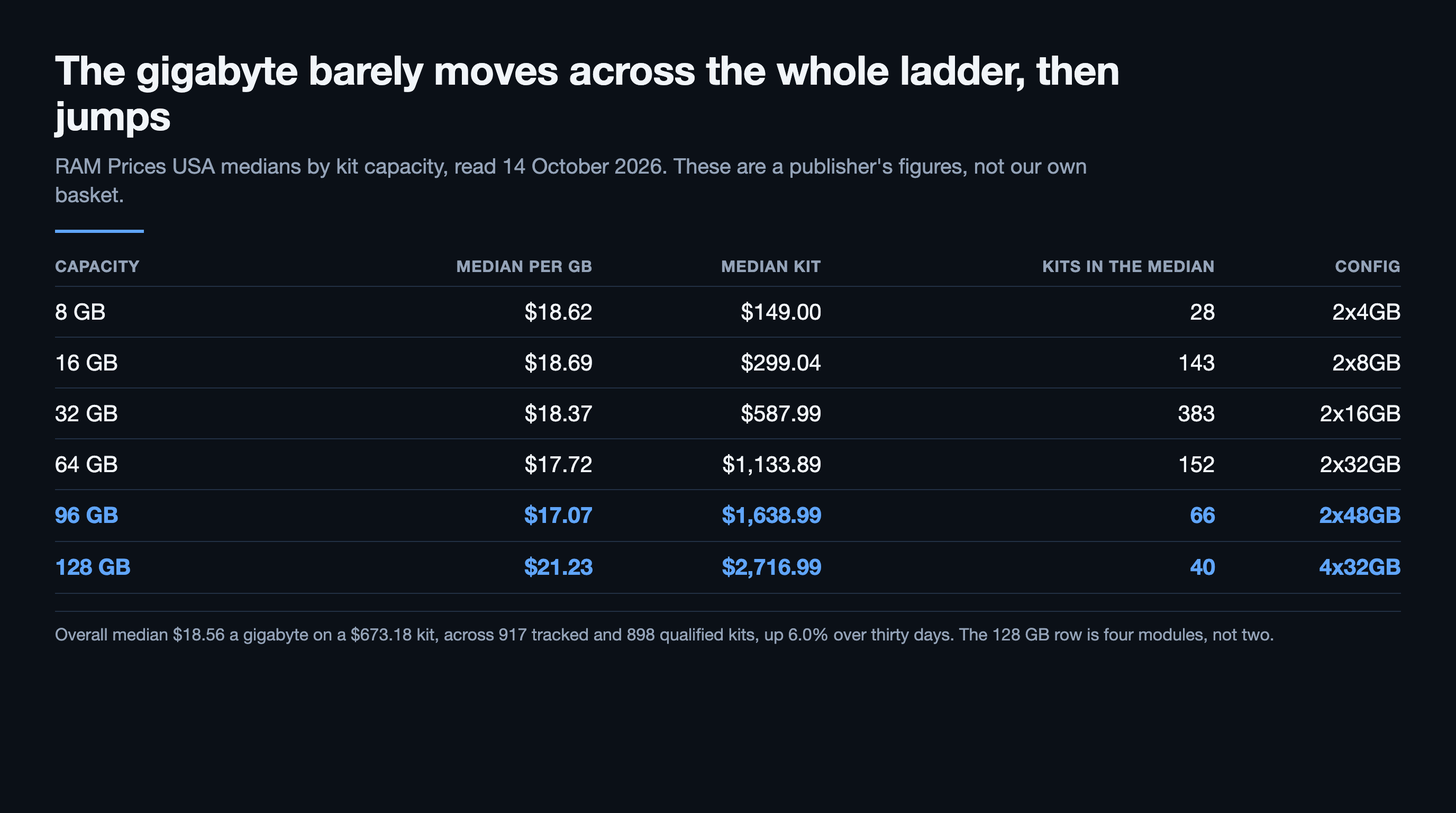
The gigabyte barely moves across the whole ladder
We have argued before, at length, that the gigabyte is the only unit that survives a comparison between parts. That is still true, and this is where it stops being useful. On DDR5 in 2026 the per-gigabyte price is nearly constant across the entire capacity range, so the unit that makes parts comparable cannot tell you which capacity to buy. The ladder below is RAM Prices USA’s, chosen over the other three because its kit prices and its per-gigabyte figures reproduce each other at every rung.
| Capacity | Typical config | Median kit | Median $/GB | Kits | $/GB step |
|---|---|---|---|---|---|
| 8GB | 2×4GB | $149.00 | $18.62 | 28 | — |
| 16GB | 2×8GB | $299.04 | $18.69 | 143 | +0.4% |
| 32GB | 2×16GB | $587.99 | $18.37 | 383 | −1.7% |
| 64GB | 2×32GB | $1,133.89 | $17.72 | 152 | −3.5% |
| 96GB | 2×48GB | $1,638.99 | $17.07 | 66 | −3.7% |
| 128GB | 4×32GB | $2,716.99 | $21.23 | 40 | +24.4%module count changes |
Read the two middle columns against each other. From 8GB to 96GB the capacity multiplies by 12 and the median kit price multiplies by 11.00x — from $149.00 to $1,638.99 — while the gigabyte falls just 8.3%, from $18.62 to $17.07. Every step that keeps the kit at two modules moves the gigabyte by under 3.7%. The capacity discount that storage still pays, and that the 32GB against 64GB step tests directly, is close to nil on this ladder.
The cheapest gigabyte is at 96GB, built as 2×48GB — a non-binary capacity that exists because Micron shipped 24GB and 48GB DDR5 modules, and one that none of the three other publishers quotes at all. It is also, at $1,638.99, the single most expensive kit on the ladder bar one. Both facts are true at once, and that is the whole problem with ranking memory per gigabyte.
At one capacity, the configuration costs more than the capacity
If the steps between capacities move the gigabyte by under 3.7%, something else is moving it. Hold the capacity completely fixed and change only how the kit is cut into modules. The rows below are TechFuel HQ’s, the one publisher in the set that names both the kit and the retailer on every price.
| Capacity | Kit | Config | Kit price | $/GB | Gap | Also differs |
|---|---|---|---|---|---|---|
| 16GB | Patriot Viper Venom | 1×16GB | $214.99 | $13.44 | — | — |
| 〃 | G.Skill Flare X5 | 2×8GB | $264.99 | $16.56 | 23.3% | different brand |
| 128GB | V-COLOR Manta XFinity RGB CL32 | 2×64GB | $2,999.99 | $23.44 | — | — |
| 〃 | A-Tech DDR5-5600 CL46 | 4×32GB | $1,858.33 | $14.52 | 61.4% | different brand; DDR5-5600 CL46 against CL32 |
At 128GB, the two-module kit is 61.4% dearer per gigabyte than the four-module one — $23.44 against $14.52, for the same total memory on the same retailer on the same day. Note the direction: the kit with FEWER sticks is the expensive one, which is the opposite of the intuition that fewer, denser modules save money. The 64GB module is the premium part; four mainstream 32GB modules reach the same capacity for less.
Either way, the comparison that matters is against the capacity ladder: configuration moves the gigabyte up to 61.4%, the widest capacity step moves it 24.4%, and that widest capacity step is itself the 96GB-to-128GB rung where the module count changes. Strip the configuration changes out and the capacity ladder has almost no signal left in it.
Four readings of one step, and they disagree on its direction
You might reasonably ask whether our reading of the ladder is just one publisher’s table. So here is the same step — 32GB to 64GB, the most-quoted comparison in the niche — as four published figures have it inside ten weeks.
| Publisher | Figures dated | 32GB $/GB | 64GB $/GB | Step | Direction |
|---|---|---|---|---|---|
| RAM Prices USA | Oct 14, 2026 | $18.37 | $17.72 | −3.5% | bigger kit cheaper |
| Capital & Compute | Oct 7, 2026 | $14.25–$18.44 | $20.30 | +10.1% to +42.5% | bigger kit dearer |
| Capital & Compute | Sep 30, 2026 | $17.50 | $17.17 | −1.9% | bigger kit cheaper |
| TechFuel HQ | Aug 1, 2026 | $12.50 | $13.59 | +8.7% | bigger kit dearer |
2 of the four readings make the bigger kit the dearer gigabyte and 2 make it the cheaper one. They do not disagree about the size of the step; they disagree about which way it points. An offset fitted to one publisher is therefore worse than no offset: there is no sign to correct, which is the same conclusion the RAM price tracker comparison reached from a different direction.
The cleanest version of this needs no cross-publisher adjudication at all, because one publisher reverses itself. Capital & Compute had the 64GB gigabyte $17.17 against $17.50 at 32GB on Sep 30, 2026 — the bigger kit cheaper — and $20.30 against $14.25–$18.44 one week later, which makes it dearer on either end of its own range. Same page, same methodology, seven days, opposite sign. Whatever moved is real, but it is not a gradient you can plan a purchase around.
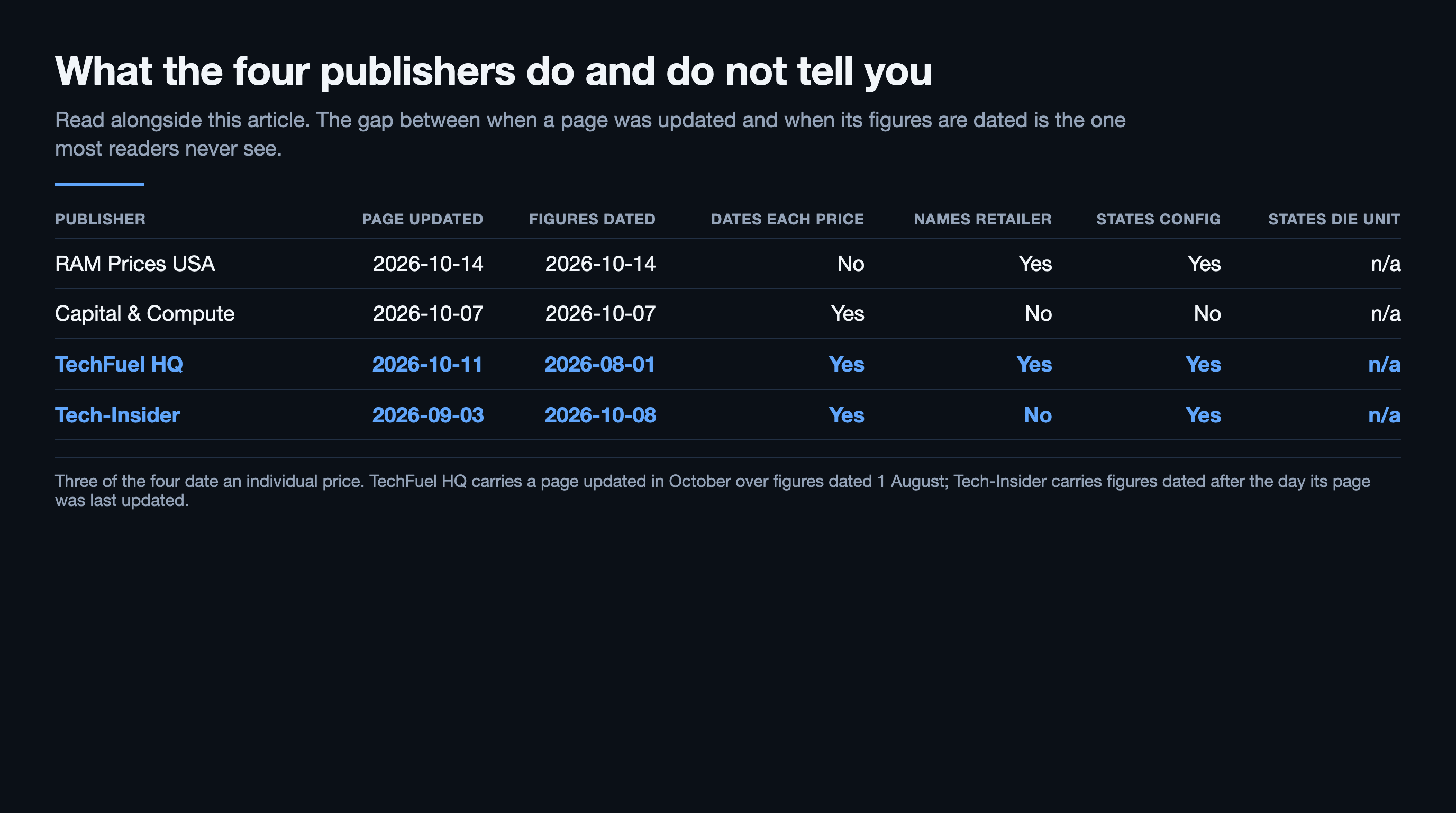
| Publisher | Page says | Figures dated | Dates each price | Names retailer | States config |
|---|---|---|---|---|---|
| RAM Prices USA | Oct 14, 2026 | same | no | yes | yes |
| Capital & Compute | Oct 7, 2026 | same | yes | no | no |
| TechFuel HQ | Oct 11, 2026 | Aug 1, 2026 | yes | yes | yes |
| Tech-Insider | Sep 3, 2026 | Oct 8, 2026 | yes | no | yes |
3 of the 4 publishers put a date on an individual price rather than only on the page. One of them, TechFuel HQ, stamps its page Oct 11, 2026 while its headline capacity figures are dated Aug 1, 2026 — 71 days apart — and the fresher observation table further down the same page prices 32GB kits well above its own summary. This is why we print the observation date in the row and not in the footer.
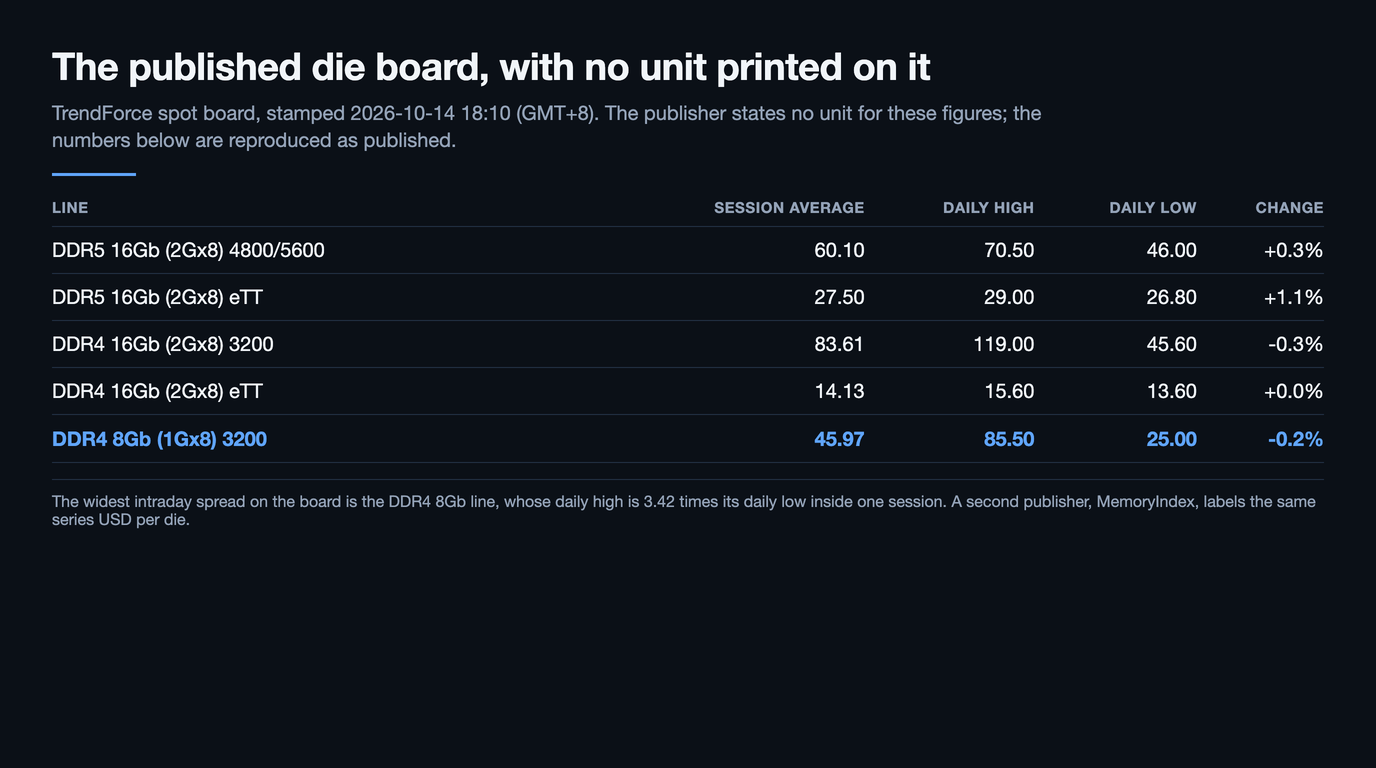
The published DDR5 price has no unit on it
Every “DDR5 prices up X%” headline traces back to one artefact: the DRAM spot board. We read TrendForce’s today. It is the most authoritative DDR5 price in existence and it does not say what it is measured in.
| Item | Session avg | Day low | Day high | Low-to-high | Change | Unit given |
|---|---|---|---|---|---|---|
| DDR5 16Gb (2Gx8) 4800/5600 | 60.10 | 46.00 | 70.50 | 1.53x | +0.3% | none |
| DDR5 16Gb (2Gx8) eTT | 27.50 | 26.80 | 29.00 | 1.08x | +1.1% | none |
| DDR4 16Gb (2Gx8) 3200 | 83.61 | 45.60 | 119.00 | 2.61x | −0.3% | none |
| DDR4 16Gb (2Gx8) eTT | 14.13 | 13.60 | 15.60 | 1.15x | +0.0% | none |
| DDR4 8Gb (1Gx8) 3200 | 45.97 | 25.00 | 85.50 | 3.42x | −0.2% | none |
The columns read Item, Daily High, Daily Low, Session High, Session Low, Session Average, Session Change. There is no unit anywhere on the table and no currency symbol on any figure, which is why the numbers above are printed bare. A reader who wants to know whether 60.10 is dollars per die, dollars per gigabyte or an index cannot find out from the page that publishes it — and the difference between the first two is a factor of two.
It converts only because a second publisher, MemoryIndex, carries the same series sourced to the same board and labels its column USD / die, at $56.95 for the DDR5 16Gb die on Sep 24, 2026. That label is doing a lot of work for a third-party footnote. It is also not perfectly clean: the same publisher’s news section gives $57.667 for the identical row and date, and does not explain the gap.
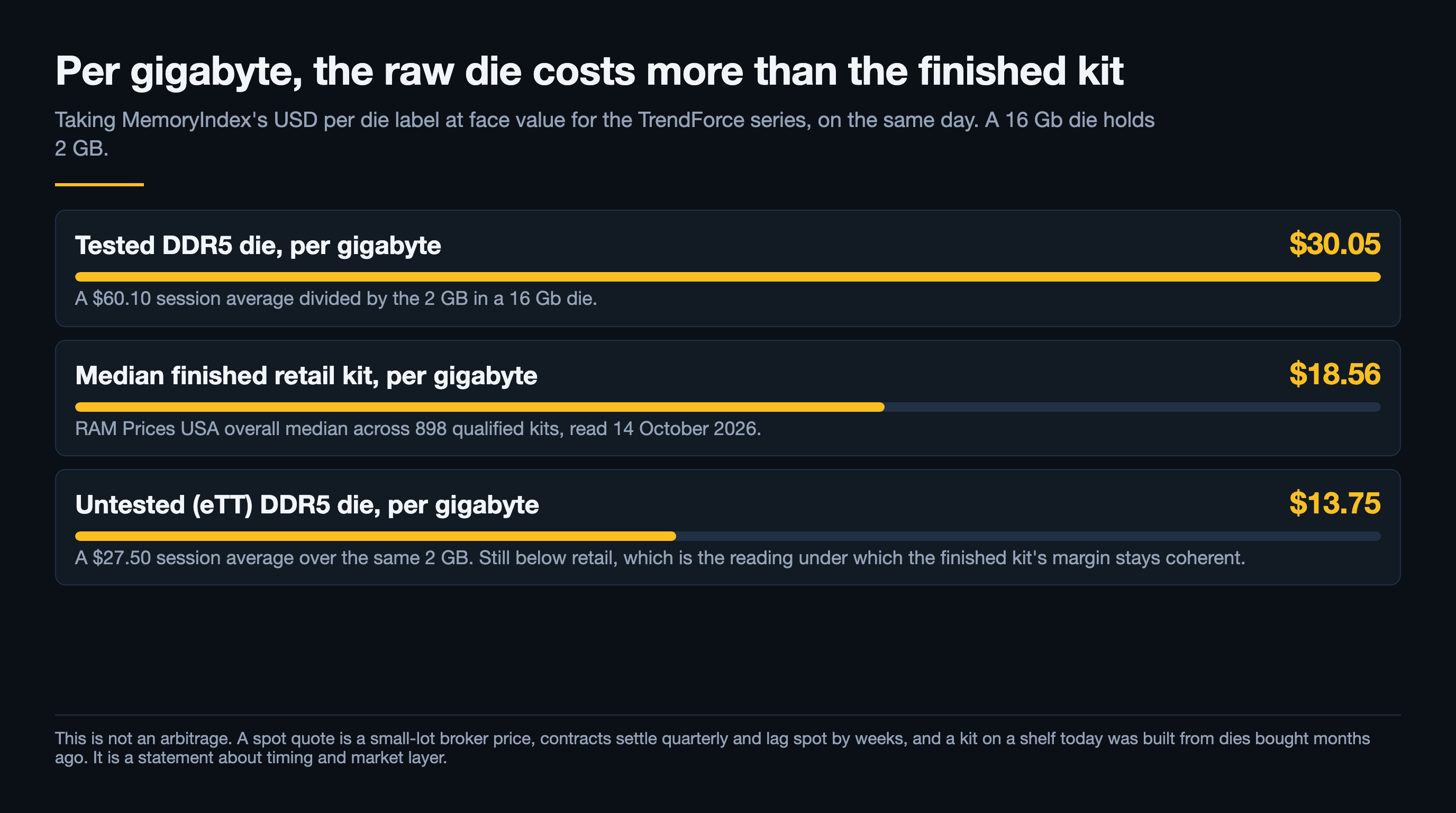
The die costs more per gigabyte than the finished kit
Take the unit label at face value and one comparison becomes available that nobody in this niche publishes: the raw memory die against the finished kit it goes into, per gigabyte, on the same day.
| Layer | Figure as published | Per GB | Publisher | Dated |
|---|---|---|---|---|
| Tested die, spot | 60.10 per 16Gb die | $30.05 | TrendForce | Oct 14, 2026 |
| Tested die, labelled | $56.95 USD / die | $28.48 | MemoryIndex | Sep 24, 2026 |
| Untested (eTT) die, spot | 27.50 per 16Gb die | $13.75 | TrendForce | Oct 14, 2026 |
| Finished retail kit, median | $673.18 | $18.56 | RAM Prices USA | Oct 14, 2026 |
| Finished retail kit, our floor | $529.00 | $16.53 | ByteWatch | Oct 20, 2026 |
A tested DDR5 die prices at $30.05 a gigabyte on the spot board. The median finished retail kit prices at $18.56, and the cheapest gigabyte in our own basket at $16.53. The raw component is 1.62x the price of the assembled product, which is not a sustainable state for anyone in the chain and is the clearest signal in this article that retail prices have not caught up with the component market.
What it licenses is a direction, not a date — the buy-now-or-wait article explains why we rate forecasts in this market at nothing. The measurable statement is narrower: the component underneath your kit has already repriced upward and the shelf has not followed.
Spot and shelf disagree about DDR4 by direction
The same board carries DDR4, and reading the two generations across both layers turns the unit problem from a pedantic complaint into a trap with money in it.
| Layer | DDR4 per GB | DDR5 per GB | DDR4 vs DDR5 |
|---|---|---|---|
| Tested die, spot | $41.81 | $30.05 | +39.1% |
| Finished kit, our floor | $7.50 | $16.53 | −54.6% |
On the die market DDR4 is 39.1% dearer per gigabyte than DDR5. On our shelves the DDR4 kit is 54.6% cheaper. The two layers do not disagree about magnitude — they disagree about which generation is expensive. A withdrawn standard whose dies are scarce can sit on cheap finished stock for a long time, and the DDR4 price article prices that stock kit by kit.
So a headline built on the die market calls DDR4 the expensive memory and the shop says the opposite, and both correctly report the layer they can see. A page that does not name its layer cannot answer what a kit costs.
What to pay, and five checks before you click
Turning all of that into something usable this afternoon. The bands are the published medians, not our pick of a kit — the 32GB value ladder is where we name parts.
| Capacity | Median kit today | Median $/GB | The check that pays |
|---|---|---|---|
| 16GB | $299.04 | $18.69 | Price the single 16GB module against the 2×8GB kit before anything else. |
| 32GB | $587.99 | $18.37 | Four of our five tracked kits sit inside one speed grade; sort the grade, then the price. |
| 64GB | $1,133.89 | $17.72 | Compare 2×32GB against two 32GB kits bought separately — the per-GB gap runs both ways. |
| 96GB | $1,638.99 | $17.07 | The cheapest gigabyte on the published ladder, and the rung nobody quotes. Check your board takes 2×48GB. |
| 128GB | $2,716.99 | $21.23 | Count the modules: 4×32GB and 2×64GB are different products at the same capacity. |
One. Fix the capacity from your board and your workload first: the per-gigabyte figure is flat, so it cannot choose it for you. Two. Count the modules, and treat 4×32GB and 2×64GB as different products. Three. Check your board posts with the non-binary capacities before buying the cheapest gigabyte on the ladder. Four. Read the date on the price, not on the page: 71 days of drift is a live defect on one of the four pages above. Five. Ask what unit a quoted price is in — a per-die figure is roughly 1.62x the retail per-gigabyte number and describes a market you cannot buy in.
How these numbers are produced, and what we withhold
We scrape live product pages at tracked US retailers and store every observation with a timestamp, so the basket table above renders from the database when you load the page rather than from a number typed into this file. Best price means the lowest in-stock observation for that SKU in the last 30 days. We price 7 DDR5 SKUs across 1 reporting retailer, which is narrow, and we would rather say so than widen the basket with listings we cannot date.
We withhold medians below a five-part sample floor and publish no forecasts. Every third-party figure carries its publisher and that publisher’s own date; where a publisher gives no unit, the figure is printed without one. New retail stock only, no deal scores, and no affiliate links anywhere on this page.
Related reading
FAQ
How much does a DDR5 kit cost in 2026?
Depends entirely on the capacity, and the kit price moves far more than the per-gigabyte price does. The freshest published by-capacity medians, read 14 October 2026, run $149.00 at 8GB, $587.99 at 32GB, $1,133.89 at 64GB and $2,716.99 at 128GB. Our own tracked basket observes $16.53 to $21.87 per gigabyte across the 7 kits we currently price. Check the date on any figure you are quoted.
Why is the price per gigabyte almost the same at every DDR5 capacity?
Because in 2026 it is. From 8GB to 96GB the published median falls only 8.3% while the kit price multiplies by 11.00x. Memory does not currently pay a meaningful bulk discount, unlike storage, where the capacity discount is real up to a point. That makes the per-gigabyte figure good for comparing a kit against another kit and useless for choosing which capacity to buy.
Does the number of sticks change what DDR5 costs?
More than the capacity does. At 128GB, one publisher's own Newegg rows put a 2×64GB kit at $23.44 per gigabyte against $14.52 for a 4×32GB kit — 61.4% apart at identical total capacity, though a speed grade and a brand differ too. The widest step between adjacent capacities on the published ladder is 24.4%. Count the modules before you compare prices.
What are 48GB and 96GB DDR5 kits, and are they cheaper?
They are non-binary capacities, built from 24GB and 48GB modules rather than the usual powers of two — Micron announced 24GB and 48GB DDR5 modules for desktops, at DDR5-5200 and DDR5-5600 with CL46 latency. On the freshest published ladder, 96GB as 2×48GB is the cheapest gigabyte of any capacity at $17.07, while costing $1,638.99 as a kit. Confirm your motherboard posts with them before buying.
Why do DDR5 price trackers disagree so much?
Different baskets, different retailers, different dates, and in 2026 they do not even agree on direction. Across four published readings of the 32GB-to-64GB step inside ten weeks, some make the bigger kit the dearer gigabyte and some make it cheaper, and one publisher reverses its own sign between two of its own dates a week apart. Because the gap between two trackers has no consistent sign, an offset fitted to one of them makes the next figure worse rather than better.
Is the DRAM spot price the same as a DDR5 kit price?
No, and it is not in the same unit. The spot board quotes a memory die — a 16Gb die is 2GB — and one published, labelled figure for the DDR5 16Gb die works out to roughly $30.05 per gigabyte against $18.56 for a finished retail kit. The board itself prints no unit and no currency at all. A percentage move on the spot board is a statement about the component market, not about what a kit will cost you this week.
Should I buy DDR4 instead, since the kits are cheaper?
On price per gigabyte, DDR4 kits are substantially cheaper than DDR5 kits right now, so if your board takes DDR4 it is the better value purchase today. Two caveats. DDR4 is being withdrawn from production rather than discounted, so the saving is on existing stock and not a trend. And the socket usually decides this for you — a DDR4 platform has no upgrade path, which is a different question from what a gigabyte costs.
A date and a unit on every price
We track DDR5, DDR4 and NVMe listings at US retailers and tell you when one of yours moves. New retail stock only, no deal scores, no affiliate links, no commission on anything you buy — observed prices, dated, with the sample size printed next to them.