Refurbished Warranty Replacements in 2026: Six Yardsticks, One Silence
Key takeaways
- 7 of 11 makers may send a used part when they honour a claim, in 4 words: “refurbished”, “previously used”, “reconditioned”, “recertified”.
- They measure “close enough” against 6 different things, from your own capacity down to whatever is in stock. Only 2 forbid ending up with less than you sent.
- None states the remaining life of what it sends — though the same documents cap your cover by the writes a drive has already taken, 5 ways.
- SanDisk and Samsung publish the same sentence with the brand swapped, both benchmarking to their own spec rather than to a new drive.
- Kioxia alone defines its standard, and the definition admits a competitor’s product.
You post a dead drive, wait a fortnight, and a padded envelope comes back. Nobody tells you whether what is inside is new. A refurbished warranty replacement is not a loophole or a scandal — it is what 7 of the 11 warranty documents we read say they may send, in their own words, and most owners have never read the sentence. The money is real: on a market where a kit that cost $90 now lists near $390, the difference between a part that matches yours and one that merely matches your category is the upgrade you did not get.
So we read the clause in every document we could open on November 13, 2026 — 11 makers across 11 hosts, consumer and enterprise lines kept apart — and tabulated what each promises about the substitute’s condition. The answer is not “they send refurbished parts”. It is that they promise 6 different things, the differences are measured in gigabytes and dollars, and the quantity that matters most for a flash drive is missing from all of them.
Who reserves the right to send a used one
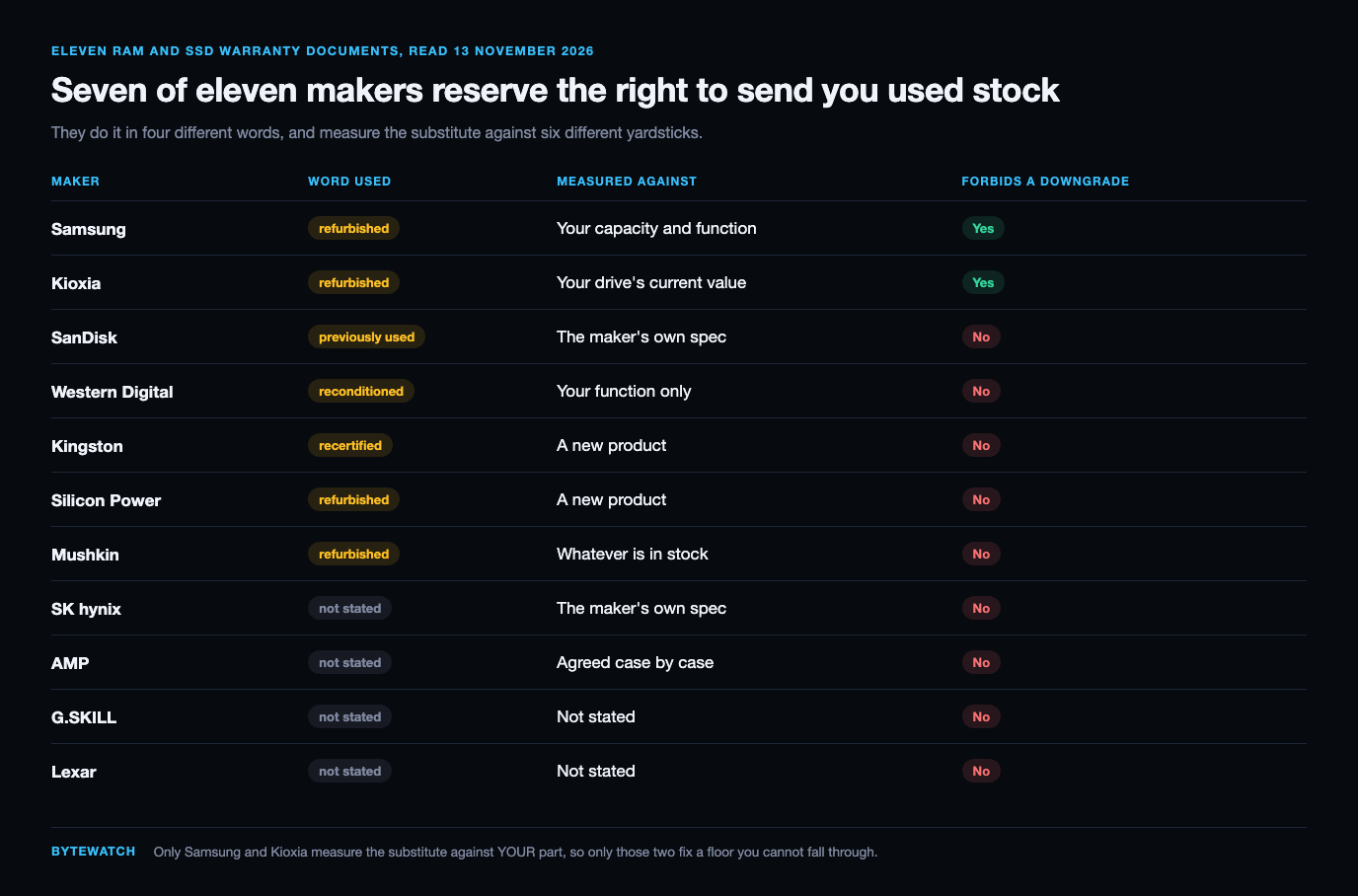
Does the document say the part may be second-hand? Seven say so outright, and disagree on what to call it. “Recertified” sounds like a process, “reconditioned” like a repair, “previously used” like exactly what it is.
| Maker | Scope | Used stock named | Their word | Measured against |
|---|---|---|---|---|
| Samsung | consumer SSD | Yes | “refurbished” | Your capacity and function |
| SanDisk | enterprise SSD | Yes | “previously used” | The maker’s own spec |
| Western Digital | commercial flash | Yes | “reconditioned” | Your function only |
| Kingston | memory and SSD | Yes | “recertified” | A new product |
| Kioxia | legacy OCZ-brand SSD | Yes | “refurbished” | Your drive’s current value |
| Silicon Power | memory and SSD | Yes | “refurbished” | A new product |
| SK hynix | consumer SSD | No | — | The maker’s own spec |
| Mushkin | memory and flash | Yes | “refurbished” | Whatever is in stock |
| AMP | industrial memory and storage | No | — | Agreed case by case |
| G.SKILL | memory | No | — | Not stated |
| Lexar | memory and SSD | No | — | Not stated |
Two say nothing about condition: G.SKILL and Lexar. That is not a promise of new stock. Lexar reserves the choice of remedy — “Your exclusive remedy and Lexar's entire liability under this warranty will…” — without saying what state the replacement arrives in, and G.SKILL’s RMA policy details packaging, freight, customs and processing time while never describing the part itself.
6 ways to say “close enough”
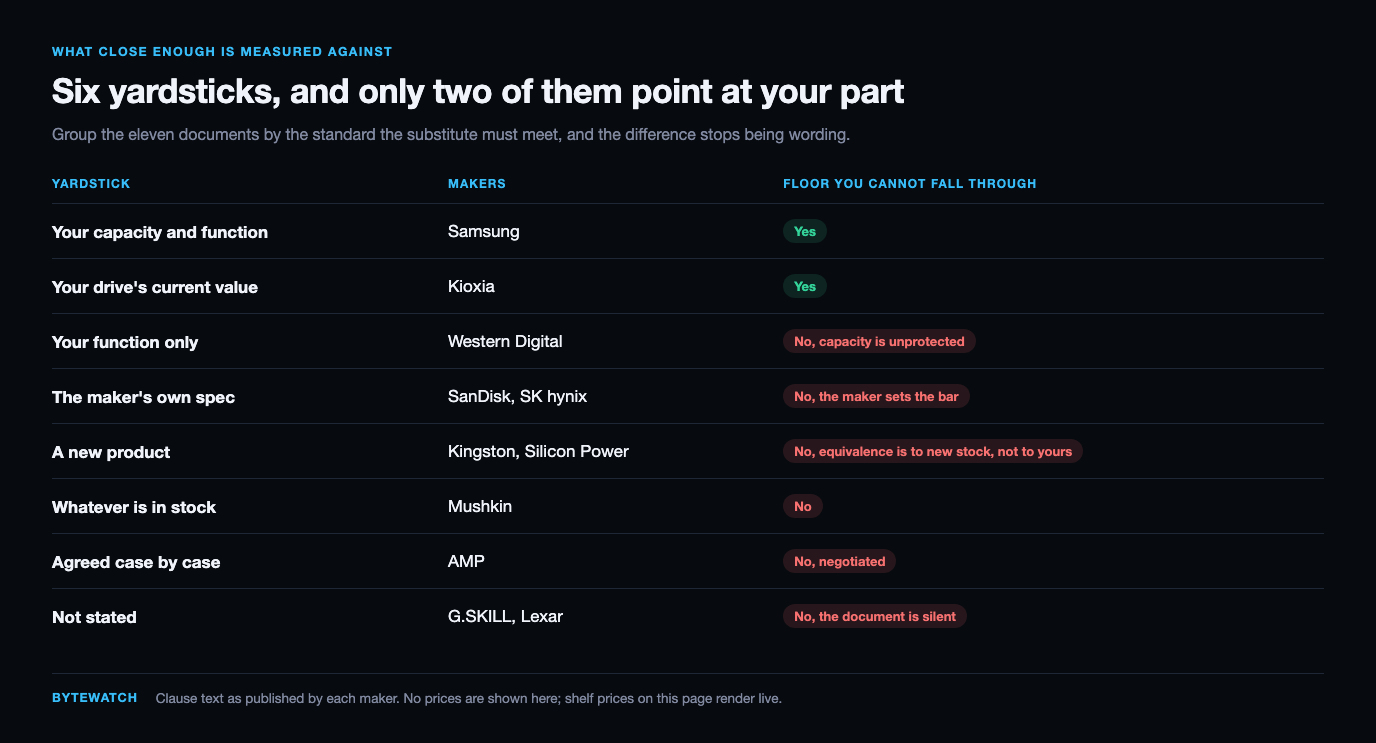
Every document that names a standard measures the substitute against something, and the something differs almost every time. This is where a refurbished warranty replacement becomes 6 topics.
| Yardstick | Maker | Can you end up with less? | Their words |
|---|---|---|---|
| Your capacity and function | Samsung | No | “repair or replace the Product with new or refurbished Product of equal or greater…” |
| Your drive’s current value | Kioxia | No | “replace the product with a new or refurbished product with the same or similar…” |
| A new product | Kingston | Yes | “Repaired parts or replacement products will be provided by Kingston on an exchange…” |
| A new product | Silicon Power | Yes | “SP will either replace it with a refurbished, new one or repair it to be functionally…” |
| The maker’s own spec | SanDisk | Yes | “SanDisk may replace your Product with a product that was previously used, repaired…” |
| The maker’s own spec | SK hynix | Yes | “an functionally-equivalent replacement at no additional cost. The replacement shall…” |
| Your function only | Western Digital | Yes | “Such replacement will be made with a new or reconditioned Product of equal or greater…” |
| Whatever is in stock | Mushkin | Yes | “repair or exchange (with the most similar available product, refurbished or new) the…” |
Two clauses in that table are one word apart, and the word is the capacity guarantee. Samsung promises “equal or greater capacity and functionality”. Western Digital’s commercial terms promise “equal or greater functionality” and stop there. A smaller drive of the same class is a downgrade in capacity and arguably identical in function, so one clause forbids it and the other does not reach it. Only Samsung and Kioxia fix a floor you cannot fall through — Samsung on capacity, Kioxia on value.
At the other end, Mushkin measures against its own inventory: “repair or exchange (with the most similar available product, refurbished or new) the…”. “Available” is not a property of your drive at all — and the same document carries a second, tighter standard later, “where the replacement product is an equivalent product at the time a claim for…”. Two standards in one document, the looser one in the warranty’s opening sentence, and the tighter one dating equivalence to “the time a claim for warranty service is made”: today’s catalogue, not the one you bought from.
“Functionally equivalent” to what, exactly?
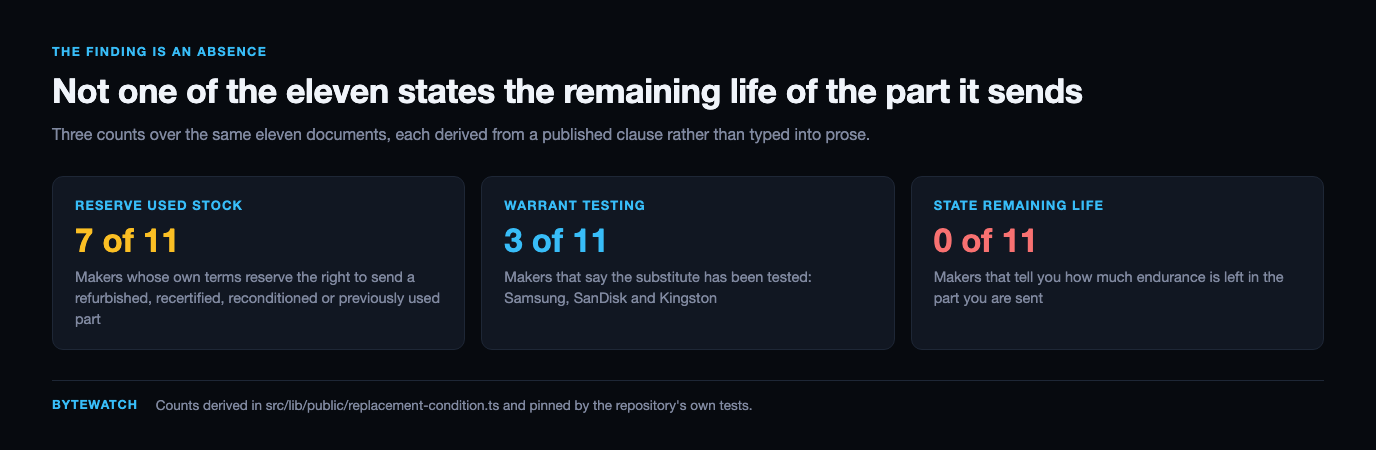
Four documents use “functionally equivalent” or a near variant, which makes it look like the industry has a shared standard. It does not. The phrase is only as strong as the thing on the other side of it, and there are two of those.
| Benchmark | Makers | What it fixes | What it leaves open |
|---|---|---|---|
| A new product | Kingston, Silicon Power | Performance equal to new stock | Nothing said about hours or writes already on the part |
| The maker’s own spec | SanDisk, SK hynix | Conformance to the published datasheet | A worn part inside spec still conforms |
Kingston is the most generous reading in the set, and worth quoting in full because it warrants a process rather than reserving a right: “Repaired parts or replacement products will be provided by Kingston on an exchange basis, and will be either new or recertified” — then “All recertified products have been tested to ensure that they are functionally equivalent to new products”. That is a claim about testing, against new stock, and 3 of 11 documents make one.
SK hynix shows the other reading: “an functionally-equivalent replacement at no additional cost. The replacement shall meet the…” — the reference point is the maker’s datasheet, not a new drive and not your drive. A spec sheet is a floor, and a part can sit on that floor with most of its working life behind it. Silicon Power is blunter about the consequence than anyone: “the repaired product that you receive might not be the one you originally sent”.
Two makers, one sentence
The oddest thing we found is not a clause but a coincidence that cannot be one. Samsung, on its consumer storage warranty, and then SanDisk:
“SanDisk may replace your Product with a product that was previously used, repaired and tested to meet SanDisk specifications”
Same sentence, different brand, two companies, two tiers — one a consumer warranty, the other covering enterprise SSD parts. This is boilerplate that has travelled, and it tells you something about the clause’s origin: drafted to be reusable, which is to say drafted for the maker rather than negotiated for the buyer. Both benchmark to the company’s own specifications — the weaker of the two readings above — and both bury the admission mid-paragraph.
The counter that does not reset
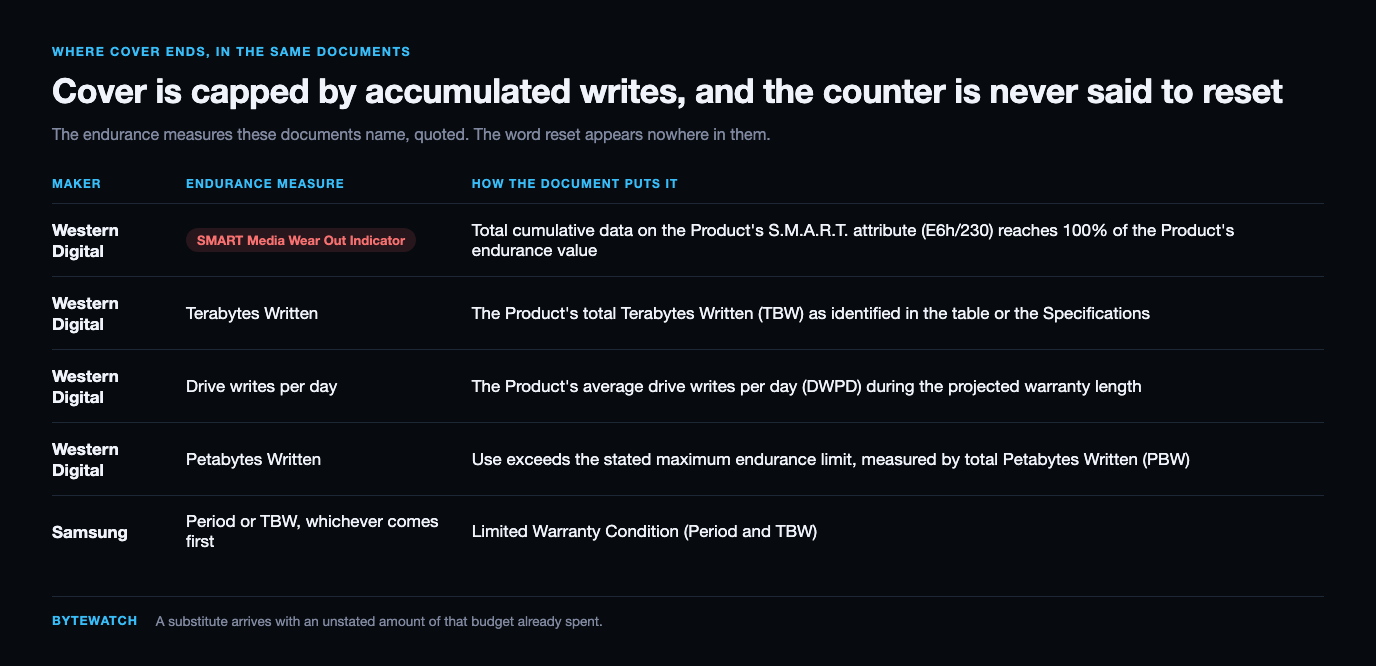
The finding that made this article worth writing is an absence rather than a clause. Every document is silent on the number that decides what a used flash part is worth: how much of its rated life is gone. Not one of the eleven states it. That would be unremarkable if the same documents did not also make wear the thing that ends your cover:
| Maker | What it counts | Their words |
|---|---|---|
| Western Digital | SMART Media Wear Out Indicator | “the time at which such Product’s total cumulative data (as recorded on the…” |
| Western Digital | Terabytes Written | “the Product’s total Terabytes Written (TBW) as identified in the table…” |
| Western Digital | Drive writes per day | “the stated maximum endurance limit, which shall be measured by calculating…” |
| Western Digital | Petabytes Written | “the point at which Customer’s use of the product exceeds the stated maximum…” |
| Samsung | Period or TBW, whichever comes first | “Limited Warranty Condition (Period and TBW)” |
Read that first row again. Western Digital ends the warranty when a counter stored on the drive itself reaches 100% — the SMART “Media Wear Out Indicator”, attribute E6h/230 — and the same document permits a “reconditioned” substitute. It never says what that attribute reads on the part they send, and “reset” does not appear in it at all. A new unit starts at 0% and cover ends at 100%; where in that range a refurbished replacement begins is the figure nobody publishes, so we will not put a number on it either.
| Series | Capacity | Term | Write ceiling |
|---|---|---|---|
| 750 EVO | 120GB | 3 years | 35 TB |
| 750 EVO | 250GB | 3 years | 70 TB |
| 750 EVO | 500GB | 3 years | 100 TB |
| 850 PRO | 128GB/256GB | 10 years | 150 TB |
| 850 PRO | 512GB/1TB | 10 years | 300 TB |
| 850 PRO | 2TB | 10 years | 450 TB |
| 850 PRO | 4TB | 10 years | 600 TB |
Samsung makes the same arrangement explicit in table form: cover runs for a term or a write ceiling, whichever arrives first — 10 years or 450 TB at 2TB — and the replacement may be “previously used”. A dual-limit warranty on a part whose consumed writes are undisclosed is a term of unknown length. We have costed a terabyte of writes separately; the narrow point here is that the clause granting the remedy and the clause limiting it count the same thing, and only one is reported to you.
The only maker that defines its own standard
Kioxia is the exception that shows how much the others leave unsaid. Its remedy is “replace the product with a new or refurbished product with the same or similar features, the value of…” — a value floor rather than a capacity or function one, and the only standard tied to what the drive is worth now rather than what it was. In a market that has moved this far, that is the standard most likely to hand you something better than you sent.
Then it does what no other document does and defines its terms: “Product of similar function is defined as a product with the same, similar, and/or equivalent specifications, of KIOXIA and/or competitors' product within the territory and/or continent”. Read that twice. The definition is clearer than anyone else’s and simultaneously the most permissive, because “competitors' product” means the substitute need not be the maker’s own. Precision and generosity are not the same thing: this is the document you can most easily hold to a standard, and the standard explicitly includes somebody else’s drive.
What “anything in stock” is worth on our shelf
A standard bounded by availability is priced by whatever is available — the one half of this we measure rather than read. Here is our tracked basket as it stands, each part’s own category used as the pool a substitute would be drawn from.
| Part | Capacity | Same or greater | Anything in stock | The gap |
|---|---|---|---|---|
| Crucial Pro DDR5-5600 64GB (2x32GB) | 64 GB | $1299.77 | $528.97 at 32 GB | $770.80, 32 GB less |
| Samsung 990 Pro 4TB NVMe Gen4 SSD | 4 TB | $764.99 | $182.89 at 1 TB | $582.10, 3 TB less |
| Crucial Pro DDR4-3200 64GB (2x32GB) | 64 GB | $583.75 | $249.99 at 32 GB | $333.76, 32 GB less |
| Kingston KC3000 2048GB NVMe Gen4 SSD | 2 TB | $379.55 | $182.89 at 1 TB | $196.66, 1 TB less |
Of 18 priced rows, 8 (44%) would come back smaller than they went if a maker read “most similar available” literally — and across those 8 the median gap between the strictest standard and the loosest is $181.39. The rest are already the cheapest thing in their own category, so no standard can downgrade them. The widest today is Crucial Pro DDR5-5600 64GB (2x32GB): $1299.77 to honour its capacity, $528.97 to honour only its category — $770.80 and 32 GB apart.
This is the seam where buying and claiming meet. What the refurbished discount buys is a decision made with a price in front of you; a refurbished warranty replacement is the same class of goods arriving without one. The discount that makes second-hand flash attractive to a buyer is, in a claim, the part of the remedy nobody compensates you for.
Who tells you to check the part
If the substitute may be used stock drawn against a standard you cannot verify from the outside, who tells you to look? Two documents address arrival, and they ask different things.
| Maker | What they ask you to check | How long you get | Their words |
|---|---|---|---|
| Silicon Power | The part | 3 days | “If there are any issues with the quantity or specifications, simply reach out to our…” |
| G.SKILL | The carton | Until you sign | “Please check the package for any signs of damages before signing for the package. If…” |
Silicon Power is the only one pointed at the part itself: “If there are any issues with the quantity or specifications, simply reach out to our customer…” — 3 days from delivery, for a quantity or specification problem. That is the window in which a wrong capacity or speed grade is still the maker’s problem, and as the turnaround census noted, it runs on a part you have probably not installed yet.
G.SKILL’s section is headed “When receiving your replacement” — and it is about the box: “Please check the package for any signs of damages before signing for the package. If there are…”, after which “any damages will be the End User’s responsibility”. The one maker with a receiving-instructions section asks you to inspect the packaging and says nothing about the contents. The other 9 ask nothing. With the 3-day clock, the practical rule is to open and test the part the day it lands.
How to file so the substitute is the one you want
None of this argues against claiming — a free replacement beats a dead drive on every reading above. It argues for filing with the clause in front of you:
- Find your maker’s standard first. It is one sentence in the remedy paragraph, and the difference between “equal or greater capacity” and “equal or greater functionality” decides whether a smaller drive is a valid substitute.
- Ask in writing whether the part will be new. Seven of 11 documents permit used stock, so the question is reasonable and the answer is quotable later.
- Record your own drive’s SMART data. Percentage used and host writes, before it leaves. You cannot compare what arrives against what left if you never read what left.
- Open and test it the day it arrives. The only part-inspection window we found is 3 days, and the only other arrival clause expires when you sign for the carton.
- Keep that reading with the paperwork. The cover that comes back is the remainder of the original term in every document that addresses it — see what a storage claim pays — so the part’s condition at arrival is the only thing that tells you what the term is worth.
The pattern across all 11 documents is the one this series keeps finding: the owner’s obligations are specified to the day and the dollar, the maker’s against a standard it writes itself. None of it is hidden, and none of it is on one page anywhere — the only reason an article like this has anything to say.
Related reading
FAQ
Is a warranty replacement new or refurbished?
Either, on most of the documents we read. 7 of 11 makers reserve the right to send used stock in their own words: Samsung "new or refurbished Product of equal or greater capacity and functionality", Kingston "either new or recertified", Western Digital "a new or reconditioned Product of equal or greater functionality". G.SKILL and Lexar say nothing about condition, which is not a promise of new stock. Read 2026-11-13.
What does "functionally equivalent" actually guarantee?
Less than it sounds, and it depends which thing the phrase points at. Kingston and Silicon Power benchmark against a new product — Kingston: "All recertified products have been tested to ensure that they are functionally equivalent to new products". SanDisk and SK hynix benchmark against their own specification, which a worn part can meet. A datasheet is a floor, not a statement about remaining life.
Do manufacturers say how much life is left on a refurbished replacement?
No. Not one of the 11 documents states the remaining endurance, power-on hours or consumed writes of the part it sends — while the same documents cap cover by accumulated writes, in 5 formulations. Western Digital alone ends it when the drive's own SMART "Media Wear Out Indicator" (attribute E6h/230) reaches 100% of the rated endurance value. Pull the SMART data when the part arrives and keep it with the claim.
Can a warranty replacement be smaller than the drive I sent?
Only 2 of the 8 published standards forbid it. Samsung's "equal or greater capacity and functionality" does. Western Digital's commercial terms say "equal or greater functionality" with no mention of capacity, and Mushkin measures against "the most similar available product" — its own stock, not your part.
How long do I have to reject a replacement that is wrong?
3 days from delivery, on the only maker that fixes a window for the part itself. Silicon Power is "unable to process claims submitted after this timeframe". G.SKILL's receiving instructions cover only visible damage to the package before you sign. The other 9 documents set no arrival window at all.
Can they replace my drive with a different brand?
Kioxia says so explicitly, and it is the only document that defines its own standard: "Product of similar function is defined as a product with the same, similar, and/or equivalent specifications, of KIOXIA and/or competitors' product within the territory and/or continent". Everyone else leaves it to an undefined "equivalent" or "similar", which neither permits nor forbids a rival's part in terms.
Is it worth claiming at all if the replacement might be used?
Usually yes — a tested substitute beats a dead drive, and 3 makers warrant that used stock was tested before shipping. Read the clause because the remedy is worth different amounts under different standards, and where our DDR5 observations span $16.53-$25.15 per gigabyte, "similar" covers a wide range of money. File it; record what you sent and what came back.
Know what the replacement is worth before you post the old one
We track DDR5, DDR4 and NVMe listings at US retailers and tell you when one of yours moves. New retail stock only, no deal scores, no affiliate links — observed prices, dated, with the sample size next to them. A standard bounded by availability is priced by the market, so it helps to know what the market says.