Used vs New SSD Price in 2026: What the Refurbished Discount Actually Buys
- The cheapest terabyte of flash you could actually buy on 16 October 2026 was a new one, at $137.19. Not the refurbished listing ranked above it.
- At both capacities where a buyable drive existed in each condition, the refurbished one cost more per terabyte — +1.7% at 2TB and +5.1% at 1TB. Same capacity on both sides, so this is not the capacity curve in disguise.
- 4 of the 6 refurbished offers in the tracker’s cheapest-ten table were not refurbished offers by the time we opened them, and the price on arrival averaged +12.0% higher. All 4 of the 4 new rows matched to the cent.
- On hard drives the same publisher measures the refurbished discount at 34.7% like for like, across 11 capacities. It publishes no equivalent figure for SSDs, and neither does anybody else.
- The four SSD pages that do publish a figure span 30% to 70%, and not one names a source, a model or a retailer. A 40-point spread, wider than the whole measured hard-drive discount.
- Used vs new SSD price: the cheapest buyable terabyte is new
- Four of six refurbished offers were gone when we opened them
- On hard drives the discount is measured, published and about a third
- Why the hard-drive discount does not transfer to flash
- What the SSD pages claim the used vs new SSD price gap is
- The refurbished offer that survives is the one carrying a grade
- Our own basket is the new-condition control, and only that
- Five checks before you pay a used price for flash
- How these numbers were produced, and what we withhold
- Related reading
- FAQ
Every page that answers the used vs new SSD price question answers it with a bare percentage — 30% off, 30 to 50% off, half price — and not one of them names a drive, a shop or a day. That is not a style complaint: a wrong discount sends you to a marketplace listing with no warranty and no write history, and the figures on offer span 30% to 70%, a spread wider than any discount anybody has actually measured. So we did the thing none of those pages did. We took the one tracker that separates SSD conditions, read its cheapest ten listings, then opened all ten of its own drive pages to see what a buyer would meet on arrival.
Used vs new SSD price: the cheapest buyable terabyte is new
Start with the only comparison that holds everything else constant: the same capacity, the same marketplace, the same day, each condition’s cheapest offer as its own page showed it. DatacenterDisk’s SSD table carried ten in-stock listings across three capacities, and at two of those capacities a buyable drive existed in both conditions.
| Capacity | Cheapest new | $/TB | Cheapest refurbished | $/TB | Refurb vs new |
|---|---|---|---|---|---|
| 1TB | Kingston NV3 1TB (SNV3S/1000G) | $156.99 | Seagate FireCuda 520 1TB (ZP1000GM3A002) | $164.97 | +5.1% |
| 2TB | Kingston NV3 2TB (SNV3S/2000G) | $146.98 | Corsair MP700 PRO 2TB PCIe 5.0 | $149.50 | +1.7% |
The refurbished drive is the dearer terabyte at both. At 2TB a refurbished Corsair MP700 PRO ran $149.50 against $146.98 for a new Kingston NV3 — +1.7%. At 1TB a renewed Seagate FireCuda 520 ran $164.97 against $156.99 for the new NV3, +5.1%. The 4TB rung had no buyable refurbished offer at all, so it is left out rather than compared against a 2TB drive: on flash the per-terabyte price has a floor in the middle of the capacity curve, which the 2TB against 4TB step works through, and mixing capacities into a condition comparison measures the wrong thing.
The cheapest terabyte of any capacity in any condition on that page was $137.19 on a new Kingston NV3 4TB, sold by i77e. The refurbished column won on price nowhere we could check it fairly — the opposite of what the search results promise. The next section is why.
Four of six refurbished offers were gone when we opened them
A tracker’s cheapest-listings table is a snapshot of a daily scrape; its drive pages show the offer holding the listing right now. Normally those agree, and for every new row here they did — all 4 of 4 matched to the cent. The refurbished rows behaved differently.
| Drive | Table says | Table $/TB | Its own page says | Page $/TB | Move |
|---|---|---|---|---|---|
| Kingston NV3 4TB (SNV3S/4000G) | refurbished | $119.74 | newNew / Unknown | $137.19 | +14.6% |
| Crucial P310 2TB (CT2000P310SSD8) | refurbished | $137.50 | newNew / Unknown | $158.00 | +14.9% |
| Kingston NV3 2TB (SNV3S/2000G) | new | $146.98 | newNew / Unknown | $146.98 | same offer |
| Corsair MP700 PRO 2TB PCIe 5.0 | refurbished | $149.50 | refurbishedUsed / LikeNew | $149.50 | same offer |
| Seagate FireCuda X1070 2TB (ZP2000GS3A001) | refurbished | $151.04 | newNew / Unknown | $175.00 | +15.9% |
| Kingston NV3 1TB (SNV3S/1000G) | new | $156.99 | newNew / Unknown | $156.99 | same offer |
| Crucial T705 4TB PCIe 5.0 | new | $158.50 | newNew / Unknown | $158.50 | same offer |
| Crucial P310 2TB PS5 heatsink (CT2000P310SSD5-01) | refurbished | $160.00 | newNew / Unknown | $163.93 | +2.5% |
| Crucial P310 2TB integrated heatsink | new | $160.00 | newNew / Unknown | $160.00 | same offer |
| Seagate FireCuda 520 1TB (ZP1000GM3A002) | refurbished | $164.97 | refurbishedUsed / VeryGood | $164.97 | same offer |
2 of 6 refurbished rows survived being opened. The other 4 had reverted to a new offer, and in every case the new offer cost more: +14.6%, +14.9%, +15.9% and +2.5%, averaging +12.0%. The tracker documents this in its own notes — a listing can move “because stock ran out and a dearer seller became the cheapest offer for that product” — and calls its drive pages “the offer shown now, not the drive”. Nothing here is a tracker getting it wrong. It is what a refurbished price is: one seller’s one unit, and when it goes the listing stays and the price does not.
On hard drives the discount is measured, published and about a third
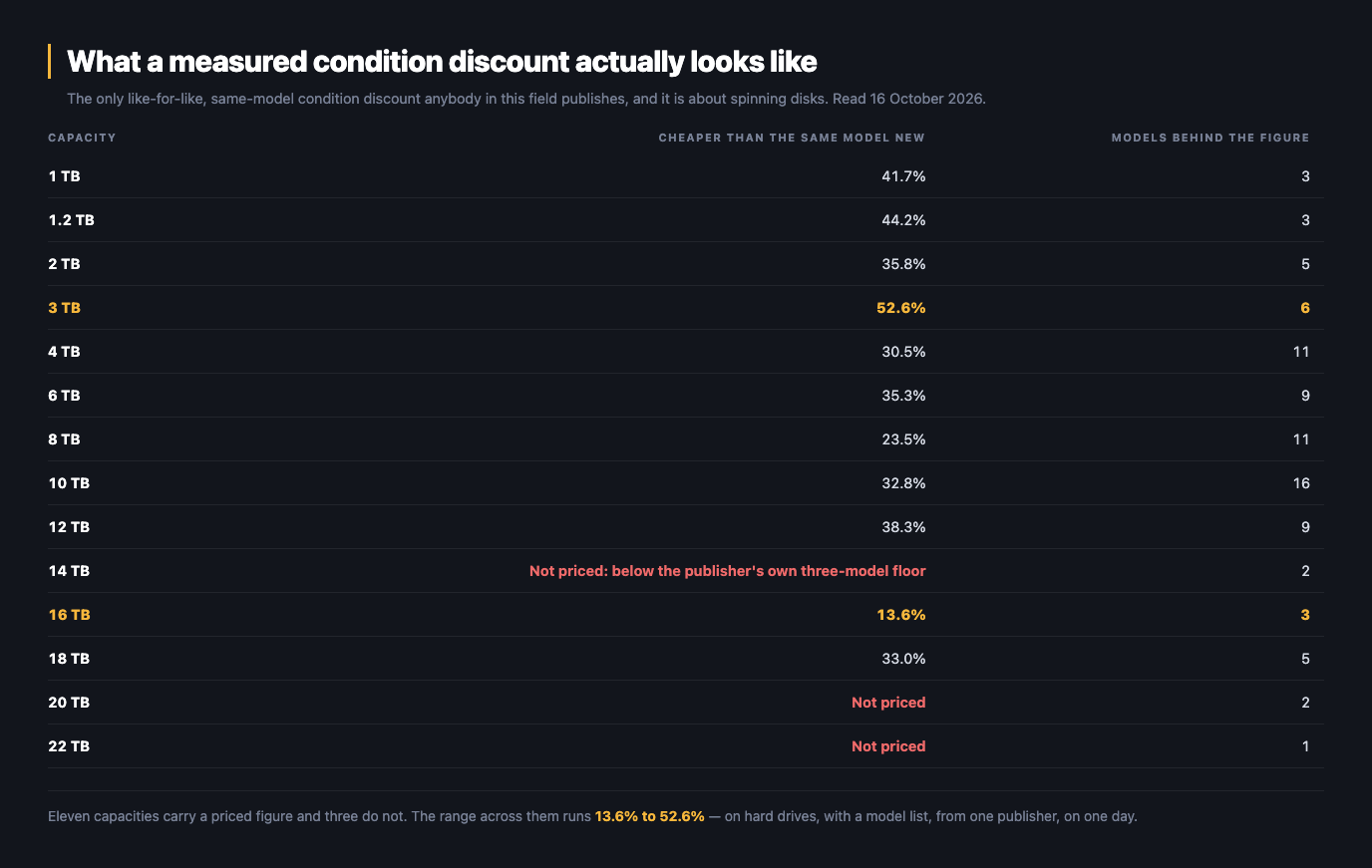
The reason the used-SSD figures feel plausible is that they are roughly right — about a different product. On spinning disks the condition discount is large, consistent, and two publishers measure it independently. DatacenterDisk’s refurbished-drive page compares every hard-drive model stocked in both conditions against its own price new, averages the model-level differences at each capacity, and prints the model count beside every figure.
| Capacity | Refurb vs same model new | Models compared |
|---|---|---|
| 1TB | 41.7% cheaper | 3 |
| 1.2TB | 44.2% cheaper | 3 |
| 2TB | 35.8% cheaper | 5 |
| 3TB | 52.6% cheaper | 6 |
| 4TB | 30.5% cheaper | 11 |
| 6TB | 35.3% cheaper | 9 |
| 8TB | 23.5% cheaper | 11 |
| 10TB | 32.8% cheaper | 16 |
| 12TB | 38.3% cheaper | 9 |
| 14TB | too few models to call | 2 |
| 16TB | 13.6% cheaper | 3 |
| 18TB | 33.0% cheaper | 5 |
| 20TB | too few models to call | 2 |
| 22TB | too few models to call | 1 |
Across the 11 capacities with at least three models each, refurbished runs 34.7% cheaper like for like, with per-capacity figures from 13.6% to 52.6%. On the separate question of which condition holds the cheapest listing, refurbished wins at 15 of 16 capacities, across 174 in-stock refurbished drives. A second publisher got there another way, grouping 429 used listings and 477 new ones by capacity and taking medians.
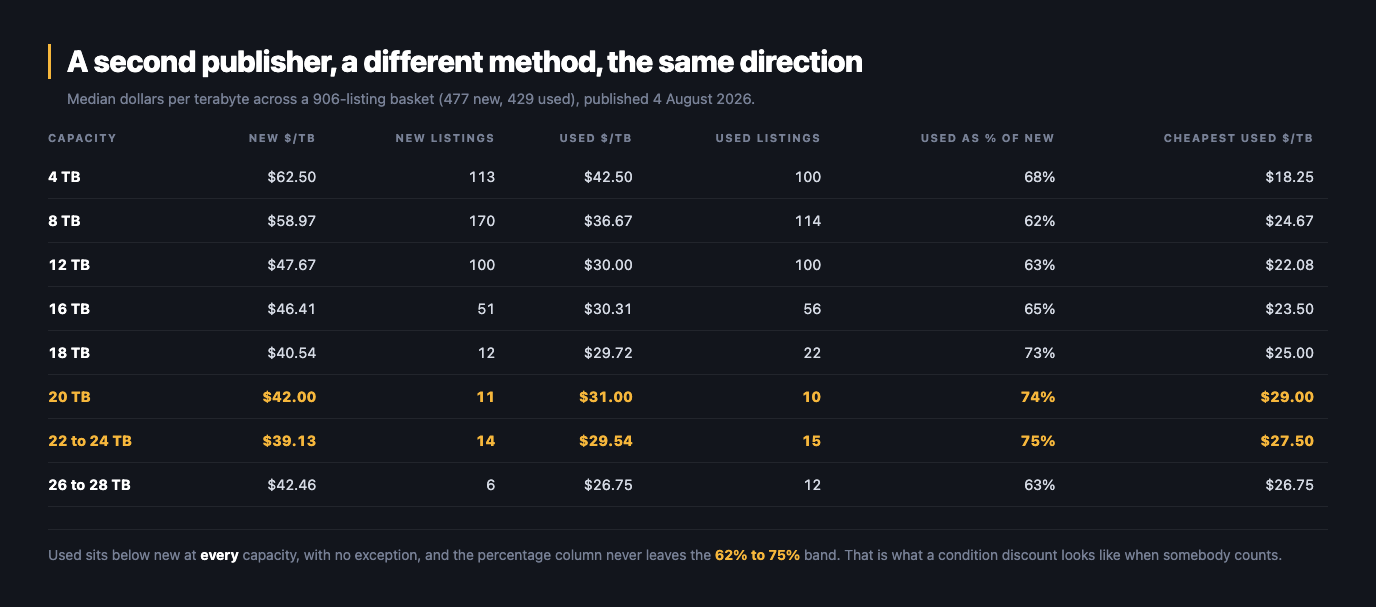
| Capacity | New median $/TB | n | Used median $/TB | n | Used as % of new |
|---|---|---|---|---|---|
| 4 TB | $62.50 | 113 | $42.50 | 100 | 68% |
| 8 TB | $58.97 | 170 | $36.67 | 114 | 62% |
| 12 TB | $47.67 | 100 | $30.00 | 100 | 63% |
| 16 TB | $46.41 | 51 | $30.31 | 56 | 65% |
| 18 TB | $40.54 | 12 | $29.72 | 22 | 73% |
| 20 TB | $42.00 | 11 | $31.00 | 10 | 74% |
| 22 to 24 TB | $39.13 | 14 | $29.54 | 15 | 75% |
| 26 to 28 TB | $42.46 | 6 | $26.75 | 12 | 63% |
Used sits at 62% to 75% of new at every capacity in that table, with no exception. Two publishers, two methods, one answer: on hard drives you keep about a third of the money. Against +3.4% on flash, that is not a difference of degree.
Why the hard-drive discount does not transfer to flash
These are not the same market wearing different labels, and the trackers say so. Refurbished hard-drive supply is retired datacenter stock: DatacenterDisk notes that it “arrives in batches as datacenters retire hardware”, so a sharp fall there usually means a batch landed. That is a wholesale channel with volume, and volume is what produces a stable discount.
Refurbished flash at the cheap end of a consumer marketplace is a different animal. The two offers that survived were graded Used / LikeNew and Used / VeryGood, and the one carrying a seller note described itself as “Professionally renewed. SSD only. No retail packaging or accessories included.”. That is a returned or open-box drive, one at a time, not a pallet out of a decommissioned rack. A returns discount prices a missing box; a datacenter-pull discount prices five years of spinning and an expired warranty. And on flash the supply squeeze pushing new prices up sits in the same enterprise channel that would have to supply the pulls.
What the SSD pages claim the used vs new SSD price gap is
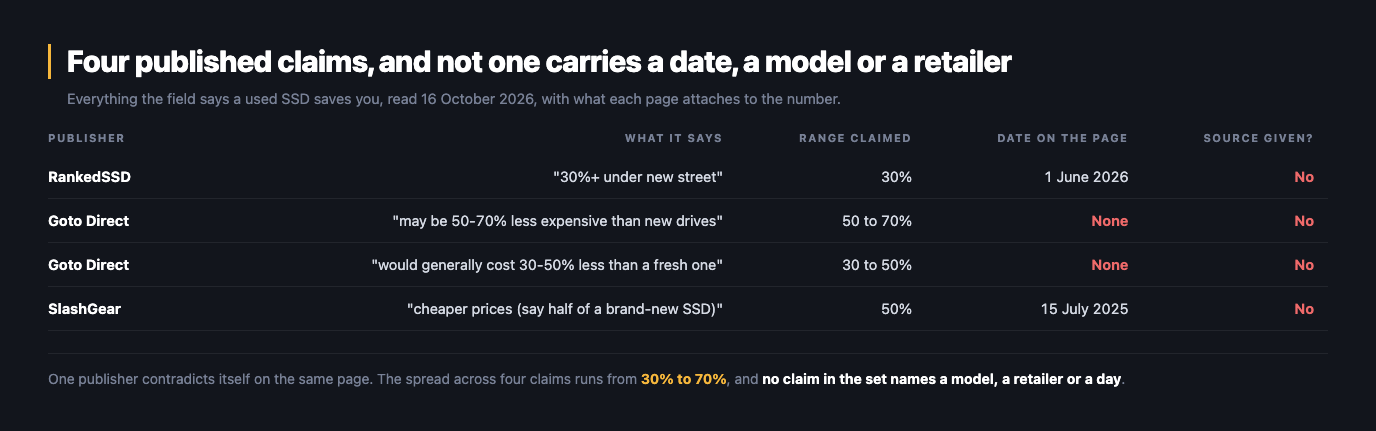
Here is every condition-discount figure published by the SSD-specific pages that rank for this question, read from each page’s own markup on the same day as the price data above.
| Publisher | The page’s own words | Page dated | Source named | Device |
|---|---|---|---|---|
| RankedSSD | “30%+ under new street” | Jun 1, 2026 | no | SSD |
| Goto Direct | “may be 50-70% less expensive than new drives” | none | no | SSD |
| Goto Direct | “would generally cost 30-50% less than a fresh one” | none | no | SSD |
| SlashGear | “cheaper prices (say half of a brand-new SSD)” | Jul 15, 2025 | no | SSD |
Not one names a model, a retailer, a date for the figure, or a source. One contradicts itself inside a single article: Goto Direct, which also sells refurbished SSDs, prints “may be 50-70% less expensive than new drives” in one section and “would generally cost 30-50% less than a fresh one” in another, about the same 1TB comparison, on a page carrying no date. The freshest of the four was updated Jun 1, 2026, the oldest Jul 15, 2025 — the same defect we found in the six SSD trackers we audited: the number is not wrong so much as unattached.
Then the arithmetic. The claims span 40 percentage points; the entire measured hard-drive discount is 34.7%. Estimates that disagree with each other by more than the quantity being estimated are not evidence about flash. They are the hard-drive number, half-remembered and rounded up.
The refurbished offer that survives is the one carrying a grade
The reconciliation table holds one pattern worth more than the headline, because you can act on it before you pay. Of the 6 refurbished rows, 2 showed a real marketplace condition grade — Used / LikeNew, Used / VeryGood — and 4 showed New / Unknown, which is what the platform reports when it has nothing to say about condition. All 2 of the graded offers were still there when we opened them. None of the 4 ungraded ones were.
Six listings is an anecdote and we will not dress it as a market measurement. It is a cheap test to run yourself, and there is a reason to expect it to hold: a grade is a claim the marketplace stands behind, whereas a title reading “renewed” is a claim the seller typed. The same publisher measured that gap on its hard-drive side, where it publishes the counts. Of 174 refurbished listings it re-read, 55 — 31.6% of them — claim refurbishment in the title while the marketplace’s own condition field says New, and 59 cannot be classified at all because neither the title nor the seller says whether anybody refurbished anything.
Our own basket is the new-condition control, and only that
We track new retail stock at named US retailers, with the observation date on every row, and we hold no used or refurbished stock of any kind — so our column here is a baseline, not a side of the comparison. A baseline is the thing the four pages above lack: a new-condition price with a date and a shop attached.
| Drive | Price | $/TB | Vs floor | Retailer | Observed |
|---|---|---|---|---|---|
| Crucial T500 2TB NVMe Gen4 SSD | $369.00 | $184.50 | — | Newegg | Oct 20, 2026 |
| Crucial P3 Plus 1TB NVMe Gen4 SSD | $187.46 | $187.46 | +1.6% | Newegg | Oct 20, 2026 |
| WD Black SN850X 2TB NVMe Gen4 SSD | $374.92 | $187.46 | +1.6% | Newegg | Oct 20, 2026 |
| Samsung 990 Pro 4TB NVMe Gen4 SSD | $796.50 | $199.13 | +7.9% | Newegg | Oct 27, 2026 |
| Samsung 990 Pro 2TB NVMe Gen4 SSD | $408.95 | $204.48 | +10.8% | Newegg | Oct 27, 2026 |
| SK hynix Platinum P41 2TB NVMe Gen4 SSD | $446.35 | $223.17 | +21.0% | Newegg | Oct 20, 2026 |
| Kingston KC3000 2048GB NVMe Gen4 SSD | $499.00 | $243.65 | +32.1% | Newegg | Oct 27, 2026 |
The median terabyte across the 7 storage drives we price is $199.13. The observations span one retailer, the freshest dated Oct 27, 2026. These are canonical parts rather than the cheapest listing anywhere, which matters here: a basket chasing the floor would pick up the single-unit offers this page has just shown evaporating. What the shelf actually did in 2026 takes the new-price series apart.
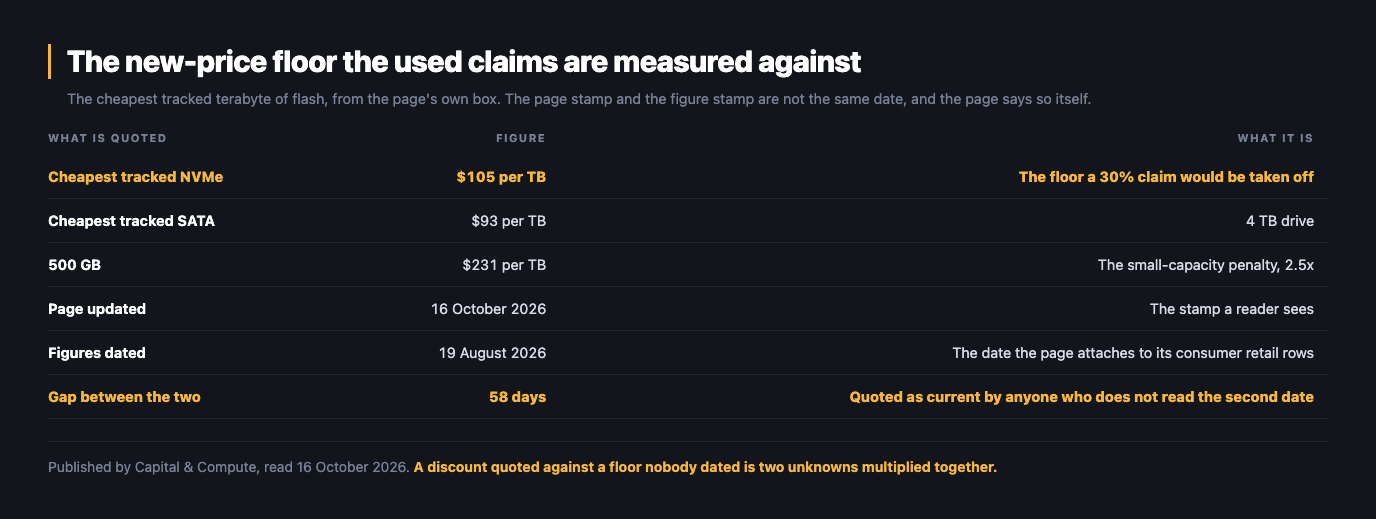
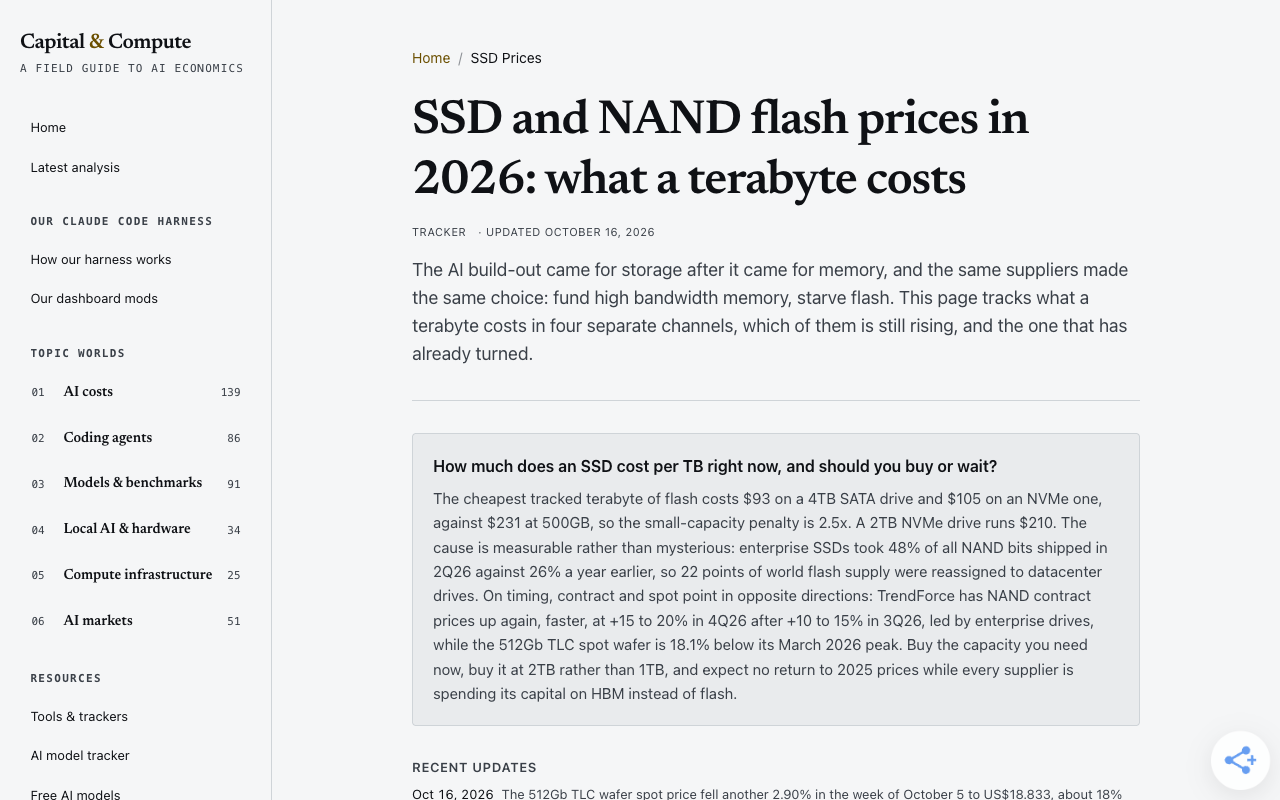
For scale rather than comparison: Capital & Compute puts the cheapest tracked new NVMe terabyte at $105.00, well under every listing in the tracker table above, because it is a different basket read on a different day. Its page carries today’s stamp and dates those consumer rows 58 days earlier, which it discloses itself. Two baskets, two dates, two answers, and the only reason you can tell them apart is that both publishers say which is which.
Five checks before you pay a used price for flash
None of this makes a refurbished SSD a bad purchase. It makes the published discount a bad reason to buy one. Five things to do instead, each out of the data above.
- Open the listing and re-read the price. Two thirds of the refurbished offers here were gone hours after a scrape. A tracker figure, ours included, is a timestamped observation, not a quote.
- Compare against the cheapest new offer at the same capacity, not against a list price. Both inversions above appear only when you do. Against the dearest new listing on the page, every refurbished row looks like a saving.
- Require a marketplace condition grade, not a title that says renewed. 31.6% of re-read refurbished listings disagree with their own marketplace condition field, and the graded offers were the ones still standing when we checked.
- Price the warranty, because it is the real gap. A new consumer NVMe drive carries a manufacturer term in years; a marketplace renewal carries whatever that seller promises. At a couple of percent off, you are paying almost full price to give that up.
- Read the SMART percentage-used figure on arrival, and keep the return window. It is the only wear number flash gives you and no listing carries it. A drive reporting meaningful life already spent is a return, not a bargain to rationalise.
How these numbers were produced, and what we withhold
Our own prices come from our database at request time: the cheapest in-stock observation per drive inside a 30-day window, at a named retailer, dated. We print no median below five priced parts, and the scrape cadence is 48 to 240 hours per listing, so nothing here is a live quote.
Every third-party figure carries its publisher and that publisher’s own date. The condition data is one tracker’s, read twice on 16 October 2026 — once from its cheapest-listings table, once from the drive page each row links to — covering 146 priced SSD listings on one marketplace with 74 days of history. One shop and a short window, and still the largest condition-separated SSD price set we could find. Six refurbished listings is an anecdote about a market, which is the point: nobody has published the market measurement for flash, while two publishers have for spinning disks.
What we withhold: any forecast, any blended new-and-used average, any claim about failure rates. We do not track used drives, so we cannot tell you what a used one costs — only what the people who do track them publish, and what happened when we clicked it.
Related reading
FAQ
Are used SSDs cheaper than new ones in 2026?
Not reliably, and on the day we checked offer by offer, not at all. On 16 October 2026 the cheapest buyable terabyte of flash on the one tracker that separates conditions was new, at $137.19. At both capacities where a buyable drive existed in each condition the refurbished one cost more per terabyte — +1.7% at 2TB and +5.1% at 1TB. Our own basket is new retail only and observes $184.50 to $243.65 per terabyte across the 7 drives we currently price.
How much is the refurbished SSD discount, really?
Nobody publishes a measured figure. The SSD pages ranking for the question print numbers spanning 30% to 70% off, and not one of them names a model, a retailer, a date or a source; one page prints two different ranges for the same 1TB comparison. The two publishers who do measure a condition discount properly measure it on hard drives, where it is about 34.7% like for like. The honest answer for flash is that the discount is small, inconsistent, and often absent at the cheap end.
Why do used SSD prices on trackers disappear when you click through?
Because a refurbished listing is usually one seller with one unit. 4 of the 6 refurbished offers in the cheapest-ten table we read had reverted to a dearer new offer within hours of the scrape, while all 4 new rows matched to the cent. The tracker says as much itself: a listing can move because stock ran out and a dearer seller became the cheapest offer for that product. Any discount computed from the scrape is a discount off a price nobody can pay.
Is a refurbished hard drive a better deal than a refurbished SSD?
On price alone, clearly yes, and it is not close. Used hard drives sit at 62% to 75% of new at every capacity in one publisher's 906-listing scrape, and a second measures 34.7% off like for like across 11 capacities. The supply explains it: refurbished hard drives arrive in batches as datacenters retire hardware, while refurbished consumer flash is mostly returns and open-box units one at a time.
What does "renewed" mean on an SSD listing?
Less than the word suggests, and it is not the same as the marketplace's own condition grade. Of 174 refurbished listings one tracker re-read, 55 claim refurbishment in the title while the marketplace's own condition field says New, and 59 cannot be classified at all because neither the title nor the seller says who refurbished anything. A grade such as Used / LikeNew is a claim the marketplace carries; "renewed" in a title is a claim the seller typed.
How do I check the health of a used SSD?
Read its SMART data as soon as it is installed — the percentage-used figure is the drive's own estimate of how much of its write budget is spent, and it is the one wear number flash reports. The catch is that no marketplace listing field carries it, so unlike a hard drive's power-on hours you cannot see it before paying. That makes the return window part of the purchase: check on arrival, and send back a drive that reports meaningful life already gone.
Should I buy a refurbished SSD at all?
It can be a fine purchase when the discount is real and the offer is graded — in our small sample all 2 graded refurbished offers were still available when we opened them and none of the ungraded ones were. What should not drive the decision is a published percentage. Compare the listing against the cheapest new drive at the same capacity on the same day, price in the warranty you are giving up, and if the gap comes to a few percent, buy new.
Does the price per terabyte settle used versus new?
It settles the comparison between two offers and nothing else. Price per terabyte is the only unit that makes drives of different capacities comparable, which is why every figure here uses it, but it says nothing about warranty, write history or whether the offer still exists. On flash it also has a floor in the middle of the capacity curve rather than falling with size, so comparing a 2TB refurbished drive against a 4TB new one measures capacity and calls it condition.
A date and a shop on every price
We track NVMe, SSD, DDR5 and DDR4 listings at US retailers and tell you when one of yours moves. New retail stock only, no deal scores, no affiliate links, no commission on anything you buy — observed prices, dated, with the sample size printed next to them.