Does XMP Void Your Warranty in 2026? Six Documents, Read
Key takeaways
- The question has two answers, and the memory maker is not the one with the exclusion — 1 of 3 readable memory warranties uses the word “overclock” at all; 0 withdraw cover for it.
- AMD says “will void”; Intel says “may void” — and publishes it as a footnote on the page advertising its own one-click memory profile, adding “even when enabled via AMD hardware and/or software”.
- AMD’s own warranty document never uses the word — it excludes “damages due to external causes, including … alteration”, a causation test rather than a switch.
- 6 of 12 kits we track are rated above AMD’s published maximum, and 0 of 12 above Intel’s — 5 are outside one vendor’s spec and inside the other’s. Same sticks, two answers.
- The above-ceiling grade is not a price premium on today’s shelf — the DDR5 kits rated past AMD’s ceiling have a median of $17.50/GB against $18.75/GB for the ones inside it, a 0.93x multiple.
- The short answer, and whose warranty you mean
- What the memory warranties actually say
- Intel says “may”. AMD says “will”
- “Beyond specification” is two numbers
- What the above-ceiling grade costs on our shelf
- What “lifetime” means, and what it asks of you
- “Will void” is a sentence, not a switch
- How to decide, in five checks
- Related reading
- FAQ
You paid for DDR5-6000, the kit boots slower until you tick one box in the BIOS, and that is when the question arrives: does XMP void your warranty, and if so, whose? The kits in our basket run from $239.99 to $699.99 and sit beside a processor worth several hundred more, so a wrong guess costs cover on the dearest part in the machine. We read six documents on Oct 24, 2026 from 5 publishers’ own pages, and priced the answer against our own dated observations.
The short answer, and whose warranty you mean
None of the three memory warranties we could read withdraws cover on a module because you enabled the profile it was sold with. Both processor vendors reserve the right to refuse a claim on the processor when it has run outside their published specifications, and one says so on the page advertising its own memory-overclocking feature. The exposure is the CPU, not the RAM — and whether it exists depends on a number neither marketing page prints next to the warning.
What the memory warranties actually say
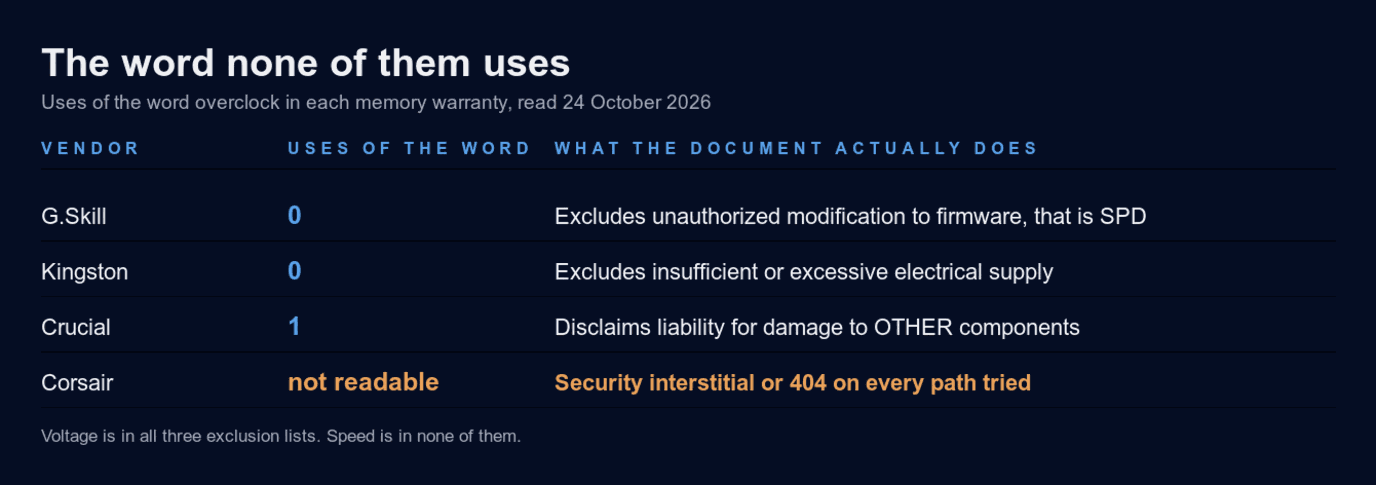
Our RAM basket is four brands. Three publish a warranty document we could read; the fourth, Corsair, answered 6 URLs with a security interstitial or a 404, so we quote nothing from it rather than paraphrase a retailer’s page.
| Vendor | Term | “Lifetime” ends | Kits we track | “Overclock” appears |
|---|---|---|---|---|
| G.Skill | Limited Lifetime Warranty | until that model is discontinued | 4 | not once |
| Kingston | Product Lifetime Warranty | the industry’s normal time expectancy | 3 | not once |
| Crucial | Limited Lifetime Warranty | open-ended, capped by country | 2 | 1× |
| Corsair | could not be read | 6 paths tried, all blocked | 3 | unknown |
The right-hand column is the finding. G.Skill and Kingston never use the word “overclock” anywhere, and Crucial uses it once, in a sentence that does something different from what everyone assumes: “Overclocking, running a system faster than the speed for which it was designed or the published speed, or otherwise modifying the system timing may result in damage to computer components, and Micron CPG disclaims any and all liability for such damage”. Read its object. It disclaims liability for damage to other components — a statement about your motherboard and your CPU, not a withdrawal of cover on the module.
G.Skill has the clause that looks closest, and it is about firmware rather than speed: the exclusion list covers “Unauthorized modification to firmware (i.e. SPD) of DRAM products”. XMP and EXPO profiles live in the SPD, so it reads alarmingly until you notice the word unauthorized — the vendor wrote those profiles. Flashing your own is a different act from selecting one of theirs, and only the first is listed.
Intel says “may”. AMD says “will”
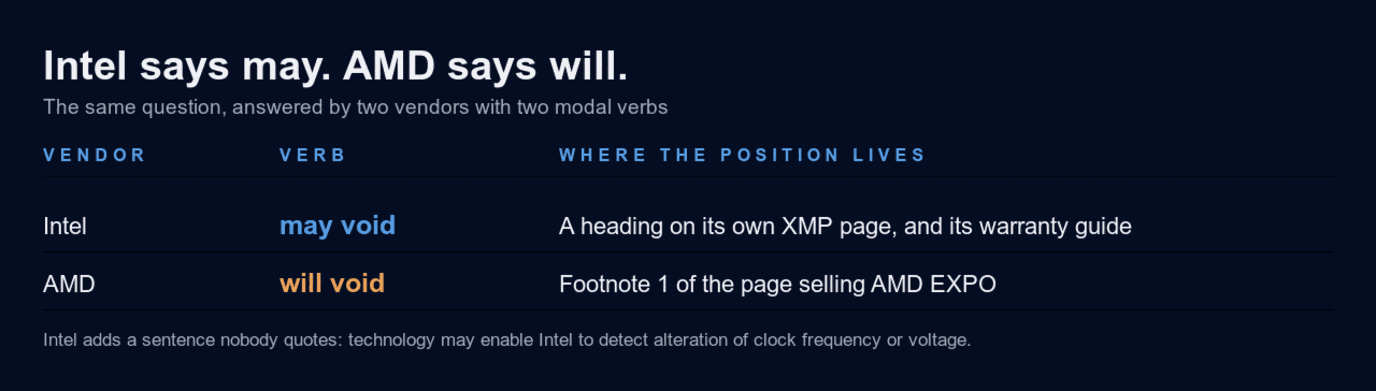
Now the party with the exclusion. Both vendors answer in public, and the answers differ by one word worth a lot of money.
| Vendor | Verb | Where it is published | Its warranty document says “overclock” |
|---|---|---|---|
| Intel | “may void” | Intel® XMP product page, “Does Use of Intel® XMP Void the CPU Warranty?” | 1×, in a section heading |
| AMD | “will void” | AMD EXPO™ technology page, footnote 1 (GD-106) | not once |
Intel answers under a heading on its own XMP page — “Does Use of Intel® Extreme Memory Profile (Intel® XMP) Void the CPU Warranty?” — with “Altering the frequency and/or voltage outside of Intel specifications may void the processor warranty. Examples: Overclocking and enabling Intel® XMP, which is a type of memory overclocking, and using it beyond the given specifications may void the processor warranty”. Note the double hedge: may void, and only when used beyond the given specifications. It repeats the warning in its warranty guide, in a section headed after the feature, and adds a sentence nobody quotes: “Technology may enable Intel to detect alteration of clock frequency or voltage during issue investigations”.
AMD is blunter, and the location is the story. Its position is footnote 1 of the page selling AMD EXPO (Extended Profiles for Overclocking): “Overclocking and/or undervolting AMD processors and memory, including without limitation, altering clock frequencies / multipliers or memory timing / voltage, to operate outside of AMD’s published specifications will void any applicable AMD product warranty, even when enabled via AMD hardware and/or software”. Two things the “just enable EXPO” advice never carries — will rather than may, and even when enabled via AMD’s own software. The company brands the feature, certifies the kits, and footnotes the result.
Then the document that would be quoted at an RMA desk says none of it. AMD’s boxed-processor warranty promises the part “will substantially conform to AMD’s publicly available specifications” for 3 years and excludes “This limited warranty does not cover damages due to external causes, including improper use, problems with electrical power, accident, neglect, alteration, repair, improper installation, or improper testing” — with the word “overclocking” appearing zero times. The marketing footnote states an automatic consequence; the contract states a causal one. Those are not the same promise.
“Beyond specification” is two numbers
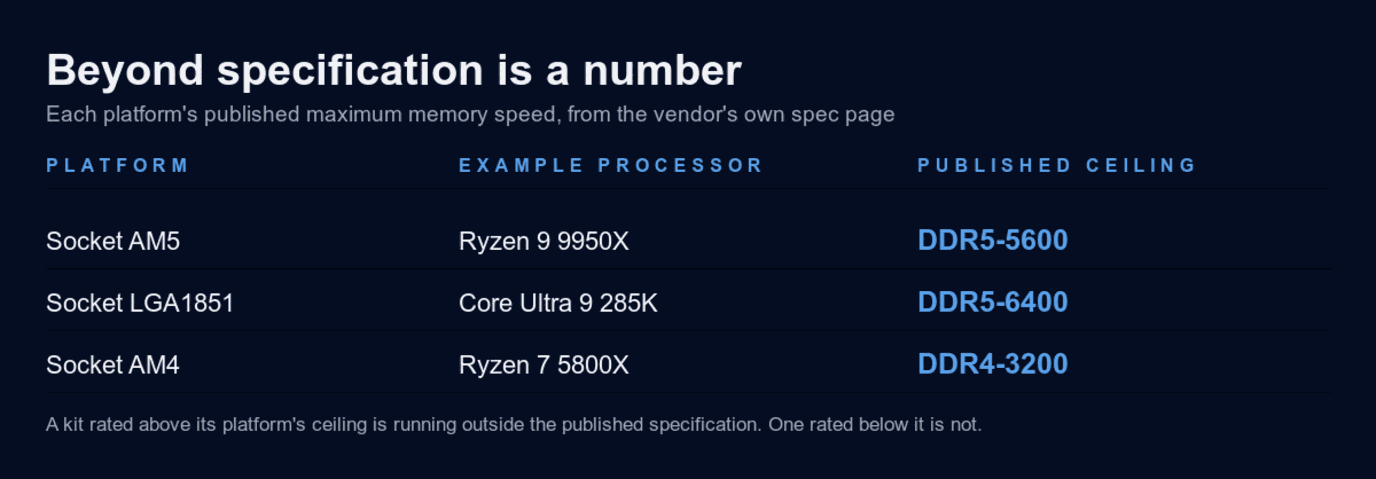
Both positions turn on one phrase — published specifications — and both vendors print the number it refers to on every processor page. It is the maximum memory speed, and lower than most buyers think.
| Platform | Processor on the page | Memory | Published maximum | For |
|---|---|---|---|---|
| AMD Socket AM5 | Ryzen 9 9950X | DDR5 | 2x1R DDR5-5600, 2x2R DDR5-5600 (4 DIMMs: DDR5-3600) | two single- or dual-rank UDIMMs |
| Intel Socket LGA1851 (Core Ultra 200S) | Core Ultra 9 285K | DDR5 | Up to DDR5 6400 MT/s | as published, without a DIMM count |
| AMD Socket AM4 | Ryzen 7 5800X | DDR4 | Up to 3200 MT/s | as published, without a DIMM count |
Put a kit’s rating next to the ceiling for the socket it is going into and the question answers itself. A DDR5-6000 kit is 7.1% above what AMD publishes for two UDIMMs on AM5 and 6.3% below what Intel publishes for its current desktop platform. Same sticks, same BIOS toggle, two different answers.
| Kit | Rated | vs AMD’s published max | vs Intel’s published max | Profile as the vendor labels it |
|---|---|---|---|---|
| G.Skill Trident Z5 RGB DDR5-6400 CL32 32GB | 6,400 MT/s | 14.3% above | inside it | Trident Z5 RGB (DDR5/Intel XMP) |
| G.Skill Trident Z5 Neo DDR5-6000 CL30 32GB | 6,000 MT/s | 7.1% above | inside it | Trident Z5 Neo (DDR5/AMD EXPO) |
| G.Skill Flare X5 DDR5-6000 CL36 32GB | 6,000 MT/s | 7.1% above | inside it | Flare X5 (DDR5/AMD EXPO) |
| Kingston FURY Beast DDR5-6000 32GB | 6,000 MT/s | 7.1% above | inside it | Intel XMP 3.0 or AMD EXPO, “two new DDR5 overclock specs” |
| Corsair Vengeance DDR5-6000 CL30 32GB | 6,000 MT/s | 7.1% above | inside it | none published for the part |
| Crucial Pro DDR5-5600 64GB | 5,600 MT/s | inside it | inside it | none published for the part |
| Corsair Vengeance DDR5-5600 64GB | 5,600 MT/s | inside it | inside it | none published for the part |
| Kingston FURY Beast DDR5-5200 32GB | 5,200 MT/s | inside it | inside it | Intel XMP 3.0 or AMD EXPO, “two new DDR5 overclock specs” |
| G.Skill Ripjaws V DDR4-3600 CL18 32GB | 3,600 MT/s | 12.5% above | no figure published here | Ripjaws V |
| Kingston FURY Beast DDR4-3200 32GB | 3,200 MT/s | inside it | no figure published here | none published for the part |
| Corsair Vengeance LPX DDR4-3200 CL16 32GB | 3,200 MT/s | inside it | no figure published here | none published for the part |
| Crucial Pro DDR4-3200 64GB | 3,200 MT/s | inside it | no figure published here | none published for the part |
Across the basket: 6 of 12 kits above AMD’s published maximum, 0 of 12 above Intel’s, and 5 sitting outside one and inside the other. The DDR4 kits make the same shape with older numbers — AM4 publishes 3,200 MT/s, three of our four are rated exactly there, and the DDR4-3600 kit is 12.5% past it.
What the above-ceiling grade costs on our shelf
Here is the sum none of the competing pages can do, because it needs dated prices: if the above-ceiling grade carried a premium, this would be a cost-benefit calculation. On our shelf it does not.
| Kit | Rated | AMD spec | Cheapest in stock | $/GB | Observed |
|---|---|---|---|---|---|
| G.Skill Trident Z5 Neo DDR5-6000 CL30 32GB | 6,000 MT/s | 7.1% above | $699.99 | $21.87 | Newegg, Oct 27, 2026 |
| G.Skill Trident Z5 RGB DDR5-6400 CL32 32GB | 6,400 MT/s | 14.3% above | $659.99 | $20.62 | Newegg, Oct 27, 2026 |
| Crucial Pro DDR5-5600 64GB | 5,600 MT/s | inside | $1,199.99 | $18.75 | Newegg, Oct 20, 2026 |
| Kingston FURY Beast DDR5-5200 32GB | 5,200 MT/s | inside | $599.99 | $18.75 | Newegg, Oct 27, 2026 |
| Corsair Vengeance DDR5-6000 CL30 32GB | 6,000 MT/s | 7.1% above | $559.99 | $17.50 | Newegg, Oct 28, 2026 |
| Kingston FURY Beast DDR5-6000 32GB | 6,000 MT/s | 7.1% above | $559.00 | $17.47 | Newegg, Oct 20, 2026 |
| G.Skill Flare X5 DDR5-6000 CL36 32GB | 6,000 MT/s | 7.1% above | $529.00 | $16.53 | Newegg, Oct 20, 2026 |
| Kingston FURY Beast DDR4-3200 32GB | 3,200 MT/s | inside | $319.99 | $10.00 | Newegg, Oct 27, 2026 |
| Crucial Pro DDR4-3200 64GB | 3,200 MT/s | inside | $583.88 | $9.12 | Newegg, Oct 20, 2026 |
| Corsair Vengeance LPX DDR4-3200 CL16 32GB | 3,200 MT/s | inside | $259.99 | $8.12 | Newegg, Oct 24, 2026 |
| G.Skill Ripjaws V DDR4-3600 CL18 32GB | 3,600 MT/s | 12.5% above | $239.99 | $7.50 | Newegg, Oct 20, 2026 |
Among DDR5 kits with a live observation, the 5 rated above AMD’s ceiling have a median of $17.50 per gigabyte and the 2 inside it sit at $18.75 — a 0.93x multiple, $1.25 per gigabyte in favour of the faster cohort. A snapshot, not a law: with 2 kits on one side the sample is tiny, and that kit is a 64GB part, so capacity is confounded with speed.
The DDR4 half is cleaner, because there the comparison holds capacity still. At 32GB the DDR4-3600 kit — the only one past AM4’s published 3,200 MT/s — is $7.50 per gigabyte against a median of $9.06 for the two rated exactly at the ceiling. The faster-than-published grade is the cheapest row in its generation.
So this is not a question about money you pay for speed. The profile comes free with kits that cost the same as or less than the ones that do not need it; what it costs is optional exposure on a different component. For context, the DDR5 median across our basket is $18.75 per gigabyte from 7 priced SKUs.
What “lifetime” means, and what it asks of you
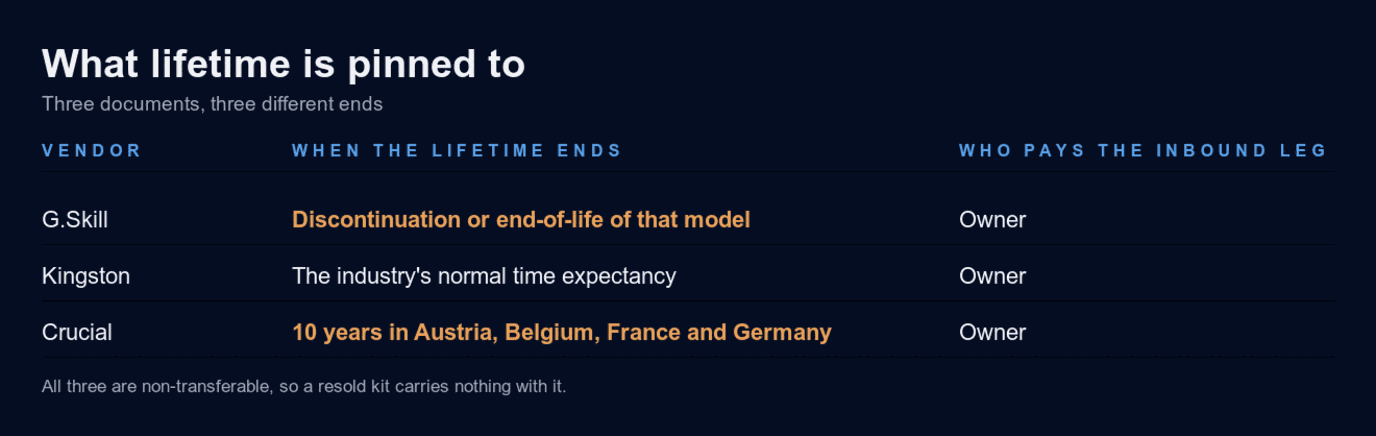
While the documents were open we read the rest, because “limited lifetime warranty” is the other phrase on a memory box that does not mean what it looks like. Three vendors, three definitions, none of them the lifetime of the buyer.
G.Skill is the narrowest and the one to know: ““Lifetime” means the period during which the specific model number is actively manufactured and supported by G.SKILL. This limited lifetime warranty automatically terminates upon discontinuation or end-of-life (“EOL”) designation of that specific model”. A lifetime that ends on discontinuation covers a product line, not your sticks — and the parts likeliest to be discontinued are the older DDR4 kits whose owners are likeliest to claim. Kingston is vaguer and softer: “Product lifetime is defined as the normal time expectancy for the use of products in the industry”. Crucial caps it anyway: “Limited lifetime warranty is limited to 10 years from purchase in Austria, Belgium, France and Germany”.
Kingston also carries the set’s one cash clause, in the construction we found across the SSD documents in the SSD warranty article: where a part has been discontinued, a refund comes at “the lesser of the purchase price or the product’s current value”. In a market that has moved the way memory has this year, that pays the smaller of two numbers.
“Will void” is a sentence, not a switch
One more document, because it changes how those footnotes read. In the US, the FTC’s own interpretation of the Magnuson-Moss Warranty Act addresses warranty language that threatens blanket voiding, and the operative idea is causation.
Read the scope honestly: that rule is about parts and service, not clock speeds, and we will not pretend it is a provision about memory profiles. What it shows is the shape US warranty law gives these disputes. A warrantor may exclude damage caused by something and may deny a claim where it can show the damage was so caused — the standard AMD’s own warranty text uses, and narrower than the footnote on its marketing page. That gap between two of one vendor’s documents is the vendor’s to close. None of this is advice or a prediction about any claim.
How to decide, in five checks
The decision is small once the numbers are in front of you. Five checks, in order, each a minute’s work.
- Find your processor’s published memory maximum on its own product page, not the motherboard box — the number both warranty positions refer to.
- Compare it with the profile speed. At or under it, you are inside the published specification and Intel’s hedge applies to you. Over it, you are making a choice.
- Check the DIMM count. AMD publishes 5,600 MT/s for two UDIMMs on AM5 and 3,600 MT/s for four, so filling all four slots lowers the ceiling you are measuring against.
- Keep the receipt and the whole kit. All three documents want a dated proof of purchase from an authorised reseller, one wants the kit back complete, and an auction-site receipt is explicitly invalid at G.Skill.
- Buy the grade on price, not the profile. On our shelf the above-ceiling kits are not the dear ones, so there is no premium to recover. Watch the kit you want on the live RAM chart.
The cheapest honest way to sidestep the question: buy a kit rated at or under your platform’s published maximum and leave the profile off. Our per-gigabyte value ranking shows what that costs, and in 2026 it is usually not a saving.
Related reading
FAQ
Does XMP void your RAM warranty?
Not in any of the three memory warranties behind our basket. 1 of 3 readable documents uses the word "overclock" at all — Crucial's, and that sentence disclaims liability for "damage to computer components" rather than withdrawing cover on the module. G.Skill and Kingston never mention it: their exclusions are about voltage, physical damage, modified firmware and unauthorised sales channels, not the speed grade you selected.
Does XMP void your CPU warranty?
That is the real question, and the vendors answer differently. Intel says altering frequency or voltage outside its specifications "may void the processor warranty", naming XMP as an example, and adds that technology "may enable Intel to detect alteration of clock frequency or voltage during issue investigations". AMD says operating outside its published specifications "will void any applicable AMD product warranty, even when enabled via AMD hardware and/or software" — in a footnote on the page advertising EXPO.
Is EXPO treated differently from XMP?
Not by the documents. EXPO is AMD's own name for the same thing — "AMD Extended Profiles for Overclocking" — and its warning covers profiles "even when enabled via AMD hardware and/or software", which includes its own. Kingston calls XMP 3.0 and EXPO "two new DDR5 overclock specs". The difference is which platform validated the profile, not what the warranty says.
How do I know whether my kit is outside my CPU’s specification?
Compare two numbers. AMD publishes DDR5-5600 for two UDIMMs on a Ryzen 9 9950X (DDR5-3600 with four), Intel publishes "Up to DDR5 6400 MT/s" for the Core Ultra 9 285K, and AM4 parts publish "Up to 3200 MT/s". A DDR5-6000 kit is about 7% above AMD's figure and about 6% below Intel's, so one kit can be outside one vendor's specification and inside the other's.
Do you pay more for a kit that needs a profile?
On our shelf, no. The page computes the medians live, and when this was written the DDR5 kits rated above AMD's ceiling were cheaper per gigabyte than the one inside it, and the DDR4-3600 kit was the cheapest row in its generation at 32GB. You are not paying a premium for the profile — so there is no saving to recover by avoiding it either.
What does a "limited lifetime" memory warranty actually last?
It depends whose. G.Skill defines "lifetime" as the period a specific model "is actively manufactured and supported", terminating on discontinuation or end-of-life designation. Kingston defines it as "the normal time expectancy for the use of products in the industry", capped at ten years in Russia. Crucial caps it at ten years from purchase in Austria, Belgium, France and Germany. None is the lifetime of the owner, and all three are non-transferable.
Can a vendor refuse a claim just because XMP was enabled?
What a document permits and what happens at an RMA desk are different questions, and a price tracker has no standing on the second. On the first: the FTC's interpretation of the Magnuson-Moss Warranty Act, 16 CFR 700.10(c), says a warrantor "cannot, as a matter of law, avoid liability under a written warranty where a defect is unrelated to" unauthorised articles or service, while preserving the right to deny liability "where the warrantor can demonstrate that the defect or damage was so caused". That provision is about parts and service, not clock speeds — but it is the same causal standard AMD's own warranty text uses, against the blanket wording of its marketing footnote.
Buy the grade on price, not on the badge
We track DDR5, DDR4 and NVMe listings at US retailers and tell you when one of yours moves. New retail stock only, no deal scores, no affiliate links, no commission on anything you buy — observed prices, dated, with the sample size printed next to them.