Best SSD Price Tracker in 2026: Six Read, and What Their Cheap Rows Actually Are
Key takeaways
- Ask 6 trackers for the cheapest 2TB NVMe drive and the answers run $90.00 to $369.00 — a 4.10x spread on one capacity, on one day. They are ranking different products, and saying so to very different degrees.
- 4 of the 6 cheapest-2TB figures are not a new current-generation TLC drive. They are Gen3 parts, DRAM-less parts or used stock, and a $/TB sort is blind to all three.
- One publisher’s own correction records a 5.0x error: for five months its cheapest “SSD” was an LTO-9 tape cartridge, printed at $20.91/TB against $105.00/TB orderable. Nobody else here publishes a mechanism that would catch it.
- We lose on coverage: only Newegg reported in-stock storage prices in the last 30 days, across 7 priced drives, since 22 June 2026. Three of the six track hundreds of listings. Pick on what you need, not who wrote the table.
- What an SSD price tracker is actually claiming
- Six SSD price trackers, side by side
- The cheapest 2TB row is usually a different drive
- Five months when the cheapest "SSD" was a tape cartridge
- One model number, five prices, one page
- Four drives, one publisher: the gap runs both ways
- Who dates a price, and who dates the page
- How to choose one — including where we lose
- How our own figures are produced
- Related reading
- FAQ
Searching for the best SSD price tracker gets you a page of tools and no way to tell them apart, because every one of them ranks itself. We read 6 of them on 12 October 2026 and asked each the same narrow question — what is the cheapest 2TB NVMe drive you will show me right now — then put our own answer in the table, last, with the columns where we are beaten filled in. The answers ran from $90.00 to $369.00: a 4.10x spread on one capacity in one sitting. Budget a build or a four-drive array off the wrong end of that and you are out by hundreds of dollars before you open a retailer tab.
On the memory side of this market the gap is mostly refresh clocks and which shop is priced. On storage a fourth thing swallows the other three: the cheap end of the sort is a different product — older PCIe generations, DRAM-less controllers, external drives filed as internal, used marketplace stock, and in one documented case a tape cartridge. So we scored every figure on four things rather than three (which drive, which seller, what date, what condition), then checked one publisher against our own dated observations of the same five drives — the comparison none of these pages runs on itself.
What an SSD price tracker is actually claiming
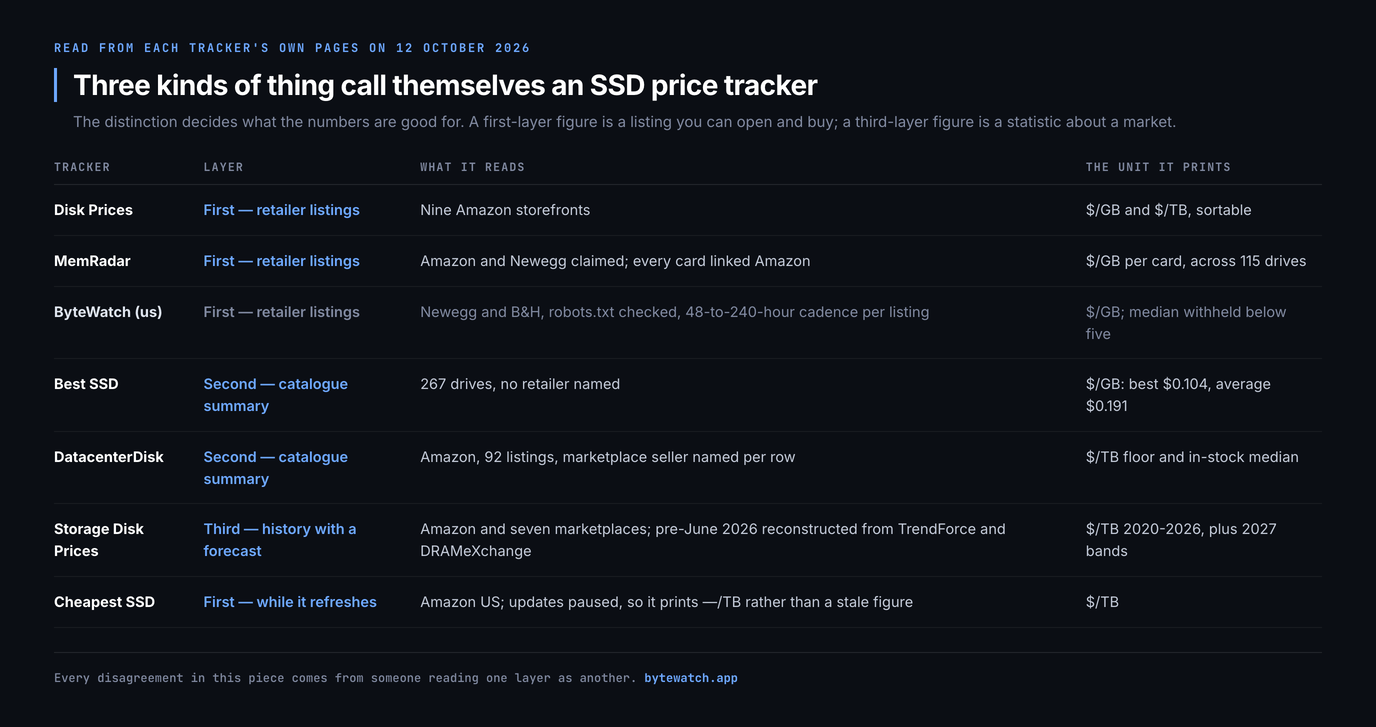
Three kinds of thing call themselves an SSD price tracker, and the distinction decides what the numbers are good for. The first reads retailer listings and republishes them: Disk Prices sorts nine Amazon storefronts by price per terabyte, MemRadar prices 115 drives with a per-gigabyte figure on every card, and we scrape Newegg and B&H.
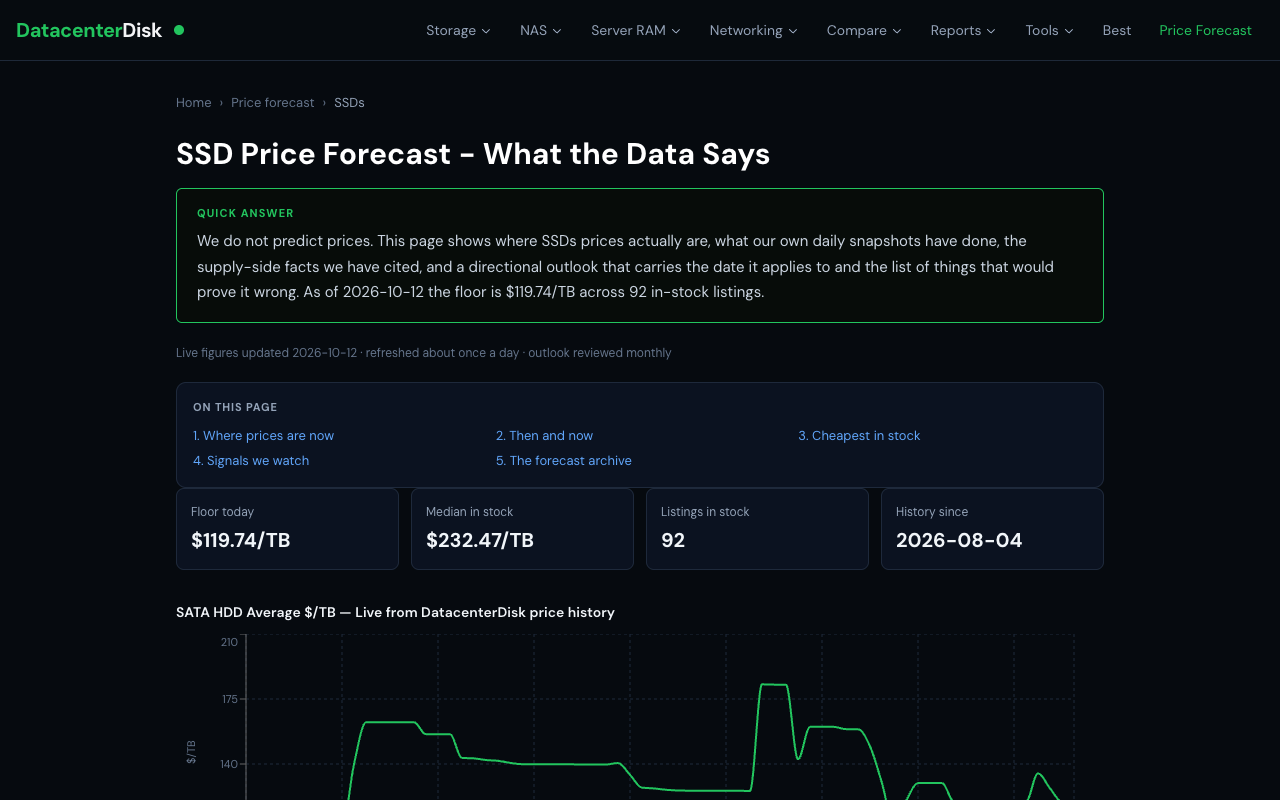
The second kind aggregates a catalogue and summarises it: Best SSD prints a best and an average price per gigabyte over 267 drives, and DatacenterDisk a floor and an in-stock median per terabyte over 92 listings. The third is a market history with a forecast attached: Storage Disk Prices runs a $/TB series from 2020 to 2026 and publishes 2027 bands, saying plainly that everything before June 2026 is “estimates reconstructed from TrendForce and DRAMeXchange data”.
Six SSD price trackers, side by side
Here is what each says about itself, read from its own pages on the same day. There is no score column: the only honest ranking depends on whether you need retailer breadth, history depth, a stated condition or a date. The columns do show the storage field disclosing more than the memory one — 4 of 6 date a price and 4 of 6 state condition, against two of six on each count on the RAM trackers two days earlier.
| Tracker | Retailers priced | Refresh claim | Price dated? | Condition stated? | Commission |
|---|---|---|---|---|---|
| DatacenterDisk daily snapshots since 4 Aug 2026 | Amazon; marketplace seller named per row | about once a day per listing | yes — "Live figures updated 2026-10-12" | yes — per row, with the Amazon grade | Amazon Associates |
| Storage Disk Prices 2020-2026; pre-June 2026 reconstructed | Amazon, seven marketplaces | every six hours | yes — snapshot, 26 Sep 2026 | yes — new, in-stock only | Amazon Associate |
| MemRadar up to a decade, it says | Amazon and Newegg claimed; every card linked Amazon | every few hours | no | no — the word is absent | Newegg via Rakuten |
| Best SSD charts per capacity tier | none named | updated daily | yes — site-wide, Oct 12, 2026 | no | Amazon Associate |
| Disk Prices none — current listings | nine Amazon storefronts | not stated | no | yes — a column per row | paid affiliate links |
| Cheapest SSD none while the feed is down | Amazon US | only while refreshable every 24h — paused | yes — 6 Oct 2026, 15:33 UTC | yes — new and used, labelled | Amazon Associate |
| ByteWatch since 22 June 2026, count printed | Newegg and B&H, robots.txt checked | every 48 to 240 hours per listing | yes — per price | yes — new retail only | none found |
One row deserves reading twice. Cheapest SSD prints no prices at all: its tracker shows “—/TB” behind “our price feed is currently unavailable”, because it publishes Amazon prices only while it can refresh them every 24 hours. That is the right behaviour and the rarest here — and Storage Disk Prices sources its September snapshot from Cheapest SSD, so the page that withheld is upstream of one that did not. Both are dated; only one of them is current.
The cheapest 2TB row is usually a different drive
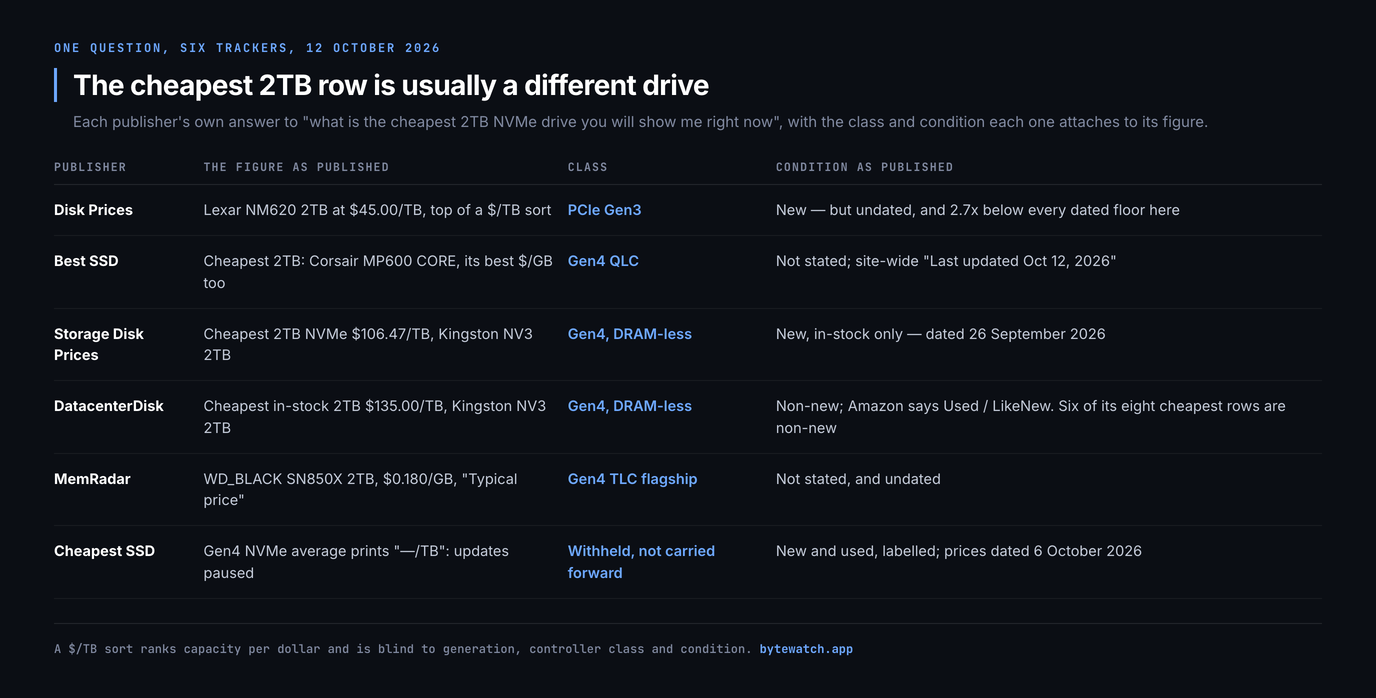
Ask all six the same question and the answers are not comparable — which is the finding, not a complaint about any of them. 2TB is the volume tier and every tracker here prices it, so the only thing varying down the table is how much each will say about what it is pricing.
| Publisher | Figure as published | Price | $/TB | What it is | Condition | Score |
|---|---|---|---|---|---|---|
| Disk Prices undated | Lexar NM620 2TB at $45.00/TB, top of a $/TB sort undated, and 2.7x below every dated floor here | $90.00 | $45.00 | PCIe Gen3 | New | 3 of 4 |
| Best SSD site-wide "Last updated Oct 12, 2026" | Cheapest 2TB: Corsair MP600 CORE, its best $/GB too | $208.50 | $104.25 | Gen4 QLC | not stated | 2 of 4 |
| Storage Disk Prices 26 September 2026 | Cheapest 2TB NVMe $106.47/TB, Kingston NV3 2TB sourced from Cheapest SSD, whose feed has since paused | $212.93 | $106.47 | Gen4, DRAM-less | new, in-stock only | 4 of 4 |
| DatacenterDisk 2026-10-12 | Cheapest in-stock 2TB $135.00/TB, Kingston NV3 2TB six of its eight cheapest rows are non-new | $270.00 | $135.00 | Gen4, DRAM-less | Non-new, Amazon says Used / LikeNew | 4 of 4 |
| MemRadar undated | WD_BLACK SN850X 2TB, $0.180/GB, "Typical price" | $369.00 | $184.50 | Gen4 TLC flagship | not stated | 2 of 4 |
| ByteWatch the observation date | Cheapest 2TB in our basket, from the database | $369.00 | $184.50 | Gen4 TLC flagship | new retail | 4 of 4 |
| Cheapest SSD prices dated 6 October 2026, none shown | Gen4 NVMe average prints "—/TB": updates paused the one here that will not print a price it cannot refresh | no price published | — | withheld, not carried forward | new and used, labelled | 4 of 4 |
The spread is 4.10x end to end, and 4 of the 6 priced rows are not a new current-generation TLC drive. The cheapest is a PCIe Gen3 Lexar NM620, the next two are DRAM-less parts, and one of those is used marketplace stock. Only the dearest rows are the Gen4 TLC flagship a reader comparing 990 Pros and SN850Xs has in mind. Two of them price the same model, a Kingston NV3 2TB, and the used listing is 26.8% dearer than the new one — so either the market moved that far in sixteen days, or one figure is not what its sort implies.
Score the rows and the ladder sorts itself: a mean of 3.00 of 4 across the cheaper half against 3.33 across the dearer one. We do not score accuracy, deliberately: a tracker pricing Amazon is not wrong because we price Newegg, it is pricing a different shelf. The narrower claim survives that objection — a price you cannot attribute is not a cheaper market, it is a weaker claim.
Five months when the cheapest “SSD” was a tape cartridge
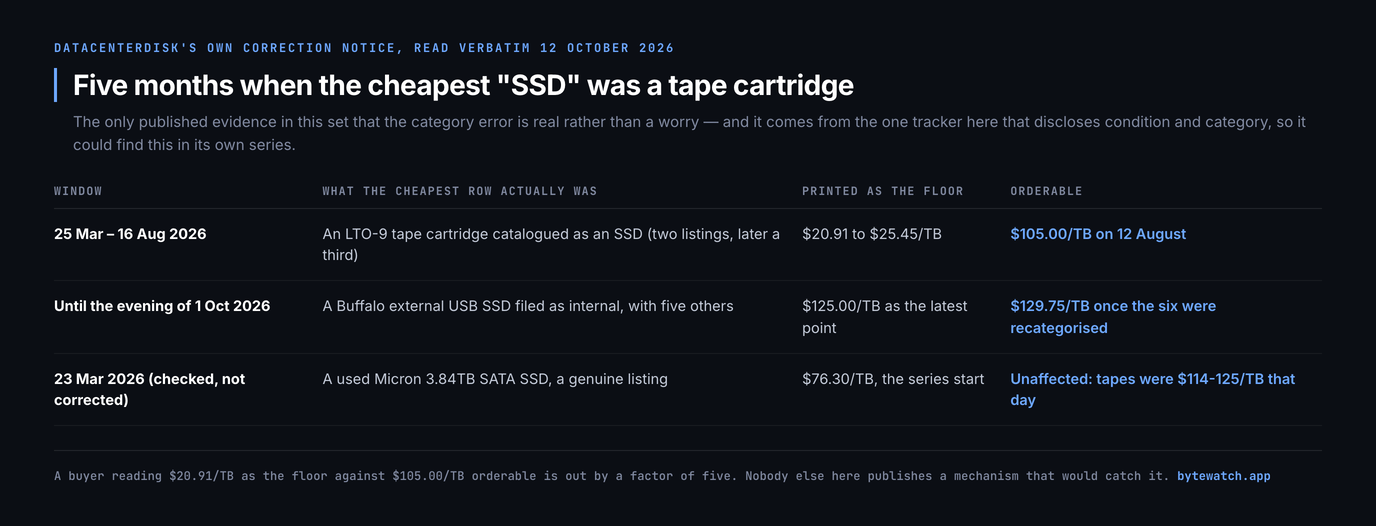
That category error is not hypothetical, and we are not the ones who found it. On 1 October 2026 DatacenterDisk published a correction to its own SSD series — the most useful thing any of these pages has written about itself.
| Window | What the cheapest "SSD" actually was | What the page printed | What was orderable |
|---|---|---|---|
| 25 Mar – 16 Aug 2026 | an LTO-9 tape cartridge catalogued as an SSD (two listings, later a third) | $20.91 to $25.45/TB as the SSD floor | $105.00/TB on 12 August |
| until the evening of 1 Oct 2026 | a Buffalo external USB SSD filed as internal, with five others | $125.00/TB as the latest point | $129.75/TB once the six were recategorised |
| 23 Mar 2026 (checked, not corrected) | a used Micron 3.84TB SATA SSD, a genuine listing | $76.30/TB, the series start | unaffected: tapes were $114-125/TB that day |
For nearly five months the published floor sat 5.0x below the cheapest SSD a buyer could order: $20.91 per terabyte against $105.00 on 12 August. An LTO-9 cartridge really is cheap storage per terabyte — it is also a tape you cannot boot from, in a market where $/TB is the sort key.
The obvious lesson is that a catalogue sort is only as good as its categories. The one worth keeping: the publisher that caught this is the one printing condition and category on every row. Disclosure is not decoration on a price table, it is the mechanism that makes an error findable. The two trackers here printing neither a condition nor a date could be running the same fault today, and nobody would have any way to tell.
One model number, five prices, one page
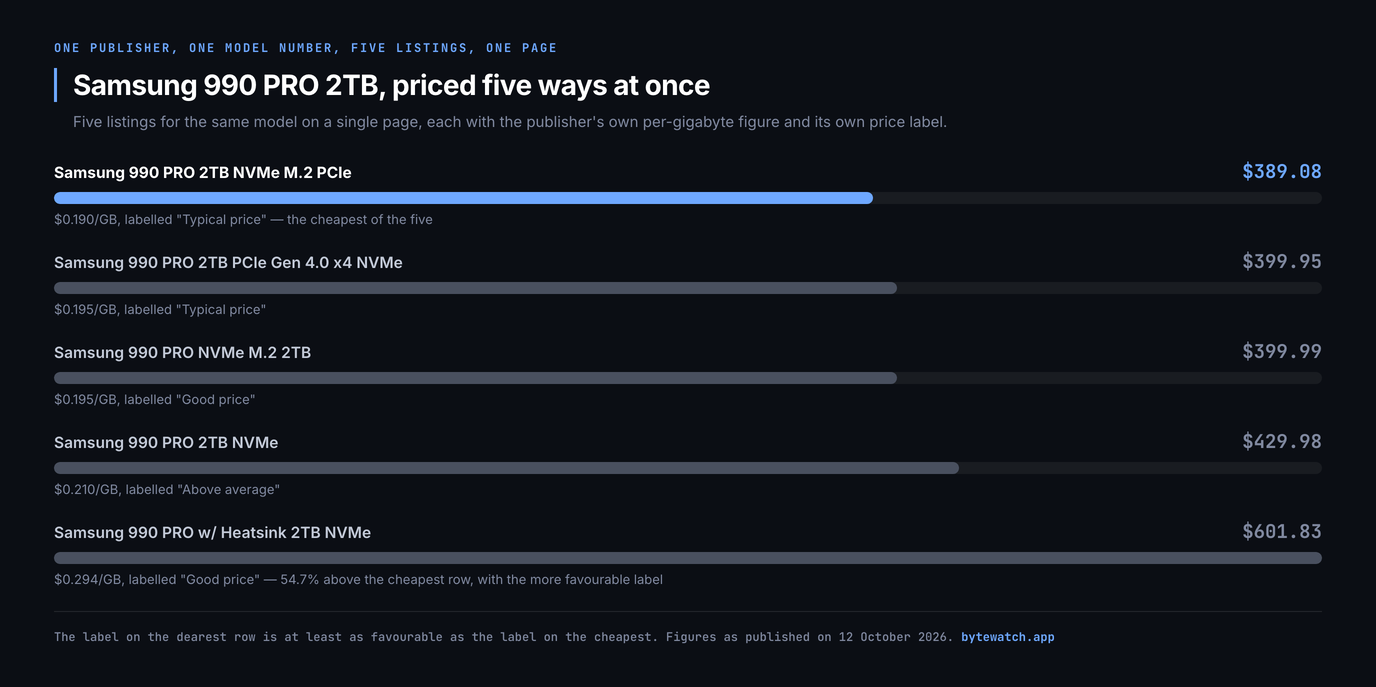
Cross-tracker disagreement is the obvious failure mode, so it is worth knowing how much of it reproduces inside one tracker. On 12 October MemRadar carried five listings for one Samsung 990 PRO 2TB.
| Listing as the publisher names it | Price | Their $/GB | Their label |
|---|---|---|---|
| Samsung 990 PRO 2TB NVMe M.2 PCIe | $389.08 | $0.190/GB | Typical price |
| Samsung 990 PRO 2TB PCIe Gen 4.0 x4 NVMe | $399.95 | $0.195/GB | Typical price |
| Samsung 990 PRO NVMe M.2 2TB | $399.99 | $0.195/GB | Good price |
| Samsung 990 PRO 2TB NVMe | $429.98 | $0.210/GB | Above average |
| Samsung 990 PRO w/ Heatsink 2TB NVMe | $601.83 | $0.294/GB | Good price |
| Samsung 990 Pro 2TB, as we track it Newegg $408.95 against B&H Photo Video $409.99 | $408.95 | $0.204/GB | Newegg, Oct 27, 2026 |
The five span 54.7%, from $389.08 to $601.83 — wider than the gap between most of the trackers in the previous table. The dearest is the heatsink variant, so some of that is a real product difference, and the bare-drive listings alone still span 10.5% for nominally identical hardware.
The part that would cost a reader money is the label column: the cheapest of the five is marked “Typical price” and the dearest “Good price”, because each label grades that listing against its own price history rather than against what the model costs elsewhere on the same page. A deal score is a statement about one listing’s past, and reading it as one about the market is the easiest mistake to make with any of these tools. Our own two retailers carry this drive 0.3% apart, and we print both prices rather than a verdict on either.
Four drives, one publisher: the gap runs both ways
The natural workaround, once you know two trackers disagree, is to pick one and fit a correction factor to it. That does not work. Five drives read from one publisher, on one day, on one shelf, against our own dated observations of the same five:
| Drive as they name it | Their price | We observe | Multiple | Direction |
|---|---|---|---|---|
| Samsung 990 PRO 2TB NVMe M.2 PCIe cheapest of five 990 PRO 2TB listings | $389.08 Amazon, undated | $408.95 Newegg, Oct 27, 2026 | 1.05x | our shelf dearer by 5.1% |
| Samsung 990 PRO 4TB PCIe Gen 4.0 x4 NVMe cheaper of two listings | $889.99 Amazon, undated | $796.50 Newegg, Oct 27, 2026 | 0.89x | our shelf cheaper by 10.5% |
| Western Digital WD_BLACK SN850X 2TB NVMe cheaper of two listings | $369.00 Amazon, undated | $374.92 Newegg, Oct 20, 2026 | 1.02x | our shelf dearer by 1.6% |
| Western Digital WD_BLACK SN850X 4TB NVMe cheapest of three listings | $699.99 Amazon, undated | awaiting observation | — | — |
| Crucial T500 2TB PCIe Gen4 NVMe Gaming PS5 | $499.95 Amazon, undated | $369.00 Newegg, Oct 20, 2026 | 0.74x | our shelf cheaper by 26.2% |
Across the 4 drives we could check, their figures came in up to 26.2% above our observations and up to 5.1% below them — a 31.3% span with no consistent sign. An offset fitted to one drive is wrong on the next. 1 of the five is missing from that count on purpose: we hold no in-stock observation for it inside the window, and quoting a price we cannot date would be the exact error this page is about.
We got a 24.3% span doing this on memory two days earlier, with a different page and different parts. Two categories at the same width is a replication, not a new finding, and the conclusion holds in both: use a tracker for the ranking between drives, which travels between shops, and open the listing for the price, which does not. For that ranking done per gigabyte, our best-value NVMe ladder is this basket sorted that way.
Who dates a price, and who dates the page
Four of the six attach a date to a price, twice the rate on the memory side — but the quality of those dates varies more than the count suggests. DatacenterDisk stamps “Live figures updated 2026-10-12” and re-checks about once a day per listing. Best SSD carries one site-wide “Last updated Oct 12, 2026” over every price on the page. Cheapest SSD dates its prices to “October 6, 2026, 15:33 UTC” and declines to print them.
Storage Disk Prices is the instructive one. Its freshness stamp reads “Updated 51 minutes ago” — it read “47 minutes ago” on our first load — while the priced snapshot it presents is dated 26 September 2026, sixteen days earlier, from a tracker whose feed has since paused. Nothing there is untrue. A relative timestamp measures when the page was built, and a reader scanning for freshness reads it as when the prices were seen.
How to choose one — including where we lose
There is no best SSD price tracker in the abstract, which is the honest answer and the reason the results are full of tools ranking themselves. There is a best one per job:
- Buying one drive this week, and you want to know what it is: DatacenterDisk. Condition, Amazon grade and seller on every row, a daily re-check, a matched-model index rather than floor-to-floor deltas, and a published correction when it got something wrong. We have no Amazon coverage.
- Sorting the widest catalogue by cost per terabyte: Disk Prices. Nine storefronts, with capacity, warranty, form factor, interface and condition on every line. No date anywhere, so treat it as a shortlist tool and confirm at the retailer.
- Market context for a budget conversation: Storage Disk Prices. A six-year $/TB series, 2027 bands with confidence labels, named sources, and an honest note that the early years are reconstructed. We forecast nothing.
- Pricing a purchase order against a dated, auditable floor: us. Every figure carries its retailer and observation date, medians are withheld below five drives, a move over 60% is held until a second scrape confirms it, and nothing is interpolated.
Our weaknesses are specific and belong in writing. We name two retailers and, in the last 30 days, only Newegg contributed in-stock storage observations, so a cross-retailer spread is something we can show on a handful of drives rather than across the basket. We hold 7 priced drives against 267 at one aggregator, no Amazon, no used stock, and a series that began on 22 June 2026, so no all-time low worth the name. What we have instead is a date on every number, a condition on every listing, and a basket small enough to check by hand.
How our own figures are produced
Our side of every table above is an observation, not a model. We scrape live Newegg and B&H product pages on a 48-to-240-hour cadence per listing — the free-tier budget, stated rather than dressed up as hourly — and store each reading with a timestamp. Amazon is never scraped. A drive contributes its cheapest in-stock price from the last 30 days, so our figures are a dated floor rather than a live quote, and an out-of-stock listing records no price rather than carrying the last one forward.
A median is printed only where a band holds five or more drives; below that the page says withheld, because a median off two listings is one lucky listing wearing a statistic’s clothes. The SSD price chart prints the observation count under each series so a young line is visibly young, and the SSD price tracker guide sets out how to read this market without any tracker. Where this page quotes another publisher the figure is theirs as printed, with the date we read it. Tom’s Hardware’s SSD price tracking page is the one page-one result missing from every table here: it returns 200 and serves a navigation shell with no article body, the fifth time in nine days on that publisher.
Related reading
FAQ
What is the best SSD price tracker in 2026?
It depends on the job, and any tracker answering otherwise is ranking itself. To know what a cheap listing actually is, DatacenterDisk prints condition, the Amazon grade and the seller on every row. To sort the widest catalogue by cost per terabyte, Disk Prices covers nine Amazon storefronts, though it carries no date. For history, Storage Disk Prices runs a six-year $/TB series. For a dated floor, ours.
Why do SSD price trackers show such different prices for the same capacity?
Mostly because they are ranking different products. We asked six for the cheapest 2TB NVMe drive on 12 October 2026 and the answers spanned more than four times over — the cheap end a PCIe Gen3 drive, a DRAM-less drive and used marketplace stock, the dear end a current Gen4 TLC flagship. A price-per-terabyte sort is blind to generation, controller class and condition.
Is the lowest price an SSD tracker shows the price I will pay?
Often not, and the reason is usually what the listing is rather than when it was read. The cheapest 2TB figures we collected name an older PCIe generation or a used drive, and two of the six name no condition at all. Across the NVMe drives we track the gigabyte currently runs $0.184 to $0.244, every figure a new retail listing observed on a stated day.
Which SSD price trackers say whether a drive is new or used?
Four of the six we read on 12 October 2026. DatacenterDisk states it per row with the Amazon grade and the seller, Disk Prices carries a condition column, Storage Disk Prices counts new in-stock listings only, and Cheapest SSD says new and used listings are labelled. MemRadar and Best SSD print no condition anywhere.
Can an SSD price tracker accidentally price the wrong product?
Yes, and one of them has published the proof. DatacenterDisk’s correction of 1 October 2026 records that from 25 March to 16 August 2026 the cheapest "SSD" in its series was an LTO-9 tape cartridge catalogued as an SSD, printed as a $20.91/TB floor on 12 August when the cheapest orderable SSD was $105.00/TB. A tape is genuinely cheap per terabyte, which is why a $/TB sort cannot catch it.
Can I use one tracker and apply a correction factor to it?
No, and that is the clearest finding here. We matched one publisher’s cheapest listing for five drives to our own dated observations of the same five, read in one sitting: their figures sat about 5% below our shelf on one drive and about 19% above it on another. An offset fitted to one drive is wrong on the next.
A date and a condition on every price
We track NVMe, DDR5 and DDR4 listings at US retailers and tell you when one of yours moves. New retail stock only, no deal scores, no affiliate links, no commission on anything you buy — observed prices, dated, with the sample size printed next to them.