Laptop RAM vs Desktop RAM Price in 2026: Ten Matched Pairs, One Price
Key takeaways
- Laptop and desktop memory cost the same — on all 10 matched pairs we could price. Not close: $0.00 apart on every one, at the memory maker’s own store on Oct 28, 2026.
- The part numbers differ in one character — CT16G56C46S5 against CT16G56C46U5 — so capacity, rate, CAS latency, module count and brand are held still by construction, not by our judgement.
- It holds in a second currency — 7/7 in US dollars, 3/3 in pounds sterling, same part numbers, same day. One store’s rounding would not survive that.
- The published answers disagree, and one disagrees with itself — datacenterdisk.com answers both ways on one page on one day: its cheapest listing and its median point opposite ways.
- The gap people see is in the shops — a German retail index has desktop DDR5 at 559% of its July 2025 level against 417% for notebook memory.
- Both are swamped by which channel you buy in. Our cheapest observed tracked gigabyte is $16.53/GB against $9.41/GB direct — 75.8% apart, where the form factor is $0.00 apart.
- Laptop RAM vs desktop RAM price, part for part
- The same test in a second currency
- Why the published answers disagree
- Where the laptop RAM vs desktop RAM price gap lives
- The adapter route, and what it costs
- What is actually different about a SODIMM
- One seller, and a closing one
- Five checks before you call laptop memory the cheap route
- Related reading
- FAQ
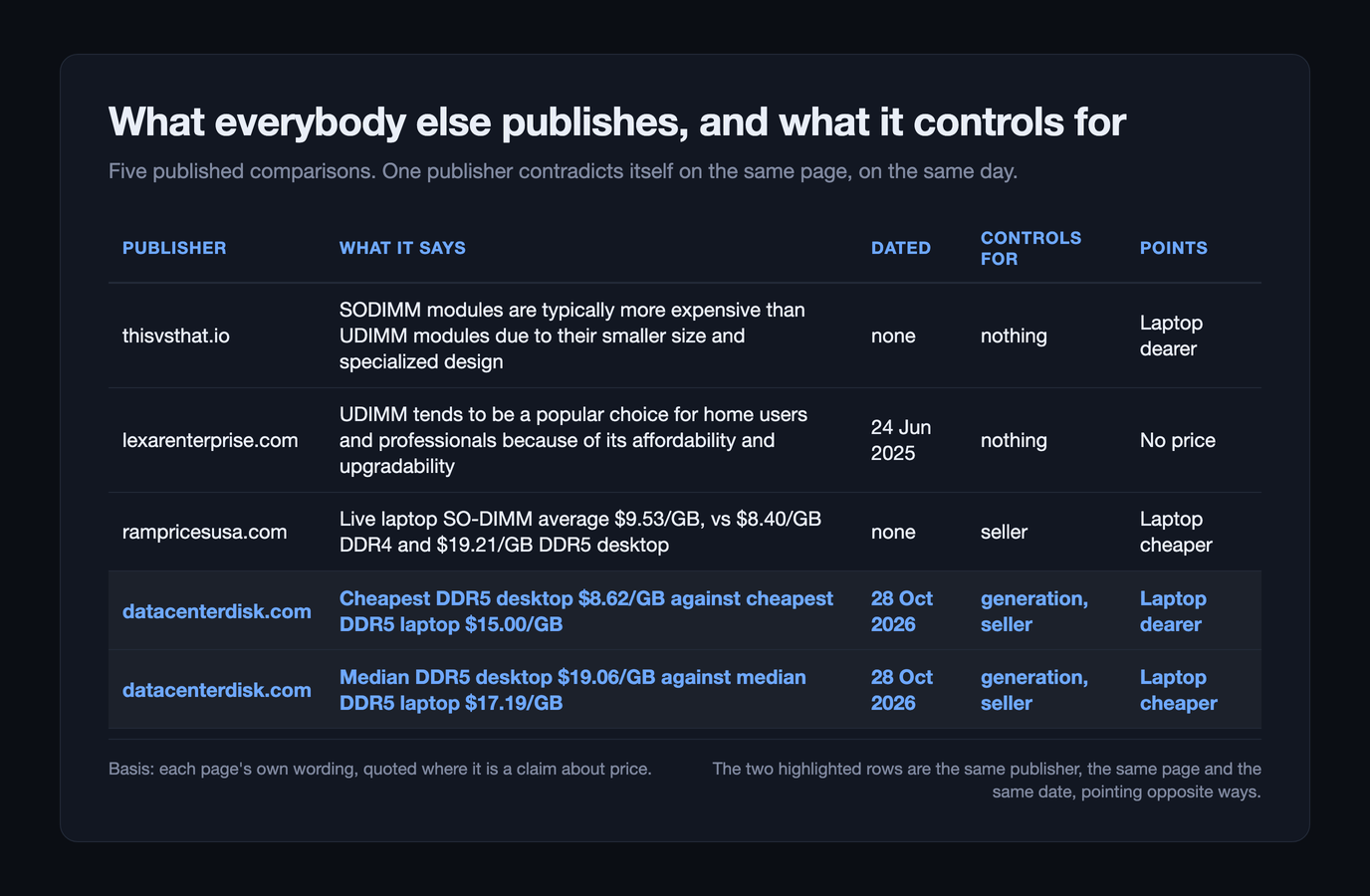
Ask what the laptop RAM vs desktop RAM price difference is and you will get an answer about manufacturing. Smaller board, denser chips, specialist design, therefore dearer — or the reverse, depending which page you land on. What you will not get is two prices. We read the five pages that rank for this question and 2 of 5 of them control for nothing at all, and the two that do publish figures contradict each other.
That matters more than usual right now. Memory is in the middle of a price shock, the two form factors have not risen together, and people are buying adapters on the strength of the answer — so the cheapest route into a given number of gigabytes is a live question with real money on it.
So we did the boring version. This memory maker sells the same silicon in both form factors under part numbers differing in a single character, so capacity, transfer rate, CAS latency, module count, brand, store, currency and day can all be held still with the form factor left as the only thing moving. We priced 10 such pairs across two of its storefronts, straight from each product page’s structured data, checking every one against the seller’s own Module Type field rather than our reading of the part number.
Laptop RAM vs desktop RAM price, part for part
| Capacity | Rated | Laptop part | Desktop part | Laptop | Desktop | Difference |
|---|---|---|---|---|---|---|
| 16GB | 4,800 MT/s CL40 | CT16G48C40S5SODIMM | CT16G48C40U5UDIMM | $137.99 | $137.99 | $0.00 |
| 16GB | 5,600 MT/s CL46 | CT16G56C46S5SODIMM | CT16G56C46U5UDIMM | $144.99 | $144.99 | $0.00 |
| 32GB (2×16) | 4,800 MT/s CL40 | CT2K16G48C40S5SODIMM | CT2K16G48C40U5UDIMM | $285.99 | $285.99 | $0.00 |
| 32GB | 5,600 MT/s CL46 | CT32G56C46S5SODIMM | CT32G56C46U5UDIMM | $281.99 | $281.99 | $0.00 |
| 32GB (2×16) | 5,600 MT/s CL46 | CT2K16G56C46S5SODIMM | CT2K16G56C46U5UDIMM | $300.99 | $300.99 | $0.00 |
| 32GB (2×16) | 6,400 MT/s CL52 | CT2K16G64C52CS5CSODIMM | CT2K16G64C52CU5CUDIMM | $328.99 | $328.99 | $0.00 |
| 64GB (2×32) | 5,600 MT/s CL46 | CT2K32G56C46S5SODIMM | CT2K32G56C46U5UDIMM | $585.99 | $585.99 | $0.00 |
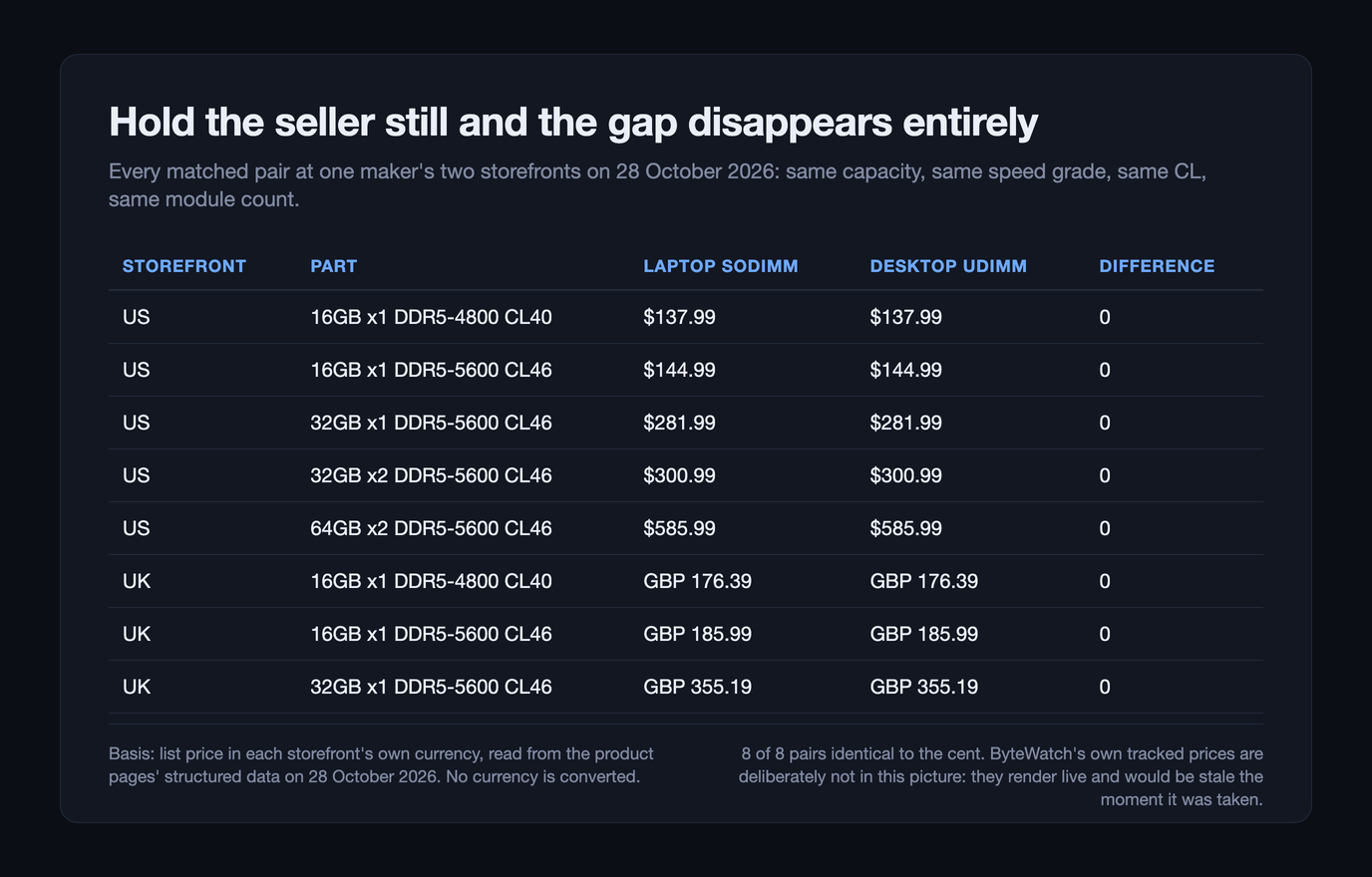
Every pair is the same price. Not within a few percent — identical to the cent, 7 times out of 7, across three capacities, three speed grades, single modules and two-module kits, and across the clock-driver variants of both formats as well. The widest difference in the whole set is $0.00.
It is worth being precise about what that is. It is not a claim that laptop and desktop memory cost the same wherever you shop — the rest of this page is about why they visibly do not. It is a claim about the price list upstream of every shop: the company that makes the chips charges the same for a given capacity and speed grade whichever board it solders them to. The denser PCB and specialist design every explainer invokes are real engineering, and worth nothing in this price list.
The pairing is deliberately mechanical, which is what makes it checkable: two listings must share a storefront, a capacity, a transfer rate, a CAS latency and a module count, and carry counterpart Module Type values from the seller’s own data, before anything here calls them a pair. A listing with no counterpart is dropped rather than compared with something adjacent.
The same test in a second currency
One storefront proves one storefront. If the parity above were an artefact of rounding, of a single price-list import or of one regional team’s habits, it should break the moment the same part numbers are read elsewhere. So we read them elsewhere.
| Capacity | Rated | Laptop part | Desktop part | Laptop | Desktop | Difference |
|---|---|---|---|---|---|---|
| 16GB | 4,800 MT/s CL40 | CT16G48C40S5SODIMM | CT16G48C40U5UDIMM | £176.39 | £176.39 | £0.00 |
| 16GB | 5,600 MT/s CL46 | CT16G56C46S5SODIMM | CT16G56C46U5UDIMM | £185.99 | £185.99 | £0.00 |
| 32GB | 5,600 MT/s CL46 | CT32G56C46S5SODIMM | CT32G56C46U5UDIMM | £355.19 | £355.19 | £0.00 |
Same result, in pounds: 3 of 3 pairs identical to the penny. The levels are not comparable with the US table and we are not comparing them — no figure on this page is converted between currencies, because a conversion would import an exchange rate and a tax regime into a measurement that currently has neither. What travels across the two tables is the difference, and in both currencies it is zero.
Why the published answers disagree
Set that against what is in print. The pages ranking for this question fall into two groups, and neither answers it.
| Publisher | What it publishes | Dated | Controls for | Points to |
|---|---|---|---|---|
| thisvsthat.io | “SODIMM modules are typically more expensive than UDIMM modules due to their smaller size and specialized design” | undated | nothing | laptop dearer |
| lexarenterprise.com | “UDIMM tends to be a popular choice for home users and professionals because of its affordability and upgradability” | Jun 24, 2025 | nothing | no price at all |
| rampricesusa.com | “Today’s live laptop SO-DIMM average is $9.53/GB, vs $8.40/GB DDR4 and $19.21/GB DDR5 desktop” | undated | seller | laptop cheaper |
| datacenterdisk.com | “cheapest DDR5 desktop $8.62/GB against cheapest DDR5 laptop $15.00/GB” | Oct 28, 2026 | generation, seller | laptop dearer |
| datacenterdisk.com | “median DDR5 desktop $19.06/GB against median DDR5 laptop $17.19/GB” | Oct 28, 2026 | generation, seller | laptop cheaper |
The explainers assert a direction and publish no number. One of them — currently the top result for the comparison — states flatly that “SODIMM modules are typically more expensive than UDIMM modules due to their smaller size and specialized design”, cites nothing, carries a 2023 copyright and appends a disclaimer that its comparisons may contain inaccurate information. That is not an unreasonable engineering intuition. It is just not a price, and the price contradicts it.
The trackers do publish numbers, and their numbers are uncontrolled. One advertises a “live laptop SO-DIMM average” against desktop figures split by DDR generation, while its own laptop average is not split by generation at all — so it blends DDR4 and DDR5 and compares the blend with two separate populations. Its laptop figure lands between its two desktop ones, as such a blend tends to.
None of this is bad arithmetic. It is what happens when a comparison runs across whole catalogues rather than matched parts, and the catalogues are different shapes. Compare their floors and you measure the desktop tail; compare their medians and you measure its absence. Compare CT16G56C46S5 with CT16G56C46U5 and you measure the form factor.
Where the laptop RAM vs desktop RAM price gap lives
If the maker charges the same, why does anybody believe otherwise? Because the shops do not charge the same, and they have been diverging all year.
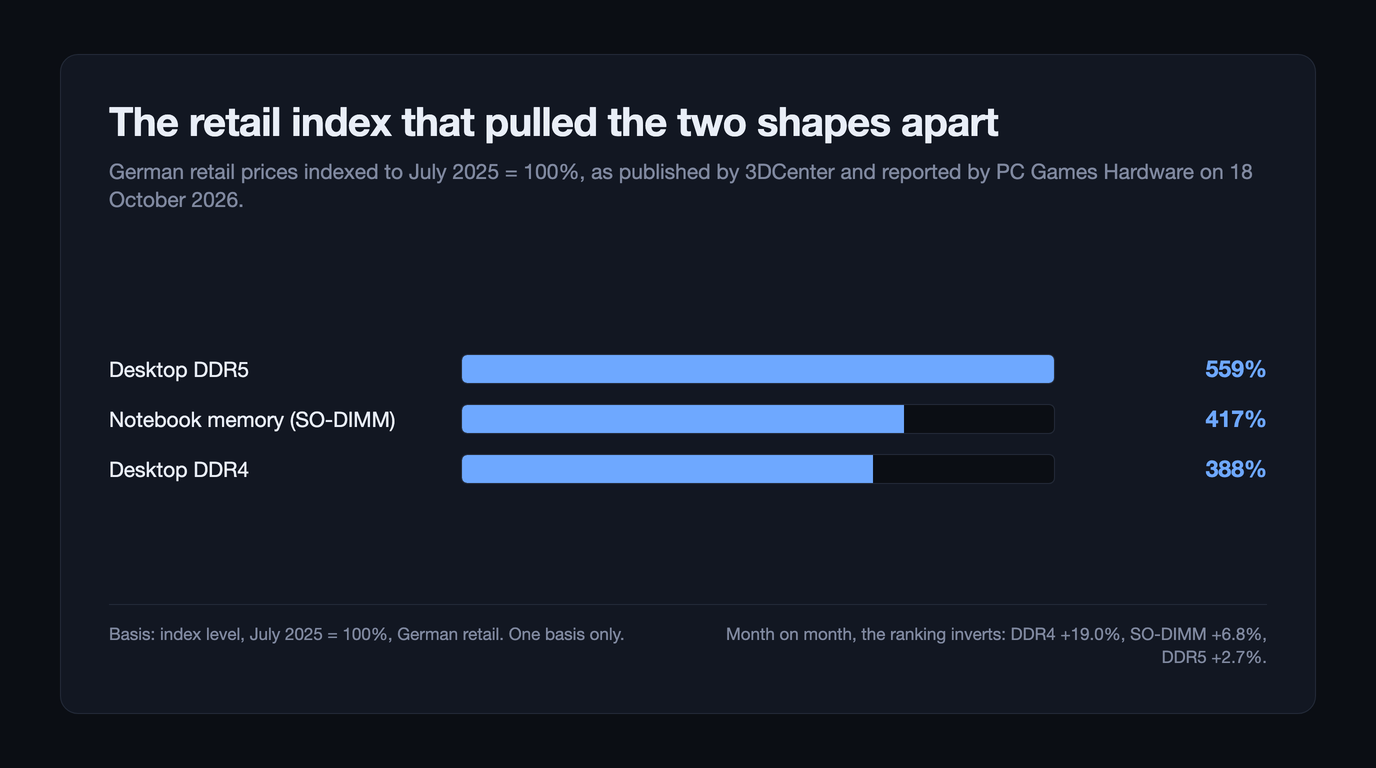
The clearest published measure of it is a German retail index that tracks the two form factors separately against a common base of July 2025 = 100. In its October 2026 reading, desktop DDR5 stands at 559% of that base and notebook memory at 417% — 142 points apart, desktop DDR5 having risen 1.34× as far from the same start. We cite it through PC Games Hardware, 18 October 2026, which attributes every figure, because the index publisher refused every fetch available to us: so these are 3DCenter’s numbers at one remove, for one market, in euros, on October 18, 2026.
A divergence in retail with no divergence in the price list is a demand story, not a cost story: desktop DDR5 is what the squeeze is competing for, and notebook modules sit on a different curve with different buyers and far less enthusiast bidding. None of that reaches the maker’s list price. Which brings us to the comparison that actually decides what you pay, and it is not the one the question asks about — our own tracked DDR5 basket, live at US retail:
| Kit | Rated | Capacity | Best price | Per gigabyte | Observed |
|---|---|---|---|---|---|
| G.Skill Flare X5 DDR5-6000 CL36 32GB | 6,000 MT/s | 32GB | $529.00 | $16.53/GB | Oct 20, 2026Newegg |
| Kingston Fury Beast DDR5-6000 32GB | 6,000 MT/s | 32GB | $559.00 | $17.47/GB | Oct 20, 2026Newegg |
| Corsair Vengeance DDR5-6000 CL30 32GB | 6,000 MT/s | 32GB | $559.99 | $17.50/GB | Oct 28, 2026Newegg |
| Kingston Fury Beast DDR5-5200 32GB | 5,200 MT/s | 32GB | $599.99 | $18.75/GB | Oct 27, 2026Newegg |
| Crucial Pro DDR5-5600 64GB | 5,600 MT/s | 64GB | $1,199.99 | $18.75/GB | Oct 20, 2026Newegg |
| G.Skill Trident Z5 RGB DDR5-6400 CL32 32GB | 6,400 MT/s | 32GB | $659.99 | $20.62/GB | Oct 27, 2026Newegg |
| G.Skill Trident Z5 Neo DDR5-6000 CL30 32GB | 6,000 MT/s | 32GB | $699.99 | $21.87/GB | Oct 27, 2026Newegg |
The cheapest gigabyte there is $16.53/GB, against $9.41/GB for the same maker’s direct 32GB desktop kit — 75.8% dearer at retail. The legs are not speed-matched — 6,000 MT/s against 5,600 MT/s — so read it as a channel gap with a grade difference inside it, not a clean like-for-like. Set that beside $0.00 for the form factor and the ranking is settled: where you buy moves the price by tens of percent; laptop versus desktop moves it by nothing.
The adapter route, and what it costs
The retail divergence has produced a predictable response: adapters that let a laptop module sit in a desktop board. They are real, they are cheap, and we would not use one.
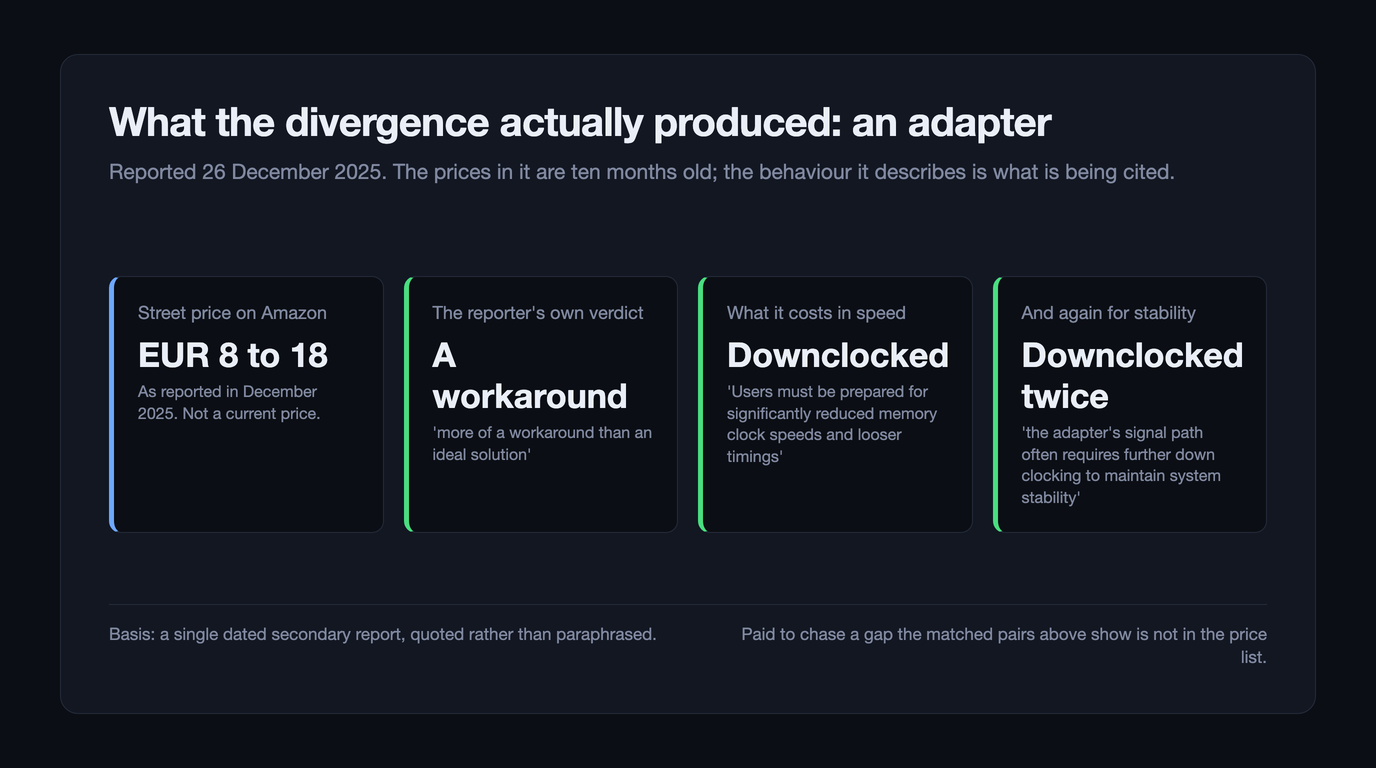
The report we can read on this is Laptop SODIMM-to-DIMM adapters rise in popularity, published December 26, 2025, which puts them at €8 to €18 on Amazon and calls them “more of a workaround than an ideal solution”. Its prices are ten months old and in euros, so treat them as an order of magnitude rather than a quote; the behaviour is what we are citing, and it is the same behaviour the index above would predict.
One narrow exception, and it is the case that makes people reach for an adapter in the first place: modules you already own cost nothing. A drawer of SODIMMs pulled from retired laptops is free memory, and an adapter is the only way into a desktop board. That is a different calculation from buying laptop memory to save money, which is the one this page is about.
What is actually different about a SODIMM
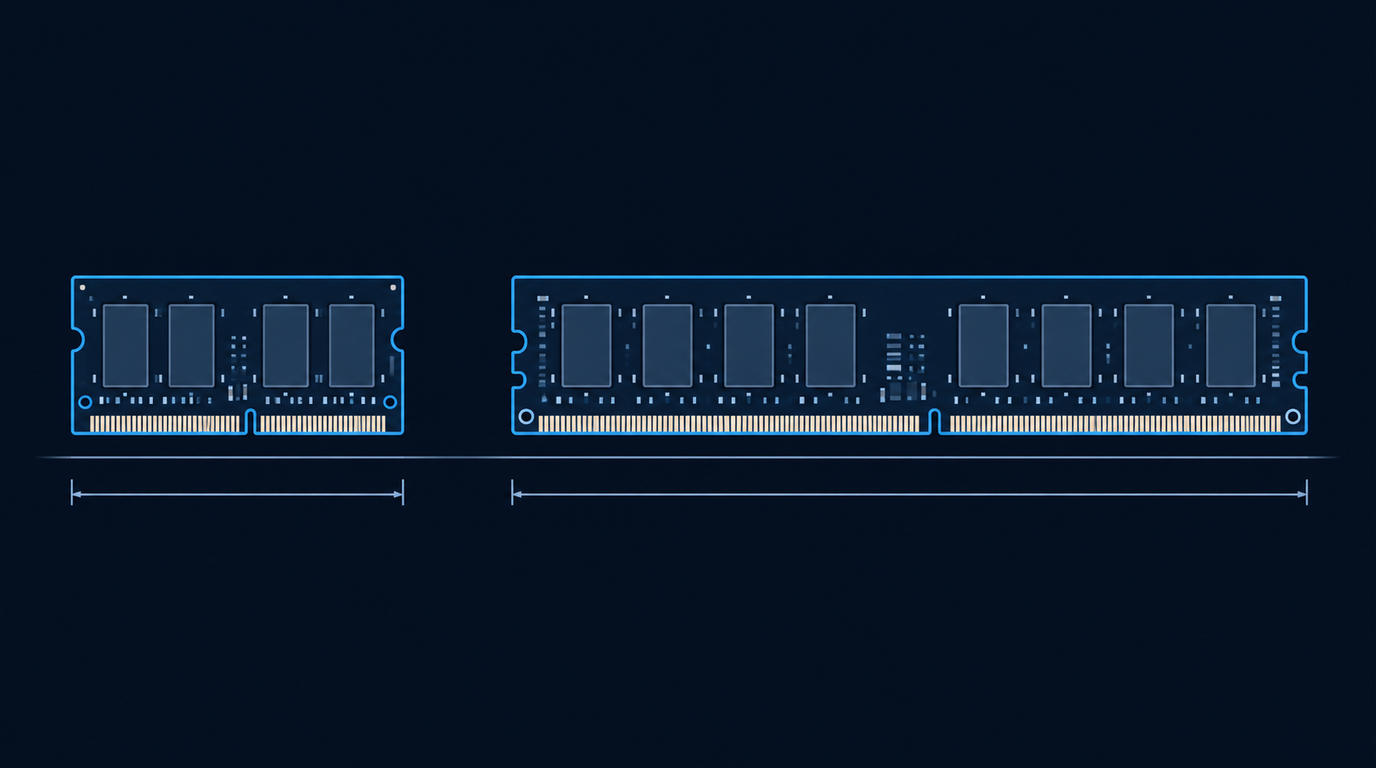
Given a zero price difference, be clear that the formats are not interchangeable in any other sense. A SODIMM is shorter, has a different pin count and notch position, and will not seat in a desktop slot — which is why the adapter above exists. You do not choose between them; your machine chooses and you buy what fits.
That is the useful way to read the parity: not an invitation to shop across form factors, but a reason to stop treating form factor as a line item. The variables that do move a memory price are the ones the rest of this site keeps measuring — the generation, the capacity, the speed grade, the badge, and above all the retailer and the day.
One seller, and a closing one
The honest limits of this measurement, in the order they matter.
It is one maker. Crucial is the only seller we found listing both form factors of the same part with structured prices a machine can read, which is why this comparison is possible here and nowhere else; our tracked retailers refused every fetch, as on Oct 26, 2026. So the finding is properly stated as: this maker’s price list does not charge for the form factor. Whether every maker’s does is not something 10 pairs at one company can settle.
They are list prices, not street prices. A list price is what the maker asks; what you pay is set by a retailer, and the whole middle of this page is about how far those two can drift apart.

Five checks before you call laptop memory the cheap route
- Check what fits first. The formats are not interchangeable without hardware in between. If your machine takes desktop modules, laptop memory is not an option you have; it is an option you would have to build.
- Refuse any comparison that does not name two part numbers. A “laptop average” against a “desktop average” is two different populations, and the answer it gives you flips with the statistic chosen. Ours is above, with the part numbers in the table.
- Hold the generation and the grade still. DDR4 against DDR5 is a far larger difference than anything in this article, and a blended figure hides it. Price 5,600 MT/s against 5,600 MT/s, not laptop against desktop.
- Then shop the channel, which is where the money is. The spread between retailers on a single part is worth multiples of the form-factor difference we measured, and it moves week to week. That is the number worth watching, and it is what our own chart watches.
- Date every figure, including ours. The list prices here were read on October 28, 2026 at one maker; our observed retail prices carry their own dates and re-render on each request. A figure from an undated page — and two of the comparisons above are undated — is of unknown age in a market that has moved several hundred percent since last year.
Related reading
FAQ
Is laptop RAM more expensive than desktop RAM?
Not at the memory maker's own price list. We priced 10 pairs differing only in form factor — same capacity, transfer rate, CAS latency, module count, brand and day — at one maker's US and UK storefronts on October 28, 2026, and 10 were identical to the cent or penny. The pages saying laptop memory costs more argue from manufacturing, not prices.
Why do price trackers say laptop memory is cheaper then?
Because they compare catalogues rather than parts, and the two catalogues are different shapes: desktop DDR5 has long tails of cheap low-capacity and expensive enthusiast kits, laptop DDR5 has neither. The answer then depends which statistic you pick. datacenterdisk.com publishes both directions on one page on one day: its cheapest desktop listing undercuts its cheapest laptop one, while its median desktop listing is the dearer.
Has laptop memory really risen less than desktop memory in 2026?
In retail, yes. The October 2026 reading of a German retail index puts desktop DDR5 at 559% of its July 2025 level against 417% for notebook SO-DIMM — 142 points apart. That divergence is in the shops, not in the maker's price list: a demand difference between two sets of buyers, not a cost difference between two kinds of module.
Can I put laptop SODIMM memory in a desktop PC?
Only with an adapter, and we would not. The formats differ in length, pin count and notch position, so a SODIMM will not seat in a desktop slot. The report we cite warns of "significantly reduced memory clock speeds and looser timings" plus further downclocking for stability — paid to chase a gap that is not in the price list. The exception is memory you already own.
Is a SODIMM slower than a UDIMM of the same speed grade?
Not by virtue of the form factor at a given rating: the pairs we priced carry the same transfer rate and CAS latency as their desktop twins, which is how they were matched. What differs is the top of each range, since the fastest grades reach desktop formats first. Compare grade against grade, not format against format.
Does the same parity hold for the new clock-driver modules?
Yes, on the one pair that exists in both shapes: the CSODIMM laptop kit and the CUDIMM desktop kit, same capacity and rating, same price on the day we read them. The catalogue is not symmetric though — we found no single-module laptop version, while the desktop single is on sale. What the driver itself costs is a separate measurement, published here on 26 October 2026.
So what actually decides what I pay for memory?
The generation, the capacity, the speed grade, the badge, and — far more than any of those right now — the retailer and the day. The spread between retailers on one named part is worth multiples of the form-factor difference we measured, which was zero. Our DDR5 observations currently run $16.53/GB to $21.87/GB.
The form factor is free. The channel is not.
We track DDR5, DDR4 and NVMe listings at US retailers and tell you when one of yours moves. New retail stock only, no deal scores, no affiliate links, no commission on anything you buy — observed prices, dated, with the sample size printed next to them.