DDR5 CUDIMM Price in 2026: What the Clock Driver Actually Costs
Key takeaways
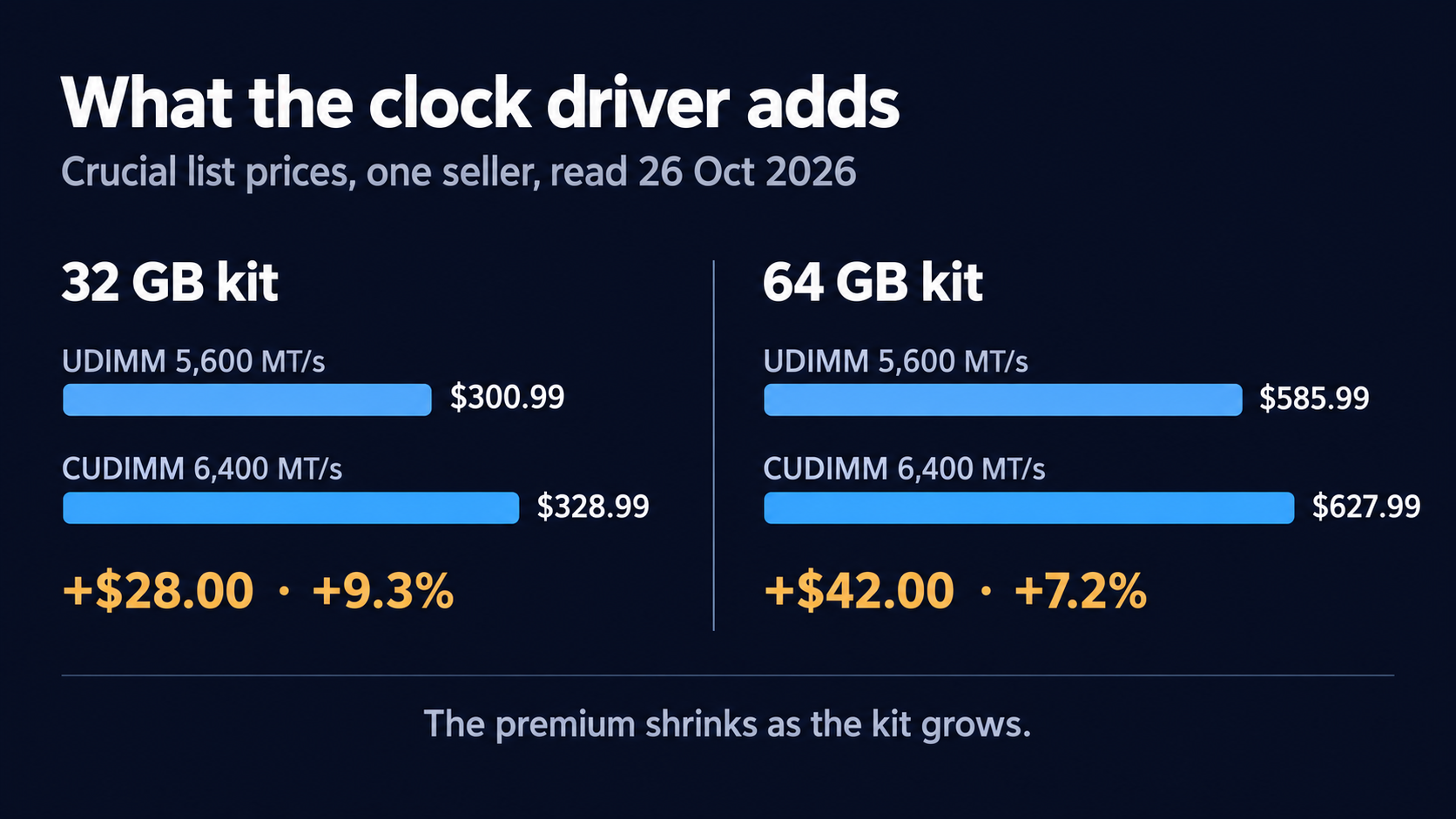
- The clock driver costs $28.00 on a 32GB kit — 9.3% over the fastest plain UDIMM of the same capacity, same seller, same day. Every guide we read estimates 10–25%.
- It shrinks as the kit grows: 7.2% at 64GB against 9.3% at 32GB — the driver is a fixed cost per module; the DRAM under it is not.
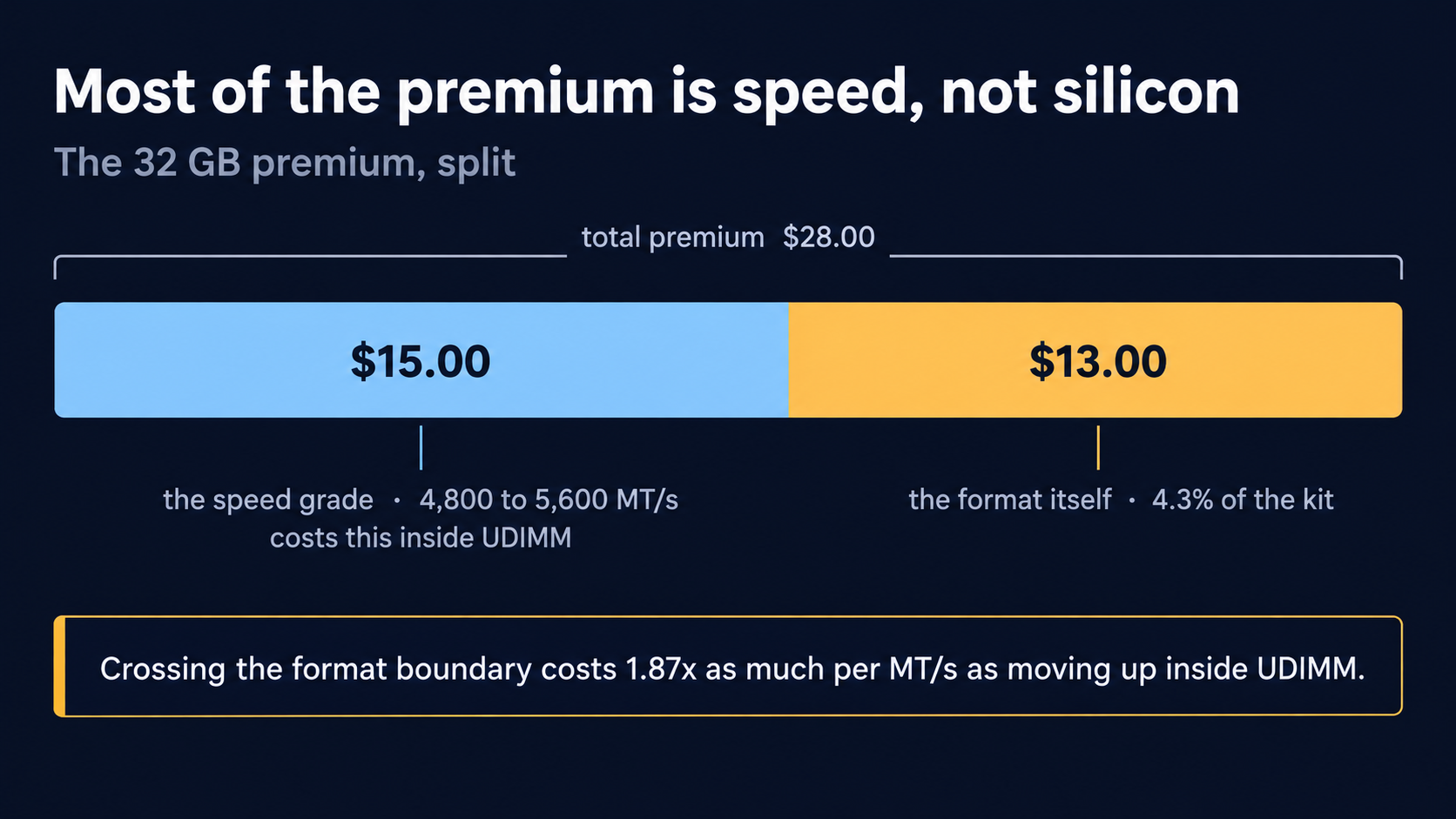
- Most of it is speed, not silicon. The same 800 MT/s of rating costs $15.00 inside the UDIMM range, leaving about $13.00 — 4.3% of the kit — for the format itself.
- Intel publishes two ceilings for one processor — 5,600 MT/s with a UDIMM, 6,400 MT/s with a CUDIMM: 14.3% more rated transfer for 9.3% more money.
- AMD publishes no CUDIMM figure at all — its spec sheet prints “UDIMM” under “System Memory Subtype” and uses the word CUDIMM 0 times. There the premium buys nothing in writing.
- Not one of the 8 DDR5 kits we track is a CUDIMM, and 1 of 8 is even rated to 6,400 MT/s — as a UDIMM.
- What the clock driver costs on a DDR5 CUDIMM
- 6400 MT/s is where the driver stops being optional
- Intel publishes two ceilings for one processor
- AMD’s own spec sheet never says the word
- What a CUDIMM price looks like against our shelf
- Why the direct price sits under the tracked floor
- Two singles cost less than the matched pair
- Five checks before you pay the premium
- Related reading
- FAQ
Every page that explains the DDR5 CUDIMM price premium gives you a range instead of a number. We read nine before starting this one: the estimates run 10–25%, none says which two parts were compared, and the deepest technical write-up on the format carries no prices at all. That matters because the premium is the whole decision — a clock driver is one chip soldered to a memory module, and the only question a buyer has is whether it is worth what it adds.
So we priced it instead. On Oct 26, 2026 we read 7 DDR5 part pages at Crucial’s own store — the memory maker, not a reseller — and took each list price from the page’s structured data. Same capacity, same brand, same morning is the only way the difference between the formats is about the format rather than the shop. Then we checked what Intel and AMD publish for each, and what our 8 tracked DDR5 kits say about who is buying them. The short version: the driver costs less than everyone says, the socket decides whether it is worth anything, and the cheapest CUDIMM we could verify is on a brand being discontinued.
What the clock driver costs on a DDR5 CUDIMM
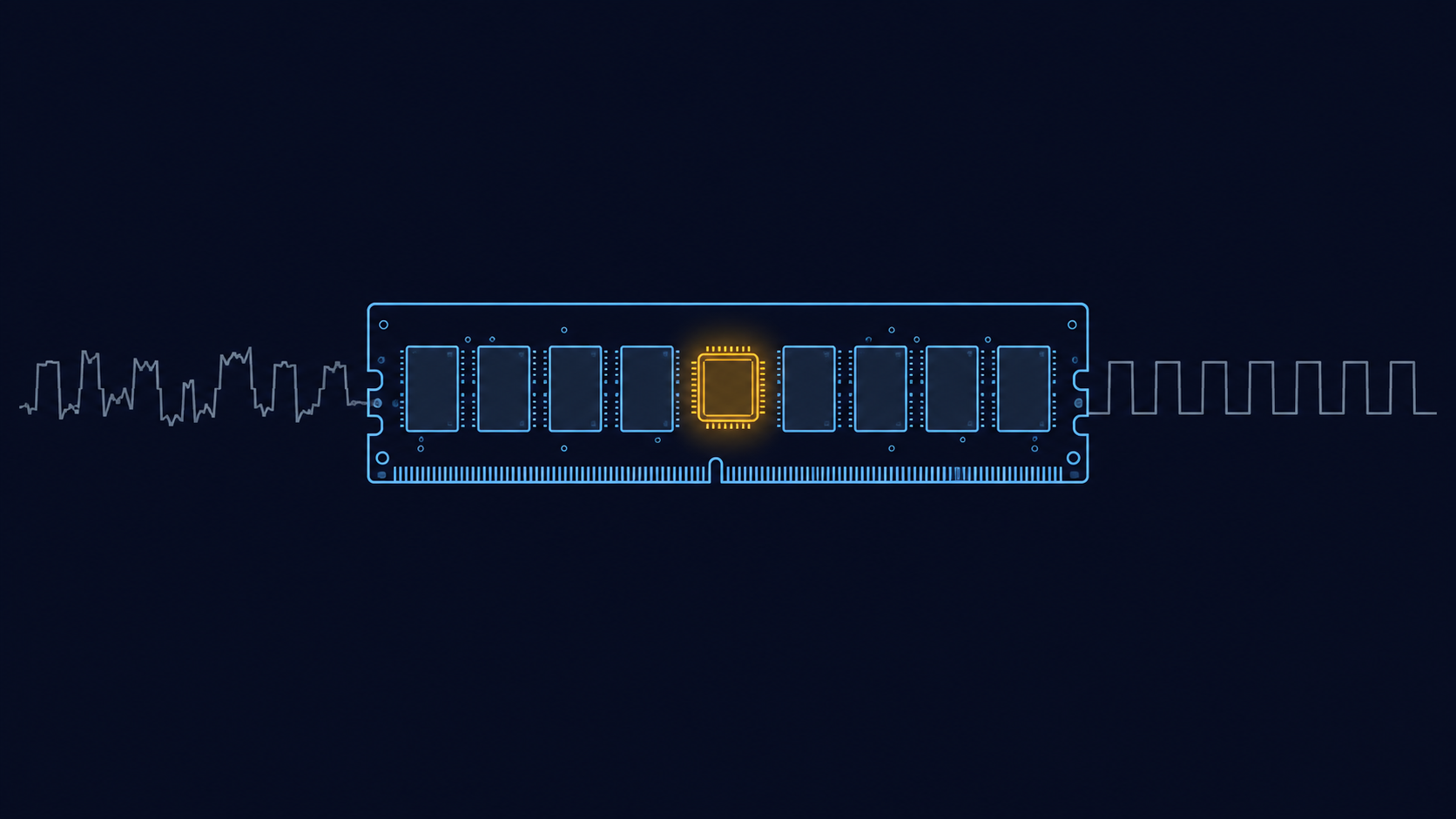
A CUDIMM is an ordinary unbuffered DIMM with one extra component: a client clock driver, which buffers the clock between the host controller and the DRAMs on DDR5 CUDIMMs and CSODIMMs. Everything else can be identical, which makes the format unusually easy to price — as long as both versions sit on one shelf.
| Part | Format | Rated | Modules | List price | Per gigabyte |
|---|---|---|---|---|---|
| 16GB DDR5-6400 CUDIMM | CUDIMM | 6,400 MT/s CL52 | 1×16GB | $158.99 | $9.94/GB |
| 32GB Kit (16GBx2) DDR5-4800 UDIMM | UDIMM | 4,800 MT/s CL40 | 2×16GB | $285.99 | $8.94/GB |
| 32GB Kit (16GBx2) DDR5-5600 UDIMM | UDIMM | 5,600 MT/s CL46 | 2×16GB | $300.99 | $9.41/GB |
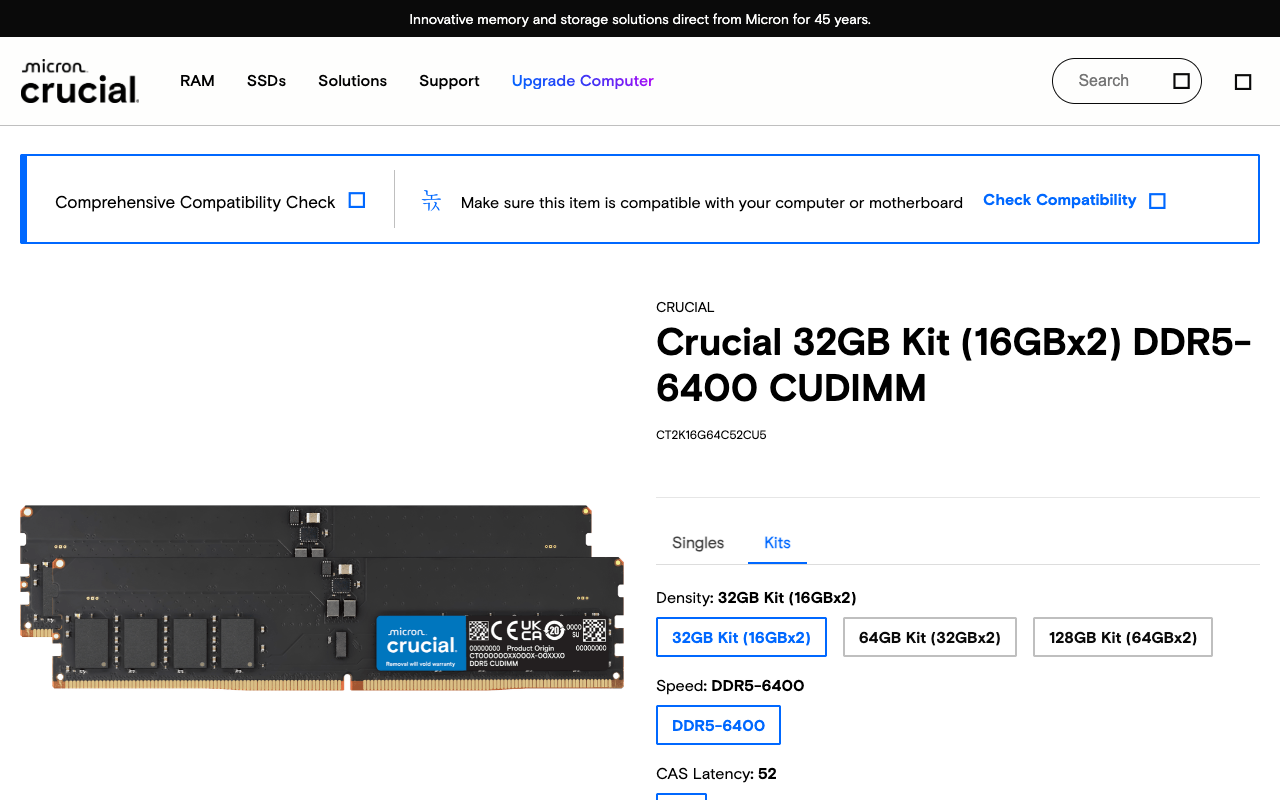
| 32GB Kit (16GBx2) DDR5-6400 CUDIMM | CUDIMM | 6,400 MT/s CL52 | 2×16GB | $328.99 | $10.28/GB |
| 64GB Kit (32GBx2) DDR5-5600 UDIMM | UDIMM | 5,600 MT/s CL46 | 2×32GB | $585.99 | $9.16/GB |
| Pro 64GB Kit (32GBx2) DDR5-5600 UDIMM | UDIMM (Pro) | 5,600 MT/s CL46 | 2×32GB | $608.99 | $9.52/GB |
| 64GB Kit (32GBx2) DDR5-6400 CUDIMM | CUDIMM | 6,400 MT/s CL52 | 2×32GB | $627.99 | $9.81/GB · cheapest CUDIMM |
At 32GB the answer is $28.00: the 6,400 MT/s CUDIMM kit lists at $328.99 against $300.99 for the 5,600 MT/s UDIMM — 9.3% more for 14.3% more rated transfer, or $10.28/GB against $9.41/GB per gigabyte.
At 64GB it falls to 7.2% — $42.00 on a kit costing $585.99 before the driver. That is what the bill of materials predicts: a fixed cost per module, diluted by doubling the DRAM under it. If you are buying the format, buy the larger kit.
There is a catch in reading that premium as the price of the chip, and it is the mistake every “CUDIMM tax” post makes: the CUDIMM is also 800 MT/s faster, and speed costs money in any format. The same shelf prices that step — 4,800 MT/s to 5,600 MT/s inside the UDIMM range costs $15.00 at the same capacity. Scale it to the rating the CUDIMM adds and about $15.00 of the premium is the grade. What is left — roughly $13.00, 4.3% of the kit — is the most the format itself can be costing.
That subtraction assumes the price of a megatransfer is roughly constant across the range, which is an assumption, so here is the same finding without it: crossing the format boundary costs 1.87× as much per MT/s as moving up inside UDIMM. A real premium, and nothing like a quarter of the kit price. Whether you get anything for it depends entirely on the socket.
6,400 MT/s is where the driver stops being optional
The clock driver is not a performance part the way a heatspreader or a tighter timing bin is. It exists because of a signalling problem: at high data rates the clock arriving at a module has picked up enough jitter that the DRAM cannot latch reliably, so the module regenerates it locally to manage jitter and close timing for the synchronous memory system.
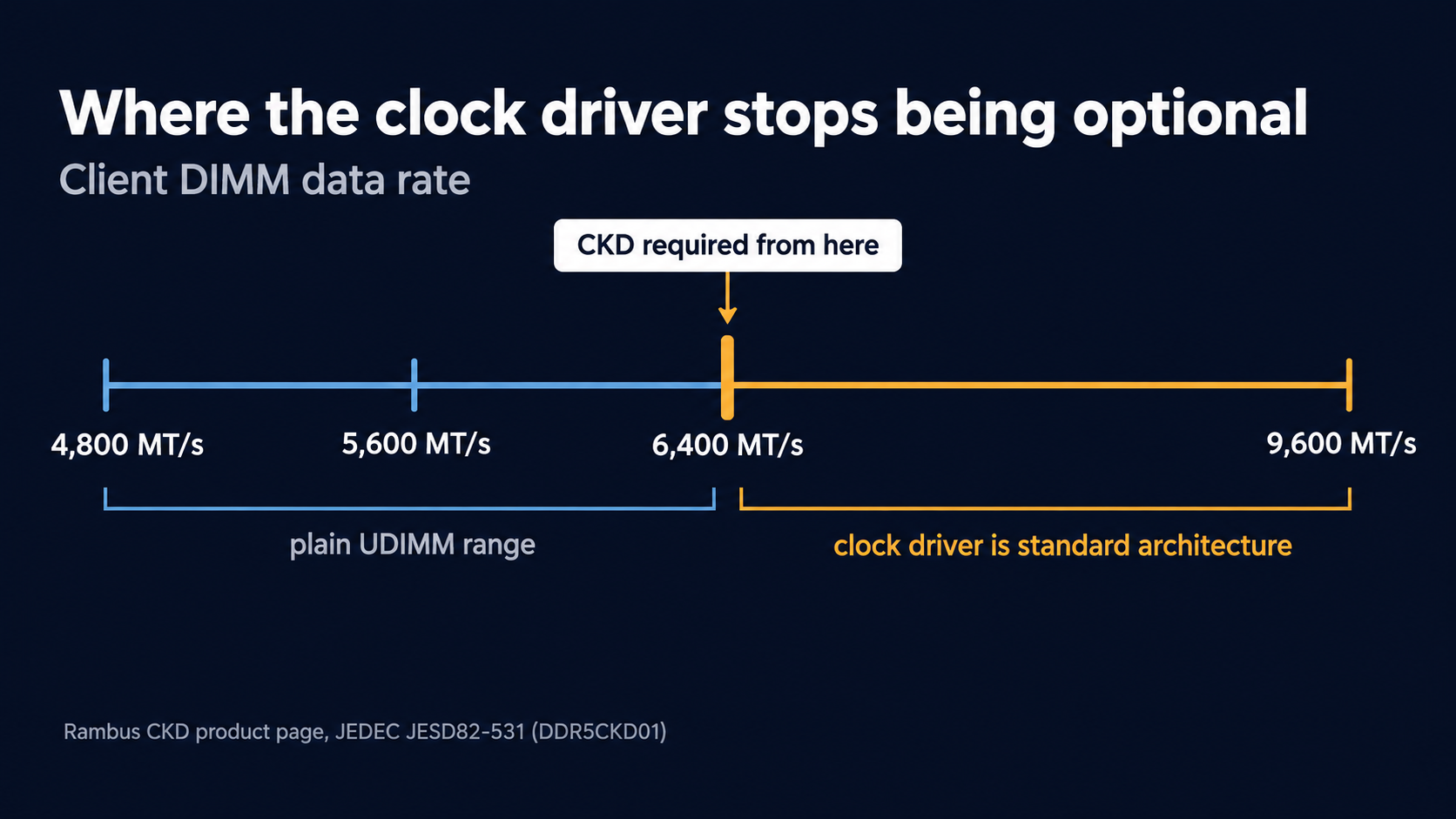
Read that carefully, because it decides the rest of the article. 6,400 MT/s is not where a CUDIMM becomes better; it is where a client DIMM stops being able to do without one. Below the line the driver is redundant hardware you paid for; at or above it there is no UDIMM to compare against, because the format cannot get there. So the premium above is not the price of extra performance. It is the price of admission to speeds the cheaper format does not reach.
So the useful question is not “is a CUDIMM faster?” but “does anything I own publish a number above 5,600 MT/s?” Two companies answer, very differently.
Intel publishes two ceilings for one processor
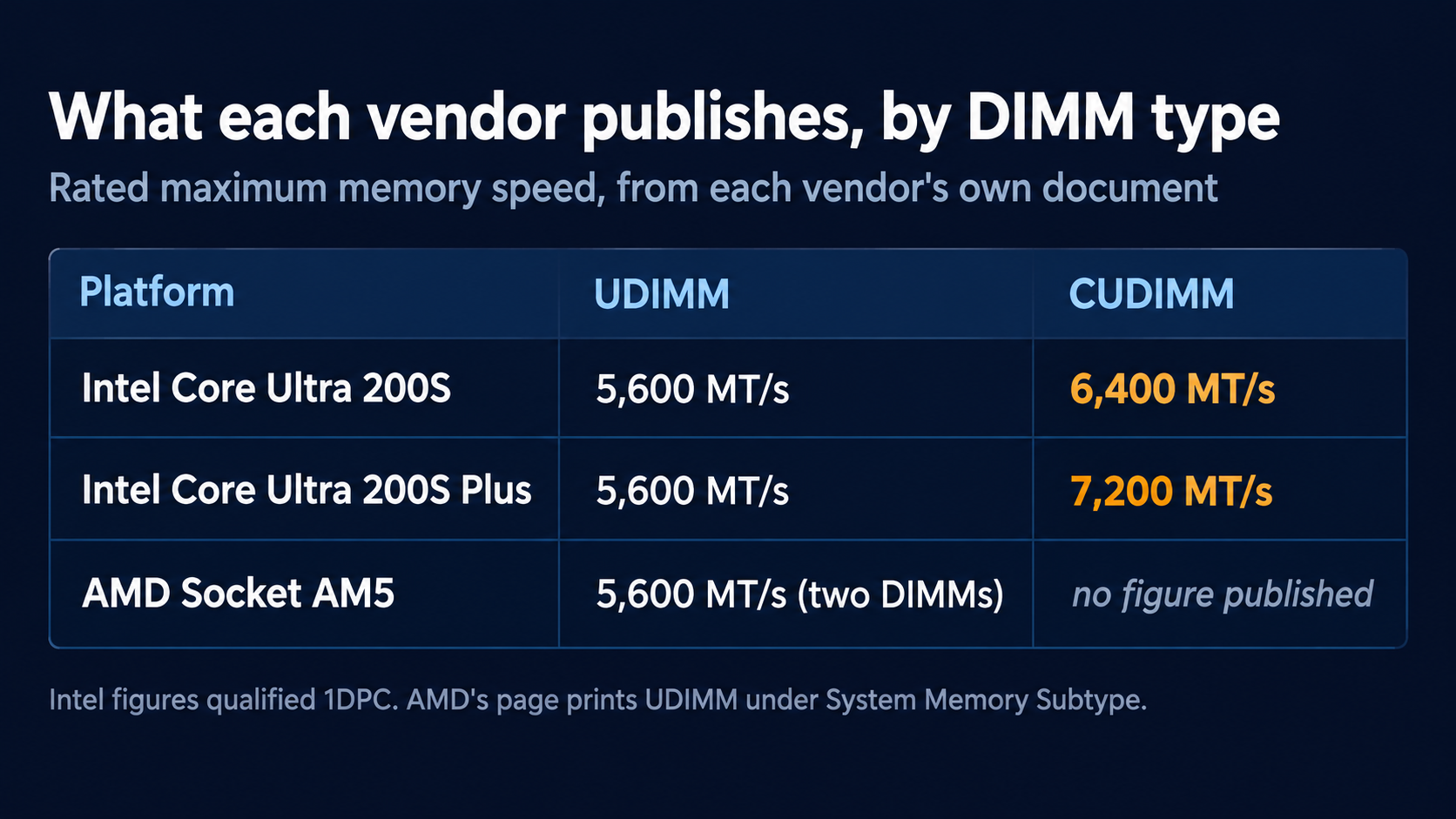
Intel’s answer is the cleanest evidence on this page. In the DDR support matrix of the Core Ultra 200S datasheet, one processor line is rated for two different memory speeds depending on which format you put in it.
| Vendor | Processor line | Format | Published maximum | As qualified |
|---|---|---|---|---|
| Intel | Core Ultra 200S (S Processor) | UDIMM / SODIMM | 5,600 MT/s | 1DPC, the matrix’s own qualification |
| Intel | Core Ultra 200S (S Processor) | CUDIMM / CSODIMM | 6,400 MT/s | 1DPC, the matrix’s own qualification |
| Intel | Core Ultra 200S Plus (S Plus Processor) | UDIMM / SODIMM | 5,600 MT/s | 1DPC, the matrix’s own qualification |
| Intel | Core Ultra 200S Plus (S Plus Processor) | CUDIMM | 7,200 MT/s | 1DPC, the matrix’s own qualification |
| AMD | Socket AM5 | UDIMM | 5,600 MT/s | two DIMMs (2x1R and 2x2R rows) |
| AMD | Socket AM5 | UDIMM | 3,600 MT/s | four DIMMs (4x1R and 4x2R rows) |
| AMD | Socket AM5 | CUDIMM | none published | no figure published; the page prints the subtype as UDIMM |
On an Core Ultra 200S part the matrix prints 5,600 MT/s against UDIMM / SODIMM and 6,400 MT/s against CUDIMM / CSODIMM — 800 MT/s of published headroom, 14.3% more rated transfer for the format with the driver on it. Against the 9.3% it costs, that is more specification than money.
On the Plus parts the gap widens again — 7,200 MT/s for a CUDIMM against the same 5,600 MT/s for a UDIMM, 28.6% more. One caveat the enthusiast write-ups blur: the ceiling is the platform’s, not the module’s. The CUDIMM we priced is rated 6,400 MT/s, so on a Plus processor it still delivers only 800 MT/s over UDIMM — the higher ceiling needs a part rated for it, from a dearer shelf than ours.
AMD’s own spec sheet never says the word
The other socket answers by not answering. We read the specifications page for the Ryzen 9 9950X the same day. Under “System Memory Subtype” it prints exactly one value: UDIMM. The word CUDIMM appears 0 times.
| Vendor and format | Published maximum | vs 6,400 MT/s | What that means for a buyer |
|---|---|---|---|
| Intel UDIMM / SODIMM | 5,600 MT/s | 14.3% above it | the driver is for speeds this line does not publish |
| Intel CUDIMM / CSODIMM | 6,400 MT/s | exactly at it | the driver is inside what this line publishes |
| Intel UDIMM / SODIMM | 5,600 MT/s | 14.3% above it | the driver is for speeds this line does not publish |
| Intel CUDIMM | 7,200 MT/s | 11.1% below it | the driver is inside what this line publishes |
| AMD UDIMM | 5,600 MT/s | 14.3% above it | the driver is for speeds this line does not publish |
| AMD UDIMM | 3,600 MT/s | 77.8% above it | the driver is for speeds this line does not publish |
| AMD CUDIMM | none published | not comparable | the format is not rated here at all |
What AMD does publish is a ceiling that moves with how many slots you fill: 5,600 MT/s for two DIMMs (2x1R and 2x2R rows), and 3,600 MT/s for four DIMMs (4x1R and 4x2R rows) — 77.8% below the rate at which a clock driver becomes standard architecture. A four-stick AM5 build is not in this market at all.
The community answer is that AM5 boards run CUDIMMs in bypass mode — the driver switched out of the clock path, the module behaving as an ordinary UDIMM — which is also why the premium would be wasted there: you pay for a chip and then disable it. We will not assert it as fact, because AMD does not document it and a price tracker cannot test it. The thing that governs the purchase is stronger than a forum consensus anyway: AMD publishes no speed for this format on this socket. If the vendor will not put a figure in writing, the premium has nothing to attach to.
The asymmetry is the shape we found in the warranty documents behind these kits too: both vendors talk about memory running outside their published specifications, and only one says it on the page selling the feature. Published specifications do a lot of work here, and they are not symmetric between the sockets.
What a CUDIMM price looks like against our own shelf
We track 8 DDR5 kits at US retailers and record every in-stock observation: a small, deliberately high-liquidity basket of the parts procurement actually buys, and the best evidence we have of what the market is really shopping for.
| Kit | Rated | Format | vs 6,400 MT/s | Best observed | Per gigabyte |
|---|---|---|---|---|---|
| G.Skill Trident Z5 RGB DDR5-6400 CL32 32GB | 6,400 MT/s | UDIMM | at the threshold | $659.99 · Newegg · Oct 27, 2026 | $20.62/GB |
| G.Skill Trident Z5 Neo DDR5-6000 CL30 32GB | 6,000 MT/s | UDIMM | below it | $699.99 · Newegg · Oct 27, 2026 | $21.87/GB |
| G.Skill Flare X5 DDR5-6000 CL36 32GB | 6,000 MT/s | UDIMM | below it | $529.00 · Newegg · Oct 20, 2026 | $16.53/GB |
| Corsair Vengeance DDR5-6000 CL30 32GB | 6,000 MT/s | UDIMM | below it | $559.99 · Newegg · Oct 28, 2026 | $17.50/GB |
| Kingston Fury Beast DDR5-6000 32GB | 6,000 MT/s | UDIMM | below it | $559.00 · Newegg · Oct 20, 2026 | $17.47/GB |
| Crucial Pro DDR5-5600 64GB | 5,600 MT/s | UDIMM | below it | $1,199.99 · Newegg · Oct 20, 2026 | $18.75/GB |
| Corsair Vengeance DDR5-5600 64GB | 5,600 MT/s | UDIMM | below it | awaiting scrape | — |
| Kingston Fury Beast DDR5-5200 32GB | 5,200 MT/s | UDIMM | below it | $599.99 · Newegg · Oct 27, 2026 | $18.75/GB |
Two counts there matter more than any price in it. 0 of 8 tracked kits is a CUDIMM, and 1 of 8 is rated as high as 6,400 MT/s — that one a UDIMM, sold right up against the line without crossing it. The mainstream shelf has not moved to this format, which is a market answer to the question we started with.
On the level rather than the format: the median tracked DDR5 observation runs $18.75/GB across 7 SKUs, from $16.53/GB to $21.87/GB — one generation, same retailers, a spread far wider than the format premium. Worth seeing before optimising for a clock driver; our per-gigabyte ranking on these kits works through it.
Why the direct price sits under the tracked floor
Put the two halves of this article together and something jumps out. Our cheapest observed 32GB DDR5 kit is the G.Skill Flare X5 DDR5-6000 CL36 32GB at $529.00, $16.53/GB, seen at Newegg on Oct 20, 2026. The 6,400 MT/s CUDIMM at the maker’s own store is $10.28/GB — 60.8% dearer per gigabyte at our tracked retailer, for the slower format. A gap that size is not a format premium. It is two channels that have stopped agreeing.
The explanation is on the seller’s own homepage, and it is the most important line here for anyone about to act on a number.
So treat the two findings here differently. The premium survives the wind-down: a difference between two parts on one shelf on one morning, where whatever depresses the level depresses both sides equally. The level does not survive at all. A direct store running down the last of a discontinued line is not a price you can plan a build around, and the notice says as much — stock “may continue to be available for purchase from distributors and resellers for some time” is about clearance, not supply.
It also explains why nobody else has published this comparison: the one shelf carrying both formats with structured prices was a manufacturer’s direct store, and that store is closing. For the broader picture underneath, our running account of the DDR5 market is the place to start.
Two singles cost less than the matched pair
One more thing fell out of pricing every SKU on the shelf rather than the one we came for. The 2-module 6,400 MT/s CUDIMM kit lists at $328.99; the identical module sold alone lists at $158.99, so 2 come to $317.98 — $11.01 less, or 3.5% under the kit price.
The same shelf breaks a rule we usually find holding. Per gigabyte the CUDIMM range does not get cheaper as it gets bigger: the 32GB kit is the dearest row in its own format at $10.28/GB, above the 64GB kit at $9.81/GB and the single module below it, with the kit premium most of the reason. Elsewhere that curve runs the other way, as our price-per-gigabyte-by-capacity work measures — so a format this new is worth checking rather than assuming.
Five checks before you pay the premium
None of this is advice about your build, and we have no idea what your board does. It is five things checkable against documents, in the order that kills the purchase fastest.
- Find your processor’s published figure for the format. Not a review, not a QVL — the vendor’s own datasheet. A CUDIMM number means the premium buys something written down. Only a UDIMM number means stop here.
- Count the slots you are filling. Every figure above is one-DIMM-per-channel. Both vendors drop the rate at four, one of them to 77.8% below the threshold the driver exists for.
- Check the module is rated for that ceiling. A platform rated higher than your kit does not make your kit faster. The two numbers are independent.
- Price the step inside the cheaper format first. 800 MT/s inside the UDIMM range cost $15.00 here. If that gets you where you need to be, the format question does not arise.
- Ask whose shelf the price is from. The cheapest CUDIMM price we could verify is a discontinued line selling down direct, and our tracked retailers carry none — so a quoted CUDIMM price is probably not one you can repeat. Watch the kit you want and buy on its own history, which is what the live RAM chart is for.
If those five leave you still wanting the format, the premium is defensible: 9.3% at 32GB and 7.2% at 64GB, most of it the grade rather than the chip — a long way from the quarter of the kit price the guides warn about. The reason to skip it is almost never the money. It is that your socket publishes no number the driver can unlock.
Related reading
FAQ
How much more does a DDR5 CUDIMM cost than a UDIMM?
Measured at one seller on one day — Crucial's own store, read 2026-10-26 — it is $28.00 on a 32GB kit, or 9.3% over the fastest plain UDIMM of the same capacity. At 64GB it falls to 7.2%, because the clock driver is a fixed cost per module while the DRAM under it is not. Secondary guides estimate 10-25%; we could not reproduce that.
Is the CUDIMM premium actually the price of the clock driver?
Only part of it, because a CUDIMM is also faster. On the same shelf 800 MT/s inside the UDIMM range costs $15.00 at the same capacity, accounting for about $15.00 of the premium. The residue — roughly $13.00, 4.3% of the kit — is the most the format itself can cost. Without the linearity assumption: crossing the boundary costs 1.87x as much per MT/s as moving up inside UDIMM.
Does AM5 support CUDIMM?
AMD does not publish a CUDIMM figure for the socket. Its Ryzen 9 9950X specifications page prints "UDIMM" under "System Memory Subtype" and uses the word CUDIMM 0 times; its published maxima are DDR5-5600 for two DIMMs and DDR5-3600 for four, both under the 6400 MT/s the driver exists for. Boards are widely reported to run CUDIMMs in bypass mode, but AMD does not document that. Either way there is no published number on that socket for the premium to buy.
What does Intel publish for CUDIMM?
Two figures for the same processor, in the Core Ultra 200S datasheet's DDR support matrix: an S processor is rated 5600 MT/s with a UDIMM and 6400 MT/s with a CUDIMM, 14.3% more. An S Plus processor goes to 7200 MT/s against the same 5600 MT/s UDIMM figure. All are one-DIMM-per-channel numbers, and the matrix adds that "Frequency is not guaranteed when mix DIMM's populated."
Why is 6400 MT/s the number that keeps coming up?
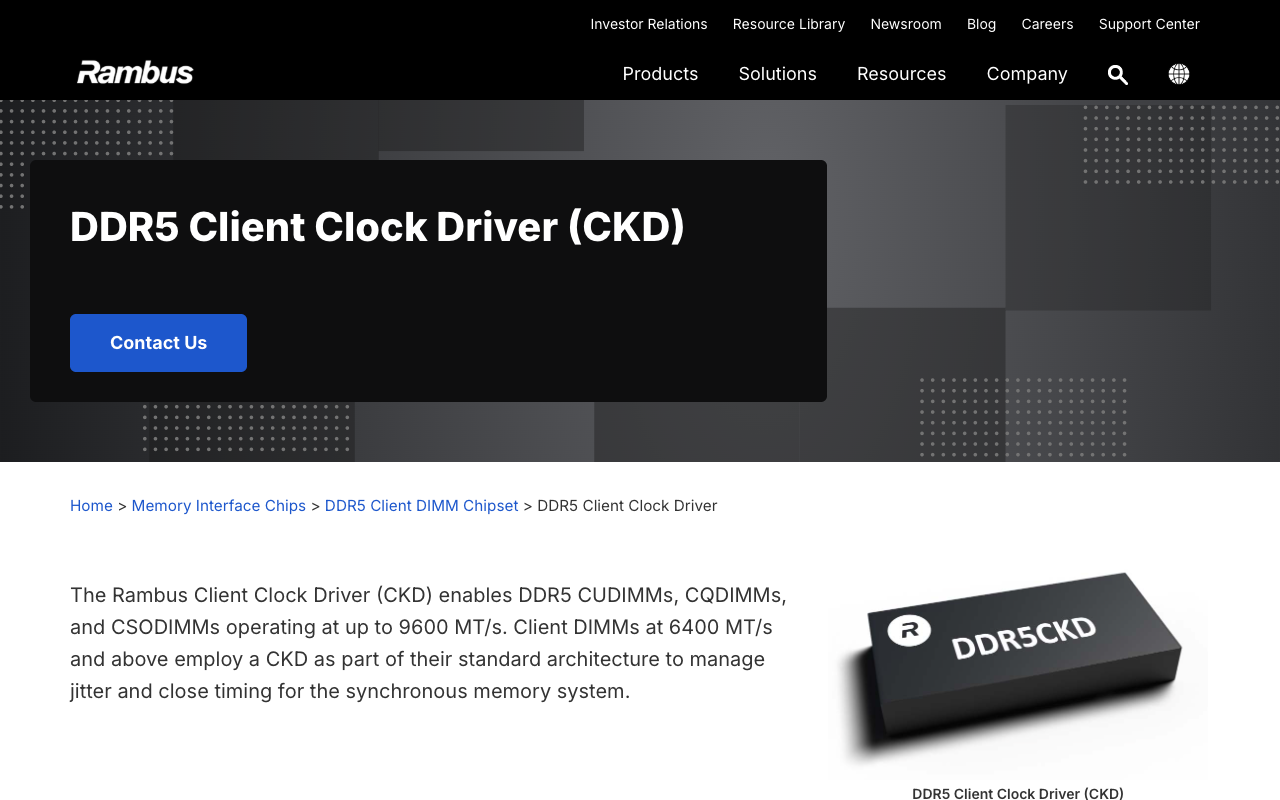
Because it is where the driver stops being optional rather than where it starts being useful. The CKD vendor's own page states that "Client DIMMs at 6400 MT/s and above employ a CKD as part of their standard architecture", and the part is built to JESD82-531 (DDR5CKD01), JEDEC's client clock driver specification. Below that line the driver is hardware you paid for and do not need; at or above it there is no UDIMM to compare against. The premium buys admission to a speed range, not speed at the same rate.
Is it cheaper to buy two single CUDIMM modules than a matched kit?
On the prices we read, yes — by $11.01, about 3.5%. We would not take it: a kit is two modules binned to run together, loose modules of the same part number are not guaranteed to pair, and several of the warranties behind these parts treat the kit as the unit for a claim.
Can I trust the CUDIMM prices in this article as a buying guide?
Use the difference, not the level. The premium (9.3% at 32GB and 7.2% at 64GB) is two parts on one shelf on one morning, so whatever moves the level moves both sides equally. The level is a discontinued line selling down: the seller's homepage says Micron "has made the difficult decision to wind down the Crucial consumer business", shipping through February 2026. Our tracked US retailers carry no CUDIMM, so a quoted CUDIMM price is unlikely to be one you can repeat.
Price the format, then watch the part
We track DDR5, DDR4 and NVMe listings at US retailers and tell you when one of yours moves. New retail stock only, no deal scores, no affiliate links, no commission on anything you buy — observed prices, dated, with the sample size printed next to them.