Price Protection Policy in 2026: Three Windows, Three Currencies
- All three retailers we could read will refund a drop in their own price after you buy. None of the three will match a competitor’s lower price once the order is placed.
- The windows are 7 days and 30 days — a 23-day, 4.3x spread, and Best Buy publishes no number at all: its window is the length of the return-and-exchange period.
- The claim is paid in 3 different units. Costco credits the original form of payment; Newegg issues a Customer Care card good for 365 days at Newegg. Newegg and Best Buy do not pay money back.
- Newegg’s standing policy carves out its own holiday sale prices, Black Friday and Cyber Monday among them. Best Buy does the opposite and extends its window through the season.
- The one round-up we found that covers component retailers has Newegg’s policy inverted on both halves — and the window it publishes is not a window any of these retailers offers.
You bought a memory kit on Tuesday and it is forty dollars cheaper on Friday. A price protection policy is the thing that decides whether those forty dollars come back to you, and on parts that have moved as hard as DRAM and NAND did this year it is not a rounding error — the biggest single fall our own basket recorded inside a month is further down this page, and it is three figures. The trouble is that the published advice treats this as one policy with a number attached, when it is at least three different instruments. So we read the documents: 3 policy pages from 3 retailers, across 3 hosts, on November 21, 2026, and we quote every one rather than summarising it.
Then we did the half nobody else can: priced the window. Every observation in our 90-day series becomes a hypothetical purchase, and the days after it are read for the lowest later price — so the question stops being how long the window is and becomes how much of the money a longer one would have caught.

Three windows, and one of them is not a number
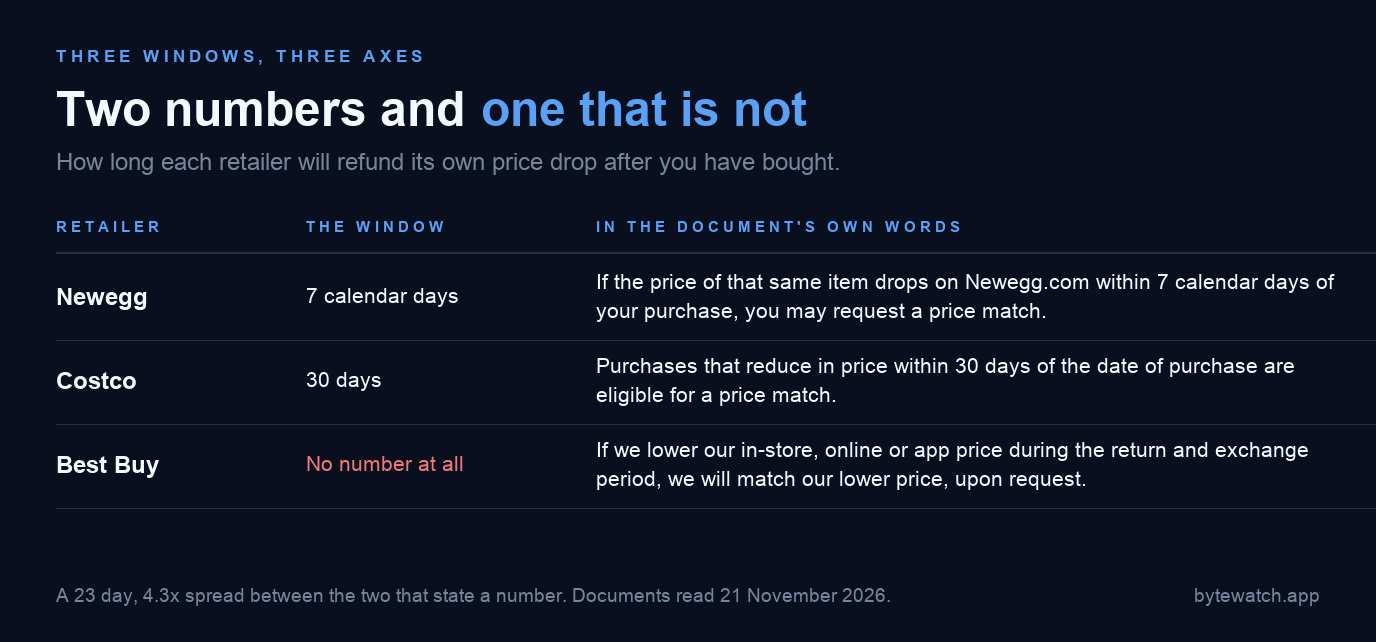
Start with the distinction the round-ups blur. A price match is what you ask for at the till, using a rival’s lower price. A price adjustment, which is what price protection actually is, happens after the money changes hands and concerns the shop’s own price falling. Most of these pages file both under one heading.
Read that way, the three documents agree on one thing and split on everything else. All three cover a fall in their own price, and not one of them — with no exception — will match a competitor’s price after the order is placed. Newegg lists competitor sites by name: “Prices on external competitor sites (Amazon, Best Buy, Walmart, Target, etc.).” Costco is blunter: “Costco does not price match with other businesses or retailers.”
| Retailer | Window | Paid in | Holiday prices | In its own words |
|---|---|---|---|---|
| Newegg | 7 days | Store credit | Carved out | “If the price of that same item drops on Newegg.com within 7 calendar days of your purchase, you may request a price match.” |
| Best Buy | Return period | Not stated | Extended | “If we lower our in-store, online or app price during the return and exchange period, we will match our lower price, upon request.” |
| Costco | 30 days | Money back | Conditional | “For members other than resellers, purchases that reduce in price within 30 days of the date of purchase are eligible for a price match.” |
The window is where they part. Newegg gives you 7 calendar days, Costco 30 — 23 days more, 4.3 times the span. Best Buy gives a number it does not print, because its clause defers to another period: “If we lower our in-store, online or app price during the return and exchange period, we will match our lower price, upon request.” That is a difference in kind, not a gap in the documentation: your window at Best Buy is as long as your return window, which varies by product and by membership, so two people buying the same drive on the same day can hold different rights.
What the refund is actually paid in
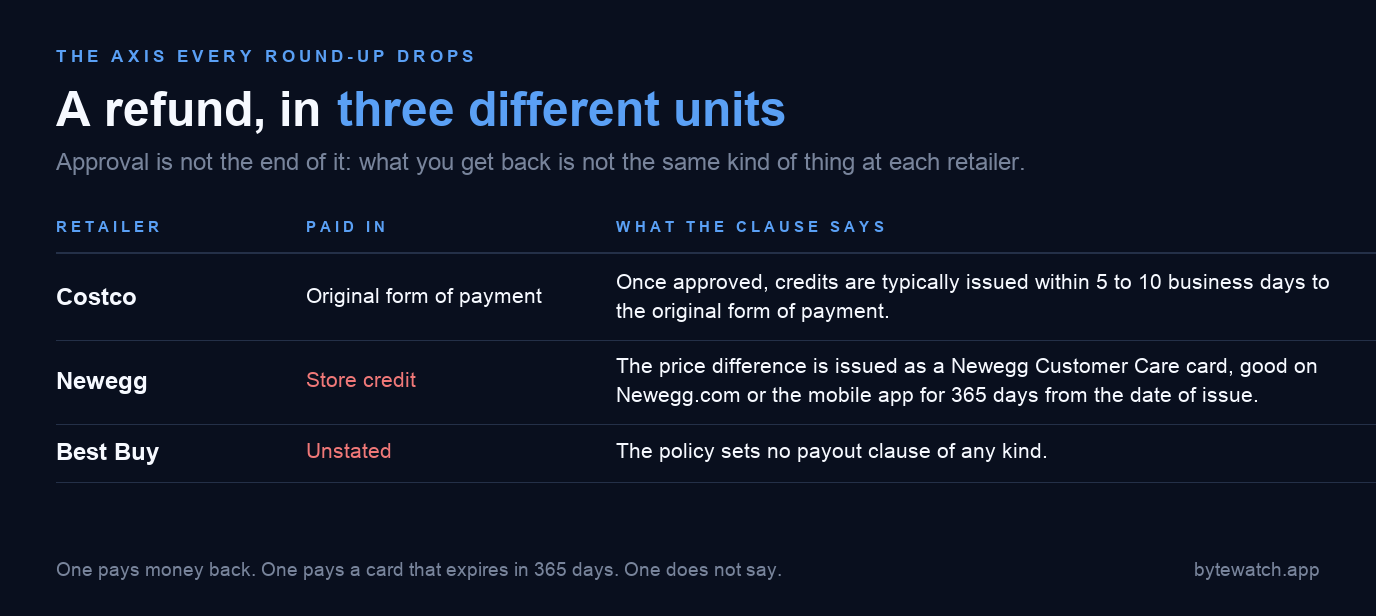
Here is the axis missing from every consumer page we read, and the one that decides what a refund is worth. An approved claim does not simply reverse part of the charge: it pays out in a unit, and the three documents name 3 different ones.
| Retailer | Unit | Expires | Clause |
|---|---|---|---|
| Newegg | Store credit | 365 days | “If approved, the price difference is issued as a Newegg Customer Care card, good on Newegg.com or the mobile app for 365 days from the date of issue.” |
| Best Buy | Not stated | — | states none |
| Costco | Money back | — | “Once approved, credits are typically issued within 5 to 10 business days to the original form of payment.” |
Costco pays money: “Once approved, credits are typically issued within 5 to 10 business days to the original form of payment.” The difference lands back where the payment came from and is yours for anything. Newegg pays store credit: “If approved, the price difference is issued as a Newegg Customer Care card, good on Newegg.com or the mobile app for 365 days from the date of issue.” That is a real refund of the difference, and also a 365-day voucher spendable at one shop. Best Buy’s page states no unit, which is not the same as paying in credit; we have not recorded it as such.
We have deliberately not discounted the voucher. Valuing a single-retailer credit against cash needs a redemption rate we do not hold, so the honest move is to report the unit and let you price it. The same discipline governs our warranty claim costing, where the freight is measurable and the inconvenience is not.
The week the price moves is the week the policy stops
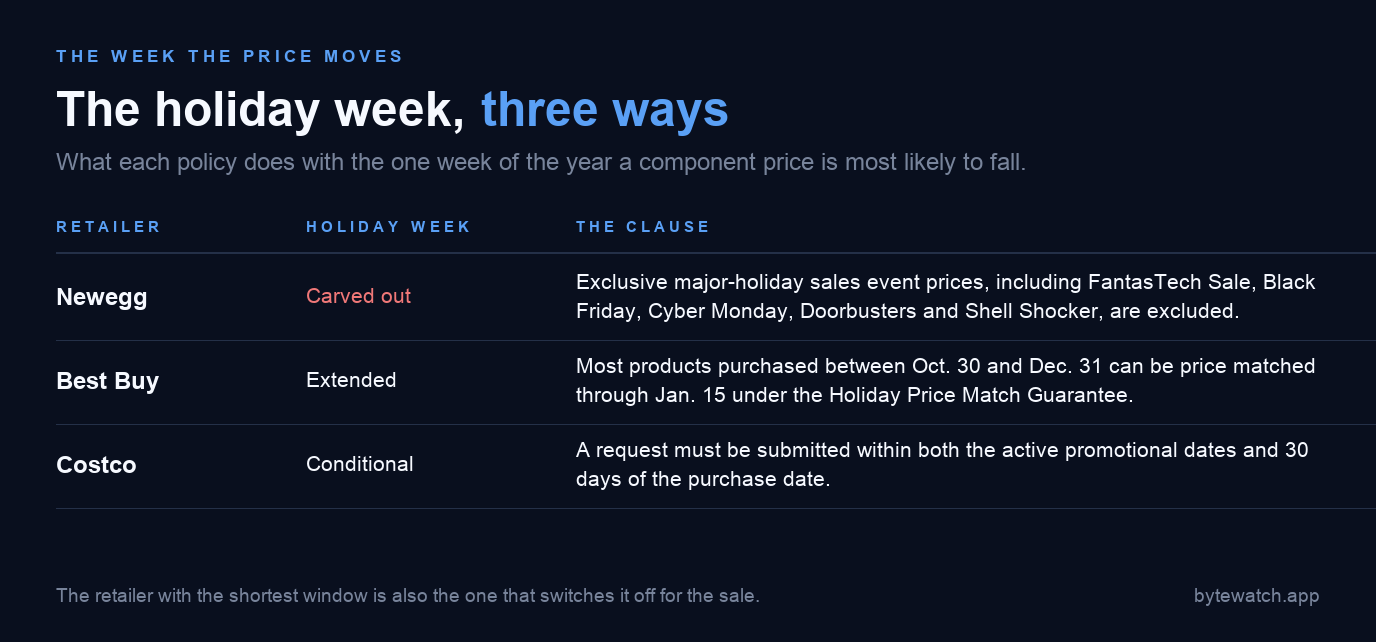
This is published six days before Black Friday 2026, which makes the holiday clause the most load-bearing sentence in each document. All three handle it differently.
| Retailer | Treatment | What the document says |
|---|---|---|
| Newegg | Carved out | “Exclusive major-holiday sales event prices — including FantasTech Sale, Black Friday, Cyber Monday, Doorbusters, and Shell Shocker.” |
| Best Buy | Extended | “Most products purchased at Best Buy between Oct. 30 and Dec. 31 can be price matched through Jan. 15 with Best Buy’s Holiday Price Match Guarantee.” |
| Costco | Conditional | “A price match request must be submitted within both the active promotional dates and 30 days of the purchase date.” |
Newegg excludes its own event pricing from the standing policy, by name: “Exclusive major-holiday sales event prices — including FantasTech Sale, Black Friday, Cyber Monday, Doorbusters, and Shell Shocker.” So the mechanism that pays you back when Newegg’s price falls does not apply in the one week of the year when Newegg’s prices fall hardest and most publicly. Best Buy runs the opposite play, printing an extension: “Most products purchased at Best Buy between Oct. 30 and Dec. 31 can be price matched through Jan. 15 with Best Buy’s Holiday Price Match Guarantee.” Costco sits between them, making the claim clear two clocks rather than one: “A price match request must be submitted within both the active promotional dates and 30 days of the purchase date.”
Newegg also runs separate, badge-gated price-protection promotions during its sale events — published per product rather than in the terms. Whether a given kit carries that badge this year is not something this page can state, and it is on the list of things it does not measure for that reason.
The article that used to cover Black Friday
While reading Newegg’s help centre we went looking for the Black Friday price protection article the promotion used to have. The slug still resolves — to the standing Price Match policy, the one whose exclusion list names Black Friday.
A redirect alone proves nothing: a help centre that routes every unrecognised slug to a nearby article would look identical. So we requested 2 controls the same way in the same minute — one plausible sibling slug, one nonsense string.
| Requested slug | Role | Ended up at | Title served |
|---|---|---|---|
/black-friday-price-protection | Observation | /knowledge-base/price-match-guarantee | Price Match |
/cyber-monday-price-protection | Control | no redirect | Newegg Help Center |
/zzz-nonexistent-control-9f3a | Control | no redirect | Newegg Help Center |
Neither control redirected; both were served a generic shell at their own address. The Black Friday slug is the only one of the three sent anywhere, and where it was sent is the policy that excludes Black Friday pricing. No intent is being read into this: help centres are reorganised constantly, and retiring a seasonal article onto the standing policy is a reasonable thing to do. It is worth recording for where it leaves a shopper searching that term — on the clause saying the sale price is not covered.
What a seven-day window is worth on our shelf
Everything above is a reading of documents, which anyone with a browser could repeat. This is the part only a price tracker can answer: on parts like these, how much does the length of the window matter? The method is deliberately dumb, because a clever one would be arguable. Take every observation we hold, treat it as a purchase at that price, look forward over the window, and find the lowest later price; the difference is what a claim would have owed. A purchase counts only once its window has fully elapsed inside our series.
Tonight the arithmetic runs over 191 matured purchase dates across 17 listings at the seven-day window, and 140 across 17 listings at thirty. Of the seven-day purchases, 14.7% would have had something to claim at all. Figures as rendered Nov 22, 2026, 07:28 PM UTC. 3 listings are too thinly sampled to simulate — under 4 observations — and are excluded rather than filled in.
| Window | Purchases | With a claim | Share | Median claim | Biggest |
|---|---|---|---|---|---|
| 7 days | 191 | 28 | 14.7% | $4.01 | $66.00 |
| 14 days | 170 | 69 | 40.6% | $10.00 | $169.00 |
| 30 days | 140 | 68 | 48.6% | $11.90 | $298.77 |
Read the middle row before the other two. Fourteen days is not a policy any of these three retailers publishes — it is the figure the one round-up covering our retailers attributes to Newegg, priced here beside the real windows.
Seven days against thirty, on the same purchases
The ladder cannot be read across its own rows, and that is the trap in every comparison of this kind: a thirty-day window matures only on purchase dates with thirty days of series after them, so its row describes a smaller, older sample. Comparing the rows straight would mix a window difference with a sample difference. Both windows are re-scored here on one set — the purchases that matured under the longer of the two.
| Window | Purchases with a claim | Total recoverable | Share of the 30-day value |
|---|---|---|---|
| 7 days (Newegg) | 18 | $159.59 | 8.9% |
| 30 days (Costco) | 68 | $1,796.01 | 100.0% |
On those purchases the seven-day window reaches 8.9% of what the thirty-day window would have owed, leaving $1,636.42 of observed price falls outside it. Both figures are floors, not estimates: our scrape cadence is 48 to 240 hours per listing, so a dip that opens and closes between two observations is invisible here while a buyer refreshing the page could have claimed it.
| Listing | Bought | Paid | Low point | Recoverable |
|---|---|---|---|---|
| SK hynix Platinum P41 2TB NVMe Gen4 SSD | Sep 30 | $745.12 | $446.35 (Oct 20) | $298.77 (40.1%) |
| SK hynix Platinum P41 2TB NVMe Gen4 SSD | Oct 10 | $615.35 | $339.60 (Oct 30) | $275.75 (44.8%) |
| SK hynix Platinum P41 2TB NVMe Gen4 SSD | Oct 20 | $446.35 | $339.60 (Oct 30) | $106.75 (23.9%) |
| Corsair Vengeance DDR5-6000 CL30 32GB (2x16GB) | Sep 28 | $604.99 | $529.99 (Oct 12) | $75.00 (12.4%) |
| Crucial T500 2TB NVMe Gen4 SSD | Sep 30 | $417.95 | $369.00 (Oct 20) | $48.95 (11.7%) |
The dearest single claim on the shelf tonight is $298.77 on the SK hynix Platinum P41 2TB NVMe Gen4 SSD, a 40.1% fall. Whether that is claimable at all turns on the two things our data cannot see: whether the purchase fell inside the window, and whether the retailer approves it.
The round-up that covers our retailers has it backwards
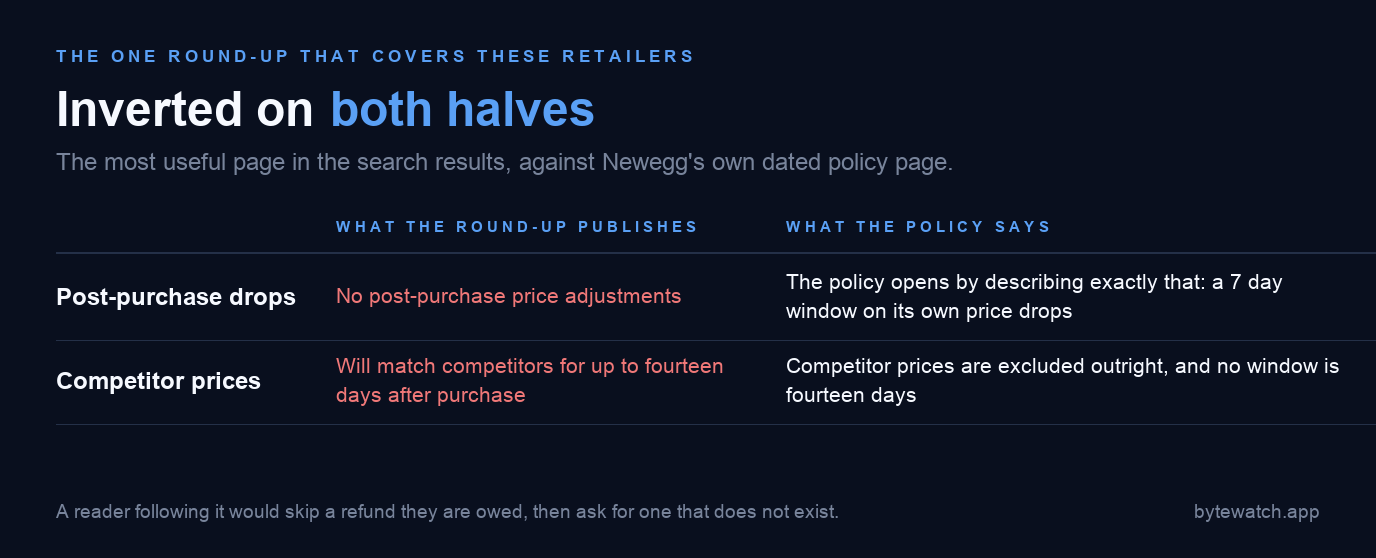
Most pages on this subject cover department stores. Exactly one of those we read covers the retailers a parts buyer uses, naming Newegg, Micro Center and B&H in a sixty-retailer table — which makes it the most useful page in the SERP and, on the Newegg row, wrong in both directions at once.
| What the round-up publishes | What the policy says |
|---|---|
| “No post-purchase price adjustments.” | “Our Price Match Policy applies when the price of an item you purchased drops on Newegg.com — so if it gets cheaper shortly after you buy, you can ask us to make up the difference.” |
| “Will match competitors’ lower prices for select items for up to 14 days after purchase.” | “Prices on external competitor sites (Amazon, Best Buy, Walmart, Target, etc.).” |
It publishes that Newegg offers “No post-purchase price adjustments.” Newegg’s own policy page, updated Jul 21, 2026, opens by describing precisely that. And it publishes that Newegg will match competitors’ prices for up to fourteen days after purchase, where the policy excludes competitor prices outright and sets the window at 7 days. A reader following it would skip a refund they are owed and then ask for one that does not exist.
This is not a point scored off a site that does more legwork than most: the failure mode is structural and will recur. A sixty-retailer table is maintained on a slower clock than sixty policies change, and Newegg’s page carries a date while the table does not. When the two disagree, the policy wins, and it is one fetch away.
The 200 that is not a document
We set out to read nine retailers and could read three. The other 6 are recorded here rather than described as having no policy: an unread policy and an absent one look identical in a table and are not the same fact.
| Retailer | Shape | What happened |
|---|---|---|
| Amazon | 200, no document | HTTP 403 to curl; 200 through a reader with site chrome and no policy text |
| Walmart | 200, no document | HTTP 200 serving a "Robot or human?" bot check, then /blocked |
| Micro Center | refused | HTTP 403 to curl; security verification page through a reader |
| B&H Photo Video | refused | HTTP 403 on both paths tried |
| Adorama | refused | HTTP 403 to curl; CAPTCHA notice through a reader |
| Target | 200, no document | HTTP 200 serving a client-rendered shell with no policy text |
Two shapes, and the second deserves a name. Micro Center, B&H and Adorama refused outright — HTTP 403, a security-verification page, a CAPTCHA notice — which is honest failure. But Amazon, Walmart and Target all answered HTTP 200 and returned no policy text at all: a bot check, a blocked redirect, a client-rendered shell. A status code is routinely mistaken for a readable document, and on 3 of these 6 it would have been. Price protection is a term you want to check before paying, and on most of the retailers we tried it is not checkable from a plain request.
What to do before and after you pay
Before you pay: check who the seller is. Newegg’s policy covers items “sold and shipped by Newegg” and excludes Marketplace sellers, so a third-party listing has no price protection at all — the same “sold by” line that decides whether the warranty attached. Check whether your price is an event price, which Newegg excludes. At Best Buy, find out what your return window is, because that is your price-protection window too.
After you pay: diary the window from the day of purchase, not delivery — both numeric policies run from the purchase date. Watch the item’s own page rather than the category, since the clause requires the identical item and item number, and Newegg needs it in stock with the lower price live when you ask. If you would rather not watch pages by hand, that is what a price alert with a sane threshold is for.
Related reading
FAQ
What is a price protection policy?
It is a retailer's promise to refund the difference if its own price falls shortly after you buy. A price match is the different thing you ask for at the till, using a competitor's price. All three policies we read on November 21, 2026 cover the retailer's own price falling, and none matches a competitor's price once the order is placed.
How long do I have to claim a price drop?
It depends on the retailer. Newegg states 7 calendar days from purchase and Costco 30. Best Buy publishes no number: its clause covers a price it lowers "during the return and exchange period", so your window is as long as your return window.
Does Newegg refund the difference if the price drops?
Yes, within 7 calendar days, on items sold and shipped by Newegg rather than a Marketplace seller, for US purchases. One published round-up states the opposite, and adds a 14-day competitor-matching window the policy does not offer. Check the dated policy page, not a table about it.
Do I get cash back or store credit?
It differs by retailer. Costco says credits are "typically issued within 5 to 10 business days to the original form of payment". Newegg issues "a Newegg Customer Care card ... for 365 days from the date of issue" — store credit with an expiry. This is the axis most comparisons omit, and it decides what the refund is worth.
Are Black Friday prices covered by price protection?
At Newegg, not under the standing policy: it excludes "Exclusive major-holiday sales event prices — including FantasTech Sale, Black Friday, Cyber Monday, Doorbusters, and Shell Shocker", though Newegg runs separate badge-gated promotions during its events. Best Buy goes the other way, stating most products bought between Oct. 30 and Dec. 31 can be price matched through Jan. 15.
Is a 7-day window long enough for RAM and SSD prices?
That is the one question here that can be measured, and the live section above measures it: every observation in our 90-day series becomes a purchase, and a 7-day and a 30-day window are scored on the same matured purchases. The figures are floors — a listing scraped every 48 to 240 hours can hide a dip between two observations.
Why could you only read three retailers’ policies?
Because the rest did not serve one. 6 retailers' pages were unreadable on November 21, 2026: some refused with HTTP 403 or a CAPTCHA, and 3 returned HTTP 200 with no policy text at all. We list which, rather than recording them as having no policy.
A seven-day window needs something watching it
We track DDR5, DDR4 and NVMe listings at US retailers and tell you when one of yours moves. Observed prices, dated, with the sample size beside them — which is exactly what a price-adjustment claim needs and exactly what nobody has when the clock runs out.