Restocking Fee in 2026: What Returning a PC Part Actually Costs
- A restocking fee is a strike price, not a charge. Returning a working part and buying it again only pays once the price has fallen further than the fee — so 15% needs a fall over 15%, and 30% needs one over 30%.
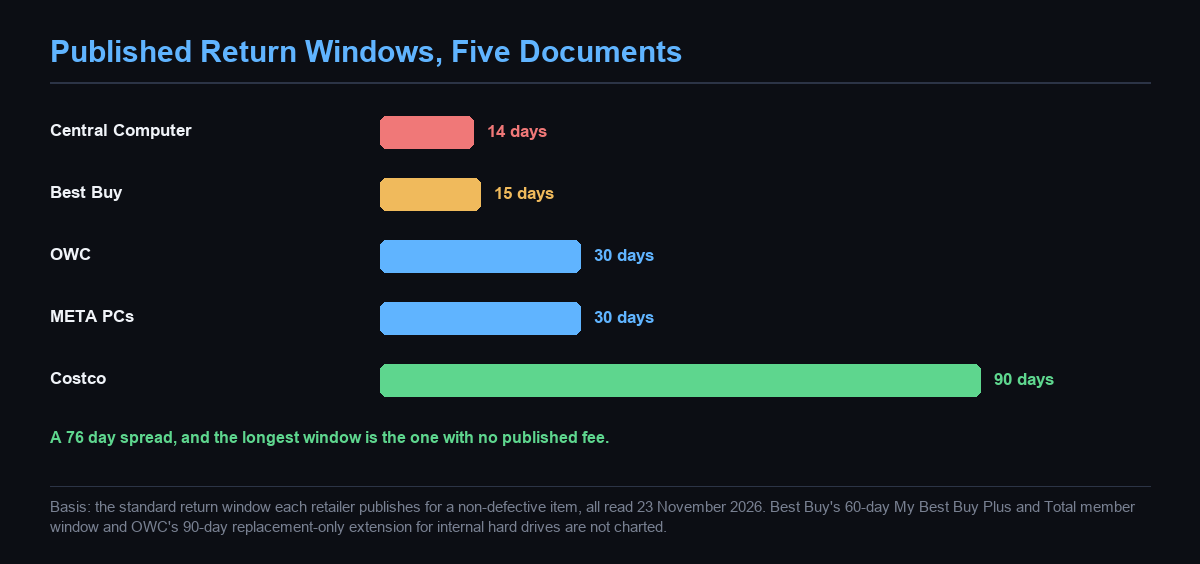
- The 5 documents we read publish windows of 14, 15, 30, 30, 90 days — a 76-day, 6.4x spread — and 3 different fees, 0% among them.
- The two terms do not move together. META PCs gives you 30 days and charges 30%; Best Buy gives you 15 and charges nothing on a part.
- 3 of the 5 documents waive the fee entirely if the box comes back unopened. That one condition is worth more than any window in the corpus.
- Best Buy publishes a 15% fee whose category list is cameras, drones and projectors. A memory kit is on none of those lists, so a fee that exists is not a fee that reaches you.
You bought a memory kit, you have not opened it, and you are wondering what it costs to change your mind. The answer turns on a restocking fee — and on DRAM and NAND, where a kit can move double digits inside a month, the fee is not a handling charge but the thing that decides whether sending the part back is worth doing at all. The published advice reports the fee as a percentage you lose, reports the window as a number of days, and never puts the two in one sentence. So we read the documents — 5 return policies from 5 retailers across 5 hosts, on November 23, 2026 — and quote each rather than summarising it.
Then we did the half nobody else can. Every observation in our 90-day price series becomes a hypothetical purchase, and each published window after it is read for the lowest later price, with the fee netted off and a rebuy priced in. That turns the fee into the only thing it really is: the fall your part has to manage before a return pays.

Five documents, four windows, three fees
Start with what is actually published, because none of it is published in one place. Two of the five documents come from retailers any parts buyer would recognise and three from the specialist end of the trade — which matters, because the specialists are the ones whose fee clauses name drives and modules.
| Retailer | Window | Longer window | Fee on a part | Return postage |
|---|---|---|---|---|
| Central Computer | 14 days | — | 15% | You pay |
| Best Buy | 15 days | 60 days — My Best Buy Plus and Total members | None published | Retailer pays |
| OWC | 30 days | 90 days — internal hard drives, replacement only | 15% | You pay |
| META PCs | 30 days | — | 30% | You pay |
| Costco | 90 days | — | None published | Not stated |
The spread in the window column is 76 days, or 6.4 times over, and if window length were the thing that mattered the table would end there. It does not, because the fee column is not a function of the window column. The longest window here does happen to charge nothing — so far, so intuitive. But look at the middle of the table: META PCs publishes 30 days at 30%, while Best Buy publishes 15 days at nothing. Half the time to decide, and the decision is free.
One housekeeping note, since this is the sort of thing that quietly ages an article. Costco still serves its previous help-centre id, which answers “This answer is no longer available.” at the old address — so anything citing that id is citing a tombstone. The live text is at Costco Returns Policy, and that is what we quote.
A restocking fee is a strike price, not a charge
Here is the arithmetic none of the pages competing for this term carries. Returning a working part and buying it again nets you what you paid, less the fee, less today’s price:
which is positive exactly when the fall from what you paid is bigger than the fee itself. So the breakeven is not some adjusted figure — it is the fee. 15% needs a fall over 15%. 30% needs a fall over 30%. 0% needs a cent.
| Fee | Charged on $240.00 | Fall it has to beat | Who publishes it |
|---|---|---|---|
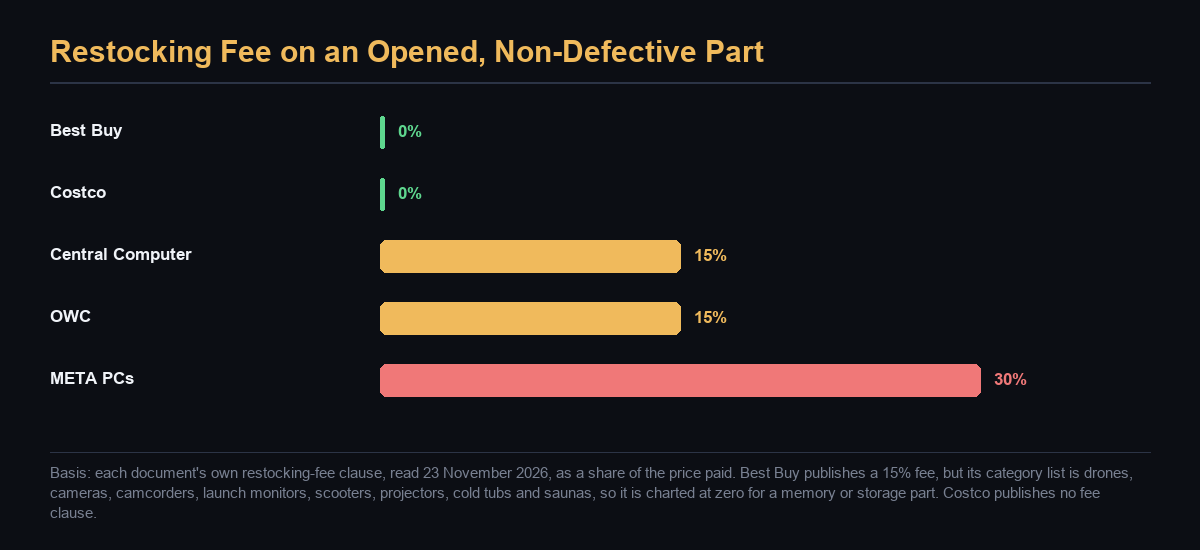
| 0% | $0.00 | Any fall at all | Best Buy and Costco |
| 15% | $36.00 | over 15% | Central Computer and OWC |
| 30% | $72.00 | over 30% | META PCs |
That reframes the comparison. A fee sounds like money off a refund you were going to collect anyway; it is really a threshold below which collecting it stops being worth doing — and a threshold on the price, so the market decides whether you are in the money, not the retailer. Which is why 30% costs far more than 30%: it costs you every return where the price fell by less than 30%, and on parts that drift rather than crash that is most of them. We measure how many further down.
The word that costs fifteen per cent
If the fee is the threshold, the next question is what switches it on — and in four of the five documents it is not the calendar at all. It is a condition.
| Retailer | Fee | What triggers it |
|---|---|---|
| Central Computer | 15% | “An automatic 15% restocking fee applies to the following products if they have been opened or used:” |
| Best Buy | None on a part | “There is no restocking fee if the product is unopened, or if the purchase occurs in: AL, CO, HI, IA, MS, OH, OK, SC” |
| OWC | 15% | “A 15% fee will be applied for any item(s) returned in a different condition than originally shipped from OWC.” |
| META PCs | 30% | “A 30% restocking fee (calculated on the sales price you paid) applies to all returned items that are not defective.” |
Read Central Computer’s clause closely: “An automatic 15% restocking fee applies to the following products if they have been opened or used:” The fee is not charged for returning something but for returning something opened or used, and the list after it names hard drives and SSDs explicitly, alongside CPUs, motherboards and video cards. OWC Return Policy frames it from the other direction: “A 15% fee will be applied for any item(s) returned in a different condition than originally shipped from OWC.” — condition, again, not time.
3 of the 5 documents waive the fee outright for an unopened box: Central Computer, Best Buy and OWC. Best Buy states it as plainly as it can be stated: “There is no restocking fee if the product is unopened”. Which produces the single most useful piece of advice on this page, and it costs nothing to follow.
Which restocking fee actually touches a memory kit
Now the distinction that decides whether any of this applies to you, and which we have not seen made anywhere. A published fee is not the same as a fee you can be charged, because every fee clause comes attached to a list of categories.
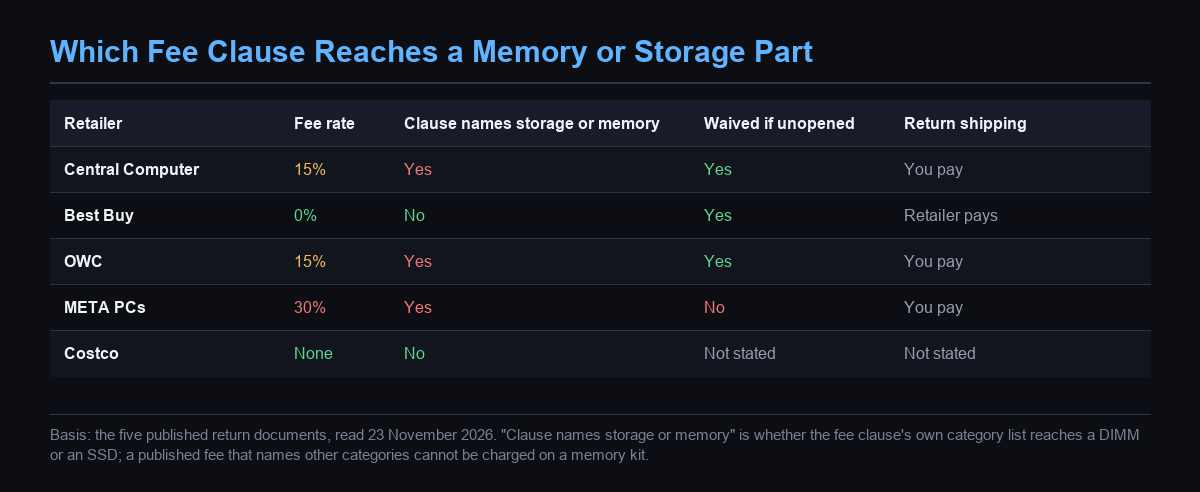
| Retailer | Fee published | Names storage or memory | What a kit costs to send back |
|---|---|---|---|
| Central Computer | 15% | Yes | 15% of what you paid |
| Best Buy | Yes, on other categories | No | Nothing |
| OWC | 15% | Yes | 15% of what you paid |
| META PCs | 30% | Yes | 30% of what you paid |
| Costco | None | No | Nothing |
Best Buy is the instructive row. It does publish a 15% restocking fee, so a round-up can cite it accurately and still mislead you completely: the categories it covers are drones, digital cameras, camera lenses, camcorders, golf launch monitors, scooters, projectors, projector screens, cold tubs, saunas and special-order products. No memory, no storage. A DIMM or an SSD bought there and sent back inside the window costs nothing, on a prepaid label: “Ship it for free with a prepaid FedEx shipping label.”
So 3 of the five carry a fee that reaches a drive or a module — Central Computer, OWC and META PCs — and 2 do not: Best Buy and Costco. The ones that do are the specialists, the opposite of what the size of the business would suggest.
The thirty per cent document, and the clause beside it
The dearest fee in the corpus is META PCs Refund Policy, and it is worth quoting in full because it is unusually blunt: “A 30% restocking fee (calculated on the sales price you paid) applies to all returned items that are not defective.” No category list, no opened-or-unopened distinction in that sentence, and a 30% threshold, which on the arithmetic above means a part has to have lost nearly a third of its value before sending it back beats keeping it.
A second fee clause sits in the same document, and the two are never reconciled: “A fee of 10% of the order total applies to all cancellations and returns, regardless of timing.” Read together a non-defective return appears to attract both, but the document does not say so and we will not assert a 40% total it never states. What is fair to say is that a buyer cannot price their own return from this page, and that “regardless of timing” detaches a charge from the window entirely, so there is no point at which cancelling is free.
We quote it because the window beside it reads 30 days, which in a table sorted by window puts this document in the generous half. Sort the same five by what a return costs and it is last by a wide margin — the whole case for not ranking return policies on their day count.
What a return window is worth on our own shelf
Everything above is what the documents say. This part is ours: we track DDR5, DDR4 and NVMe listings at US retailers, so “how often does a fall clear the fee?” is answerable rather than arguable. Every observation in the 90-day series becomes a purchase, each window after it is read for the lowest later price, and a return is priced at each published fee. A purchase counts only once the series runs the full window past it, so no row holds a window that has barely opened. That cuts both ways: a 90-day series leaves the longest policy window almost no purchase dates old enough to score, so the comparison below uses the longest window this shelf can carry rather than the longest one published.
Tonight the arithmetic runs over 169 matured purchase dates across 17 listings at the 14-day window. Charged a 15% fee, 3.0% of them would have paid anything at all to return; charged nothing, 40.2% would. Figures as rendered Nov 24, 2026, 11:02 AM UTC. 3 listings are too thinly sampled to simulate — under 4 observations — and are excluded rather than filled in.
| Window | Purchases | Return would pay | Share | Median net | Best net |
|---|---|---|---|---|---|
| 14 days | 169 | 5 | 3.0% | $27.60 | $76.70 |
| 15 days | 167 | 5 | 3.0% | $27.60 | $76.70 |
| 30 days | 139 | 5 | 3.6% | $39.80 | $187.00 |
| 60 days | 67 | 5 | 7.5% | $5.49 | $83.70 |
Read down the window column and the effect is smaller than the published advice implies. Each row counts only the purchases its own window outlives, so a longer row is a smaller, older sample — which is why the rows must not be read against each other, and why the comparison below re-scores them on one set.
| Fee | Fall it has to beat | Purchases that cleared it | Share |
|---|---|---|---|
| 0% | any fall | 67 of 139 | 48.2% |
| 15% | over 15% | 5 of 139 | 3.6% |
| 30% | over 30% | 2 of 139 | 1.4% |
That second table is the one to keep. Same purchases in all three rows, same 30-day window, and the only thing changing is the bar a fall has to clear. Moving the bar from nothing to 15% removes most of what was worth claiming, and moving it to 30% removes very nearly all of it.
Window against fee, on the same purchases
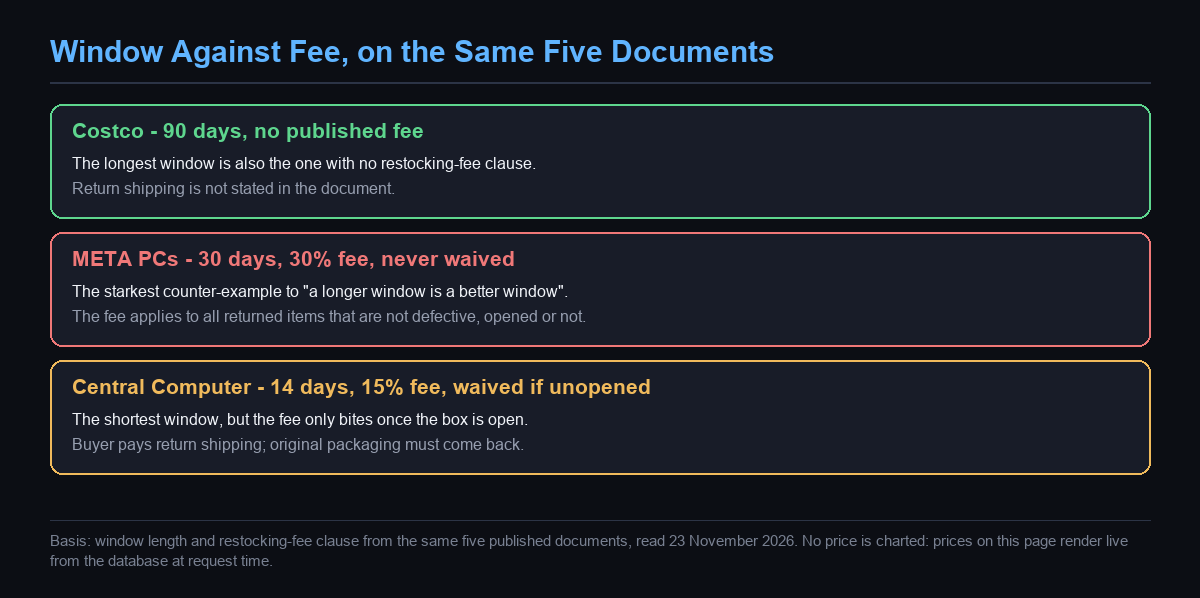
So which term should you shop on? Both levers get pulled from the same starting point here, on the purchases matured under the longer of the two windows: first the time lever, from 14 days to 60, and then the fee lever, from 15% to nothing. One set of purchases, one change each, no sample difference hiding inside the result.
| Arm | Window | Fee | Returns that pay | Total net |
|---|---|---|---|---|
| Starting point | 14 days | 15% | 0 | $0.00 |
| Pull the time lever | 60 days | 15% | 5 (+5) | $158.03 |
| Pull the fee lever | 14 days | 0% | 22 (+22) | $214.85 |
On our shelf the fee is the stronger lever: a fee-free 14-day window opened 22 more paying returns than stretching a 15% window out to 60 days, which opened 5. 4.3 times the calendar bought less than deleting one clause did. Both arms are floors rather than estimates. Our scrape cadence is 48 to 240 hours per listing, so a dip that opens and closes between two observations is invisible to this arithmetic while a buyer refreshing the page could have acted on it.
| Listing | Bought | Paid | Low after | Fall | Net at 15% |
|---|---|---|---|---|---|
| SK hynix Platinum P41 2TB NVMe Gen4 SSD | Sep 10 | $498.00 | $339.60 (Oct 30) | 31.8% | $83.70 |
| SK hynix Platinum P41 2TB NVMe Gen4 SSD | Sep 20 | $467.60 | $339.60 (Oct 30) | 27.4% | $57.86 |
| Crucial P3 Plus 1TB NVMe Gen4 SSD | Aug 31 | $227.00 | $187.46 (Oct 20) | 17.4% | $5.49 |
| Crucial P3 Plus 1TB NVMe Gen4 SSD | Sep 10 | $227.00 | $187.46 (Oct 20) | 17.4% | $5.49 |
| Crucial P3 Plus 1TB NVMe Gen4 SSD | Sep 20 | $227.00 | $187.46 (Oct 20) | 17.4% | $5.49 |
The deepest fall on the shelf tonight is 31.8% on the SK hynix Platinum P41 2TB NVMe Gen4 SSD. Note the last column rather than the fall: a fee of 15% takes $74.70 off a $498.00 purchase, so even a fall that size nets $83.70 — before the postage none of these documents pays for.
The five retailers that would not serve a document
An honest corpus says what is missing from it, and what is missing here is awkward: 5 retailers would not serve a return policy at all, and two of them — Newegg and Micro Center — are retailers we scrape. The fee a reader of ours most likely faces is one of the two we could not quote.
| Retailer | What came back | Shape |
|---|---|---|
| Newegg | HTTP 403 on four paths, serving a Cloudflare "Just a moment..." interstitial; a reader returned a CAPTCHA notice | refused |
| Micro Center | HTTP 403 on three paths tried | refused |
| B&H Photo Video | HTTP 403 to curl and to a reader, on both help-centre paths tried | refused |
| Staples | HTTP 403 on the help-centre path tried | refused |
| Adorama | HTTP 200 on two paths, both serving site chrome and a link to the policy rather than the policy | 200, no document |
Four refused outright, Newegg behind a Cloudflare interstitial on four separate paths. The fifth is the shape worth naming: Adorama answered HTTP 200 on two paths and served site furniture and a link to the policy rather than the policy. A status code is not a document, and a checker counting 200s would have logged that as a successful read.
One consequence for anyone comparing pages. The one round-up covering component retailers states a B&H fee of “at least 15% for items that are not new or are missing box contents, and potentially higher for noticeable wear or missing parts” — SlashGear, February 17, 2026. We neither repeat it as fact nor drop it: bhphotovideo.com returned HTTP 403 to every request made on 2026-11-23, so it stands as an unconfirmed third-party figure. Returning something to B&H, read the policy in a browser rather than trusting either of us.
What to do before you open the box
Before you pay: find the fee, not the window, and check whether its clause names storage or memory — a 15% fee on cameras is not a fee on your kit. Check who the seller is, since a marketplace listing usually runs on the seller’s terms rather than the storefront’s: the same “sold by” line that decides whether the warranty attached. And check the postage, which three of these five put on you and none of them prices.
After it arrives: leave it sealed until you have looked at the price, and diary the window from the purchase or invoice date rather than delivery, which is what Central Computer and OWC both specify. If the price fell but by less than the fee, the return is the wrong instrument and a price-protection claim is the right one — you keep the part and ask for the difference, no fee and no rebuy. To avoid watching a product page by hand, a price alert with a sane threshold fires inside a 14-day window.
Related reading
FAQ
What is a restocking fee?
It is a percentage of what you paid, kept by the retailer when you send a working item back. Read it as a threshold rather than a charge: returning a part and buying it again only pays once the price has fallen further than the fee, so 15% needs a fall over 15%.
How much is a typical restocking fee on PC parts?
Across the 5 policies we read on November 23, 2026, the published figures were 0%, 15%, 30%. Central Computer and OWC both publish 15%, META PCs publishes 30%, and Costco publishes none. Best Buy publishes 15% but on categories that do not include memory or storage.
Can I avoid a restocking fee?
Often, yes, by not opening the box. 3 of the 5 documents waive the fee for an unopened return — Best Buy states "There is no restocking fee if the product is unopened", and Central Computer charges only on items "opened or used". The seal is the term you control.
Is there a restocking fee on returning RAM or an SSD?
It depends where you bought it. 3 of the 5 documents name drives or modules among the charged categories; 2 do not. Central Computer names hard drives and SSDs explicitly, while Best Buy's list is cameras, drones and projectors — so a kit returned there inside the window costs nothing.
How long do I have to return a PC part?
The five documents publish 14, 15, 30, 30, 90 days — a 76-day spread. Central Computer is shortest at 14 days, Best Buy gives 15 days as standard and 60 to Plus and Total members, and Costco accepts electronics "within 90 days". Both of the specialist policies run from the purchase or invoice date, not delivery.
Is it better to return a part or claim price protection?
Claim the difference whenever the fall is smaller than the fee, which is most of the time: price protection has no fee and no rebuy, and you keep the part. A return only wins when the fall clears the fee and you no longer want the part. We price that other instrument separately.
Why could you only read five retailers’ policies?
Because the rest did not serve one. 5 retailers' pages were unreadable on November 23, 2026: four refused with HTTP 403 or a bot interstitial, and 1 returned HTTP 200 with no policy text at all. Newegg and Micro Center are both on that list and both in our scrape basket.
The fee is fixed. The price is the part that moves.
We track DDR5, DDR4 and NVMe listings at US retailers and tell you when one of yours moves. Observed prices, dated, with the sample size beside them — which is what you need to know whether a fall has cleared a fee, while the box is still sealed.