SSD Warranty Data Loss in 2026: Nineteen Documents, One Unpaid Bill
- 15 of 19 documents make the backup your job before a claim, at 4 strengths — from a term you agreed to, down to a suggestion.
- 3 makers go further and name a device you have to own, in 4 phrasings — “a separate storage product”, “another storage medium”, “a separate storage medium”, “another media”. None pays for it.
- 6 documents say the part is not coming back — and only 2 say what will be done to the data on it.
- The one document that contemplates a drive too dead to erase makes you indemnify the maker for whatever is still on it.
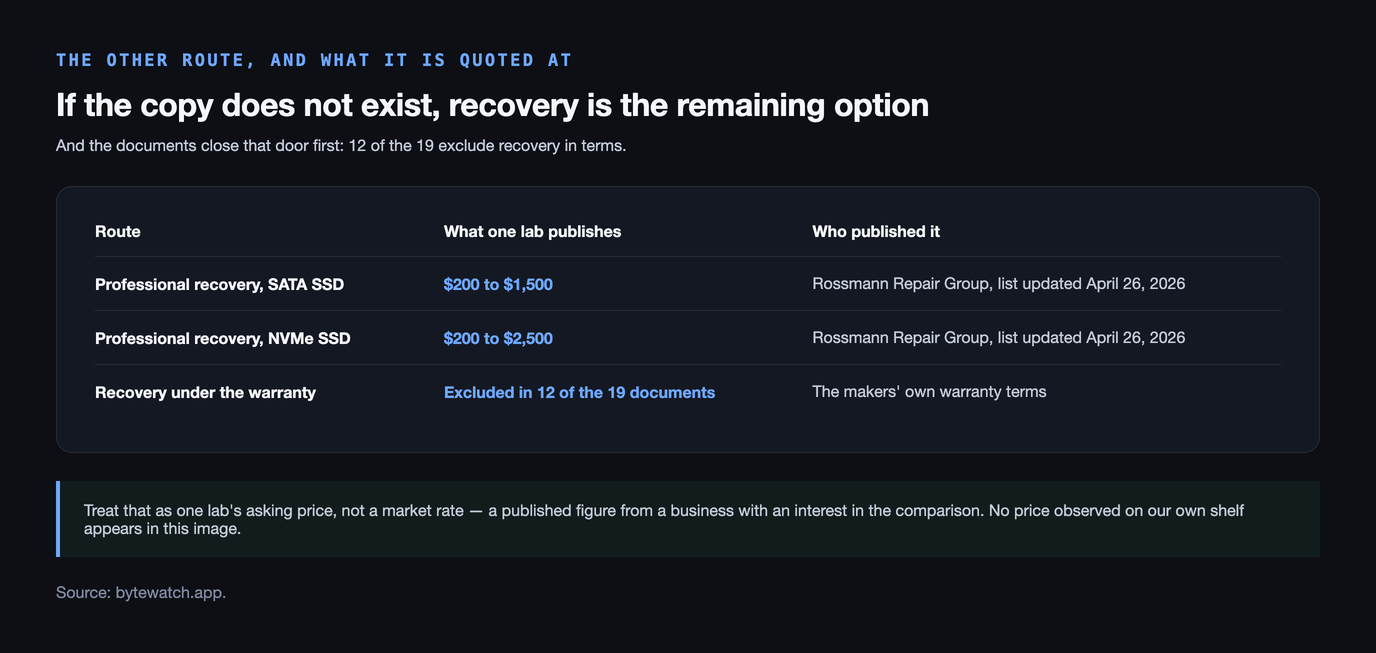
- Recovery is excluded in 12 of the 19, so the alternative to a copy is a price list: one lab publishes $200–$2,500 for NVMe.
A drive dies with your photos on it, and the warranty is the good news. Then you read the clause. SSD warranty data loss is not an edge case the industry forgot: 15 of the 19 warranty, RMA and data-security documents we read tell you in their own words that the files are your job and the hardware is theirs. The money in that sentence is what nobody prices. A claim gets you a drive; keeping your data costs a second drive, bought before the first one failed, and on tonight’s shelf that is most of the part’s price again.
So we read every document we could open on November 17, 2026 — 19 of them, from 14 named makers across 16 hosts, consumer, enterprise and industrial lines kept apart — and sorted them by how hard each pushes the duty onto you. Then we priced that duty against our own basket, because the one thing these documents agree on is that you must own something they will not buy.
Who makes your data your problem
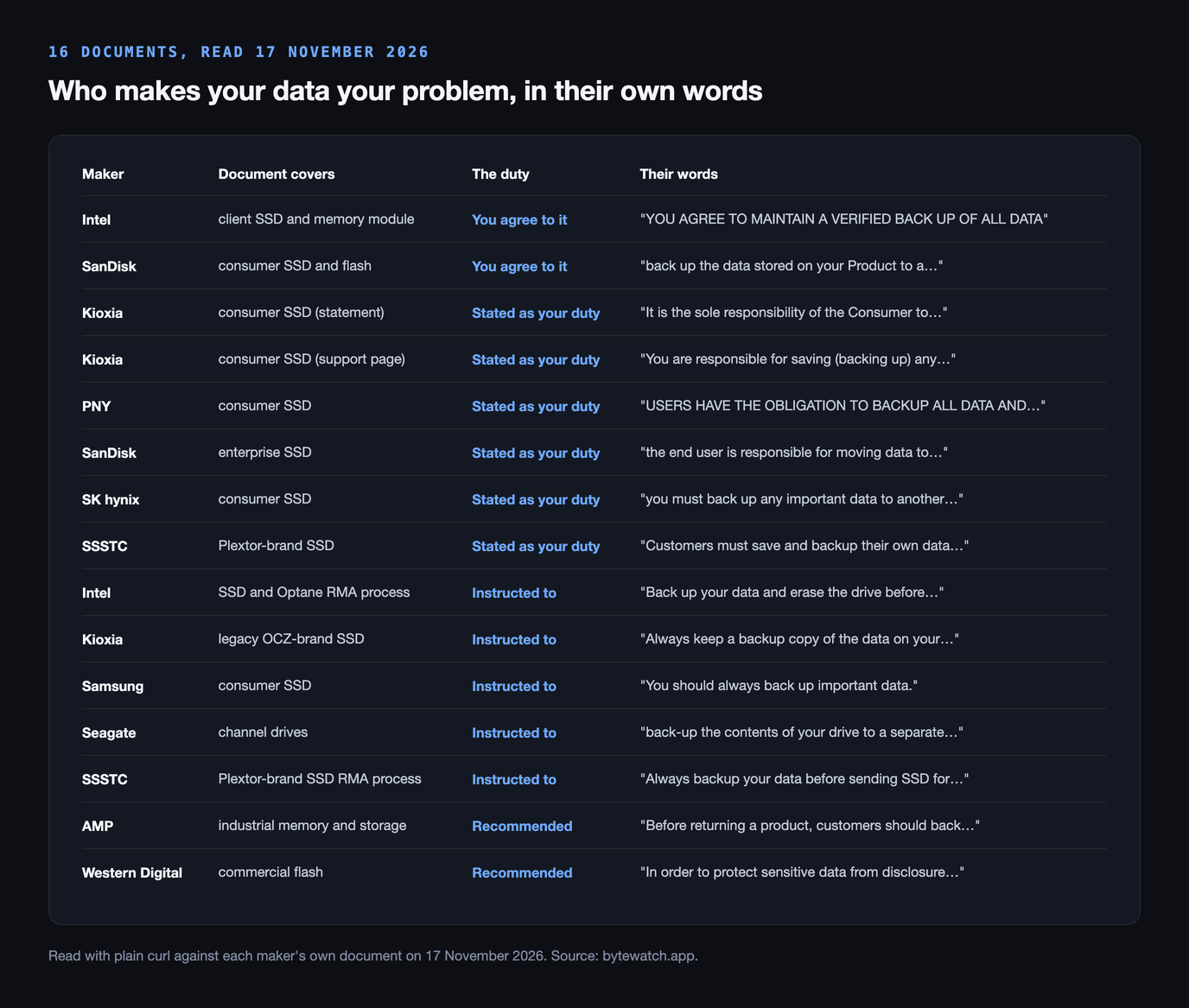
Start with the question an owner actually has: if I claim, do I lose the files? Every document answers it the same way — the warranty is on the hardware — and almost none in the same words. Samsung is brief: “You should always back up important data.” SanDisk puts it in capitals, as a term you accepted at purchase.
| Maker | Document covers | The duty | Their words |
|---|---|---|---|
| Intel | client SSD and memory module | You agree to it | “YOU AGREE TO MAINTAIN A VERIFIED BACK UP OF ALL DATA” |
| SanDisk | consumer SSD and flash | You agree to it | “back up the data stored on your Product to a…” |
| Kioxia | consumer SSD (statement) | Stated as your duty | “It is the sole responsibility of the Consumer to…” |
| Kioxia | consumer SSD (support page) | Stated as your duty | “You are responsible for saving (backing up) any…” |
| PNY | consumer SSD | Stated as your duty | “USERS HAVE THE OBLIGATION TO BACKUP ALL DATA AND…” |
| SanDisk | enterprise SSD | Stated as your duty | “the end user is responsible for moving data to…” |
| SK hynix | consumer SSD | Stated as your duty | “you must back up any important data to another…” |
| SSSTC | Plextor-brand SSD | Stated as your duty | “Customers must save and backup their own data…” |
| Intel | SSD and Optane RMA process | Instructed to | “Back up your data and erase the drive before…” |
| Kioxia | legacy OCZ-brand SSD | Instructed to | “Always keep a backup copy of the data on your…” |
| Samsung | consumer SSD | Instructed to | “You should always back up important data.” |
| Seagate | channel drives | Instructed to | “back-up the contents of your drive to a separate…” |
| SSSTC | Plextor-brand SSD RMA process | Instructed to | “Always backup your data before sending SSD for…” |
| AMP | industrial memory and storage | Recommended | “Before returning a product, customers should back…” |
| Western Digital | commercial flash | Recommended | “In order to protect sensitive data from disclosure…” |
| G.SKILL | memory | Liability excluded, no duty stated | “G.SKILL shall not be liable for, and does not cover…” |
| Kingston | memory and SSD | Liability excluded, no duty stated | “Kingston is not liable for, and does not cover…” |
| Lexar | consumer SSD and flash | Liability excluded, no duty stated | “Lexar does not warrant against loss of any data or…” |
| Mushkin | memory and SSD | Data not mentioned | — |
Four are the interesting minority. Kingston, Lexar and G.SKILL disclaim liability for your files without asking anything of you, and Mushkin’s lifetime warranty does not contain the word “data”. A document that never mentions your files is not one that protects them.
One instruction, 6 strengths
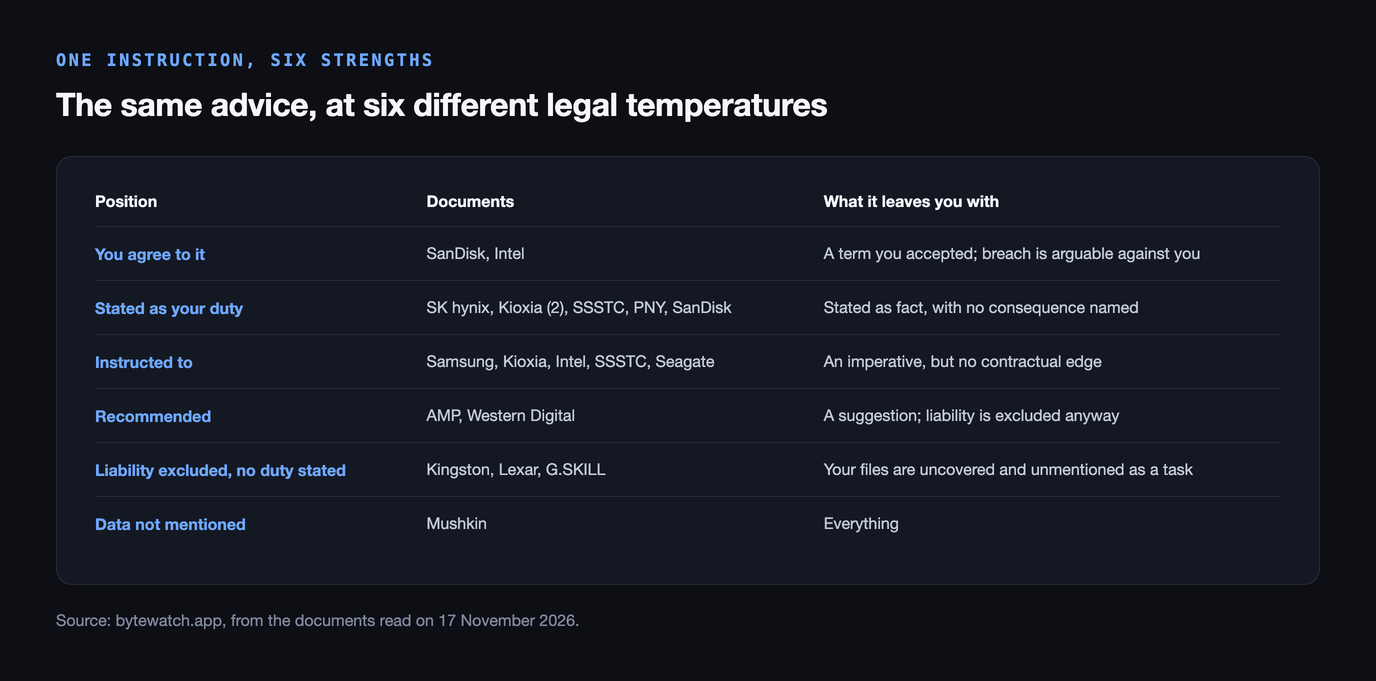
Read the clauses next to each other and the duty stops looking like an industry standard. It is a drafting choice at 6 settings, and only 4 of them ask anything of you.
| Position | Documents | What it leaves you with |
|---|---|---|
| You agree to it | SanDisk, Intel | A term you accepted; breach is arguable against you |
| Stated as your duty | SK hynix, Kioxia (2), SSSTC, PNY, SanDisk | Stated as fact, with no consequence named |
| Instructed to | Samsung, Kioxia, Intel, SSSTC, Seagate | An imperative, but no contractual edge |
| Recommended | AMP, Western Digital | A suggestion; liability is excluded anyway |
| Liability excluded, no duty stated | Kingston, Lexar, G.SKILL | Your files are uncovered and unmentioned as a task |
| Data not mentioned | Mushkin | Everything |
The top row is the one to notice, because it is a promise running the other way. Intel: “YOU ARE RESPONSIBLE TO PROTECT AGAINST DATA LOSS, AND YOU AGREE TO MAINTAIN A VERIFIED BACK UP OF ALL DATA ON THE PRODUCT AT ALL TIMES.” Not “should” — you agree, and at all times: a continuous obligation attached to a product warranty. SanDisk is the other: “YOU AGREE TO CONTINUALLY BACK UP ALL DATA ON THE PRODUCT, AND TO COMPLETE A BACKUP PRIOR TO SEEKING ANY GENERAL SERVICE AND TECHNICAL…”
Intel’s wording and PNY’s are the same drafting with the verb swapped — “YOU AGREE TO MAINTAIN A VERIFIED BACK UP” against “IT IS RECOMMENDED THAT A VERIFIED BACK UP … BE MAINTAINED”. Boilerplate travels; its force does not. Our read of the replacement clauses found the same with two makers and one sentence.
The documents that name a device you must buy
Here the duty becomes a purchase. 4 documents, from SanDisk, Seagate, SK hynix, name the thing the copy must live on, each differently:
SK hynix: “you must back up any important data to another storage medium to prepare for unforeseen circumstances”
Seagate: “This limited warranty does not cover data loss – back-up the contents of your drive to a separate storage medium on a regular basis.”
SanDisk, on enterprise SSD: “the end user is responsible for moving data to another media”
“A separate storage product”. “Another storage medium”. These are not instructions to be careful; they are a hardware requirement, written into the terms of a product you already paid for. The condition on using the warranty is owning a second device, and the warranty does not contribute to it. It is a cost nobody here has put a number on, so we will.
What the second copy costs on our shelf tonight
We track new retail NVMe and SATA listings at US retailers, so we can ask what the clauses imply: for every drive we price, what is the cheapest tracked drive that could hold a complete copy of it? Where a drive is already the cheapest route to its own capacity, the answer is a second unit of itself.
| Drive | Capacity | Its price | Cheapest copy | Copy costs |
|---|---|---|---|---|
| Samsung 990 Pro 4TB NVMe Gen4 SSD | 4 TB | $764.99 | Samsung 990 Pro 4TB NVMe Gen4 SSD $764.99 | 100% of the drive |
| Kingston KC3000 2048GB NVMe Gen4 SSD | 2 TB | $379.55 | Kingston KC3000 2048GB NVMe Gen4 SSD $379.55 | 100% of the drive |
| Crucial T500 2TB NVMe Gen4 SSD | 2 TB | $349.00 | Crucial T500 2TB NVMe Gen4 SSD $349.00 | 100% of the drive |
| Crucial P3 Plus 1TB NVMe Gen4 SSD | 1 TB | $182.89 | Crucial P3 Plus 1TB NVMe Gen4 SSD $182.89 | 100% of the drive |
| WD Black SN850X 2TB NVMe Gen4 SSD | 2 TB | $381.02 | Crucial T500 2TB NVMe Gen4 SSD $349.00 | 92% of the drive |
| Samsung 990 Pro 2TB NVMe Gen4 SSD | 2 TB | $387.95 | Crucial T500 2TB NVMe Gen4 SSD $349.00 | 90% of the drive |
Across 7 priced storage listings, the cheapest complete copy costs a median of $349.00 — 100% of the price of the drive it protects. 4 of those rows (57%) are already the cheapest route to their own capacity, so the only copy available is a second unit of the same drive and the duty costs full price twice. The best case tonight is SK hynix Platinum P41 2TB NVMe Gen4 SSD: 75%, because something cheaper on the shelf is large enough to hold it. The worst is any row where nothing cheaper reaches the capacity — Samsung 990 Pro 4TB NVMe Gen4 SSD among them.
| Category | Per GB | Per protected GB | Sample |
|---|---|---|---|
| NVMe Gen4 SSD | $0.19 | $0.38 | 7 SKUs |
The second table is the one worth keeping. The real unit is not a gigabyte but a gigabyte you can still read after a failure — and it costs double, because two devices deliver it. Every price-per-gigabyte figure in this market, ours included, quietly prices the cheaper one.
The duty you cannot discharge
Now the part that makes the arrangement strange. 6 of the 19 documents ask you to erase your data before returning the part. Intel puts it in the shipping instructions: “Back up your data and erase the drive before shipping.” Kioxia asks for “a complete backup of the data stored on the SSD, followed by a complete formatting and erasure of all data”.
Every one of those requests assumes a drive that still works, and the reason you are filing is usually that it does not. A controller that will not enumerate cannot be backed up, formatted or secure-erased, so the one moment the duty matters is the moment it becomes impossible to perform. 18 of the 19 documents never address that case.
Lexar is the only document that speaks to who might read the drive once it has left you, and it promises nothing: “Lexar cannot, and does not, guarantee that your data will not be accessed by unauthorized persons”. That is the closest thing here to treating a returned drive as a disclosure risk rather than a logistics problem.
Where your data goes after you post it
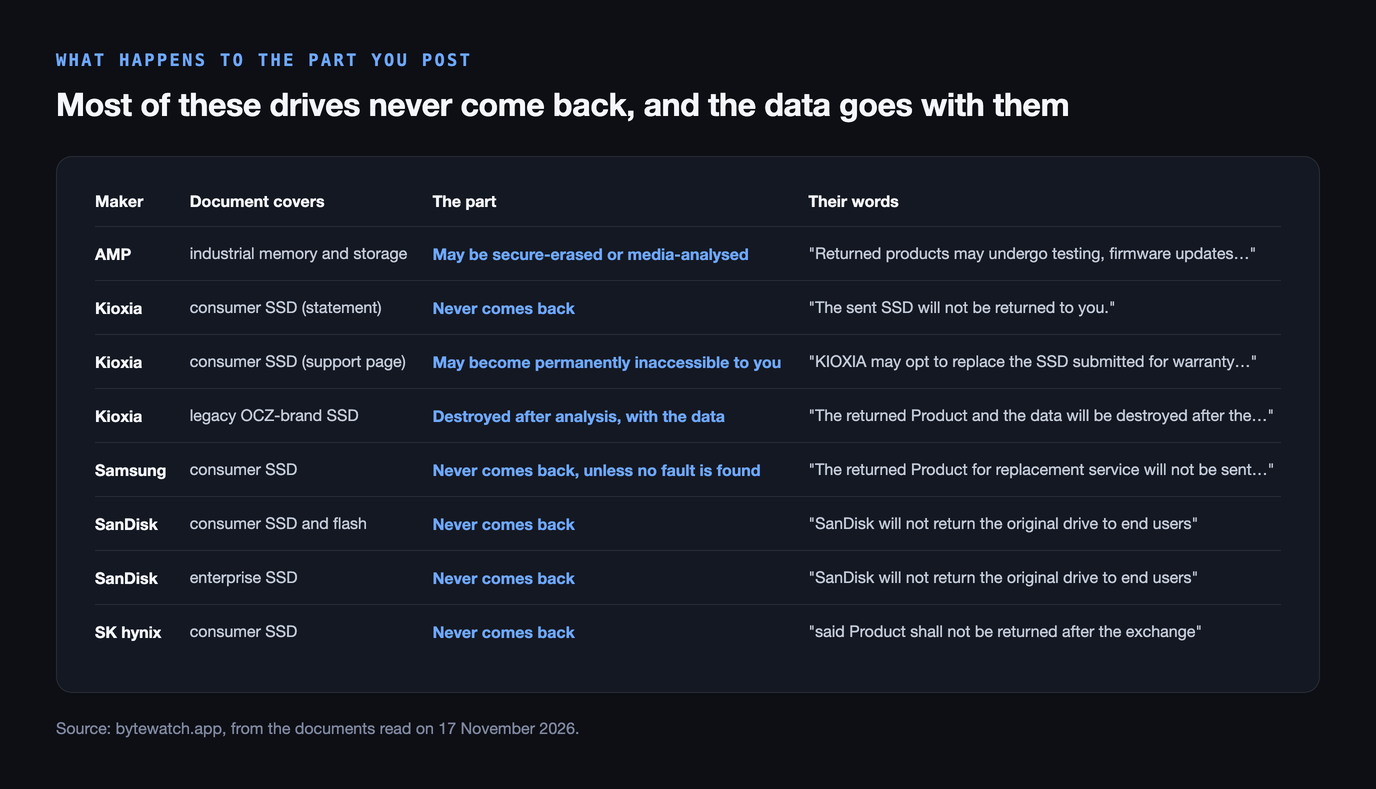
6 of these documents tell you the part is not coming back. SK hynix transfers title: “The ownership rights of the Product returned for exchange shall be transferred to SK hynix”. So the question is not whether you keep the drive, but what happens to the data on one you no longer own.
| Maker | Document covers | The part | Their words |
|---|---|---|---|
| AMP | industrial memory and storage | May be secure-erased or media-analysed | “Returned products may undergo testing, firmware updates…” |
| Kioxia | consumer SSD (statement) | Never comes back | “The sent SSD will not be returned to you.” |
| Kioxia | consumer SSD (support page) | May become permanently inaccessible to you | “KIOXIA may opt to replace the SSD submitted for warranty…” |
| Kioxia | legacy OCZ-brand SSD | Destroyed after analysis, with the data | “The returned Product and the data will be destroyed after the…” |
| Samsung | consumer SSD | Never comes back, unless no fault is found | “The returned Product for replacement service will not be sent…” |
| SanDisk | consumer SSD and flash | Never comes back | “SanDisk will not return the original drive to end users” |
| SanDisk | enterprise SSD | Never comes back | “SanDisk will not return the original drive to end users” |
| SK hynix | consumer SSD | Never comes back | “said Product shall not be returned after the exchange” |
2 of 19 answer that, and 5 keep the part while saying nothing about it. Kioxia’s legacy warranty is clearest — “The returned Product and the data will be destroyed after the analysis.” — and AMP, the industrial supplier, is the only other to describe its handling: “Returned products may undergo testing, firmware updates, secure erase, or media analysis that can permanently erase or modify stored data…”
Kioxia’s consumer statement adds the detail that matters: the drive goes for “failure analysis” carried out “outside the Territory” — a legitimate quality process, published honestly, and also your drive leaving the jurisdiction you bought it in. Its other page is blunter: “KIOXIA may opt to replace the SSD submitted for warranty services which may become permanently inaccessible to you.”
No document states a wipe standard, a retention period or a window inside which your data is destroyed. Not one gives a number, so we will not estimate one. Compare the precision about hardware: our read of the warranty terms found capacity floors, value floors and endurance ceilings specified to the terabyte. The asymmetry is the finding.
The other route, and what it is quoted at
If the copy does not exist, the remaining option is professional recovery, and the documents close that door first: 12 of the 19 exclude it in terms. Samsung: “Data recovery is not covered under this warranty and is not part of the replacement process.” G.SKILL lists “recovery of data” first among what it will not cover. SSSTC: “We will not responsible for lost of data on the unit, and we do not provide data rescue and backup services.”
What recovery costs is harder to state honestly, because no two labs quote alike and the firms that publish prices are selling the service. Rossmann Repair Group publishes a list, updated April 26, 2026: $200 to $1,500 for a SATA SSD, $200 to $2,500 for NVMe. Treat that as one lab’s asking price, not a market rate — a published figure from a business with an interest in the comparison.
Put the two next to each other, and the band matters more than either end. A complete copy of a median tracked drive costs $349.00 tonight. That published NVMe quote runs from $200 to $2,500 — 0.6 to 7.2 copies, at tonight’s prices. So the cheapest recovery on that list is cheaper than keeping a copy, and the dearest is several copies over. Which is to say the copy is not the frugal choice on every drive — it is the only one whose price you know in advance. A warranty claim prices the hardware for you; this is the half of the bill the clauses leave you to quote yourself.
One more trap sits at the end of that route, and it belongs to the warranty rather than the lab: the exclusion lists treat evidence of recovery as damage. The drive-label rules in SanDisk’s own policy reject a returned part showing “No tape seal – (non-authorized data recovery sticker)”, covered in our warranty terms piece. Recover first and you may have no claim; claim first and the drive is gone. The copy avoids the choice.
What to do before you file
None of this argues against claiming: a replacement drive is worth having, and our costing of the claim puts freight and packaging at a few dollars against a part worth far more. It argues for the right order.
- Buy the copy while the drive still works. Three makers require a second device in terms; a dead drive cannot be copied.
- Erase before you ship, and record it. 6 documents ask for it; one makes you indemnify the maker when you cannot.
- Assume the part is gone. 6 documents say so; only 2 say what happens to the data.
- Decide about recovery before you open an RMA — a recovery sticker can cost you the claim, and the claim ends the recovery.
- Keep the serial, the date and the SMART readout. Our turnaround read shows how long the copy has to do the work.
Related reading
FAQ
Does an SSD warranty cover data loss?
No. In all 19 documents we read on 2026-11-17, cover runs to the hardware and the files sit outside it. Samsung: "Data recovery is not covered under this warranty and is not part of the replacement process." 12 of the 19 rule out data recovery by name.
Do I have to back up before making a warranty claim?
15 of the 19 documents say so, at 4 strengths. Two make it a term you agreed to — Intel: "YOU AGREE TO MAINTAIN A VERIFIED BACK UP OF ALL DATA ON THE PRODUCT AT ALL TIMES." Others state it as your sole responsibility, instruct it, or only recommend it. Four never ask.
Do manufacturers send the original drive back?
Usually not. 6 documents say the part stays: SK hynix takes ownership of it, SanDisk "will not return the original drive to end users", and Kioxia's statement says "The sent SSD will not be returned to you". Samsung returns it only when the diagnosis finds no fault.
What happens to my data on the drive I send in?
Only 2 of the 19 say. Kioxia's legacy warranty is clearest — "The returned Product and the data will be destroyed after the analysis" — and AMP warns that returns "may undergo testing, firmware updates, secure erase, or media analysis". No document publishes a wipe standard or a retention period, so there is no number to quote.
What if the drive is too dead to back up or erase?
That is the common case, and one document addresses it. Western Digital's commercial terms name it — "if it is not the case that all data is or can be removed" — then require the customer to "indemnify, defend and hold harmless" the manufacturer and reseller for data left on the part. So buy the copy while the drive still works, and encrypt it.
How much does the second copy the clauses require cost?
On our basket, most of the drive's price again: for many listings the cheapest route to the same capacity is a second unit of the same part. With NVMe Gen4 SSD observations at $0.17-$0.23 per gigabyte, a gigabyte you can still read after a failure costs double. A hard disk or cloud storage is cheaper; we track neither, so these are upper bounds.
Does data recovery void an SSD warranty?
It can. SanDisk's returns rules reject a drive showing "No tape seal – (non-authorized data recovery sticker)". Once the claim is filed the drive is gone; once a lab has been inside it, the claim may be refused.
Price the second copy before you need it
We track DDR5, DDR4 and NVMe listings at US retailers and tell you when one of yours moves. Observed prices, dated, with the sample size next to them. The duty in these clauses is a purchase, so it helps to buy it on a good day.